
Israel’s largest rehabilitation hospital is set to rise in Tel Aviv’s Sde Dov district under a $390 million initiative. The 540-bed campus will replace and significantly expand the existing Reuth Rehabilitation Hospital, currently operating out of the Yad Eliyahu neighborhood. The Jusidman Family Charitable Foundation is contributing NIS 200 million ($68 million) toward the new campus, the lead private donation in the project.
Construction is expected to take about six years, and the system the new campus will join is one the Health Ministry itself said had only 150 of its 780 rehabilitation beds free by October 18. The Tel Aviv Foundation has folded the project into its 50th anniversary “Hope Strategy.”
The 540-Bed Campus Planned for Sde Dov
The new campus, to be called the Jusidman Rehabilitation Hospital, will occupy a roughly 4-acre site in the Sde Dov district in north Tel Aviv. 540 beds will make it Israel’s largest rehabilitation center, per the project announcement. The hospital is being built as a partnership between the Tel Aviv Foundation, the Reuth Association, and the Tel Aviv-Yafo Municipality, with additional funding expected from municipal, government, and private sources. The total projected investment stands at $390 million.
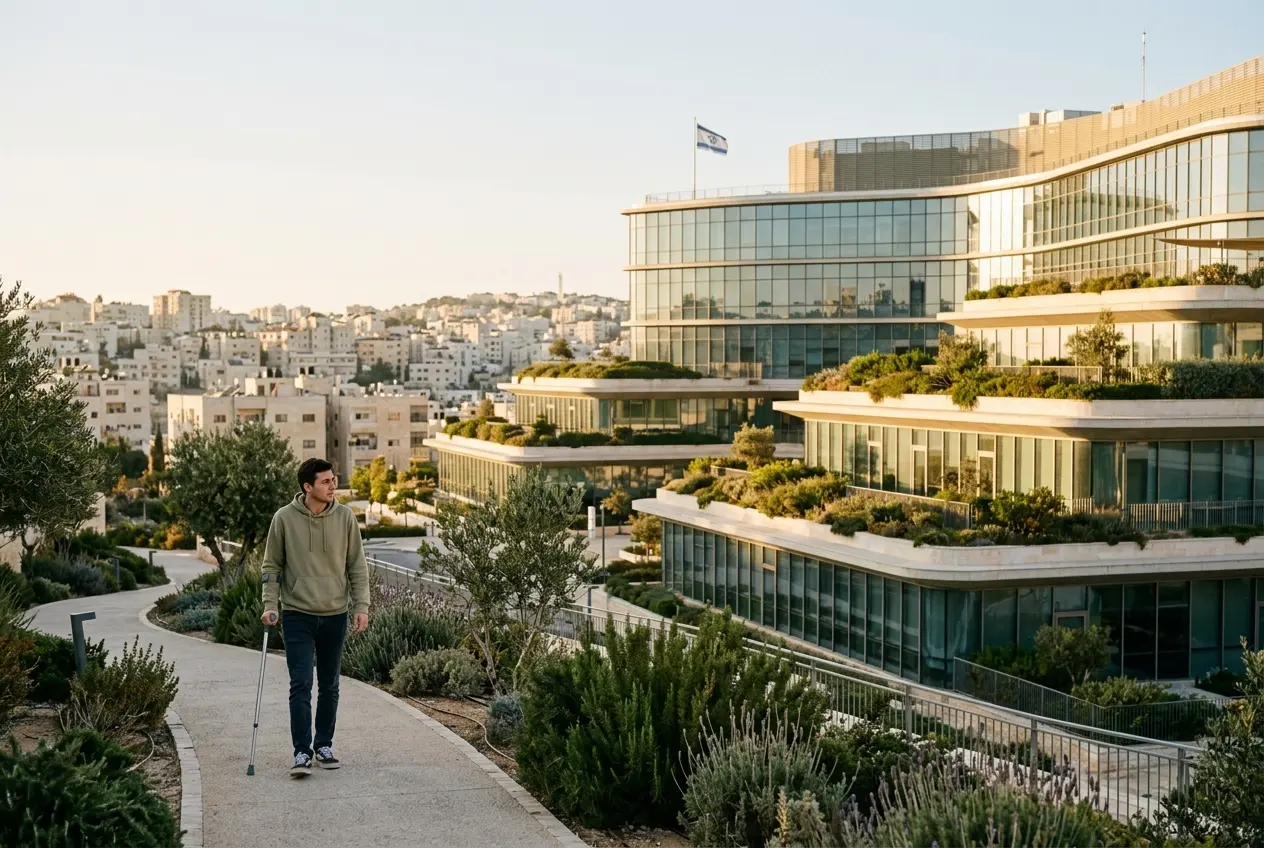
The facility is being designed to serve two overlapping patient populations: wounded soldiers and trauma survivors, and an aging population that the Health Ministry has warned is straining the existing rehabilitation system. The expanded campus is set to include advanced rehabilitation and geriatric care units, a hydrotherapy pool, and a specialized trauma clinic. The broader program also brings research and development facilities, outpatient clinics, and what the project’s planners describe as extensive green spaces built around patient and family use.
The research and development wing, included in the new campus’s plans, sits alongside the inpatient and outpatient programs. That mix tracks the Defense Ministry’s data on rising disability caseloads and gives the site a clinical-research function the existing Yad Eliyahu campus does not carry.
- Advanced rehabilitation and geriatric care units
- A hydrotherapy pool
- Specialized trauma services
- A research and development hub
- Outpatient clinics
- Extensive green spaces for patient and family use
A Family Donation and a Six-Year Build
The Jusidman Family Charitable Foundation’s NIS 200 million gift is the single largest private commitment to the project, and it gives the new campus its name. Igal Jusidman framed the donation as a response to underfunding in rehabilitation medicine, calling the long neglect of the field a national blind spot that the war exposed. The project is also structured as a partnership with the Tel Aviv Foundation, which is marking its 50th anniversary under what it calls a Hope Strategy of long-term, resilience-focused projects. That framing centers the hospital as both a wartime recovery investment and a long-term piece of public health infrastructure. The Reuth Association, the 65-year-old operator of the existing Yad Eliyahu campus, is the clinical partner for the new site.
Professor Nachman Ash, chairman of the Reuth Association and a former director-general of Israel’s Health Ministry, said the donation would let Reuth serve a much larger share of patients than its current campus can absorb. He added that discussions with the Ministries of Health and Finance are continuing to finalize the government’s share of the build. Tel Aviv Mayor Ron Huldai, who also chairs the Tel Aviv Foundation, tied the project to demand that has grown increasingly urgent for wounded soldiers, trauma victims, and others.
For many years, rehabilitation medicine did not receive the attention it deserved within Israel’s healthcare system. It took a long and painful war to remind us of the critical role rehabilitation plays in restoring lives, dignity and independence. Through the Jusidman Rehabilitation Hospital, we hope to contribute to the recovery of those who have defended Israel and paid a heavy personal price in its service.
October 7 Has Already Redrawn the Patient Pipeline
The hospital is being built into a patient pipeline that the war has already redrawn. Reuth’s current campus is already serving survivors of the October 7 attacks and veterans of the ongoing conflict, alongside the day-to-day orthopedic, neurological, respiratory, and geriatric rehabilitation work that has defined the hospital since its founding 65 years ago. The Jusidman campus is designed to absorb both that standing demand and the new wartime caseload. That mix is what made a 540-bed build the project’s planning floor, not its ceiling.
Since October 7, more than 10,580 Israelis have been wounded in the war in Gaza, the Hezbollah border campaign, and attacks in the West Bank, the Health Ministry has reported. Of those, 6,125 are members of the IDF, the Israel Police, and other security forces, and 2,005 have already been recognized as permanently disabled. Each new patient enters a rehabilitation system that the Health Ministry itself told the Knesset a month into the war was not prepared to absorb the wartime caseload on top of its civilian load.
The Defense Ministry’s rehabilitation department currently handles around 82,000 patients and is on track to treat some 100,000 patients through its system by 2028, according to figures the ministry shared in January. A quarter of the patient roster was added in two years, the Times of Israel reports. Professor Eyal Fruchter, a former head of the IDF’s mental health division, said the ministry is now receiving 3,500 applications for disability recognition each month, compared to the historical baseline of about 4,000 per year. Of those recent applications, roughly 38 percent are purely mental, 40 percent purely physical, and 18 percent a combination of both.
Layered on top of the wartime surge, Israel’s broader demographic curve is pushing rehabilitation demand higher across the country. The combination is what the Jusidman campus is being asked to absorb from the day it opens.
- 10,580+ Israelis wounded since October 7, 2023
- 6,125 members of the IDF, Israel Police, and other security forces among the wounded
- 2,005 recognized as permanently disabled
- 3,500 monthly applications for disability recognition, against a historical baseline of about 4,000 a year
- 100,000 patients projected through the Defense Ministry’s rehabilitation department by 2028
How Israel Ended Up With a Bed Shortage
Israel’s rehabilitation bed shortage predates October 7 by years, and it is the structural backdrop against which the Jusidman project has been planned. The OECD average for rehabilitation beds per 1,000 people is 0.5; Israel has 0.3, or 60 percent of the average. Germany runs 2.0 per 1,000, Poland 1.8, and Switzerland 0.8, by the same OECD-style measure.
The shortage is not evenly distributed. Tel Aviv carries two to three times the rehab bed density of the rest of the country, the Times of Israel reports. Jerusalem, the country’s largest city with a population of about 1.2 million, ranks last per capita, and the gap has been a recurring theme in Knesset Health Committee hearings. The Hadassah Medical Center is partway through a 132-bed Gandel Rehabilitation Center on Mount Scopus, and Sheba Medical Center converted a geriatric floor in three days in early November 2023 to add 86 beds to its standing 140.
Reuth’s 356-bed campus in Yad Eliyahu, the hospital the Jusidman project will replace, is operating at full stretch. The Reuth campus currently accepts only one in five requests, per the Tel Aviv Foundation, and the new building is being sized to take the volume the old one cannot.
Bridging the Six Years Before the Doors Open
The six-year build timeline is the most expensive number in the project. The Sde Dov campus will not be ready to take its first patient for about six more years, and Israel’s rehabilitation system has to absorb the intervening years on its existing footprint. The Tel Aviv Foundation, the Reuth Association, and the Ministries of Health and Finance are still in talks over the government’s share of the build, and that process has to finish before the building can move from announced to shovel-ready. The Jusidman gift is a down payment on a longer funding plan, not the full bill.
The system is already improvising. Ichilov Hospital in Tel Aviv converted its rehabilitation division into a standalone 120-bed facility, Bishvilam, with 100 outpatient stations, and Loewenstein Rehabilitation Hospital in Ra’anana has partnered with Beilinson Medical Center in Petah Tikvah to open a 14-bed rehab unit at a hospital that had not previously offered the service. Hadassah expanded its existing rehabilitation facility from 40 to 50 beds in the war’s first weeks and is pushing to complete the first two floors of its new Gandel center as private donors close the funding gap.
Nonprofits are filling parts of that gap. Belev Echad, a private organization supporting wounded soldiers, grew its annual budget from $1 million in 2020 to $18 million in 2025, and the soldiers it serves rose from around 400 before October 7 to some 2,000 today. Brothers for Life, which used to grow its roster by about 100 soldiers a year, is now adding roughly 1,000 annually, and the organization is in the process of building an additional location in the south. These private efforts are running alongside the public system, and they are the difference between the patient counts the Defense Ministry reports and the patient counts the public system can absorb on its own.
The new campus is expected to open within six years, and the Defense Ministry projects 100,000 patients will pass through its rehabilitation department by 2028. Between the two dates is the period the existing Reuth campus, the surrounding hospital network, and a fast-growing nonprofit sector have to bridge.
