
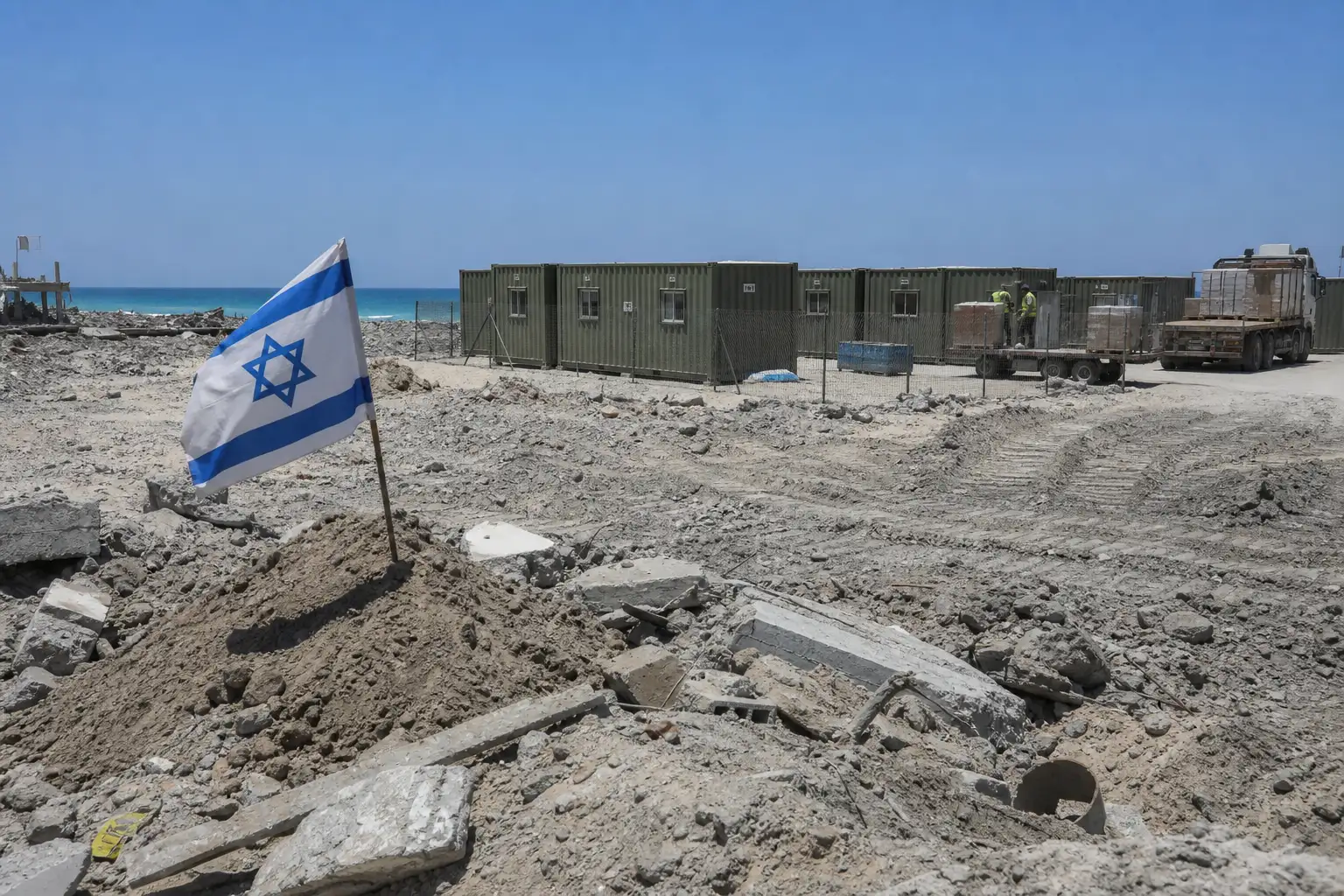
Israel’s defence minister, Israel Katz, wants to build three military outposts on the same strip of northern Gaza that Israel emptied of Jewish settlers in 2005. The plan arrived this week alongside a previously secret 1.3 billion shekel fund, more than $400 million, for West Bank settlement construction. A national election falls in just over three months.
Katz has tried a version of this plan before. Washington made him stand down within hours the first time. This week he tried again anyway.
Katz’s Outposts Target Ground Israel Evacuated in 2005
“I intend to establish three Nahal outposts, which is also a military entity, in those places that were [Israeli settlements] in northern Gaza,” Katz told Channel 14 TV during a visit to Israeli-controlled parts of the territory.
Israeli and Palestinian outlets have identified the target sites as Nisanit, Dugit and Elei Sinai, a trio of communities on the sandy coast just south of Ashkelon. Nisanit was the largest, with roughly 1,000 residents by 2002. All three were evacuated in August 2005 as part of Prime Minister Ariel Sharon’s unilateral disengagement.
That withdrawal dismantled 21 Jewish settlements across Gaza plus four more in the northern West Bank, relocating about 9,000 settlers at a cost of roughly $2 billion to the Israeli treasury. It remains the only time Israel has removed a settlement bloc rather than expanded one.
Washington Already Said No Once
This is not Katz’s first attempt. He first floated Nahal outposts for northern Gaza in late December, telling an audience in the West Bank settlement of Beit El that Israel would build them “in due course… in place of the settlements that were uprooted.”
Katz’s office walked back the same idea within hours, after U.S. officials demanded clarification. He revived it weeks later anyway, telling Israeli media the outposts would be “military in nature,” before repeating the plan again this week from inside Gaza.
The original walk-back came days after President Trump ruled out Israeli annexation of the West Bank when a reporter raised it at the White House. Trump’s own Gaza ceasefire framework calls for Israeli forces to progressively hand over occupied territory to an international stabilization force, and rules out Israeli resettlement of the strip.
How Does a Military Post Become a Settlement?
A Nahal outpost starts as a fenced military installation staffed by soldiers who double as agricultural pioneers, officially there for border defence. Over months or years, the military presence transfers to civilian authorities, and the fence line becomes a town. Israel has repeated this sequence dozens of times since the 1950s.
“The military is only the first phase, which aims to prepare it for future settlement,” said Dror Etkes, founder of the advocacy group Kerem Navot, which tracks Israeli land seizures in the occupied West Bank. “All together, dozens of Israeli settlements in the West Bank were established in this way.”
Nahal settlements were first built along Israel’s border regions in the 1950s, including around the Gaza Strip, Etkes said. After 1967, the same model spread into the newly occupied West Bank, starting in the Jordan Valley before reaching other areas. The expansion Etkes describes is still running: Israel approved 13 new settlements along the Route 60 corridor earlier this year alone.
Gaza’s own settlement history shows the same mechanism at work, years before any of it was torn down.
| Outpost | Founded As Nahal Post | Fate |
|---|---|---|
| Kfar Darom | 1970 | Evacuated, August 2005 |
| Netzarim | 1972 (civilian from 1984) | Evacuated, August 2005 |
| Morag | 1972 | Evacuated, August 2005 |
| Nisanit | 1980 (civilian from 1984) | Evacuated 2005; named in Katz’s new plan |
Every settlement on that list began as a security posture before it became a home.
Smotrich’s Billion-Shekel Sprint Before the Vote
Finance minister Bezalel Smotrich announced 1.3 billion shekels, more than $400 million, in new funding for dozens of settlements across the West Bank. The cabinet approved the money last month, Israeli media reported, but kept it quiet to avoid provoking American objections before it became public.
Smotrich said last month that plans for three settlements in Gaza were already finished and could begin the moment Prime Minister Benjamin Netanyahu gave the order. Netanyahu’s office did not respond to requests for comment on Katz’s announcement.
The government is on a reckless pre-election sprint to raid the public purse in order to create facts on the ground.
Hagit Ofran, of the Israeli monitoring group Peace Now, said bulldozers were already working on at least seven settlements the government hopes to populate before the 27 October vote. The same electoral math is already running in the West Bank, where settlers are pushing a parallel annexation campaign timed to the same October vote.
Peace Now’s own tally puts the acceleration in context.
- 210 settlements and outposts now stand across the West Bank and East Jerusalem, risen by nearly half since 2022.
- 86 new outposts went up in 2025 alone, a single-year record for the settler movement.
- Over 36,000 Palestinians were forcibly displaced across the West Bank in the twelve months to October 2025, the United Nations human rights office found.
- A 25-24 vote gave the Knesset preliminary approval in October 2025 to a bill asserting Israeli sovereignty over the West Bank, the first of four required votes.
U.S. Vice President JD Vance called that bill “a very stupid political stunt,” and Secretary of State Marco Rubio described it as counterproductive to Trump’s own Gaza effort. Neither reaction slowed construction on the ground.
The General Who Calls Illegal Outposts His Security Partners
Maj Gen Avi Bluth, who commands Israeli forces in the West Bank and grew up in a settlement himself, addressed the Farms Association on Wednesday. The group represents outposts that are illegal even under Israeli law, built without permits on private Palestinian land.
Bluth told the gathering he “appreciates their work” and considers them partners in security alongside the military.
The description matches what the United Nations human rights office found earlier this year, when it described a coordinated and strategic pattern of violence, with Israeli authorities central to directing or enabling it and impunity nearly total.
Olmert and Barak Break With Their Own Government
A leaked letter sent to Netanyahu’s office last month carried the signatures of two former prime ministers, Ehud Olmert and Ehud Barak, alongside more than 30 former heads of the military, Mossad, Shin Bet and police.
“This letter is a wake-up call and a final warning,” the group wrote, demanding that Netanyahu’s government act to eradicate what they called “Jewish terrorism” in the West Bank. The letter accused Israeli officials of allowing extremists to act with near total impunity, and warned that continued violence deepens Israel’s global isolation.
The letter directly challenged Netanyahu’s own account of the violence. It said his claim that settler attacks were the work of a few dozen teenagers had “no basis in reality,” and it asked Bluth by name why he had not moved against perpetrators whose identities were no secret.
Signatories said they would petition Israel’s High Court if the government failed to act. The prime minister’s office did not respond to that letter either.
Victory by the Numbers
A Ceasefire Line Already Crossed
Katz’s Gaza visit doubled as a briefing on territorial control. Maj Gen Tamir Yadai, Israel’s deputy chief of staff, told him on camera that Israel now holds 65% of the Gaza Strip, well beyond the 53% agreed under the ceasefire brokered last year by Trump.
About 2 million Palestinians who survived the war are packed into the remaining third of the territory. Katz told Channel 14 he “felt good” seeing the rubble that has replaced Palestinian homes and communities across most of Israeli-occupied Gaza. The expanded footprint complicates an Egyptian-mediated Hamas disarmament framework mediators are again negotiating, since it hands Israel more ground than that deal accounted for.
Names Behind the Count
“I don’t know how to describe this, other than victory, when you control 65% of the territory, when you have killed over 70,000 terrorists here,” Yadai said.
His figures appear to label the war’s youngest victims as combatants. Israel’s own military has acknowledged that a Gaza health ministry database of the dead, listing more than 73,000 people by name with Israeli-issued ID numbers, is broadly accurate. More than 21,000 of those names belong to children, including over 1,000 babies who never reached their first birthday. More than 10,000 are women under 60, and more than 5,000 are elderly.
- What we know: the named database of Gaza’s dead totals more than 73,000 people, and Israel’s military calls it broadly accurate.
- What we know: more than 21,000 of the names belong to children, and more than 15,000 more to women and the elderly.
- What’s unconfirmed: whether Yadai’s figure of over 70,000 “terrorists” includes any of those same names.
- What’s unconfirmed: when, or if, the military’s internal review of how it categorizes casualties will reach civilian officials or the public.
Asked directly whether Yadai’s count folds in women, children and the elderly, the military declined to answer.
“The IDF is currently conducting a staff assessment regarding the breakdown and categorisation of its casualties. The process has not yet been completed and has not been presented to the political echelon,” a spokesperson said. The military declined separately to comment on Bluth’s endorsement of settler militants, saying decisions on settlements were a political matter.
Frequently Asked Questions
Are Israeli Settlements in Gaza and the West Bank Illegal Under International Law?
Yes. The International Court of Justice ruled in July 2024 that Israel’s occupation of the West Bank, East Jerusalem and Gaza is unlawful, and said discriminatory Israeli policies against Palestinians violate the prohibition on racial segregation. Israel disputes the finding and has continued settlement construction regardless.
What Happened in Gaza After Israel’s 2005 Settlement Withdrawal?
Hamas won Palestinian elections the year after the withdrawal and took full control of Gaza in 2007, two years after Israel evacuated its settlements there. Israeli forces have since recaptured much of the same territory during the current war, which is why ministers are now proposing to build on it again.
Why Is Israel Holding an Election on 27 October?
Israeli law requires a new Knesset election at least once every four years. The current coalition formed after the November 2022 vote, putting Netanyahu’s government up against its own expiration date this autumn.
Who Are Ehud Olmert and Ehud Barak?
Olmert led Israel’s government from 2006 to 2009. Barak served as prime minister from 1999 to 2001 after previously serving as the military’s chief of staff. Both are now among dozens of former officials publicly breaking with Netanyahu over settler violence.
How Much West Bank Land Has Israel Approved for Settlement Recently?
Israeli authorities advanced or approved 36,973 housing units in East Jerusalem settlements and about 27,200 more across the rest of the West Bank, some 64,000 combined, in the twelve months to October 2025, according to the United Nations human rights office.
