
Settlers sliced the irrigation pipes, cut the grape vines, and uprooted 70 young olive trees on Ilham Karajeh’s family plot in the West Bank village of Ein Arik, the latest overnight raid blamed on the neighbouring Maoz Tzur outpost. There was no doubt in the village about who was responsible: the new settler outpost was established on a neighbouring hill last year and violence has flowed down into the valleys in a gathering tide since.
A joint report by two Israeli watchdog groups, Kerem Navot and Peace Now, finds farm outposts now control more than 1 million dunams of the West Bank. Israeli elections must be held by the end of October at the latest, and as things stand Benjamin Netanyahu’s far-right bloc is facing defeat after more than three years of political domination. The radicals in his coalition are scrambling to impose facts on the ground before any vote.
The Night Ein Arik’s Trees Came Up
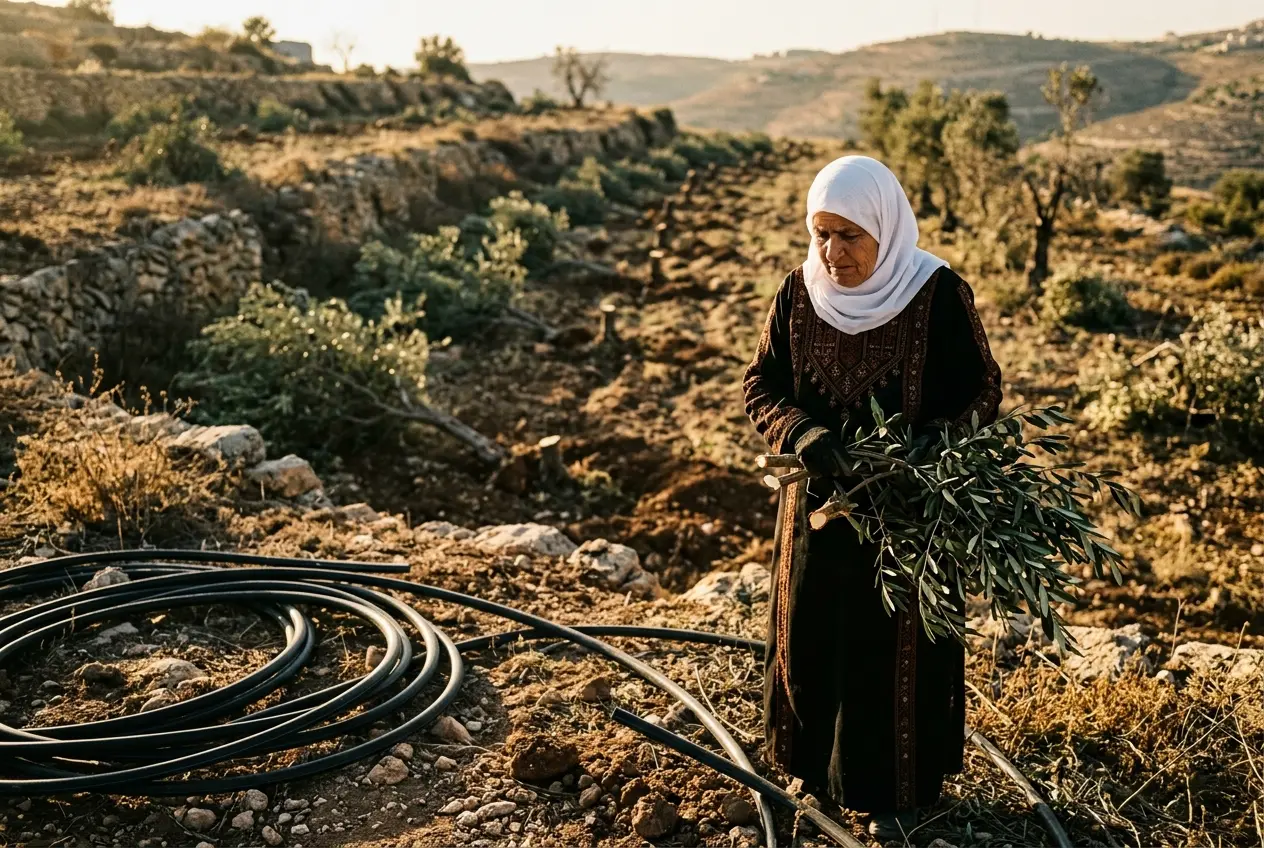
Ilham Karajeh woke on Friday to find the family allotment raided and ruined. “See, they are still wet with sap,” she cried out as she and her husband Mohammed gathered the severed branches on Sunday.
Settlers had sliced the thin black irrigation pipes, cut the grape vines, and pulled up 70 young olive trees the Karajeh family had planted as a long-term inheritance. The night raid fits a pattern documented in the Karajeh family allotment raid in Ein Arik. For more than a year, villagers have been blocked from reaching olive and citrus groves and springs on the hillsides closest to the new outpost. Those brave enough to venture in that direction were repeatedly attacked with clubs and stones.
The Karajeh plot sits at the edge of a zone of intimidation that is now extending up the slope toward the neighbouring village of Deir Ibzi. The broader campaign is the backdrop against which Dror Etkes, founder of Kerem Navot, an advocacy group dedicated to monitoring the West Bank land grab, sets the next few months. “These are going to be very tough months,” he said.
Why the Pace Has Broken Into a Gallop
The joint report by Kerem Navot and Peace Now was published on Monday and concludes that the Israeli government has advanced de facto annexation of the West Bank “at an unprecedented pace.” It draws on government documents, budgetary data, aerial photographs, maps, and field testimonies, with findings updated through the first quarter of 2026. The report identifies four main mechanisms: structural governance changes, accelerated settlement expansion, land takeover through outposts and grazing, and a transformation of the land regime. Together, the report argues, those mechanisms form a single policy rather than a series of disconnected decisions.
The headline figure: farm outposts now control more than 1 million dunams, or 100,000 hectares, an area the report puts at 18% of the entire West Bank. Nearly a third of that wholesale seizure took place in 2025 alone. The earlier joint study by the same two organisations, “The Bad Samaritan,” had documented 786,000 dunams seized through shepherding outposts alone, a baseline the new report pushes sharply upward.
| Measure | Bad Samaritan (March 2025, shepherding outposts) | Annus Mirabilis (July 2026 report, through Q1 2026, all farm outposts) |
|---|---|---|
| Land controlled by farm or shepherding outposts | 786,000 dunams | more than 1.1 million dunams |
| New outposts established since current government took office | 185 | |
| Palestinian shepherding communities expelled | more than 60 | 118 |
| New settlements via legalisation or new status | 102 | |
| Housing units advanced in settlements | 40,064 | |
| Kilometres of new roads opened across the West Bank | at least 223 |
The Five Steps That Turn an Outpost Into a Settlement
Outposts like Maoz Tzur skip the planning and construction work of established settlements, needing only a small, highly motivated vanguard ready to use violence to drive Palestinians from a wide swath of territory.
The playbook has now been set out in detail. With land emptied, settlers apply to the Settlement Division of the World Zionist Organization for grazing contracts that are awarded without a tender process and without compensation, according to the Bad Samaritan report on shepherding outposts. The recipe, in order:
- A handful of settlers stake out a hilltop near Palestinian grazing or farming land.
- They harass and intimidate nearby Palestinian communities, often with clubs, stones, and the destruction of crops, until families stop venturing out.
- With the land emptied, settlers plant grazing outposts or small farms and apply for grazing contracts with the Settlement Division of the World Zionist Organization.
- The outpost is wired up with solar panels, electric gates, vehicles, drones, and cameras, paid for under a budget line called “Security Needs for Settlement Points.”
- Once the facts on the ground are entrenched, the finance minister retroactively legitimises the outpost as an official settlement.
Maoz Tzur itself is now an official settlement, recognised in April after Bezalel Smotrich came to celebrate and hailed its 12 “core families” as “pioneers.” Smotrich told those gathered that outposts like Maoz Tzur would “completely destroy the idea of a Palestinian state within our heartland.” Funding runs through at least four streams, tracked in the Bad Samaritan report:
- NIS 54 million under “Security Needs for Settlement Points” for road paving, solar panels, electric gates, vehicles, drones, cameras, generators, and lighting at outposts.
- NIS 30 million annually under “Establishment and Operation of Patrolling Units” for salaries, equipment, vehicles, drones, and infrastructure projects including road construction and fencing.
- NIS 3 million in “grazing grants” from the Ministry of Agriculture between 2017 and 2024, including NIS 2.6 million to Mevo Horon settlers managing a herd across 9,000 dunams.
- NIS 4.7 million from KKL-JNF on shepherding outposts under programmes for at-risk youth.
The Annus Mirabilis report on West Bank annexation adds the cumulative numbers over its three-year window. Settlers took control of at least 11,520 dunams through agricultural cultivation and 25,959 dunams were declared state land. The mechanisms are distinct but the direction is identical: more land, fewer Palestinian communities, faster.
Smotrich and Ben-Gvir Sit at the Centre of the System
The two cabinet ministers most identified with the settler movement now hold the levers of land, policing, and finance. Bezalel Smotrich, once considered too extreme for mainstream politics, was first brought into government by Netanyahu in 2019. He now serves as finance minister but has also taken over the authority to approve settlements from the defence ministry, and used the power to retroactively legitimise farm outposts such as Maoz Tzur. The same playbook is visible further west: Israel’s cabinet recently approved 13 new settlements along Route 60 in the Binyamin area, where Maoz Tzur itself sits.
Itamar Ben-Gvir has been national security minister since the end of 2022. Villagers in Ein Arik told the Guardian that complaints to the police or the courts have proved futile since his appointment, a pattern that has fed into a broader squeeze on West Bank public services such as the West Bank hospital system under Smotrich’s tax freeze.
Ahmad Abu Mayala, whose family was the target of a settler attack on 22 May, said he and his relatives went to multiple lawyers who all gave the same answer. “They said: wait for the election to see if it will change the government. Then maybe we can do something,” he said. That is the political backdrop for every raid: the coalition has the calendar it wants, and settlers in places like Maoz Tzur know it.
Roads Built for Settlers, Gates for Palestinians
The night-time attacks on plots like the Karajeh family allotment aim to demoralise the population while isolating communities by blocking the roads between Palestinian villages with steel gates or stone blocks. New roads, accessible only to settlers, are then overlaid on top of the old network, connecting the new outposts in what the report describes as a new circulatory system for the West Bank. The visible result is a settler bypass here, a blocked Palestinian lane there, and a slow, granular partition of the map. The 223 kilometres of new roads documented in the Annus Mirabilis report are the physical expression of that partition.
When you connect something, you always dissect something else; that’s the principle they act on.
Dror Etkes, founder of Kerem Navot, made the point on a tour of the West Bank monitoring settlement growth.
Etkes is pessimistic about how much a new Israeli government could reverse. Any attempt to change West Bank policy, he said, would face “the very strong opposition of the people who are today in the government, who will be out there in the field with strong political back-up.” Even a coalition that loses the election will leave behind the people who ran the outpost system, and they will still be on the ground. The settlement machinery built since 2023 was designed, the report argues, to function regardless of which coalition holds office.
Sanctions Land, But the Coalition Holds Its Course
External pressure has begun to bite, though unevenly. In June, the United Kingdom, Australia, Canada, France, and Norway imposed coordinated sanctions on financial and enabling networks behind settler violence in the West Bank. France also banned Smotrich from entering the country; the UK had already banned him in 2020.
The impact inside Israel has so far been limited. The Israeli government retains the support of the Trump administration, which opposes formal annexation but has allowed the continuing informal seizures of territory. Within the European Union, Germany and Italy have led the resistance to suspending the association agreement with Israel, leaving the bloc split. That split matters because it has undercut pressure on the Israeli government at the precise moment settlers are racing to entrench new positions, as covered in the Hebron mayor’s alarm over expanded Israeli powers.
The mayor of Ein Arik, Mohannad Othman, took a darker view still. “The way things in the Middle East work, there will be someone even worse than Smotrich,” he said. Othman has been in office for a month and is planning to invite representatives of foreign embassies and organisations to accompany villagers into the hills for the olive harvest, the traditional season for both picking and confrontation. His calculation is that international presence on the slopes during the harvest may deter some of the worst attacks. The risk is that deterrence wears off quickly when the visitors leave.
The Olive Harvest Both Sides Are Bracing For
For the Karajehs and their neighbours, the political calendar matters less than the seasonal one. The olive harvest is the moment of the year when families reclaim their groves for a few weeks, and it is also the moment when settlers intensify their attacks, partly to extend the work of separation and partly to harvest olives from land that was once Palestinian-owned. The night raid on the Karajeh plot was a foretaste: 70 young trees, planted as a long inheritance, were pulled out at a stroke. Branches that were still wet with sap were gathered into a pile by the family on Sunday, evidence of a destruction that will not regrow this season.
“These are going to be very tough months,” Etkes said. “Firstly, it doesn’t look good for the current coalition, so there could be a new government. Secondly, all the attention is on the elections so the settlers can use this period to do whatever they want.” That two-part warning now sets the pace of life on the hills above Ein Arik, where a Palestinian olive harvest is unfolding against the background of an Israeli election campaign.
