
Gaza disarmament talks restart in Egypt on Thursday with the same wall in front of them, but the more consequential move is happening away from the table. The US-led Board of Peace, the international panel set up to run postwar Gaza, is now weighing alternatives to President Donald Trump’s 20-point plan, two Arab diplomats involved in the process told The Times of Israel. The most prominent of those alternatives would let reconstruction begin inside areas of Gaza that Israeli troops still occupy, an idea donor states rejected months ago over fears it would split the Strip in two.
That revival lands at an awkward moment. Last week Prime Minister Benjamin Netanyahu said he had ordered the military to widen the slice of Gaza under Israeli control toward 70%, up from the roughly 53% the October truce assigned it. The plan to draw Palestinians out of Hamas zones with temporary housing only works if there are large occupied zones to build in. Netanyahu just made them bigger.
The Egypt Table Reopens With the Same Impasse
Mediators have been here before. Talks have largely stalled for months, with Hamas refusing to accept the Board of Peace’s disarmament framework and insisting that Israel first be held to the terms of the ceasefire’s opening phase. The group says it gave up live hostages and dead captives under that phase and got little in return.
Israel reads the same ceasefire differently. It has continued near-daily strikes across Gaza since the truce took hold, describing each one as a hit on an “imminent” threat to its forces. Each side accuses the other of repeated violations, and neither has shown much appetite to move first.
What is new is the panel’s body language. The Board of Peace has not abandoned the talks, but it is openly shopping for a Plan B, the two diplomats said. That shift, from waiting on Hamas to engineering around it, is the real signal coming out of this week. The negotiation over weapons is becoming a negotiation over maps.
The Shelved Plan Coming Back Into the Room
The alternative on the table is not new. The Trump administration floated a version of it earlier and then put it away after donor countries pushed back, worried it would entrench a permanent division of Gaza. With Hamas barely moving on disarmament, that discarded idea has been pulled back out, one of the Arab diplomats said.
The mechanics are simple to describe and hard to deliver. Reconstruction would start in the parts of Gaza held by Israeli forces, with temporary housing offered as the draw. The bet is that Palestinians living in tents will move toward rebuilt zones, thinning out the areas Hamas still controls.
Three problems sit underneath the plan, and none has an answer yet:
- Consent. It is unclear whether Palestinians will choose to live under active Israeli occupation, even for a roof and walls.
- Obstruction. Hamas could try to block residents from leaving its zones, turning movement into a loyalty test.
- Partition. The same fear that shelved the plan before has not gone away. A reconstructed occupied zone next to a starved Hamas zone starts to look like a border.
That is the second-order story here. The headline is disarmament. The механика being drafted quietly could redraw Gaza’s internal lines for years, whether or not a single rifle is handed over.
Netanyahu’s 70% Order Redraws the Map
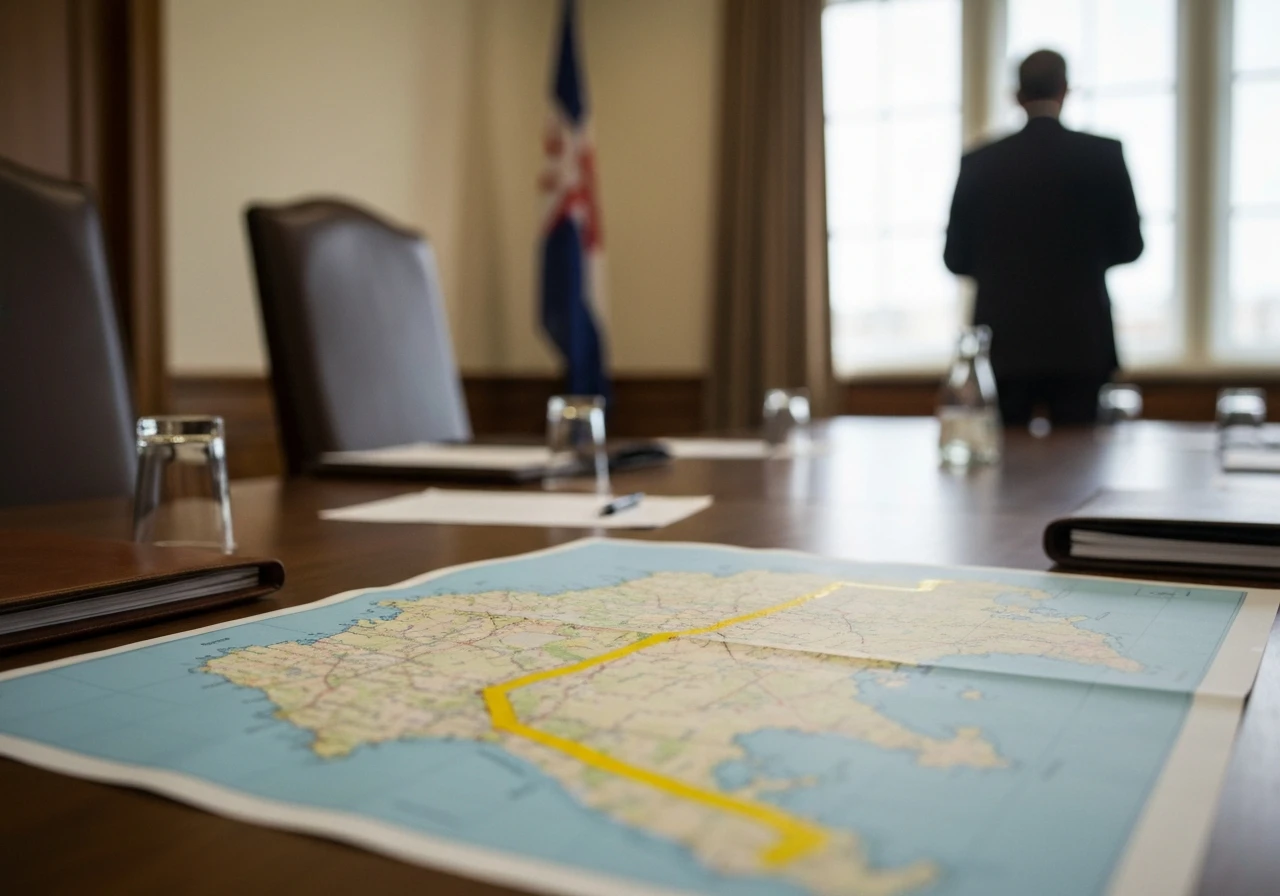
The reconstruction idea cannot be read apart from where the troops are. Under the October 2025 US-brokered truce, Israeli forces were meant to pull back to a “Yellow Line” marking the edge of their control, leaving Israel holding roughly 53% of Gaza and Hamas the rest. The line has not held still.
Netanyahu told reporters last week that Israel was “fully in control” of about 60% of the territory and that he had directed the military to push toward 70%. According to his own account of the Gaza control order, that is a deliberate expansion beyond the truce map, not a drift.
| Stage | Share of Gaza under Israeli control | Where it came from |
|---|---|---|
| October 2025 truce | ~53% | Yellow Line agreed under US-brokered ceasefire |
| Current position | ~60% | Netanyahu’s stated figure last week |
| Ordered target | ~70% | Directive to the military to expand a further 10% |
The human arithmetic is brutal. Squeezing toward 70% compresses some 2 million Palestinians, most of them living in tents, into the shrinking remainder of the Strip. The reconstruction alternative offers those same people a path out of the crush, but the only door it opens leads into occupied ground.
Why Hamas Will Not Hand Over Its Weapons
Hamas has tied disarmament to two things it does not yet have: enforcement against Israel and a settled leader. On the first, the group argues there is no point disarming while strikes continue and the ceasefire’s first phase goes unmet. On the second, it says no binding decision on weapons can come before its own leadership question is resolved.
That election has dragged on for more than a month, an opaque internal process across Gaza, the West Bank, and the diaspora. It has narrowed to a close race between two hardliners who would steer the group in different directions.
The Two Men in the Race
| Candidate | Base | Posture toward disarmament |
|---|---|---|
| Khalil al-Hayya | Gaza-connected, led negotiations with Israel | Wants Hamas to stay a dominant force inside Gaza |
| Khaled Mashaal | Qatar-connected, former political bureau chief | More willing to take practical steps to preserve Hamas as a long-run political entity |
The choice matters for the talks. A win for Khalil al-Hayya, the group’s Gaza leader, points toward a Hamas that refuses dormancy and stays embedded in the Strip’s daily power. A win for Khaled Mashaal, who ran the political bureau until 2017, points toward a group more prepared to trade ground now to survive later.
The Technocrats Still Waiting Outside
There is a third body that was supposed to be running Gaza’s civil affairs by now. The National Committee for the Administration of Gaza (NCAG, a panel of Palestinian technocrats meant to be unaffiliated with both Hamas and the Palestinian Authority) was set up in January. It has yet to set foot in the Strip. The Board of Peace has kept it parked, preferring to settle the disarmament question first, which leaves civilian governance frozen while the weapons fight grinds on.
The May Document That Tilts the Field
The leverage in these talks is not balanced, and a document obtained by The Times of Israel in May spelled out why. It showed that the Board of Peace will not hold Israel to the ceasefire’s terms if Hamas refuses the panel’s disarmament framework. The pressure runs one way.
Nickolay Mladenov, the Board of Peace’s High Representative for Gaza, went further in that document than his public warnings. He has said openly that Hamas refusal to disarm could restart the war. In the document, he indicated Israel would not be expected to halt its attacks or to ensure humanitarian aid enters Gaza.
We are not asking Hamas to disappear as a political movement.
That was Mladenov speaking at a Jerusalem news conference in May, drawing the line he says the panel wants: disarmament without political erasure. In his briefing to the UN Security Council, he framed the Office of the High Representative as the link holding the civilian and security tracks together. Hamas hears the offer differently, as surrender dressed as compromise, which is part of why the conditions Netanyahu has attached to ending the war have not produced a deal.
The Killings That Hang Over the Talks
No one walks into the Egypt room without the past three weeks in their head. Israel has kept striking even as the panel talks peace, and two of those strikes hit the very top of Hamas’s military command in quick succession.
- Mid-May: Israel assassinated Izz al-Din al-Haddad, the Al-Qassam Brigades commander.
- 26 May: Israel killed his successor, Mohammed Odeh, just 11 days after Odeh took the top military role in Gaza.
- Through the ceasefire: near-daily Israeli strikes across the Strip, each cast as a hit on an imminent threat.
The pattern is its own message. A military chief who survives less than two weeks tells Hamas that holding weapons is no longer protection, and that giving them up buys no guarantee either. These are the same kind of decapitation strikes seen in the strike on Nasser Hospital that killed a senior Hamas operative, and they keep narrowing the space for any negotiator to sell a compromise back home.
So Thursday’s session opens with the table tilted and the map moving. If the Board of Peace can sell reconstruction inside occupied zones to donors who balked once already, Gaza starts rebuilding on terms that may fix its division in concrete. If donors refuse again and Hamas keeps stalling on weapons, the panel’s own document points to where this goes next, with Israel free to keep striking and aid free to keep stalling, and the war that the truce was supposed to end inching back toward the front of the room.
