
W Hotels has opened its first Saudi Arabia property, a 210-room tower called W Riyadh KAFD, inside a Riyadh business district that spent nearly twenty years as a punchline about empty skyscrapers. The hotel brings marble floors, a six-metre tapestry and a rooftop pool deck to King Abdullah Financial District (KAFD), the kingdom’s answer to Canary Wharf.
Marriott Bonvoy announced the debut on July 16, calling it a milestone for its lifestyle luxury brand’s push into the Middle East. Twenty years ago, banks would not lease space in this same district. Saudi Arabia’s own economic blueprint once admitted the project had failed to win over investors. Now it has a sovereign wealth fund’s offices, four global tenants and, as of this month, its first five-star address.
Inside W Riyadh KAFD’s 210 Rooms
The property offers 210 guestrooms, including 17 suites, two penthouse suites and a 390-square-metre W Penthouse with two bedrooms, a private office, a kitchenette and its own steam and sauna setup, according to details from the hotel’s operator.
LW Design, the studio behind the interiors, pulled from Al Sadu weaving patterns and Najdi textile motifs, pairing them with stone and veined marble to create a distinctly local reading of the brand’s usual maximalism. Guests walk into a lobby anchored by a six-metre tapestry from Saudi artist Abdulnasser Gharem, alongside sculptural installations and drapery inspired by traditional weaving.
“The opening of W Riyadh KAFD is a significant moment for the brand as it enters Saudi Arabia and reinforces our commitment to redefining luxury lifestyle hospitality across the Middle East,” said Helen Leighton, Marriott International’s vice president of luxury brands for Europe, the Middle East and Africa, in the company’s opening announcement. She added that the property expresses the brand’s “design ethos, anticipatory service evolution, and immersive programming.”
Sira, Beni and W’s Social Playbook
W Riyadh KAFD spreads its personality across several venues instead of one flagship restaurant. Four spaces do most of the work.
- Sira – Latin American-inspired dishes cooked over an open fire, with a central bar pouring crafted mocktails
- Beni – an all-day coffee house serving specialty coffee and artisanal ice cream
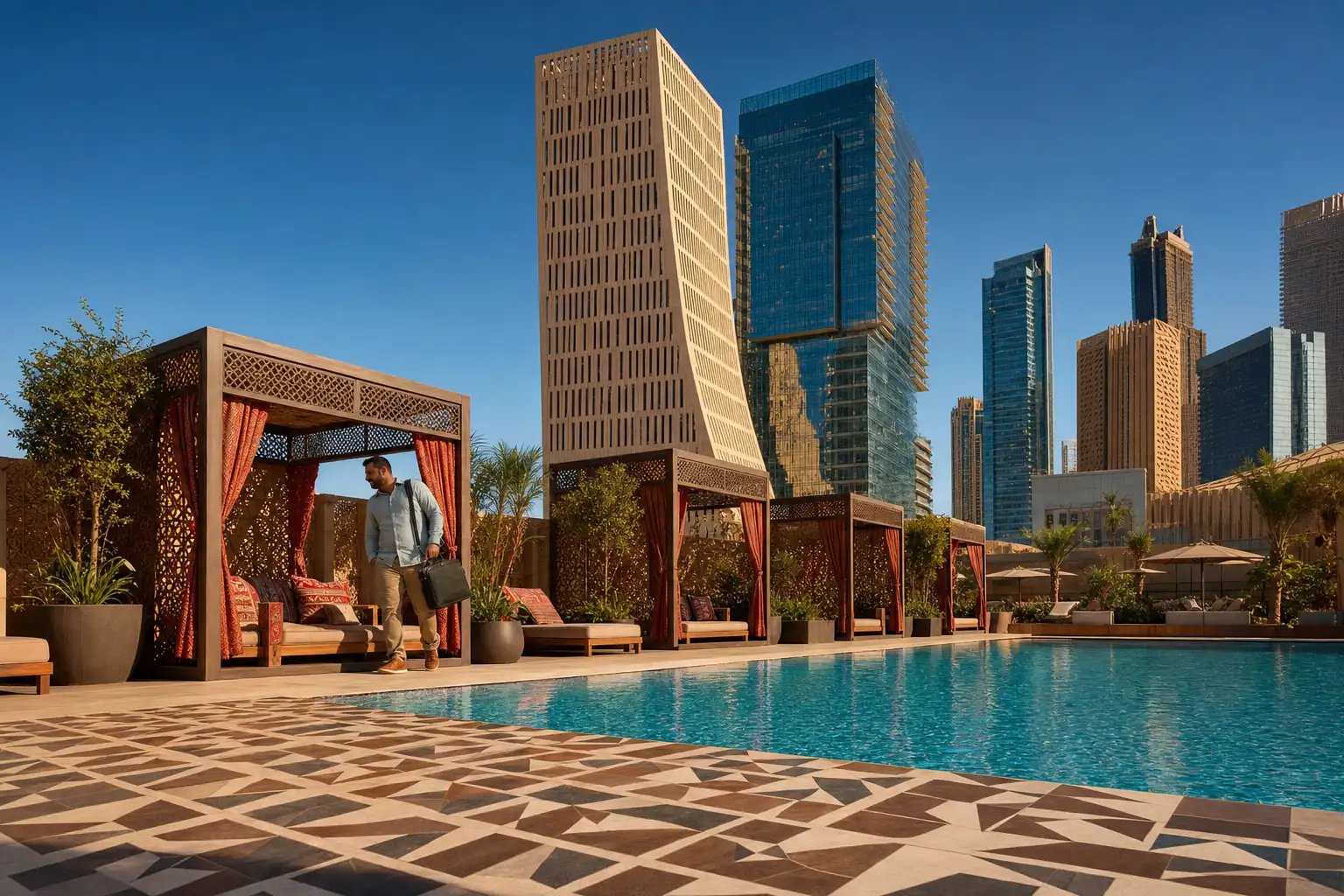
- WET Deck – the outdoor pool scene, with Mediterranean-inspired food, private cabanas and poolside seating
- Sahari – an outdoor lounge opening later this year, named for the Arabic tradition of staying up late
Guests also get the brand’s AWAY Spa and FIT fitness studio, plus 15 meeting rooms and a ballroom built for the corporate crowd KAFD was designed around from the start.
The Financial District That Sat Empty for Nearly Twenty Years
King Abdullah Financial District did not start as a hospitality story. It began in 2006 as a government bet that Riyadh could build its own financial capital from scratch, on a 1.6-million-square-metre site meant to house banks, regulators and the country’s stock exchange.
Ten years in, that bet looked broken. Saudi Arabia’s own Vision 2030 document, published in 2016, later admitted the district had been started “without consideration of its economic feasibility” and had failed to convince the financial community to invest.
- 2006: Construction begins on King Abdullah Financial District, a planned $10 billion financial hub on the northern edge of Riyadh.
- 2016: Bloomberg reports that not one bank has agreed to lease space in the district’s 73 buildings; Vision 2030 admits the project moved forward without regard for its own economics.
- 2022: Tadawul Tower, home of the Saudi stock exchange, reaches completion inside KAFD as more towers finish construction even as tenants stay scarce.
- 2024: The Public Investment Fund moves staff into KAFD’s tallest tower, and global firms including HSBC and Accenture begin taking office space, according to the Financial Times.
- April 2026: Saudi authorities order companies to evacuate KAFD over fears of Iranian missile or drone strikes, emptying towers that house Goldman Sachs and Deloitte.
- July 2026: W Hotels opens W Riyadh KAFD, the district’s first lifestyle luxury hotel and the brand’s debut in Saudi Arabia.
Each entry above traces the same three-mile stretch of Riyadh. None of them were guaranteed to connect.
How Goldman Sachs and Deloitte Ended Up Next Door
The fix came from the same institution that funds much of Vision 2030. The Public Investment Fund, Saudi Arabia’s $940 billion sovereign wealth fund, took over stalled parts of the project and moved its own staff into KAFD’s tallest building, pulling HSBC and Accenture in behind it.
Observers watching the shift compare it to Canary Wharf in the late 1990s, when London’s docklands were still convincing tenants they were not a mistake. Pedestrian bridges, high-end restaurants and new skywalks followed the tenants in, turning a half-built skyline into something closer to a functioning neighbourhood.
Marriott has been building toward this moment for longer than most guests checking in this month would guess. The company crossed 100 combined open and pipeline hotels in the kingdom last November, after signing a 1,100-room Courtyard for Makkah’s Masar district.
A Missile Alert Three Months Before the Ribbon-Cutting
The comeback has not been risk-free. On April 2, Saudi authorities told companies to evacuate KAFD immediately and warned staff not to return until at least April 6, according to a notice reviewed by Semafor.
The concern was that Iranian missiles or drones could strike the district. The order emptied towers that host Goldman Sachs and Deloitte, along with the sovereign fund’s own offices.
Saudi Arabia has spent heavily on countering exactly that kind of threat. Washington’s approval of a $2 billion sale of anti-drone rockets to the kingdom this year reflects how seriously the danger is taken at a government level, even as five-star hotels keep opening a few blocks from where staff were told to shelter in place.
Not everyone treated the evacuation as a reason to slow down. Benefit Street Partners, a $92 billion private credit manager owned by Franklin Templeton, said it still planned to expand into the Gulf region despite the conflict.
Marriott’s Bigger Bet on the Kingdom
W Riyadh KAFD is one hotel inside a much larger wager. Saudi Arabia’s hospitality sector is being built out at a pace that dwarfs any single opening.
| Metric | Figure | Detail |
|---|---|---|
| Total hotel stock (Q1 2025) | 167,500 keys | 61% luxury, upscale or upper-upscale |
| Pipeline additions by 2030 | 99,500 keys | 78% in high-end categories |
| Visitors in 2024 | 127 million | About 4.7% of Saudi GDP |
| Visitor target for 2030 | 150 million | Tied to Expo 2030 and the 2034 World Cup |
| Marriott’s Saudi footprint | 100 hotels | Open and pipeline combined, as of November 2025 |
Those figures come from Knight Frank’s Saudi Arabia hospitality market review, and they explain why a single hotel opening carries more context than the ribbon-cutting suggests. The timing lines up with Saudi Arabia’s push to cut its dependence on oil revenue, a push that looks shakier every time the kingdom weighs strikes on Houthi positions that threaten its own oil lifeline.
Demand has not caught up with supply everywhere. Occupancy across the kingdom’s fast-growing hotel stock runs around 49%, and Marriott’s newest Saudi deals lean toward midscale and extended-stay brands rather than five-star towers, a shift Skift’s reporting on a 2,700-room deal ties to filling existing rooms rather than chasing new ones.
Saudi Arabia is not the only government leaning on one anchor project to pull hotel investment into a single skyline. Egypt is running a similar play in Giza, where a tourism master plan built around the Grand Egyptian Museum’s opening is pulling in new hotel supply of its own.
A separate deal signed with developer Blacksand adds ten more hotels and over 1,300 rooms across the kingdom by 2030, with the first expected in Riyadh. For now, W Riyadh KAFD stands as the district’s only five-star address.
Frequently Asked Questions
How many W Hotels are there around the world?
W Hotels operates more than 70 destinations globally, built around the brand’s signature Whatever/Whenever service and buzzing Living Room lobby concept. W Riyadh KAFD is the newest addition and the brand’s first in Saudi Arabia.
What other Marriott luxury brands are moving into Saudi Arabia?
Marriott Bonvoy’s wider luxury roster includes The Ritz-Carlton and St. Regis alongside W Hotels. A separate 2026 deal with developer Blacksand also plans to bring Autograph Collection, Moxy, Courtyard, Residence Inn and Apartments by Marriott Bonvoy properties to the kingdom over the next four years.
Is Riyadh’s hotel market oversupplied right now?
National occupancy runs around 49% even as new supply keeps arriving, and Saudi officials have responded by pushing to grow domestic tourism to help fill the gap rather than relying purely on international arrivals.
What is Sahari at W Riyadh KAFD?
Sahari is an outdoor lounge scheduled to open later in 2026, named after the Arabic tradition of staying up late into the night. It will host live entertainment and curated evening events, rounding out the hotel’s four food and beverage venues.
How big is Saudi Arabia’s Expo 2030 opportunity for hotels?
Expo 2030 alone is projected to inject roughly $94.6 billion into Riyadh’s economy, with an estimated 40 million visitors expected during the six-month exhibition, according to Al Rajhi Capital estimates cited in Knight Frank’s hospitality research.
