
A second car exploded on Israeli pavement on Tuesday night, 14 hours after the first one. Magen David Adom emergency-service medics reached the wreck at the Or Akiva interchange on Route 2 just after 8:04 p.m. and pronounced one man dead at the scene; that morning, at 8:40 a.m., another vehicle had detonated in Afula and killed a man in his 30s before he reached HaEmek Medical Center. Israel Police were treating both blasts as suspected criminal assassinations rather than nationalistic attacks.
The pair of bombings landed in a country where, by Abraham Initiatives’ running count, the 100th violent killing of an Arab citizen in 2026 was recorded earlier this month, a pace roughly 20% above the trajectory that produced 252 murders last year.
Two Cars, Fourteen Hours, One Pattern
Tuesday’s blasts opened and closed the same workday with the same equipment: a passenger vehicle, an improvised device, and a single male target inside. The morning wreck struck a city in the lower Galilee; the night wreck sat on a highway shoulder roughly 70 kilometers further south on the Mediterranean coast. Police investigators treated them as separate criminal incidents even as the choreography lined up.
Two car bombings in one calendar day is rare anywhere. In Israel it has become familiar enough that Fire and Rescue Services dispatched a department investigator to the second scene within the hour, and emergency-service logs flagged the same multi-system-injury notation at both wrecks.
| Attribute | Morning Blast | Evening Blast |
|---|---|---|
| Time | 8:40 a.m. | 8:04 p.m. |
| Location | Afula, lower Galilee | Or Akiva interchange, Route 2 |
| Victim | Man in his 30s | Adult male, age withheld |
| Outcome | Unconscious at scene; died en route to HaEmek Medical Center | Pronounced dead at the roadside |
| Police framing | Criminal, mob hit suspected | Criminal, assassination probe opened |
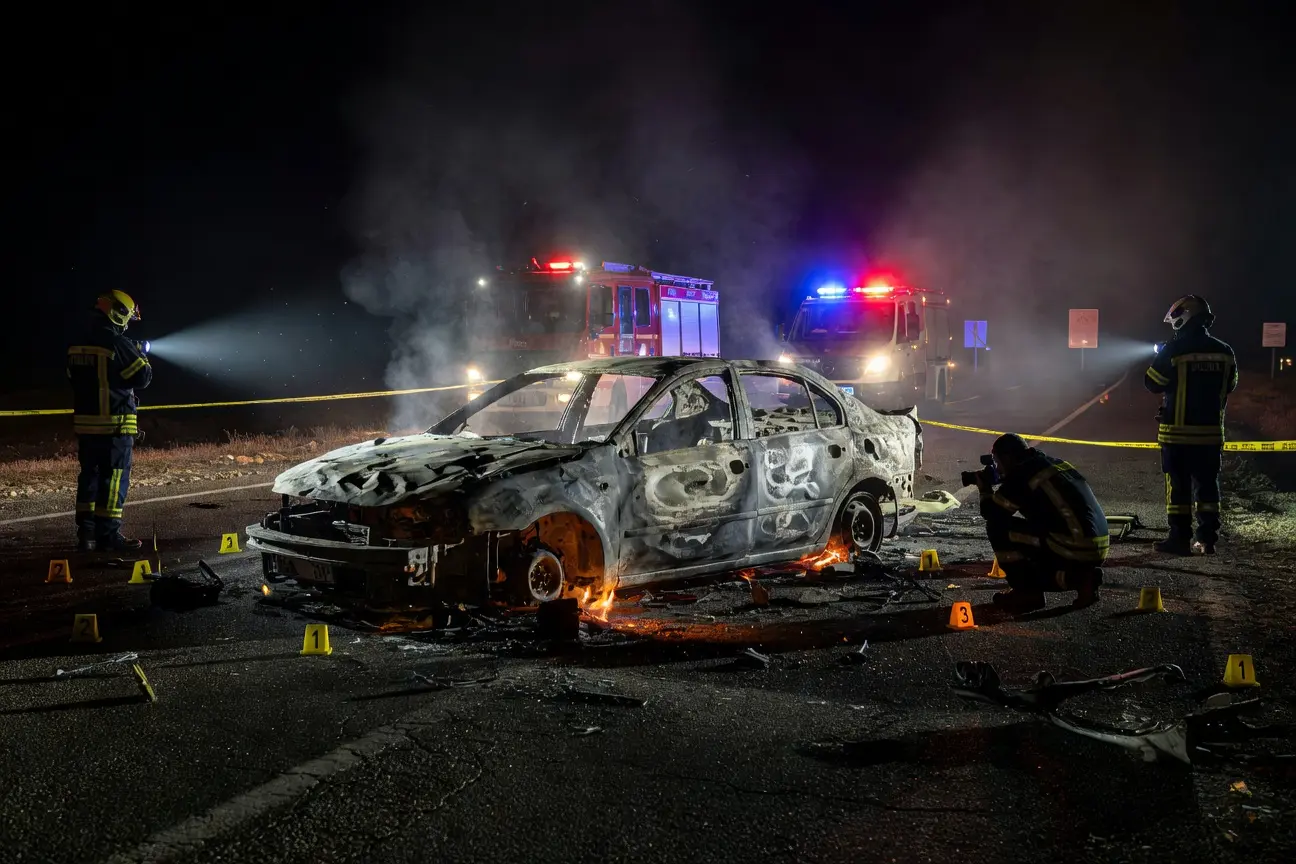
Route 2 at the Or Akiva Interchange
Route 2 is the coastal artery between Tel Aviv and Haifa, and the interchange feeds a mixed city of roughly 18,000 residents just south of Caesarea. Paramedic teams arrived shortly after the emergency call to find a vehicle already engulfed in flame on the highway shoulder, with one occupant inside.
Teams found the man with no signs of life and multi-system injuries from the blast, and pronounced him dead at the roadside, the emergency service said. Fire and Rescue Services said its crews extinguished the burning vehicle and a small brush fire that the heat had pushed into surrounding scrub, then handed the wreck to a department investigator and police technicians.
The victim’s name was not publicly released on Tuesday night. Israel Police opened an investigation into whether the explosion was an assassination linked to organized-crime feuds, the standard framing local police use when a vehicle detonates with a single occupant and no claim of nationalistic responsibility. A prior single-victim explosion case in Tel Aviv followed the same investigative track.
A Morning Detonation in the Galilee
The morning bombing struck a city of about 60,000 in the lower Galilee at 8:40 a.m. Medics found a man in his 30s unconscious beside the wreckage with multi-system injuries from the explosion. Resuscitation attempts continued en route to HaEmek Medical Center, where he was pronounced dead shortly after arrival.
Police investigators concluded within hours that the motive was criminal rather than nationalistic, a determination that routed the case from Shin Bet (Israel Security Agency, the domestic counter-terrorism service) channels into the central police unit on organized crime. The victim’s identity was withheld pending family notification.
The lower Galilee sits along a corridor where, police data suggests, the Hariri and Jarushi crime networks have operated for years. Successive northern car bombings since 2023 have been tied to settlement-of-accounts disputes inside or between those organizations, and investigators were canvassing nearby businesses for surveillance footage by mid-morning.
A Body Count Already 20% Ahead of 2025
Tuesday’s pair of bombings folded into a tally the Abraham Initiatives has been keeping for several years and updating in near-real time. The civil-society group logged the year’s 100th violent killing of a member of Israel’s Arab community earlier in May, a milestone reached after a fatal shooting in Shfaram.
The 2025 Record
Last year was the deadliest on the organization’s record. The group documented 252 murder victims in Israel’s Arab community in 2025, with 88% killed by gunfire and 23 women among the dead, the highest annual figure for female victims it has logged.
The 2026 Trajectory
This year is running ahead of that pace. The 100-victim mark arrived earlier in the calendar than last year’s equivalent, and the running count was tracking roughly 20% above the corresponding 2025 figure at the same point. If the slope holds through the back half of the year, the 2026 total pushes past 270 by December.
Method of Killing
Of the first 100 Arab victims logged this year:
- 93 were killed by gunfire
- 5 were stabbed to death
- 1 was burned to death inside a vehicle
Tuesday’s two car bombings, if classified as criminal homicides, would extend that vehicle-fire subset and tilt the year’s mix further toward explosives rather than handguns alone.
Ben Gvir’s Police, Levin’s Empty Benches
Government critics returned to two familiar names on Tuesday night. National Security Minister Itamar Ben Gvir holds the police portfolio at the Ministry of National Security; Justice Minister Yariv Levin holds responsibility for filling judicial vacancies. The Arab community’s leadership and opposition lawmakers have argued for two years that each has played a part in letting the crime wave compound.
The Police Portfolio
Homicide cases among Palestinian citizens of Israel more than doubled in 2023, Ben Gvir’s first full year overseeing the police, and have remained above the pre-2023 baseline ever since. President Isaac Herzog has publicly called the violence a national emergency. The minister has rejected the framing that police are failing the community and pointed to enforcement operations against the largest crime families.
The Judicial Bottleneck
Levin has refused to convene the Judicial Appointments Committee in the configuration required to fill vacant seats on the magistrates’ and district courts, a stance tied to his broader push to reshape the judiciary. The empty seats slow indictments, lengthen detention hearings and stretch prosecutions of organized-crime defendants past statutory deadlines, lawyers practising in the relevant courts have told local outlets.
The Solve-Rate Gap
The clearance disparity is the figure community leaders return to. Israel Police closes roughly 15% of homicides in Arab communities versus 65% among Jewish Israelis, according to data compiled for the Knesset and by Eilaf, the Center for Advancing Security in Arab Society. Investigators attribute the gap to witness intimidation, weaker informant networks and fewer detectives assigned to the relevant districts.
The Hardware and the Hands Behind the Hits
Israeli police and academic researchers describe the violence as the product of a tight oligopoly. The Big Five crime families, the Hariri, Abu Latif, Jarushi, Bakri and Qarajah clans, divide territory along regional lines and account for the bulk of the targeted killings that show up in the Abraham Initiatives ledger.
The Abu Latif organization runs the corridor from Hadera to the Lebanese border, the geography that swallowed both of Tuesday’s bombings. The Hariri network operates from Wadi Ara further inland, and the Jarushi family disputes territory with the Masrati clan around Ramla and Lod, where car bombings have become a recurring tactic in long-running feuds.
The weapons themselves are mostly contraband. Israeli security forces seized more than 800 guns in 35 thwarted smuggling runs from Jordan between March 2021 and April 2023, according to the Combating Terrorism Center at West Point’s border-smuggling study, and Israeli investigators estimate that tens of thousands of illegal firearms now circulate inside the country’s Arab communities.
- $2,000: Typical price of a handgun in Jordan’s saturated black market.
- $5,000: Resale price on the West Bank side of the border.
- 800+ guns, 35 attempts: Smuggling runs from Jordan that Israeli forces interdicted across roughly two years.
Improvised car bombs, assembled from commercial explosives and remote triggers, are cheaper still. By Wednesday morning the highway shoulder was open again under a forensic tent, with a fire-department investigator still inside it. Whether the man pronounced dead at the roadside on Tuesday becomes victim 102, or victim 103, of 2026 depends only on which other case the running ledger logs first.
