
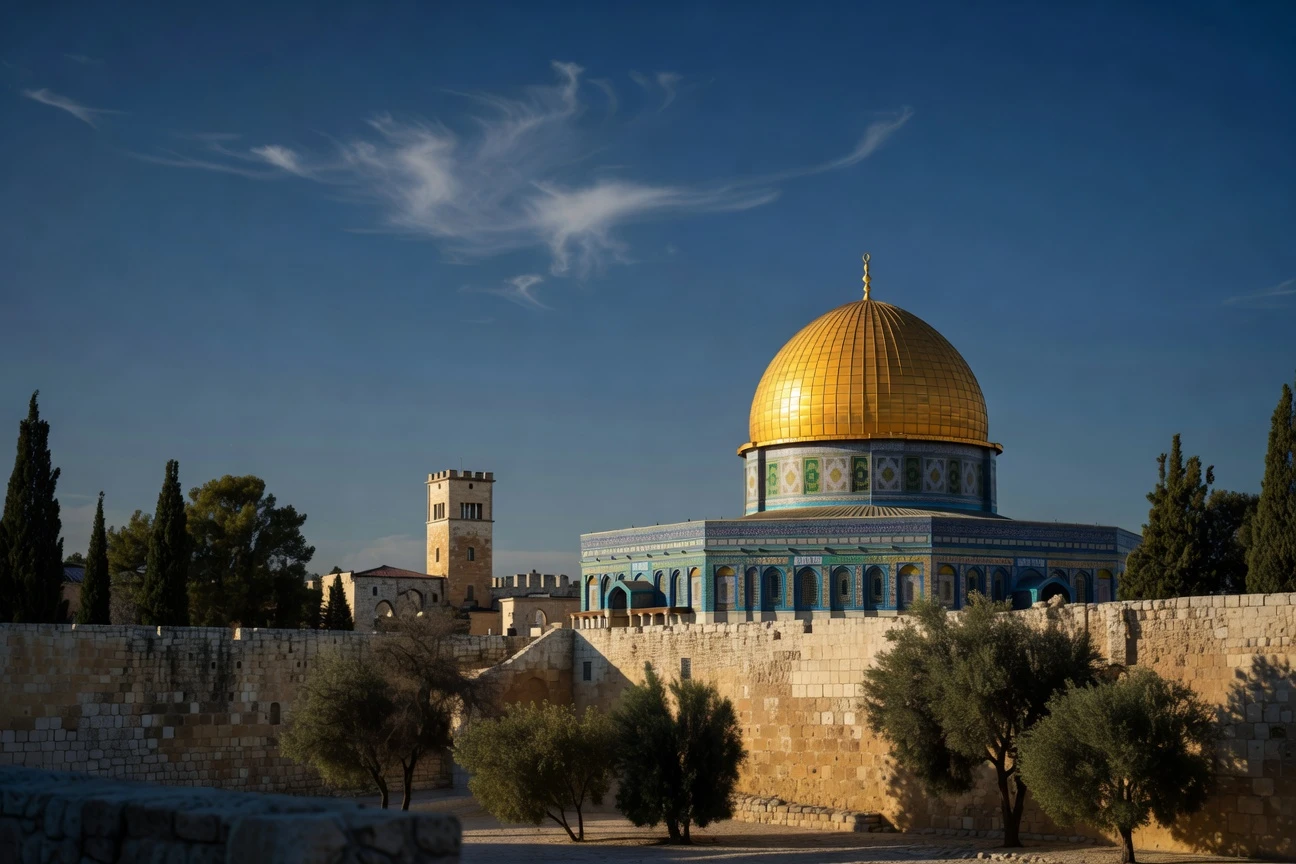
The Palestinian Authority warned on Tuesday that a US-Israeli proposal to end Jordan’s century-old custodianship of Jerusalem’s Al-Aqsa Mosque complex would carry “serious repercussions for security and stability in the region”, responding to a Middle East Eye report that named Jared Kushner, son-in-law of President Donald Trump, and Mike Huckabee, US ambassador to Israel, as the plan’s principal backers. According to that report, the framework would dissolve the Jordanian-backed Islamic Waqf’s 102-year authority over the site, declare the complex a “multi-faith centre” with formal Jewish prayer rights, and hand Israeli officials approval over imam appointments and the content of Friday sermons.
The Plan as Sketched in Washington
Two US officials told Middle East Eye’s exclusive on the draft custodianship paper that the Trump administration wants Al-Aqsa “stripped of its Muslim identity” and rebranded as a tourist landmark shared by the three Abrahamic faiths. A separate US official, contacted by the outlet after publication, called the report “totally false”.
The components reporters laid out are concrete, and they cluster around five operational changes:
- Termination of the Islamic Waqf’s authority and creation of a new Israeli-appointed body to run the complex
- A formal “multi-faith centre” designation that ends restrictions on Jewish group prayer at the site
- Israeli sign-off on the appointment of imams, preachers and senior mosque officials
- Israeli review of the content delivered in Friday sermons
- Rotational Arab oversight intended to dilute any single Muslim state’s voice at the site
Of the four Gulf and North African states reportedly briefed on the proposal, Bahrain and the United Arab Emirates (UAE, signatories to the 2020 normalisation track) have the warmest existing channels to Israel. Egypt and Morocco received the same briefing. Saudi Arabia, briefed separately, told Jordanian counterparts it would oppose any move against the Hashemite role, according to Gulf and Jordanian sources cited by MEE.
Why the Hashemite Throne Cannot Cede This
The custodianship sits at the centre of King Abdullah II’s domestic legitimacy. Jordan’s population is heavily Palestinian in origin, its treasury runs on aid streams the Gaza war has squeezed, and its political opposition reads every Jerusalem move with hawk eyes. Ceding the role would not register as a diplomatic tradeoff inside Amman; it would register as a constitutional injury to the throne.
The institutional anchors run deep:
- 102 years since the 1924 Supreme Muslim Council decision that named Hussein bin Ali, great-grandfather of the current king, as custodian
- 32 years since the 1994 peace treaty with Israel wrote Jordan’s “special role” into Article 9
- 13 years since King Abdullah II and Palestinian President Mahmoud Abbas signed a 2013 Amman pact reaffirming the custodianship after Palestine’s UN observer-state upgrade
- One billion Muslims whose feelings the king warned would be “ignited” by any assault on the city’s holy sites, in his 2025 General Assembly address
That is not rhetorical scaffolding the palace can quietly walk back. Jordanian officials, briefed by counterparts in Washington and Tel Aviv over the last year, have repeatedly told visiting envoys the custodianship is non-negotiable, according to the MEE reporting and corroborating Jordanian press accounts. The throne’s information ministry has not issued a separate public statement on Tuesday’s PA warning, a silence that reads as deliberate while Amman calibrates its response.
Riyadh Says No, and That Matters
Saudi Arabia’s quiet opposition is the variable that complicates the entire Washington blueprint. Two Gulf Arab sources and a person familiar with Jordanian thinking told MEE that Riyadh views any move against the Hashemite role as a trigger for regional instability.
The kingdom has a separate institutional stake here. The al-Saud monarchy’s own claim to the title “Custodian of the Two Holy Mosques” of Mecca and Medina rests on the same Islamic logic that anchors Hashemite custody of the Haram al-Sharif, the platform Jews refer to as the Temple Mount. A precedent in which a non-Muslim power dissolves Muslim custodianship over a top-tier shrine is a precedent the al-Saud cannot endorse without weakening its own.
That instinct lines up with the broader Saudi position on the post-October 7 regional order, the same calculus that has kept Riyadh outside the Abraham Accords without a credible roadmap to a Palestinian state. Crown Prince Mohammed bin Salman has tied the kingdom’s normalisation price to Palestinian sovereignty; an Al-Aqsa shock arriving at the wrong moment in those talks would torch the file.
If Riyadh decides to lean on the UAE and Bahrain to back off the proposal, the Washington draft loses its Arab cover. If it does not, the Gulf normalisation track that Kushner spent the first Trump term building becomes the wedge that prises open the third-holiest site in Islam.
Nabi Samuel Lands as a Live Precedent
On the same day the Palestinian Authority issued its warning, Israel’s civil administration in the occupied West Bank announced it was seizing 28 acres of land containing the tomb of the Prophet Samuel, a religious landmark long run by the Islamic Waqf and venerated in Jewish, Christian and Muslim tradition. The Israeli settlement-watch group Peace Now flagged the move as the first ever expropriation of a Waqf-administered holy site by the Civil Administration in the West Bank.
The Palestinian villages of Beit Iksa and the Nabi Samuel hamlet sit on the parcel. The official Palestinian news agency Wafa’s report on the Awqaf ministry condemnation said the order would “suffocate the mosque and completely isolate it from its Palestinian surroundings, turning it into a Jewish archaeological site by force of arms”.
For the Palestinian Authority statement issued hours earlier, Nabi Samuel reads as confirmation of intent. The same Waqf whose authority Washington is reportedly preparing to dissolve at Al-Aqsa lost a smaller Waqf site the same week, under the signature of the same civil administration that would in practice be asked to enforce any new arrangement at the Haram al-Sharif.
What Article 9 Promised in 1994
The official Hashemite custodianship record traces the role back to the 1924 Supreme Muslim Council, through Jordan’s 1948 annexation of East Jerusalem, and into the 1988 disengagement, when the late King Hussein cut political ties to the West Bank while keeping Jerusalem’s holy sites under Hashemite authority. Article 9 of the 1994 Israel-Jordan peace treaty then codified the arrangement, with Israel committing to “respect the present special role of the Hashemite Kingdom of Jordan in Muslim Holy shrines in Jerusalem”.
| Element | 1994 Israel-Jordan Treaty | 2026 Proposal as Reported |
|---|---|---|
| Custodian of Al-Aqsa | Hashemite Kingdom of Jordan | New Israeli-appointed body |
| Waqf authority | Sole administration of complex interior | Dissolved, role reassigned |
| Jewish prayer | Banned at the complex under status quo | Formally permitted, group prayer allowed |
| Imam appointments | Waqf decision | Subject to Israeli approval |
| Friday sermons | Waqf-controlled content | Israeli review of content |
| Site identity | Islamic shrine | “Multi-faith centre” tourist designation |
The gap between the two columns is the gap between a binding treaty and a redesign. Israel has not formally repudiated Article 9. Successive governments have, however, allowed the visible facts on the ground at the complex to drift away from the 1994 baseline through police raids, ministerial visits to the platform, and tolerated group prayer by ultranationalist activists. Jordan and Palestinian leaders have catalogued the drift for years without securing a reversal, and that record is what makes the current draft land with a heavier thud in Amman than it might have ten years ago.
The Border Risk Nobody Is Pricing
Israel’s longest peaceful frontier runs through Jordan. The 1994 treaty has held for thirty-two years through three Lebanese wars, two intifadas, the Arab Spring, the rise and fall of the Islamic State, and the Gaza war that followed October 7. A serious challenge to the Hashemite custodianship is the most plausible single trigger for that border arrangement to fray, because the role is one of the load-bearing reasons King Abdullah II can publicly survive a peace treaty with Israel inside Amman’s domestic politics.
Any assault on the city’s holy sites would ignite the feelings of more than a billion Muslims around the world.
King Abdullah II addressed the United Nations General Assembly in 2025 with that line. It read at the time as standard rhetorical positioning. This week’s reporting positions it as a pre-stated red line, delivered exactly twelve months before the draft was leaked, from the lectern of the body whose Educational, Scientific and Cultural Organisation (UNESCO) Jordan and the PA are now asking to intervene.
Washington would have to weigh whether dissolving Waqf authority is worth provoking a public rupture with the Arab state that polices its eastern frontier with Israel, hosts the largest contingent of US troops in the Levant outside Iraq, and runs the air corridor used during last year’s Iran-Israel missile exchanges. The same calculation runs through Riyadh, where the kingdom has spent two years negotiating a US security framework that hinges on regional stability. An Al-Aqsa shock, in the language CAIR used in its Washington condemnation, cuts directly across that framework.
If the draft is shelved or denied louder than this week’s “totally false” line, the status quo holds and the Nabi Samuel seizure stands as an isolated marker on a longer creep. If the draft moves into operational planning, Amman’s calculation shifts from defending the custodianship to defending the treaty that contains it.
