
Mark Carney landed in Jeddah last week as the first Canadian prime minister in 26 years to visit Saudi Arabia, and he left with 13 commercial agreements and memorandums of understanding worth more than $1 billion. The trip put a permanent Canadian defence attache in Riyadh for the first time, signed Ottawa on to Saudi Arabia’s mining and AI buildout, and booked a Canadian national pavilion at the World Defence Show in January 2028.
Three days after Carney left the region, Yemen’s Houthi rebels fired missiles and drones at Saudi Arabia’s Abha International Airport in retaliation for a strike on a Houthi-held runway in Sanaa. The Houthis said the attack ended a de-escalation phase that had held since a 2022 ceasefire.
What Carney Signed in Jeddah
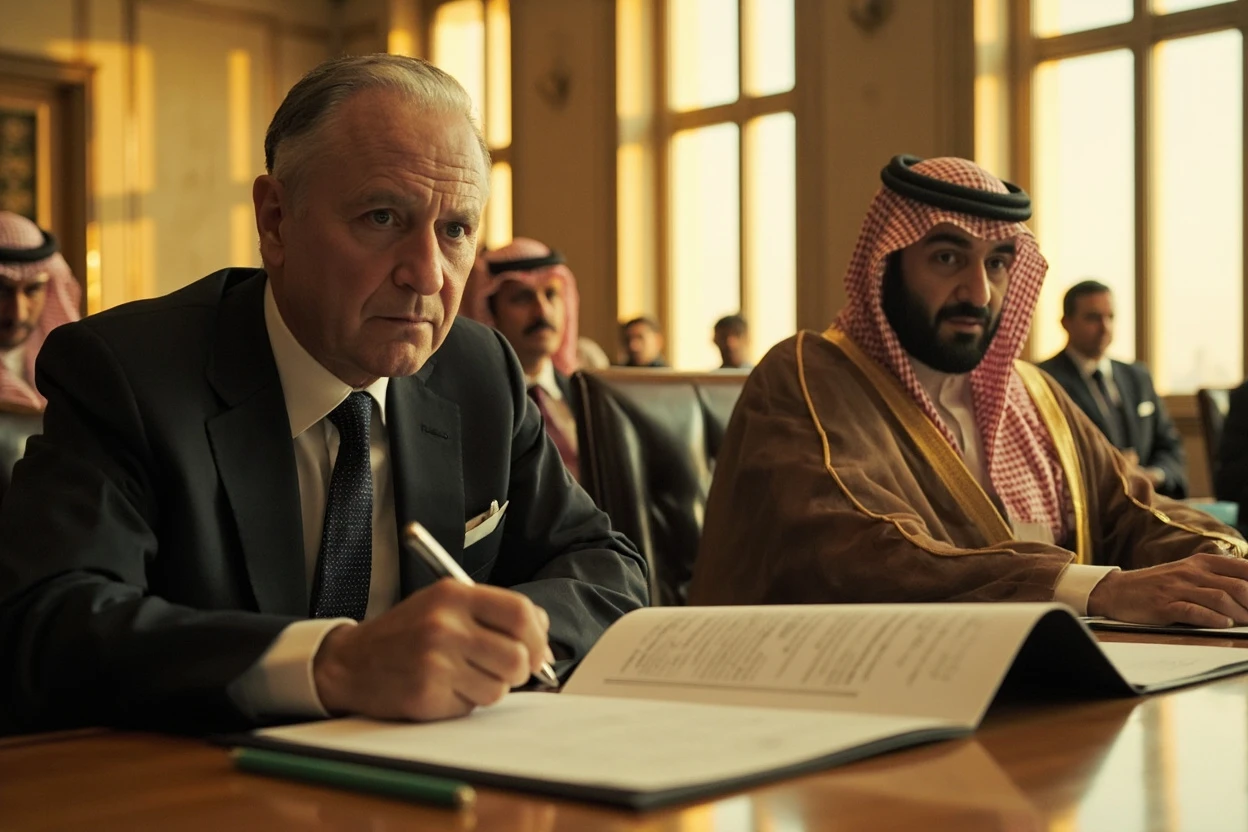
Carney landed in Jeddah last week, the first Canadian prime minister to make the trip in 26 years, his office said. The visit followed the NATO summit in Ankara and included a meeting with Saudi Aramco chief executive Amin Nasser. In Jeddah, the prime minister and Crown Prince Mohammed bin Salman issued a joint statement and signed 13 commercial agreements and MOUs worth over $1 billion, spanning health technology, mining, infrastructure and defence (PM Carney’s official release on the Jeddah visit). Carney’s office framed the deal as a way to ‘cultivate a dense web of new connections’ beyond the United States.
- Saudi Arabia’s economy: $1.8 trillion
- Saudi sovereign wealth fund: over $1 trillion
- Untapped mineral wealth in the Arabian Shield: $2.5 trillion
- Saudi population: more than 30 million citizens
- World’s largest proven oil reserves
The MOUs are the kind of breadth Ottawa has been building toward since 2023, when the two countries began restoring diplomatic ties after a 2018 rupture. Saudi Arabia is now Canada’s second-largest trading partner in the Middle East, and Vision 2030 is offering ‘significant opportunities for Canadian workers, businesses, and expertise’ across mining, energy, AI and infrastructure, Carney’s office said. The Carney government has framed the trip as part of a wider push to grow non-US exports and attract investment in strategic sectors.
- Health technology: patient monitoring, clinical decision support, surgical intelligence platforms
- Mining and critical minerals
- Infrastructure: roads, rail lines, Vision 2030 mega-projects
- Defence and security, with a cooperation MOU to be finalised
- Energy: LNG, renewables, hydrogen, carbon capture and storage
- Artificial intelligence
- Education and workforce training
Carney also announced that Canada will lead a delegation of pension funds to Saudi Arabia to explore long-term investment in energy and AI. He committed Canada to a national pavilion at the World Defence Show in Riyadh in January 2028, the first time a Canadian government has taken that floor space.
Mining Sits at the Centre of the $1 Billion
Saudi Arabia’s $2.5 trillion mineral prize sits beneath a stretch of Precambrian rock called the Arabian Shield, a geological formation in central Saudi Arabia. The kingdom’s Ministry of Industry values the rock for its gold, copper, silver, zinc, nickel and rare earth deposits, and has revalued the resource by almost 90% above its 2016 baseline after a sweeping survey. Vision 2030 names mining the second pillar of the post-oil economy.
Steiner of the Canada Saudi Business Council said: ‘This is a whole new industry for the kingdom because oil was so easy. Mining is a Canadian specialty and Saudi Arabia, in the last five to six years, has embarked on making mining their second pillar.’ Hatch, the Canadian engineering firm, signed a strategic delivery partnership with Maaden, the Saudi Arabian Mining Company, with Carney on hand for the announcement in Jeddah.
The deal sits inside the $1 billion envelope of MOUs Carney announced. It also marks a shift in how Canadian firms are positioning themselves in the kingdom. Canadian firms are now signing design, finance and operating partnerships on Saudi mineral assets, the kind of embedded contract Vision 2030’s planners say they need.
Two of Carney’s stated export pitches map directly onto Saudi demand. Critical minerals processing and clean-energy infrastructure both sit under the Vision 2030 mining push, where Canadian engineering and project-management depth is rare outside the major Anglo-Saxon mining houses.
AI Compute, and a Concrete Pour for Riyadh’s Airport
The second anchor deal is artificial intelligence. Cohere, a Canadian sovereign AI company, signed a strategic compute collaboration with Saudi Arabia’s HUMAIN to provide dedicated infrastructure for frontier model training. HUMAIN will designate at least 50 megawatts of dedicated AI compute capacity to support Cohere’s next-generation foundation models, Carney’s office said. The deployment is expected to go live by the fourth quarter of 2027, according to Arab News.
Two days after Carney’s departure, a Canadian firm secured another contract: CarbonCure is part of the consortium supplying low-carbon concrete for the third runway at King Salman International Airport in Riyadh. The deal is small relative to the mining envelope, but it folds another Canadian clean-tech company into a Saudi mega-project, and it ties Canadian emissions-reduction technology to a kingdom that has framed Vision 2030 as a low-carbon transformation.
A Defence Attache in Riyadh, and a Canadian Submarine Order
Carney’s office also announced that Canada will establish a resident defence attache presence in Riyadh to ‘increase exports from Canada’s defence sector.’ The posting is a permanent military-diplomatic role, replacing the rotating visits Ottawa has used in the past.
Saudi Arabia is one of the world’s largest arms importers, and Canadian-made light armoured vehicles, sniper systems and aerospace components have been on the kingdom’s shopping lists for years. Carney committed Canada to a national pavilion at the World Defence Show in Riyadh in January 2028, a step up from a one-off industry visit. The same trip saw Carney announce the largest defence procurement in Canadian history, selecting Thyssenkrupp Marine Systems (TKMS) as the preferred supplier for up to twelve state-of-the-art submarines.
Global Affairs, asked by CBC News whether the hoped-for arms sales would carry human-rights caveats, said all sales are subject to ‘Canadian law, our international obligations and Canadian foreign policy objectives, including human rights.’ The department added that specific Saudi arms requests were already denied last year ‘in instances where officials could not verify that approving the permit would be consistent with Canada’s foreign policy priorities.’ A resumption of the war in which Saudi Arabia was accused of indiscriminate bombing of targets such as wedding tents would likely complicate future Canadian sales. The new attache’s posting is meant to manage that risk in real time, alongside the contracts the pavilion and the procurement are designed to produce.
Then on Monday, a Houthi Missile Lit Up a Saudi Airport
The Monday after Carney left, the war risk he had been betting against showed up in real time. By evening, the Houthi-Sanaa flare-up had produced missiles over a Saudi airport and the end of a four-year ceasefire.
Air strikes hit the international airport in Sanaa, the Houthi-held capital of Yemen. The Saudi-backed Yemeni government said it targeted the runway to prevent an Iranian plane from landing. Within hours, the Houthis said they had fired ballistic missiles and drones at Saudi Arabia’s Abha International Airport.
The Houthis announced that the attack ended the de-escalation phase of Yemen’s civil war, the relative calm that had held since a 2022 ceasefire brokered by the United Nations. Houthi military spokesman Yahya Saree said his forces would ‘not go unanswered and unpunished.’ The group warned airlines against overflying Saudi airspace ‘until the blockade on Sana’a International Airport is lifted.’ UN special envoy Hans Grundberg said his team was urging both sides to ‘refrain from any actions that would risk a new cycle of violence in Yemen.’
The International Committee of the Red Cross said a separate aircraft of theirs at Sanaa was held by the Houthis, with two crew members taken hostage according to the Yemeni information minister. The Houthi transport minister, on Al Masirah TV, said the Iranian plane the government had tried to block was carrying patients and stranded people (the Houthi strike on Abha International Airport). For Canada’s new partnership, the timing is a stress test: Carney’s $1 billion envelope is built on the assumption that Saudi Arabia is a stable counterparty for the next decade of mining, AI and infrastructure work.
Carney’s ‘Lecturing From Afar’ Doctrine
Carney made the case for engagement in Jeddah, and a few of his lines landed as a repudiation of the Trudeau-Freeland approach to Saudi Arabia. The lecture critique was unmistakable, and it was the most quoted line of the trip. Carney framed the new doctrine as the lesson of the last decade of Canadian foreign policy.
I do see that lecturing countries from afar is an ineffective strategy. It’s satisfying, but it’s ineffective. Engagement can be effective.
Carney, the Canadian prime minister, said that to reporters in a news conference in Jeddah, the day after meeting Saudi Crown Prince Mohammed bin Salman. The line is a pointed repudiation of the approach of former foreign affairs minister Chrystia Freeland, whose 2018 tweet criticising Saudi arrests of women’s rights activists triggered the worst bilateral crisis between the two countries in modern memory (Carney’s broader pitch from the Jeddah trip).
The two Canadian approaches to Saudi Arabia, side by side:
| Dimension | Carney 2026 | Trudeau-Freeland 2018 |
|---|---|---|
| Public framing of Saudi engagement | ‘Engagement can be effective’ | Publicly called for release of activists |
| Trade result | 13 MOUs worth over $1 billion | Saudi Arabia froze new trade |
| Diplomatic status | Permanent defence attache in Riyadh | Ambassador expelled, envoy recalled |
Carney has been careful to keep human rights language in the talking points while removing it from the deal-breakers. He told reporters Canada cares ‘deeply about human rights, self determination for nations, territorial integrity of nations, Canadian consular cases,’ and would not trade away those concerns in exchange for market access. Whether engagement produces outcomes on the rights file is the open question of Carney’s reset.
Thomas Juneau of the University of Ottawa called the pivot ‘a pretty clear hard-nosed pragmatic calculus to put aside issues of human rights and other disagreements.’ Former foreign minister Lloyd Axworthy pushed back: he said Carney’s message breaks with a ‘long legacy of Canadians playing a strong role in being peacemakers, mediators, supporters of international law and rules,’ and peace ‘won’t come from these kinds of characters with their autocratic views,’ a reference to MBS and Turkish President Recep Tayyip Erdogan, who also met with Carney at the NATO summit the week before.
The 2018 Freeland Tweet, Receding
The Carney pivot is the second reset between the two countries in less than a decade. In 2018, then foreign affairs minister Chrystia Freeland used Twitter to call for the release of Saudi women’s rights activists, including blogger Raif Badawi and his sister Samar Badawi, and Riyadh responded by expelling the Canadian ambassador, freezing new trade and recalling its own envoy.
Ottawa and Riyadh began restoring diplomatic ties in 2023 and appointed new ambassadors in each capital. The relationship that took shape over the next two years was quieter and more transactional, focused on lower-profile trade missions rather than high-level visits. Carney’s trip is the first prime-ministerial visit since, and the breadth of the announcements signals that the 2018 rupture has been fully set aside.
Canadian officials have been careful to avoid the trigger words that started the last fight. When asked about human rights in Jeddah, Carney said the issue was ‘deeply’ important to Canada, but he did not name specific Saudi activists. His office did not release a list of consular cases of concern. The shift in tone is the most measurable change from the 2018 reset, and it tracks with Carney’s broader pattern of breaking with Trudeau-era orthodoxies on Middle East files (Carney’s listing of Tel Aviv in ‘Palestine’).
‘That’s not to say they’re into political liberalization,’ cautions Dennis Horak, the former Canadian ambassador expelled during the 2018 dispute. ‘But the kinds of economic and social reforms that they have brought in have been meaningful and have touched the lives of Saudis.’
Carney’s Diplomatic Agenda in Riyadh
Beyond the MOUs, the two leaders set a calendar. Carney and MBS announced they will conclude negotiations for a Foreign Investment Promotion and Protection Agreement (FIPA) by early 2027, a deal that would give Canadian businesses more confidence to expand operations inside the kingdom. They launched negotiations on a new double-taxation agreement, and they agreed to set up a foreign minister-level Canada-Saudi Arabia Coordination Council to oversee the work.
On regional security, the joint statement strongly condemned Iranian attacks on commercial vessels in the Strait of Hormuz on July 7, 2026, two days before the Carney visit began. Canada offered to support the Multinational Military Maritime Mission in four areas: maritime logistics, cyber support, demining expertise and satellite imagery, when conditions permit. Carney framed MBS and Erdogan as key to peace in the region, particularly in the Israeli-Palestinian conflict. A UN summit on Palestinian statehood co-hosted by Saudi Arabia, in September 2025, signalled where Riyadh wants to position itself in the diplomacy (the UN summit that co-hosted Palestinian statehood).
Steiner, the Canada Saudi Business Council leader, called Carney’s trip a ‘high-water mark’ for the bilateral relationship. The Carney government has staked a chunk of its trade diversification agenda on the bet that engagement produces results. The Houthis’ Monday missile strike has reset the baseline risk the Carney government is pricing into every Saudi contract from here on.
