
Israeli nonprofit CultivAid has helped lift Tanzania’s wine output from 4 to 5 million liters a year to 20 million liters, while training hundreds of Dodoma growers and launching a specialist pipeline that few outside the sector have noticed.
The work sits on rolling hills outside Dodoma, East Africa’s only commercial wine capital, and uses Israeli drip, pruning and nursery methods to fix low yields, weak quality and pesticide problems that long held the industry back.
Hands-On Work at the Six-Acre Dodoma Farm
Dr. Tomer Malchi, co-founder and CEO of CultivAid, told The Media Line the vineyards still sit far below capacity and could double crop output. “We saw that there was a lot to do,” he said. “There are many difficulties. They have low crop outputs, low quality, and pesticide issues. We have a lot of know-how and agronomy that can jump-start the crops.”
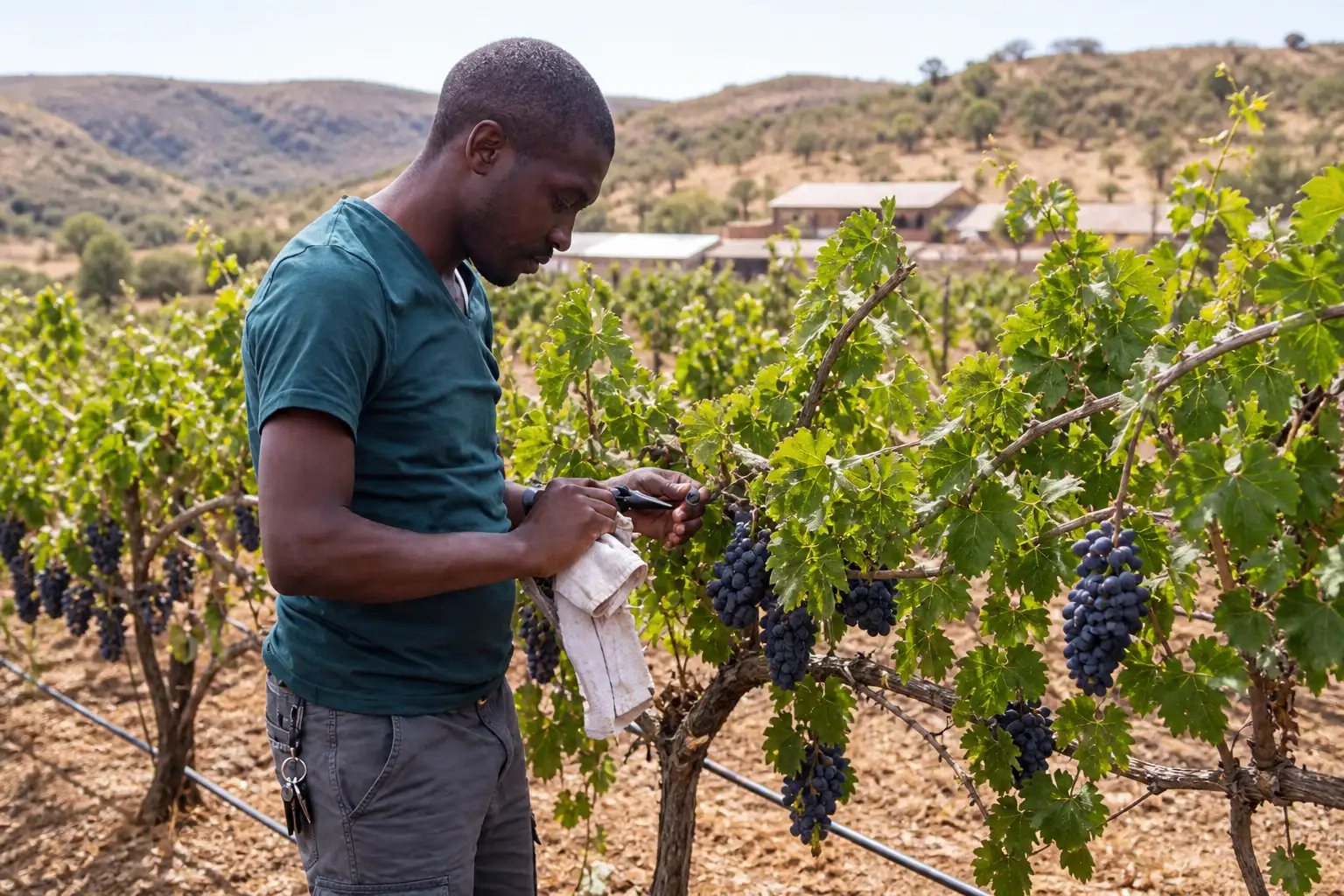
The group runs a six-acre research and experiment farm in Dodoma and recently opened a vineyard management course for 60 local participants plus a nursery. It is training residents to become Tanzania’s strongest agronomists, Malchi said.
The program rests on four essential components of the grape program: research and development, extension to farmers, stronger winery collaborations, and capacity-building courses. It forms part of the Global FEWture Alliance with the University of Maryland, Hebrew University and Mbeya University of Science and Technology.
- Research and demonstration plots test varieties under irrigated and rain-fed regimes.
- Extension clusters put trainers inside farmer groups rather than one-off workshops.
- Winery contracts link higher-quality grapes to guaranteed buyers.
- A nursery aims to supply 10,000 grape vine cuttings a year.
Each piece feeds the next. Research plots show which varieties hold sugar under local heat. Extension clusters carry those findings into the fields. Contracts give farmers a reason to meet the new standards. The nursery then multiplies clean planting material so gains do not stall when a season ends.
Local viticulturist Jacob Timothy Mwavika, who has followed Israeli irrigation and desert farming for years, said the practical side was the missing piece. “CultivAid introduced me to many experts and gave me the opportunity to physically see and practice methods that I had only learned about through reading,” he told The Media Line.
Mission Vines Became a Commercial Sector
Grape growing in Dodoma began long before any Israeli project. Catholic missionaries of the Holy Ghost planted the first vines near Hombolo in 1938 for sacramental wine. Passionist Father Irioneo Maggioni started commercial-scale work at Veyula in 1957.
After independence the government expanded plantings through prisons and national service camps. The Dodoma Wine Company arrived in 1979 together with a viticulture research center at Makutopora. South African and Italian investors followed in the late 1990s and early 2000s, turning Dodoma into Sub-Saharan Africa’s second-largest wine producer after South Africa.
- 1938, Holy Ghost missionaries plant first vines at Hombolo.
- 1957, Father Maggioni opens the first commercial farm at Veyula.
- 1961-63, Prison and national-service farms spread vines to nearby villages.
- 1979, Government founds Dodoma Wine Company and Makutopora research center.
- 1999-2002, Tanzania Distilleries and Central Tanzania Wine Company (Cetawico) bring modern investment.
- 2013, Production reaches roughly 12,000 tons of grapes and more than 3.5 million liters of wine.
- 2021, CultivAid opens its first Dodoma AITEC site with Water4Mercy and Don Bosco.
By 2018 the region already held over 1,400 farmers on more than 1,500 hectares producing close to 10,000 tons of grapes, about 6,500 tons of them for wine. Two harvests a year remain possible under Dodoma’s semi-arid climate.
That long arc matters. Mission plantings, state farms and foreign capital built the acreage. What lagged was consistent quality and yield. CultivAid entered a sector that already existed and tightened the agronomy around it.
Production Jumped Fourfold Under the New Model
Malchi’s own tally is blunt: when CultivAid began, the industry made 4 to 5 million liters a year; it now makes 20 million. Global FEWture Alliance figures through the end of 2025 add concrete farm-level gains.
| Metric | Earlier Baseline | Recent Result |
|---|---|---|
| National wine volume | 4-5 million liters | 20 million liters |
| Farmers trained | – | 500+ across 10 sites |
| Yield change | Traditional levels | 65-120% increase |
| Farmer revenue | – | 65-175% increase |
| Grape quality (Brix) | Below winery specs | 22-24 Brix |
| Nursery capacity | – | 10,000 cuttings per year |
Those 65-120 percent grape yield increases matter more than raw volume. Wineries now receive fruit that meets sugar standards instead of rejecting loads. Demo sites have pushed yields toward 6-7 tons per hectare in places.
Key program snapshots
- 500+ farmers trained across 10 Dodoma sites by end-2025.
- 60 participants in the newest vineyard-management course.
- Six-acre central research farm plus additional training plots.
- Two harvests possible each year under improved irrigation and pruning.
Mwavika notes the country still has unused land suitable for grapes and a strong tourism market that already drinks wine. Quality gains open East African export routes that no other country in the region can currently fill.
Volume alone would not have locked in buyers. The Brix jump to 22-24 means fruit clears winery gates. Rejected loads once wasted labor and water. Meeting sugar specs turns that waste into paid deliveries and steadier cash flow for the same hectares.
Israeli Techniques Match Dodoma’s Dry Hills
Israel built its modern wine industry in the 1980s and 1990s under water scarcity, moving from ancient roots to more than 300 commercial wineries today. Exports reached roughly $66 million in 2024, mostly to the United States, according to the Israel Wine Grapes Board. Techniques perfected in the Negev and Galilee-drip irrigation, precision fertigation, canopy management and recycled water-transfer directly to Dodoma’s semi-arid slopes.
CultivAid’s Agricultural Innovation and Technology Centers, or AITECs, package that knowledge into living laboratories. The model mixes research, farmer production and market contracts so improvements survive after foreign trainers leave. Malchi, a 2026 Charles Bronfman Prize laureate, founded the organization in 2016 after earlier Engineers Without Borders work. The prize recognized a decade of measurable agricultural impact across East Africa.
Ayelet Levin-Karp, CEO of SID Israel, framed the larger pattern: projects like CultivAid show partnership and long-term economic development rather than short-term aid. “Israeli expertise continues to be valued because it delivers measurable results and creates lasting opportunities for local communities,” she said.
Water is the shared constraint. Dodoma’s hills and Israel’s desert belts both punish wasteful irrigation. Drip lines and fertigation schedules cut losses while canopy work protects fruit from heat stress. The climate match is why the toolkit travels with so little redesign.
A Generation of Tanzanian Grape Specialists
Mwavika’s own career captures the shift. Years of field work gave him experience but little formal guidance. “It has always been my dream to raise a new generation of grape specialists,” he said. “The challenge was that there was no platform to train them. CultivAid has provided that solution.”
I have learned that Israelis have a genuine willingness to help transform agriculture through practical training, working directly with farmers and openly sharing the results of their research.
Mwavika told The Media Line he still hopes to visit Israel. The same hands-on approach appears in official channels. Tanzania’s foreign ministry has publicly welcomed deeper Israeli agricultural training, including MASHAV farm programs and proposals for Israeli experts at local universities. An Israeli embassy account in the region reported CultivAid reached more than 600 farmers in Dodoma and Singida in 2025 alone, distributing improved seeds and lifting vegetable output as well.
That local ownership is the sleeper layer. Once young Tanzanians master pruning calendars, irrigation scheduling and nursery propagation, the knowledge stays inside Dodoma’s farmer clusters and wineries such as Cetawico, Alko Vintage and Jambo.
The newest 60-person vineyard course sits on top of the wider 500-plus training base. Together they form a bench of people who can prune, schedule water and run nursery stock without waiting for the next foreign visit.
Why the Quiet Model Matters Beyond One Crop
Tanzania remains the only country in East Africa that commercially grows grapes and bottles wine at scale. Improved quality and volume therefore create a natural regional supplier. Jobs in vineyards, nurseries, transport and tourism follow. Mwavika calls the income and employment potential “significant.”
The same Agri-Helix template already operates AITECs in Ethiopia and Kenya, with Zambia next. It sits alongside other external farm partnerships, including broader farm and logistics deals in Tanzania that seek commercial agriculture gains without political friction. CultivAid’s grape focus simply chose the crop where Dodoma already held a comparative advantage and then professionalized it.
Israel’s own wine revival proved high-quality viticulture can thrive in tough climates. Dodoma is now running a smaller, faster version of that playbook. Production has quadrupled, farmer incomes have risen sharply, and a specialist cadre is forming. The next expansion of nursery stock and trained extension agents will decide how far the regional lead stretches.
Nursery Stock and Contracts Steady the Chain
Raw yield gains fade if planting material stays scarce or buyers stay unreliable. The program’s nursery target of 10,000 cuttings a year attacks the first gap. Clean vines reduce disease carryover and give new plantings a uniform start.
Winery contracts attack the second gap. Higher Brix fruit only pays if someone buys it at a premium. Linking growers to Cetawico, Alko Vintage, Jambo and other buyers turns quality into a price signal rather than a wasted effort.
The two levers reinforce each other in a short loop:
- Nursery cuttings raise the share of healthy vines in the ground.
- Healthier vines hit the 22-24 Brix band more often.
- Contracts reward that band and fund the next round of cuttings.
- Extension clusters keep pruning and irrigation on schedule so the loop holds.
Without the nursery, expansion stalls on poor stock. Without contracts, farmers drift back to lower-input habits. The six-acre research farm and the satellite training plots keep both sides honest by showing what works under local heat and rainfall.
East Africa Holds One Commercial Wine Source
No neighbor inside East Africa matches Dodoma’s commercial grape base. That fact turns every quality gain into a regional option rather than a purely local one. Tourism already drinks wine on the coast and in the northern parks. A steadier domestic supply can fill glasses that once relied on longer import routes.
The comparison with Israel’s path is instructive but scaled down. Israel moved to more than 300 wineries and roughly $66 million in 2024 exports after decades of water-scarce breeding and canopy work. Dodoma started from mission vines, state farms and a few thousand hectares. It does not need Israel’s full industrial depth to serve nearby markets. It needs reliable sugar levels, two solid harvests and enough trained hands to keep the vines.
| Factor | Israel’s modern sector | Dodoma today |
|---|---|---|
| Climate pressure | Water scarcity, desert belts | Semi-arid hills, two possible harvests |
| Industry scale | 300-plus wineries | Regional lead inside East Africa |
| Core methods | Drip, fertigation, canopy work | Same toolkit via AITEC sites |
| Output signal | $66 million exports (2024) | 20 million liters national wine volume |
Jobs follow the vines into nurseries, transport and cellar work. Mwavika’s “significant” income call rests on that spread. Unused suitable land still waits. Whether nursery stock and extension agents keep pace will set how wide the lead grows before another producer tries to close it.
Frequently Asked Questions
When did commercial grape growing begin in Tanzania?
Catholic missionaries planted the first vines in 1938 near Hombolo for sacramental use; commercial-scale farming started in 1957 under Passionist Father Maggioni at Veyula, and the government entered the market after independence with prison and national-service plantings.
How much has Tanzania’s wine production grown under CultivAid?
According to CultivAid CEO Tomer Malchi, annual output rose from 4-5 million liters when the organization began work to 20 million liters, a fourfold increase that tracks with measured farm-level yield gains of 65-120 percent.
What is an AITEC in the CultivAid model?
An Agricultural Innovation and Technology Center is a living laboratory that combines research plots, farmer training, technology testing and market linkages so knowledge and higher-value crops remain after external support ends; Dodoma hosts one focused on grapes.
Why is Dodoma suited to wine grapes?
The semi-arid central region offers the right soils and climate for two harvests a year, already hosts more than 1,400 grape farmers on 1,500-plus hectares, and faces no regional commercial competitors inside East Africa.
How does Israel’s modern wine industry compare?
Israel moved from ancient winemaking roots to a contemporary industry of more than 300 wineries in the 1980s-1990s by adopting international varieties and water-efficient methods; 2024 exports reached roughly $66 million, mainly to the United States.
