
Egypt’s Minister of Agriculture Alaa Farouk sat down in Cairo on 27 July with Uganda’s Frank Tumwebaze to open the Ugandan market to Egyptian chicken meat and eggs, weeks after similar talks with Ghana. The move follows a production surplus now exceeding 20 percent of national output.
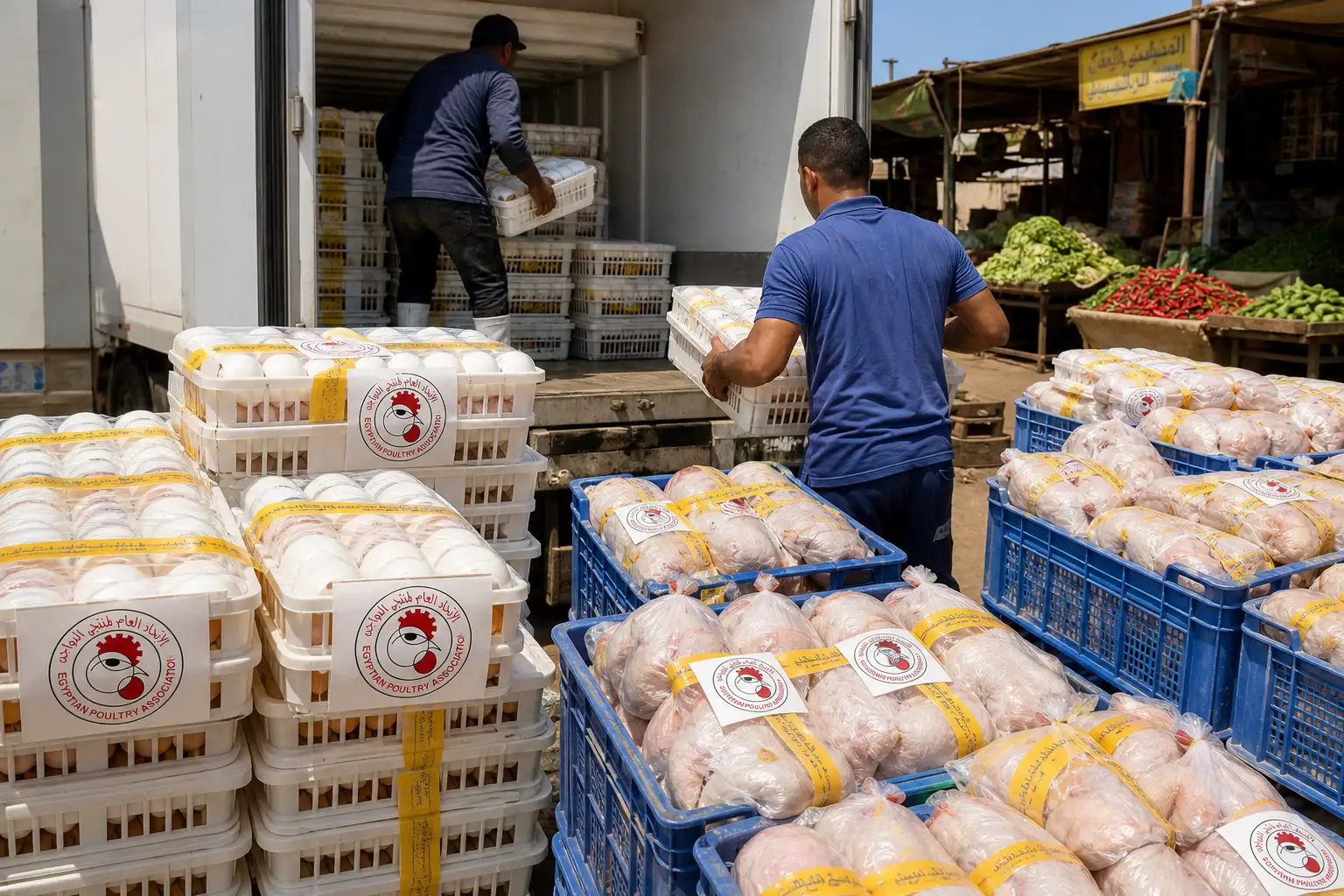
Producers already turn out 4.8 million chickens and 1.5 million trays of eggs every day. That volume has driven poultry meat and egg prices down more than 30 percent year on year, according to the General Union of Egyptian Poultry Producers, and left exporters hunting for buyers beyond the Arab world.
A Surplus That Finally Needs Outlets
The General Union of Egyptian Poultry Producers confirmed full self-sufficiency in chicken meat and table eggs in January 2026. Surplus output tops 20 percent of total production. Daily figures of 4.8 million chickens and 1.5 million egg trays give the industry clear headroom for foreign sales once domestic shelves are covered.
Minister Farouk had already listed poultry and table eggs among five commodity groups where Egypt reached complete self-sufficiency by April 2026. The Union works with the ministry to open Arab and African channels, stressing that Egyptian product meets international standards and carries continuous veterinary supervision from farm to slaughter.
- Full self-sufficiency declared January 2026 with surplus above 20 percent
- Daily slaughter-ready birds: 4.8 million
- Daily egg trays: 1.5 million
- Price drop exceeding 30 percent versus prior year levels
Price pressure is the immediate spur. Oversupply has cooled the market at home. Export sales would absorb the extra birds and eggs without forcing further cuts that hurt smaller farms.
Why the Timing Favors an African Push
Egypt already ranks as Africa’s largest chicken-meat producer. FAO production estimates for chicken meat put 2024 output near 2.59 million tonnes. That scale once served only domestic tables. Now it exceeds them.
Sub-Saharan demand for animal protein keeps rising while many countries still import the bulk of what they eat. Uganda brought in nearly US$13 million of poultry meat and live poultry in 2025. Ghana’s bill reached about US$515 million the same year, one of West Africa’s biggest import markets. Both figures come from Trade Map data cited across industry reports.
Egypt’s own poultry-meat export base remains tiny. In 2024 the country shipped just $7.62 million in poultry meat exports, mostly to Palestine, the United Arab Emirates and Kuwait. The SSA talks mark a deliberate turn toward larger, faster-growing destinations.
Brazil Still Owns the Shelf Space
Any Egyptian shipment will land in a market long dominated by Brazil, the United States and the European Union. Brazilian chicken alone reached 965,699 tonnes across Africa in 2024, up 18 percent from the year before and 74 percent since 2020, according to the Brazilian Association of Animal Protein.
Ghana alone took 94,130 tonnes of Brazilian chicken that year, six times its 2020 volume. South Africa, Libya, Angola and the Republic of the Congo round out the top buyers. Egypt starts from almost zero share.
| Player / Market | Key 2024-25 Figure | Notes |
|---|---|---|
| Egypt chicken meat output | ≈2.59 million tonnes (2024) | Africa’s largest producer |
| Egypt poultry meat exports | $7.62 million (2024) | Mainly Palestine, UAE, Kuwait |
| Brazil chicken to Africa | 965,699 tonnes (2024) | +74% since 2020 |
| Brazil to Ghana | 94,130 tonnes (2024) | Sixfold rise from 2020 |
| Ghana total poultry imports | ≈$515 million (2025) | Major West African market |
| Uganda poultry imports | ≈$13 million (2025) | Smaller but open target |
Proximity gives Egypt a logistics edge on East African routes. Political ties and existing agricultural projects add another layer. Whether those advantages offset Brazil’s scale, established cold-chain networks and price competitiveness remains the open test.
Disease-Free Status Becomes the Sales Tool
Egyptian officials repeatedly underline that production facilities are recognised as free from high-pathogenicity avian influenza under World Organisation for Animal Health rules. A recent self-declaration covers 52 compartments free from HPAI plus five slaughterhouses and two hatcheries across 21 companies.
That status lets Egypt argue it can meet the biosecurity demands of importers who have watched Brazilian and other suppliers face temporary bans after isolated cases. Egyptian labs and research centres have also offered technical support and veterinary inspection services to Ugandan counterparts.
The same meeting reviewed the existing veterinary-serum agreement under which Egypt already supplies roughly 10 million doses of foot-and-mouth disease vaccine to Uganda each year. Expanding that pipeline into poultry diagnostics and vaccines is an obvious next step.
Winners, Losers and the Feed Bottleneck
Egyptian integrated producers and exporters gain the most immediate outlet for surplus birds and eggs. Domestic price pressure eases if even a modest share of the 20 percent surplus finds foreign buyers. Consumers in Uganda and Ghana stand to see more supply options and potential downward pressure on imported chicken prices.
Local poultry farmers in those markets face a tougher picture. Many African governments have long talked up domestic flock rebuilding to cut import bills. Cheaper or more reliable Egyptian product could slow that rebuild unless paired with feed or technology support. Brazil’s exporters lose nothing overnight, yet any sustained Egyptian foothold chips at their share in two growing markets.
- Egyptian producers: surplus absorption and price stability
- SSA urban consumers: wider choice and possible lower prices
- Local SSA poultry farmers: increased competition without matching feed cost relief
- Brazilian and EU exporters: gradual share erosion risk in targeted markets
Per-capita poultry consumption still sits far lower across much of East Africa than Egypt’s roughly 19 kg. Room for demand growth exists. The binding constraint many local operators cite is feed cost, not bird availability. Egypt’s parallel talks on animal-feed cooperation with Ghana therefore matter as much as the meat and egg shipments themselves.
The Partnerships Run Deeper Than Crates of Chicken
The Cairo meeting went well beyond market access. Ministers reviewed a joint 500-hectare model farm already operating in Uganda for plant and animal production. They agreed to expand strategic crops such as maize, soybeans, beans, wheat and sunflowers, and to introduce Egyptian livestock feeding, fattening and silage systems.
Private-sector joint ventures in agro-processing, livestock and modern irrigation received explicit encouragement. Fish-farm cooperation and training through Egyptian centres also featured. These strands turn a poultry sales pitch into a broader agricultural-influence package.
That pattern echoes other Egyptian efforts to lock in African markets, from Egypt’s hold as Africa’s top sugar producer through the next decade to the recent auto expansion and Africa export push. Poultry is the latest commodity where surplus capacity meets political openings.
Market Access Still Has to Clear the Paperwork
Talks do not equal trade. Egyptian exporters must still secure veterinary certificates, negotiate tariffs or preferential terms, and prove consistent cold-chain performance. Ghana’s interest sits partly in rebuilding its own poultry sector and cutting a large import bill; pure volume dumping may meet resistance. Uganda’s smaller market can absorb trial shipments faster but will not move the Egyptian surplus needle alone.
If the first consignments clear smoothly and prices stay competitive, more SSA destinations will follow. If logistics snags or local producer pushback appear, the surplus will keep weighing on Egyptian wholesale markets. Either outcome will show whether disease-free compartments and existing vaccine ties can convert political goodwill into durable trade lanes.
For now the crates are ready, the surplus is real, and the ministers have opened the door. The next twelve months will measure how far Egyptian chicken and eggs actually travel through it.
