
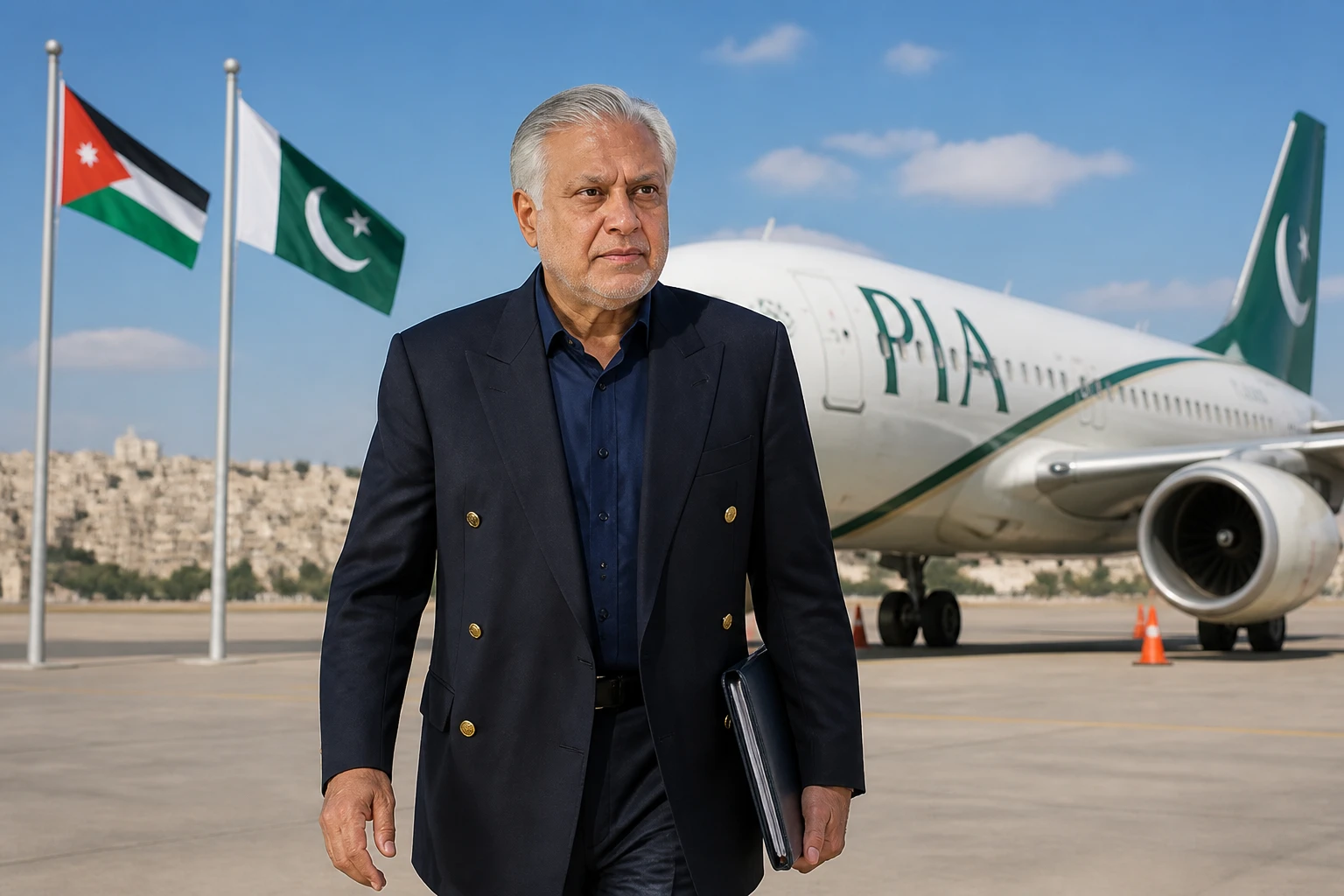
Deputy Prime Minister and Foreign Minister Senator Ishaq Dar departed Islamabad on Tuesday for a one-day trip to Amman, where he will join the Ministerial Meeting on Jerusalem on August 5. The session gathers Arab League and Islamic foreign ministers to craft a unified position on the deteriorating situation in occupied Jerusalem and its holy sites.
He travels at the invitation of Jordanian Deputy Prime Minister and Foreign Minister Ayman Al Safadi. Participating ministers will also call on King Abdullah II.
Who Sits at the Amman Table
Jordan chairs the Arab Ministerial Committee charged with coordinating international efforts against illegal Israeli policies and measures in occupied Jerusalem. The core membership already runs wide.
| Participant | Role or Country |
|---|---|
| Ayman Al Safadi | Jordan (host and chair) |
| League of Arab States Secretary-General | Institutional |
| Foreign ministers | Tunisia, Algeria, Saudi Arabia, Somalia, Iraq, Palestine, Qatar, Egypt, Morocco |
| Invited Islamic partners | Pakistan, Indonesia, Turkey, Malaysia |
According to the Jordan is hosting the foreign ministers of those states plus the non-Arab guests, the goal is a single stance on developments that target the city’s identity and its Islamic and Christian holy sites. Egypt’s Badr Abdelatty and Turkey’s Hakan Fidan are confirmed attendees. The expanded guest list turns a long-standing Arab committee into a broader Muslim diplomatic platform for one day.
The Pressure on Holy Sites That Triggered the Call
Israeli authorities have layered restrictions on Jerusalem’s sacred places through 2026. Closures and limits hit both Muslim and Christian worship under successive security and emergency decrees.
- Al-Aqsa Mosque compound faced extended full or near-full closure periods beginning in late February, cutting off Ramadan access for large numbers of worshippers.
- Age and permit restrictions repeatedly blocked West Bank Palestinians from Friday prayers.
- Church of the Holy Sepulchre saw police barriers, harassment of worshippers, and denial of entry even to senior clergy during Holy Fire and Palm Sunday observances.
- Settler activity and home demolitions continued to alter the demographic balance in East Jerusalem neighborhoods.
These steps, often justified by wider regional military tensions including earlier Iranian strikes into Jordan, prompted the emergency coordination. Participants will treat the pattern as a direct challenge to the long-standing status quo that keeps the sites under recognized custodianship arrangements.
Jordan’s Custodianship Carries Real Weight
The Hashemite Kingdom holds a formal special role over Muslim holy shrines in Jerusalem, a position reaffirmed in the 1994 peace treaty with Israel and practiced for a century through maintenance, administration and political protection. King Abdullah II is routinely described as custodian of both Islamic and Christian holy sites.
- Hashemite custodianship: the Jordanian royal family’s recognized responsibility for protecting and administering Al-Aqsa and related shrines, plus support for Christian sites such as the Holy Sepulchre.
Hosting the meeting in Amman therefore places the discussion inside the country whose sovereign stake is most immediate. Any unified communiqué gains force from that institutional anchor. The same geography has absorbed other security shocks this year, including earlier Iranian strikes into Jordan that underscored how quickly regional fire can reach the kingdom’s borders.
Pakistan’s Line Arrives Intact
Dar’s brief is straightforward. The Foreign Office departure statement said he will reaffirm Pakistan’s unwavering support for the Palestinian people and their just cause. He is also scheduled for bilateral meetings with fellow ministers on regional developments and mutual interests.
Pakistan’s standing position remains an independent, sovereign and contiguous State of Palestine based on the pre-1967 borders with Al-Quds Al-Sharif as its capital. The one-day visit at Safadi invitation is framed as a practical expression of that policy rather than a new departure. Side conversations will likely cover Gaza tracks and the wider Middle East file that has already seen intense Egyptian shuttle work.
During the visit, the DPM/FM will reaffirm Pakistan’s unwavering support for the Palestinian people and their just cause. He is also scheduled to hold bilateral meetings with participating Foreign Ministers and exchange views on regional and international developments.
That language comes directly from the official Pakistani release. On X, some observers noted the geographic distance between Amman conference rooms and the Old City checkpoints, a reminder that statements still face the test of facts on the ground.
Turkey and Egypt Add Their Own Priorities
Turkish Foreign Minister Hakan Fidan arrives ready to stress Jerusalem’s religious, historical and cultural significance for Muslims and the shared international duty to preserve its legal status. Ankara sources said he will highlight actions altering Al-Aqsa’s character, settler violence, provocations, and violations against Christian institutions. He is also expected to link the discussion to Gaza ceasefire implementation and to criticize embassy moves to Jerusalem as contrary to UN resolutions.
Egypt’s Badr Abdelatty traveled the day before. Cairo’s readout centers on supporting Palestinian rights and preserving the historical and legal status quo of Jerusalem. Bilateral meetings will aim at deeper Arab coordination for regional stability. That approach sits comfortably beside earlier Egyptian diplomacy on Middle East paths that rejected purely military exits.
The presence of Indonesia and Malaysia further widens the map. What began as an Arab committee now carries voices from South and Southeast Asia, giving any joint text a larger constituency inside the Organisation of Islamic Cooperation.
What the Session Can Still Deliver
No final communiqué has been issued as the ministers convene. The stated aim remains a unified position that can be carried into international forums and bilateral channels with outside powers.
What we know
- Attendance includes the full Arab committee plus Pakistan, Turkey, Indonesia and Malaysia.
- Agenda covers holy-site measures, identity of the city, and Palestinian rights.
- Ministers will meet King Abdullah II.
- Pakistan, Egypt and Turkey have each restated core positions before wheels-up.
What’s unconfirmed
- Exact wording of any joint statement or concrete follow-up mechanisms.
- Whether new sanctions language, legal referrals or monitoring bodies will be proposed.
- How the text will treat ongoing Gaza operations relative to Jerusalem.
Archaeology and land disputes keep the city’s contested character in public view. Recent reports on disputed digs under Jerusalem’s Old City show how every layer of soil becomes political. The Amman gathering will not resolve those fights, yet it places a broader set of capitals on record at a moment when restrictions on worship have become routine rather than exceptional.
Dar returns after the single day of talks. The test of the meeting will be whether the wider coalition produces more than another statement, and whether the status quo language travels beyond the conference hall into enforceable international pressure.
