
Thousands of mourners in Gaza City buried the remains of 112 members of the Abu Sharia and al-Hasayna families on Tuesday, nearly three years after an Israeli strike flattened their residential block in the Sabra neighbourhood. The bodies, mostly skeletal, had lain under crushed concrete until a two-week recovery operation finally brought them out.
Civil Defence teams and relatives carried flag-draped bags through the streets in one of the largest funerals of the war. The scene closed one chapter for these families while leaving thousands of others still waiting for the same chance.
Rows of Flags and Petals Through the Streets
Mourners stood shoulder to shoulder as the remains moved toward burial. Each bag bore a Palestinian flag, a sprinkling of bright pink bougainvillea petals, and a photograph of the person inside. Large banners showing the faces of the dead lined the route.
- 112 sets of remains recovered after roughly 17 days of digging through layers of concrete.
- Mostly skeletal remains rather than intact bodies after nearly three years underground.
- Roughly 40 to 44 children, around 30 to 38 women, and seven people with disabilities among the dead from the two extended families.
- Palestinian Civil Defence spokesman Mahmoud Basal called it an “exceptional and painful scene” and said it was the first time 112 martyrs were buried in a single funeral.
Mustafa Barghouti, secretary-general of the Palestinian National Initiative, said it could be “the largest funeral in Palestinian history.” Activist Ali Abo Rezeq noted that some families had earlier searched the rubble with bare hands because heavy equipment was scarce.
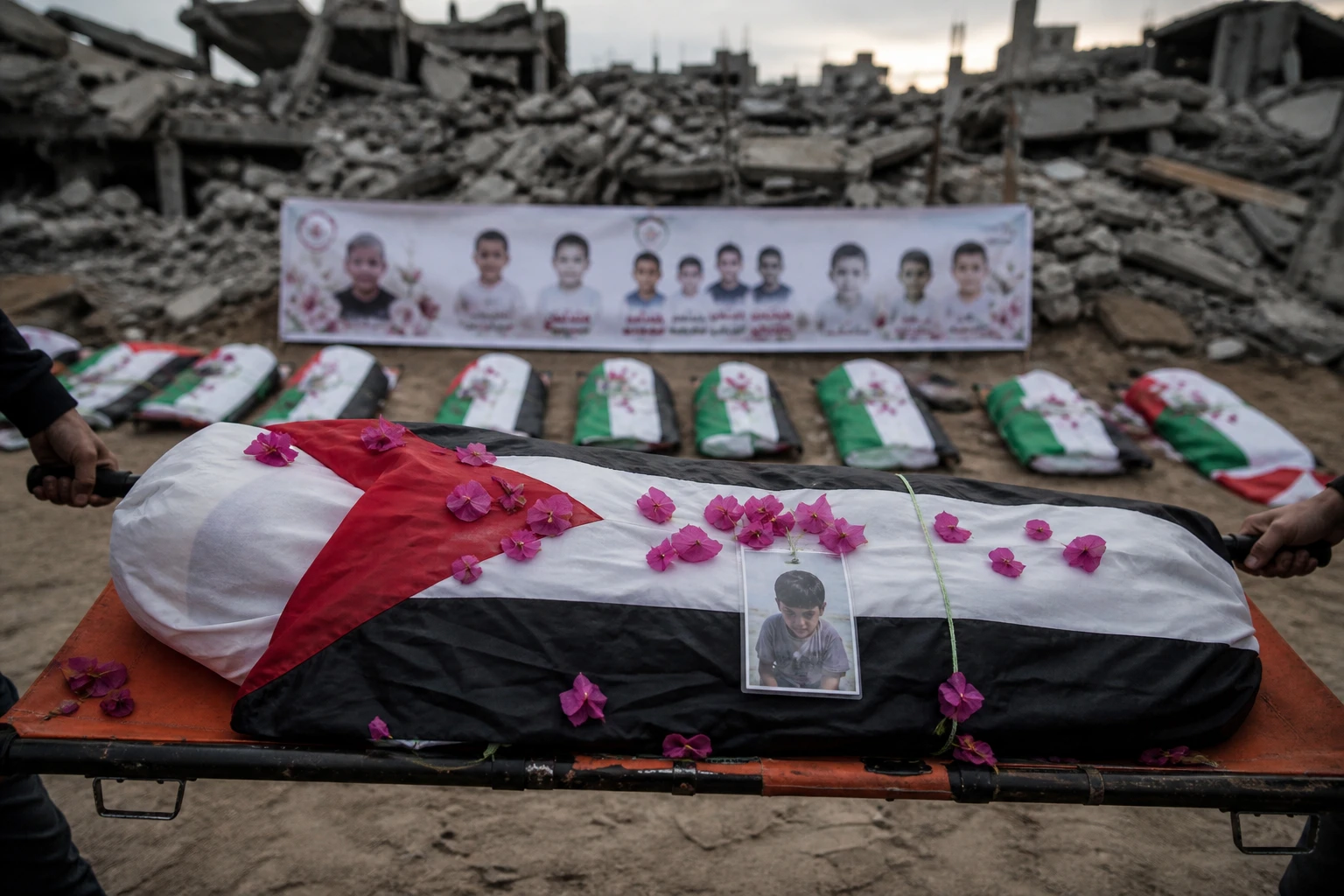
The November Strike That Buried a Clan
On 22 November 2023, an Israeli airstrike hit a multi-storey residential block in Sabra, Gaza City. Palestinian officials say the attack killed 308 members of the Abu Sharia and al-Hasayna families, who form one extended clan. Civil Defence spokesman Mahmoud Basal said at the time that around 180 civilians were inside and that roughly 90 percent were killed.
The building was completely levelled. Intense fighting and a severe shortage of machinery prevented immediate full recovery. Bodies stayed trapped while the war continued. Only after a fragile ceasefire period could teams return for a sustained dig that lasted more than two weeks.
Of the original toll, 112 remains have now been identified and buried. Authorities say about 157 people from the site remain missing, either still under the rubble or otherwise unaccounted for. Ramy Abdu, chairman of the Euro-Med Human Rights Monitor, said around 200 members of the Abu Sharia family alone are still believed to be beneath the debris, their remains possibly decomposed beyond easy identification.
Digging Through Years of Concrete
What lay on the stretchers were not fresh bodies. Decomposition and crushing left mostly bones. Identification relied on surviving family knowledge, photos, and whatever forensic capacity remains in Gaza. The recovery itself reopened wounds for relatives who had waited since late 2023.
UN reporting from July 2026 describes the wider pattern. Local teams and Civil Defence continue combing destroyed neighbourhoods with limited tools. One resident, Ramez Nabhan, waited while crews searched a building that once held his wife, children and relatives. Some bodies came out early; others took years. “We face a new ordeal: recovering the remains and then burying them,” he said.
Time makes everything harder. Natural decomposition, unexploded ordnance mixed into the debris, and the simple volume of rubble slow every shift.
The Numbers That Stretch Far Beyond One Funeral
The 112 burials form only a fraction of the unfinished work. Estimates of people still under rubble range from several thousand to more than 10,000.
| Measure | Figure | Source note |
|---|---|---|
| Bodies recovered and buried this funeral | 112 | Civil Defence / family counts, Aug 2026 |
| Killed in the Nov 22 2023 Sabra strike (official claim) | 308 | Palestinian officials, two families |
| Still missing from this site | ~157 | Palestinian authorities |
| Palestinians estimated still under rubble overall | 7,000-10,000+ | Civil Defence, National Committee for Missing Persons, UN |
| Total Palestinian deaths reported | at least 73,375 | Gaza health figures cited Aug 2026 |
| Rubble volume estimates | 50-68 million tonnes | UN, UNDP, media reporting 2025-2026 |
The National Committee for Missing Persons has described Gaza as “the world’s largest graveyard,” with more than 10,000 Palestinians remain entombed under destroyed homes. UN accounts confirm thousands remain missing under rubble amid destroyed infrastructure. Earlier reporting put debris at roughly 20 times the combined mass of all debris from prior Gaza conflicts since 2008.
Post-ceasefire Israeli strikes have killed at least another 1,250 Palestinians and injured 4,110 as of early August, according to the same tallies. About 90 percent of Gaza’s infrastructure is damaged or destroyed. That scale of wreckage is what turns a single strike into years of delayed funerals.
What Families and Monitors Keep Saying
To the world: Why are these children being killed in Gaza? Answer us, O free people of the world!
Mahmoud Basal of Gaza Civil Defence spoke those words at the funeral. Palestinian researcher Mahmoud Hamed al-Aila wrote that Gaza was “extracting the bodies of its children from under the rubble after years of genocide” and asked what heart could bear the pain. Activist Mohammed Haniyah noted that dozens more bodies have already decomposed or remain missing.
On X, poet and writer Mosab Abu Toha described the procession as the largest single-event funeral in Palestinian history and asked why major international outlets would not give it the sustained live coverage a similar event elsewhere would receive. The post, amplified by others, drew tens of thousands of views. Ramy Abdu framed the day as Gaza mourning more than names: it was laying to rest people recovered after more than two and a half years so families could finally bury them.
The crowd intelligence on the platform repeatedly returned to the same practical point: without heavy excavators, families and crews dig by hand. The shortage is not abstract. It is the reason remains stay underground for years.
Why Recovery Stays So Slow
Civil Defence and local teams work with a handful of functioning machines. Israeli restrictions have limited the entry of new heavy equipment. Unexploded ordnance turns every rubble pile into a hazard. Fuel and spare parts remain scarce. Buildings that once stood seven or eight storeys high leave compacted layers that hand tools cannot move.
UN reporting notes that even if excavators arrived in volume tomorrow, officials have estimated many months would still be needed to reach the majority of remains. Earlier phases of the war saw key machinery destroyed in strikes, setting recovery back further. The same destruction that produced the bodies also destroyed the tools needed to retrieve them. Parallel reporting has documented the destruction of over 1,000 buildings in Gaza City in concentrated assaults, adding to the debris fields crews must now clear.
Identification grows harder with each month. DNA capacity is limited. Families rely on memory, clothing fragments, and location. Some remains will never be matched. The Assembly of Palestinian Clans and Families has called on the Western-backed Board of Peace to speed body recovery, debris clearance and reconstruction. Burial of these 112 ends the wait for some households. It does not end the search for the rest.
Political tracks continue in parallel. Debates over disarmament, withdrawal and future control of the territory sit alongside the physical labour of digging. Plans floated by some Israeli figures for new settlement activity, including Israeli ministers marching to resettle Gaza, add another layer of uncertainty for residents who still cannot bury their dead.
The 112 flag-draped bags moved through Gaza City on a Tuesday in August 2026. Under the same rubble fields, thousands of other families keep waiting for their own turn at a funeral that has already been delayed too long.
