
Jordanian Foreign Minister Ayman Safadi has warned that an Israeli takeover of Jerusalem’s Al-Aqsa Mosque compound is “imminent” and could spark a religious conflict across the Muslim world. He is hosting an emergency meeting of Arab League foreign ministers plus counterparts from Turkey, Indonesia, Malaysia and Pakistan on Wednesday to coordinate a response.
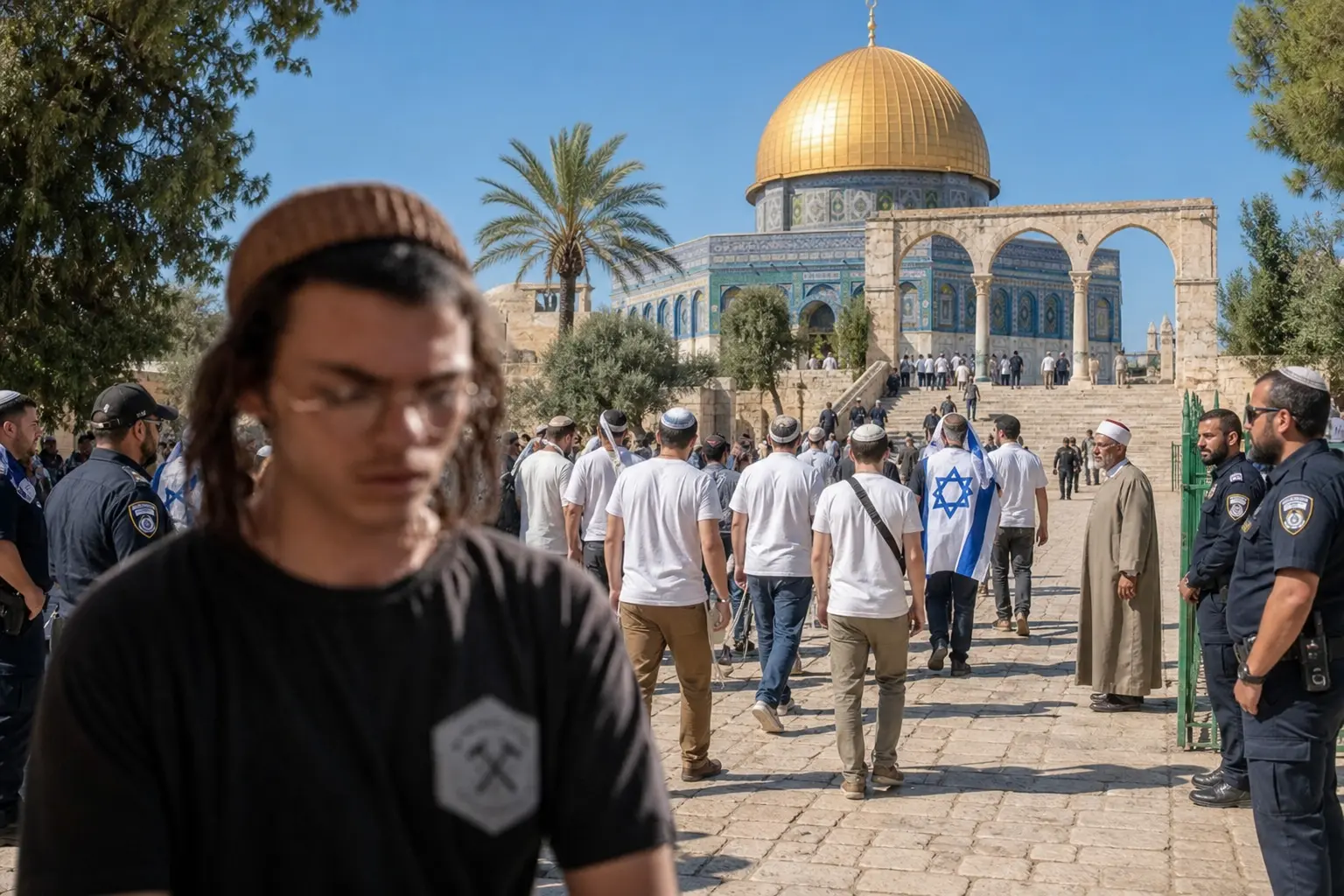
The alert follows the 23 July entry of more than 2,000 religious-right Israelis, led by National Security Minister Itamar Ben-Gvir, who prayed, waved flags and sang the national anthem on the site known to Jews as the Temple Mount. Yet Amman’s urgency tracks a deeper stake: protecting the Hashemite monarchy from the demographic, water and political shocks that a hard Israeli push in the West Bank before October elections could deliver.
Safadi’s Tinderbox Warning
Safadi told The Guardian the threat is constant and dangerous. “We warn that tampering with the status quo … could trigger a religious conflict that will reverberate beyond Palestine and Jordan into the whole Muslim world.”
Jerusalem is a tinderbox. We’re trying to explain the danger. We’re protesting legally. We are trying to create awareness of the imminent danger in the continuation of those Israeli measures.
He said that in the same interview. Amman also fears intensified Jewish prayer during the September Jewish holidays and a recruitment drive for a special Temple Mount police unit. Jordan has held custodianship for more than a century. Israel reaffirmed the arrangement in the 1994 peace treaty.
The warning frames the compound as a regional tripwire rather than a bilateral dispute. Safadi’s language ties any further erosion of the status quo to instability that would travel far past the Old City walls. Legal protest and awareness campaigns remain the tools he names, yet the urgency of an emergency ministerial gathering shows how little margin Amman believes is left.
September’s holidays compress the calendar. Larger coordinated visits in that window would test both the Waqf’s day-to-day control and the Israeli police posture that has already escorted mass entries. The special police unit under discussion would add another institutional layer on a site where security and civilian administration already sit in separate hands.
How the Status Quo Holds the Line
The arrangement traces to Defense Minister Moshe Dayan’s June 1967 meeting with Waqf leaders. Dayan’s three core principles from 1967 kept civilian management with the Muslim Waqf, security with Israeli forces, and prayer exclusive to Muslims while non-Muslims could visit.
| Principle | Who Controls | Practical Rule |
|---|---|---|
| Civilian administration | Jerusalem Islamic Waqf (Jordan) | Day-to-day running, access regulation |
| Security and order | Israeli police and forces | Public order, entry screening |
| Prayer rights | Muslims only | Jews and others visit, no prayer or rituals |
| Entry gates | Split | Non-Muslims via Maghrebi/Dung Gate; Muslims via others |
The compound covers a 144,000 square metre compound under Waqf administration and includes Al-Aqsa, the Dome of the Rock and associated structures. Quiet Jewish prayer in limited eastern areas began in 2018. Far-right groups have pressed for full prayer rights, synagogue construction and even a Third Temple. Traditional Jewish law largely forbids ascent out of purity concerns, but activist groups reject that view.
The split gate system and the prayer ban together form the practical fence that has kept larger confrontation at bay for decades. Once quiet prayer took hold in 2018, the baseline shifted. Each subsequent ministerial visit and open ritual narrows the gap between the original Dayan rules and the demands now voiced for a synagogue and full Israeli administrative control.
Custodianship gives Jordan formal standing without ground forces of its own on the plaza. That gap between legal title and physical enforcement is precisely what makes every police escort decision and every revoked staff permit carry weight in Amman.
July’s Mass Entry and the Escalation Pattern
On Tisha B’Av, Ben-Gvir joined the large group under heavy police escort. Jordan called it a desecration, escalation and barbaric provocation. Palestinian officials put the number higher than 2,000 in some tallies. Visitors performed rituals across the compound.
Recent months have brought further pressure:
- Dozens of Muslim mosque staff had entry permits revoked.
- An imam was arrested by Israeli police during Friday prayer.
- Jewish groups have increased coordinated visits and openly prayed.
- Ministers including Ben-Gvir and Finance Minister Bezalel Smotrich have repeatedly called for Israeli state takeover and a synagogue on the grounds.
These steps sit alongside disputed City of David digs nearby that already inflame land and heritage fights in Silwan. Sharon’s 2000 visit helped ignite the second intifada. Earlier Mandate-era clashes over the Western Wall also turned deadly. The pattern is known.
The July numbers matter less as a single spike than as proof that coordinated entry under ministerial leadership has become routine enough to draw heavy escort rather than prevention. Revoking staff permits and arresting an imam during prayer chip at the Waqf’s ability to manage the site on its own terms. Each move leaves the next one easier to justify as continuity rather than rupture.
Jordan’s Exposed Flanks Beyond the Mosque
Safadi’s sharper red line is displacement. “Our position that this is a red line that we will not allow to be crossed. We have made that known to everybody that we will do whatever it takes to prevent any attempt at Israeli displacement of Palestinians into Jordan.” A mass inflow would hit the economy, politics and the delicate balance between East Bankers and the majority of Palestinian origin.
Key pressures on Amman:
- Demographics: Jordanians of Palestinian refugee descent already exceed half of the 11.5 million population. East Bankers fear further dilution of national identity.
- Water: Israel refused to renew a 2021 deal supplying 100 million cubic metres a year and reverted to the 1994 treaty’s 50 million cubic metres, far short of needs. Officials linked the cut to Jordanian criticism of Gaza operations.
- Politics: The Islamist-rooted Umma party (formerly Islamic Action Front) won more than 22 percent of seats after the Gaza war. The Muslim Brotherhood was outlawed last year; the monarchy slowed political reforms.
Anti-normalisation feeling has grown over annexation talk, water denial and daily Al-Aqsa challenges. An open letter last month from hundreds of prominent Jordanians demanded withdrawal of U.S. forces after Iranian strikes killed three Americans at a Jordanian base. The U.S. presence is a security guarantee and a political liability at once.
The three pressures reinforce one another. Water scarcity sharpens public anger; that anger feeds the Islamist vote share already above 22 percent; a larger Palestinian inflow would further unsettle the East Banker identity concerns that the monarchy must manage. Jerusalem policy therefore cannot be separated from the domestic ledger Amman balances every week.
Election Calendar Raises the Stakes
Israel faces an intense campaign ahead of October elections. Netanyahu’s far-right coalition is fighting for survival. Radical elements may seek irreversible changes in the three months before the vote. September’s Jewish holidays offer a natural window for larger visits and further prayer assertions.
Ben-Gvir has framed the July visit in ownership terms, saying Jews were praying as legitimate proprietors and that Israel is the sovereign authority. Smotrich and allies push settlement expansion and administrative changes in the West Bank. Religious Israeli voters and far-right weight give these ministers outsized coalition leverage even when broader polls lag. For Amman the fear is a sudden geography shift that becomes permanent after the ballots.
Campaign logic favors visible action on the compound and in the West Bank. Ministers who draw strength from religious and far-right voters have incentive to lock in facts on the ground while coalition arithmetic still protects them. Once ballots are cast, reversing an entrenched prayer practice or a new administrative line becomes far harder. That is the irreversibility Amman reads into the next three months.
How Earlier Sparks Climbed the Same Ladder
The record already on the table shows how quickly the site moves from visit to wider violence. The steps are familiar and short.
- Mandate era: Clashes over the Western Wall turned deadly and set an early template for religious contest at the holy places.
- June 1967: Dayan’s meeting with Waqf leaders froze civilian control, security and prayer rights into the three principles still cited today.
- 2000: Sharon’s visit helped ignite the second intifada, proving that a single high-profile entry can outrun political containment.
- 2018: Quiet Jewish prayer began in limited eastern areas, shifting the practical baseline without a formal rewrite of the rules.
- 23 July and after: Mass entry under Ben-Gvir, flag-waving, anthem singing and open calls for takeover and a synagogue.
Each episode tightened the link between symbolism on the plaza and street-level reaction beyond it. Amman’s present warning draws directly on that ladder. The difference now is the combination of ministerial leadership, election timing and parallel pressure on water and West Bank displacement. The pattern does not require new ingredients to become dangerous; it requires only that the existing ones keep stacking.
Who Answers the Call and What They Can Deliver
Wednesday’s meeting gathers Arab League ministers with Turkey, Indonesia, Malaysia and Pakistan. A late-July joint statement by foreign ministers of Indonesia, Egypt, Jordan, Pakistan, Qatar, Saudi Arabia, Turkey and the UAE already condemned the mass settler incursions, flag-raising, tents erected by police and access restrictions. They reaffirmed the entire 144-dunam area as exclusively Muslim worship space under the Jordanian-affiliated Waqf and rejected any sovereignty claim by Israel over occupied East Jerusalem’s holy sites.
They called on Israel to lift Old City restrictions and on the international community to force a halt. Jordan’s tools remain legal protest, awareness campaigns and diplomatic coordination. The Hashemite custodianship inherited across generations still carries formal recognition in the 1994 treaty and successive international statements. Practical enforcement, however, rests on Israeli security decisions on the ground.
The late-July statement supplies the common language the Wednesday meeting can build on. Reaffirming Waqf administration and rejecting Israeli sovereignty claims keeps the legal frame intact even when police escorts and ritual practice on the ground have already moved. What the gathering can deliver is a higher political cost for the next incremental step, not a substitute for the security decisions Israel still controls at the gates.
Water Volumes and the Diplomatic Squeeze
The water file turns a resource shortfall into a direct lever on Amman’s room for maneuver. The numbers already public make the squeeze plain.
| Arrangement | Annual Volume | Status |
|---|---|---|
| 2021 deal | 100 million cubic metres | Not renewed |
| 1994 treaty baseline | 50 million cubic metres | Now in force |
Halving the supply lands on a country already managing demographic strain and a stronger Islamist bloc in parliament. Officials tied the refusal to renew to Jordanian criticism of Gaza operations, linking foreign-policy speech to domestic resource pain. That linkage raises the price of every public protest Amman issues on Al-Aqsa or displacement.
When water, parliamentary arithmetic and the compound crisis run together, the monarchy’s external dependence and internal legitimacy pull in opposite directions. The U.S. security relationship remains essential; the open letter demanding troop withdrawal shows how quickly that same relationship becomes a domestic liability. Wednesday’s diplomacy must therefore operate inside constraints that the water meters and the voter rolls both enforce.
Limits of Leverage in a Crowded Map
Amman depends on the United States for economic and security support and hosts a growing U.S. military footprint without formal American bases. That dependence constrains how far it can escalate. At the same time, water shortages and Islamist parliamentary strength raise the domestic cost of appearing weak on Jerusalem or the West Bank.
Israeli governments of left and right long enforced the prayer ban to avoid wider clash. The 2018 quiet-prayer opening and subsequent ministerial visits have already moved the baseline. Far-right voices now treat further change as both religious right and national equality claim. Jordan treats any partition or synagogue as a direct assault on the status quo that underpins regional calm and its own internal equilibrium.
Safadi’s meeting will test whether collective Arab and Islamic diplomacy can raise the political price of further erosion. The numbers on the compound, the water meters and the voter rolls in both countries will decide how much room remains before the next spark.
