
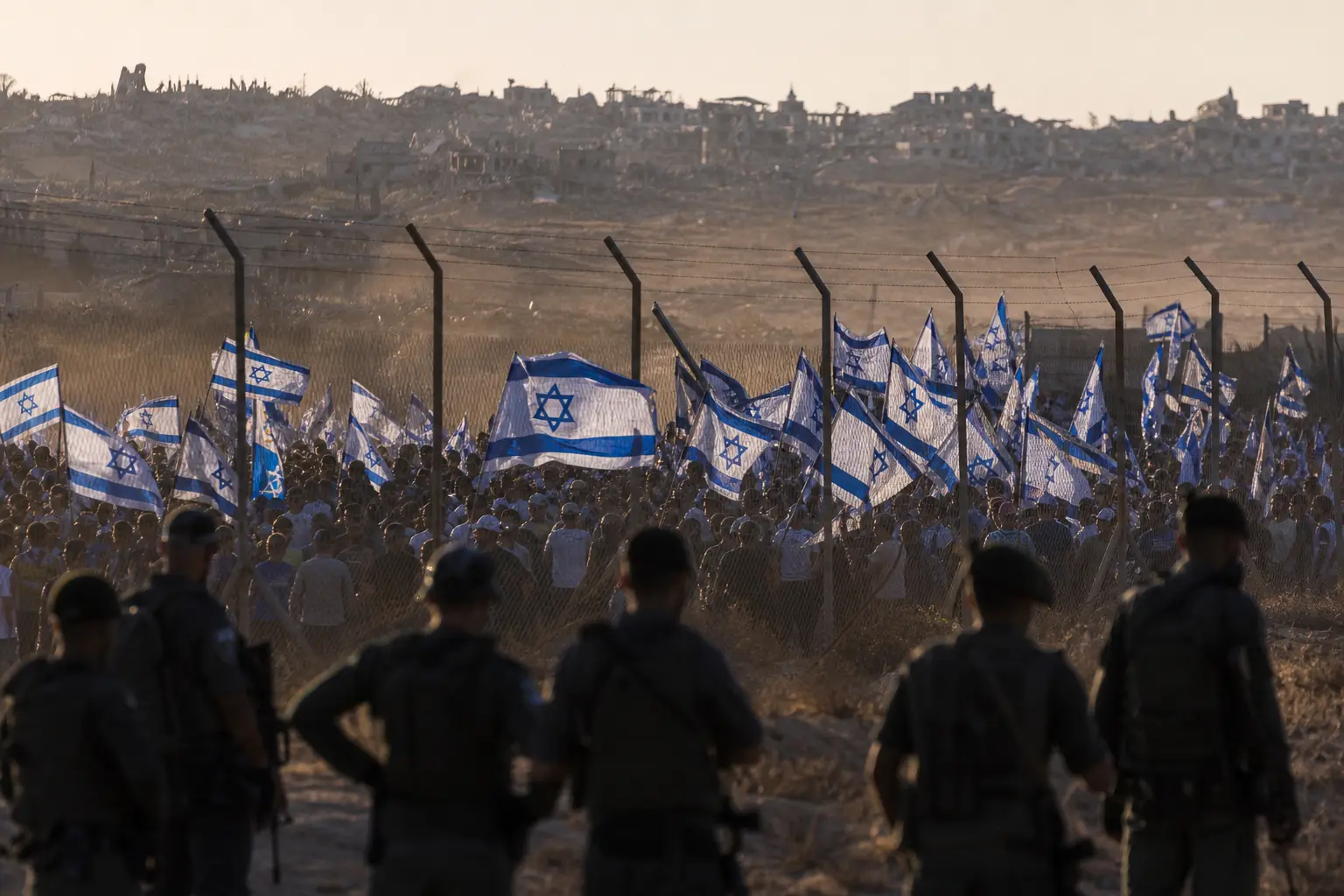
Twenty eight Israeli cabinet ministers and lawmakers walked with a crowd of settlers to the Gaza border fence on Sunday, demanding Israel rebuild three Jewish settlements it evacuated in 2005. Soldiers had sealed the route as a closed military zone. Marchers pushed through anyway, and no one was arrested.
The rally drew the loudest official backing yet for resettling Gaza, organized by the settler movement Nachala under the banner “Returning home after 21 years.” It is also the latest run of a specific, decades old method, the Nahal outpost, that has already produced dozens of towns across the West Bank. Israel’s own defense minister has already put his name on a plan to try the same method here.
Ministers Join This Time
Organizers gathered the crowd near Zikim Beach after the military barred a march closer to the border, then walked them to a hilltop overlooking the ruins of Elei Sinai, once a Jewish settlement in northern Gaza. Nachala called the event the “March of Thousands” and said more than 10,000 people came. Israeli media put the number at a few hundred.
Twenty eight ministers and Knesset members joined anyway, organizers said, including National Security Minister Itamar Ben-Gvir and Finance Minister Bezalel Smotrich, who also oversees settlement affairs. Prime Minister Benjamin Netanyahu’s Likud party was listed as a sponsor, even though Netanyahu has repeatedly said Gaza will not be resettled. Some marchers slipped past checkpoints through nearby hillsides to reach the fence.
Ben-Gvir posted video of himself among the marchers captioned “Gaza is ours.” He went further from the podium. “If they had said three years ago that we would control 70% of the territory of the Gaza Strip, no one would have believed it,” he said. “I say from here: There will be Jewish settlement in all of Gaza. Encourage voluntary immigration, send those who need it to their countries. And we return home.”
One participant, Daniel Sellem, said the march was meant to force the government’s hand. “We are walking today to tell the government of Israel and show all the world that this land belongs to us and that Gaza really belongs to us and that we want to go back there,” he said. “We lived there before they got us out in 2005.”
The Nahal Outpost Is Built to Become a Town
A Nahal outpost blends military service with farming or religious study under the IDF’s Nahal Brigade. It is designed, from the first day it goes up, to become something else.
“The military is only the first phase, which aims to prepare it for future settlement,” said Dror Etkes, founder of Kerem Navot, a watchdog group that tracks Israeli land takeovers in the West Bank. Nahal posts were first used in border regions in the 1950s, including around Gaza, Etkes said. From 1967 the same model moved into the West Bank, starting in the Jordan Valley before spreading. “All together, dozens of Israeli settlements in the West Bank were established in this way,” he said.
The pipeline generally runs in three stages.
- Stage one: IDF soldiers establish a Nahal outpost, combining a military presence with farming or study.
- Stage two: A civilian anchor community moves in, often with state funding attached.
- Stage three: The site is retroactively recognized and converted into a full civilian settlement.
The scale of that machinery is no longer disputed even by its critics. A joint report by Peace Now and Kerem Navot found that 102 settlements were created by legalizing outposts between 2023 and 2025 alone. A separate CNN analysis, drawing on the same two groups’ data, found outposts ballooned nearly 50 percent since the war began.
Katz Already Walked This Plan Back Once
Defense Minister Israel Katz first floated the idea in December 2025, telling an event at the West Bank settlement of Beit El that Israel would establish “Nahal nuclei” where evacuated Gaza communities once stood. American officials pushed back hard. “The more Israel provokes, the less the Arab countries want to work with them,” one White House official said at the time, adding that Washington remained committed to President Trump’s 20-point peace plan. Katz’s office retracted the comments within hours, insisting no civilian settlements were planned and that his remarks were strictly about security.
He did not retract them this time. Touring northern Gaza last week, Katz repeated his intention to build three Nahal outposts and said Israel would not pull back from its “Yellow Line” even if Hamas disarms. Asked how the destruction around him made him feel, he said, “I feel good. Thank God. This is all the result of a deliberate policy aimed at removing threats.” Our earlier coverage of Katz’s outpost plan traced how closely it mirrors the sites Israel tore down in 2005.
Smotrich says his own plan is already drafted. “We are ready to establish three communities in northern Gaza immediately, as soon as the prime minister gives the green light,” he said in June. At Sunday’s march, he cast the effort as unfinished business.
We erased the disgrace of the expulsion in northern Samaria, and with God’s help, we will do the same here in the Gaza Strip as well, with determination and perseverance.
Smotrich made the remark, according to Haaretz, referring to a separate set of West Bank communities evacuated in the same 2005 plan that emptied Gaza.
From a Passover Tent to a March of Thousands
Nachala’s founder, Daniella Weiss, has run this exact playbook before. In 1975, activists from the Gush Emunim movement held a Passover seder at a West Bank site that later became the settlement of Kedumim, where Weiss served as mayor for more than a decade. Kedumim now has close to 5,000 residents.
Nachala has repeated the tactic on Gaza’s edge, and the crowds have grown with each attempt.
| Date | Event | Reported Turnout | Government Involvement |
|---|---|---|---|
| April 2025 | Passover tent encampment near Kibbutz Sa’ad | About 30 families; 800 signed up for future settlements | None named |
| December 2025 | Activists cross the fence, plant a flag | Dozens | Katz vows Nahal outposts, then retracts |
| February 2026 | Tree planting march near ruins of Nisanit | 1,500 | Not specified |
| July 19, 2026 | “March of Thousands” to Zikim Beach and Elei Sinai | 10,000+ claimed; “a few hundred” per Israeli media | 28 ministers and lawmakers |
The broader West Bank numbers show the same trend line. A Haaretz report published this month found outposts now controlling nearly a fifth of the West Bank, funded and later legalized by the state.
Why Is October’s Election Shaping the Timing?
Israelis vote on October 27, and ministers pushing Gaza settlements are betting the issue plays well with a rightward shifting electorate. Former Israeli diplomat Alon Liel told Al Jazeera that Katz and other ministers talk openly about Gaza settlements because they expect it to boost their standing at the polls.
The politics are not built on thin ground. A similar mainstreaming process moved a once fringe religious campaign into a movement with real seats inside Israeli state power, and Sunday’s guest list of sitting ministers suggests Gaza resettlement is following the same route.
- 82 percent of Jewish Israelis supported expelling Palestinians from Gaza, according to a 2025 University of Pennsylvania poll.
- $400 million in new West Bank settlement funding was approved by Smotrich’s ministry last month and kept quiet over expected US objections.
- October 27 is the date Israelis next vote, the deadline both ministers are racing.
Washington Draws a Softer Line on the West Bank
The ceasefire’s “Yellow Line” was meant to cap Israeli-held Gaza territory at 53 percent. Israeli forces now hold more than 60 percent, by the government’s own account; a deputy chief of staff put the figure at 65 percent during Katz’s tour, and Ben-Gvir told Sunday’s crowd it was already 70 percent.
The US-backed plan behind that line, endorsed by the UN Security Council, calls for a phased Israeli withdrawal and explicitly rules out new settlements. Washington has objected loudly when Gaza specifically was on the table, but has been far more permissive about the West Bank. When Smotrich advanced the E1 settlement corridor last year, a State Department spokesperson said only that “a stable West Bank keeps Israel secure,” a marked shift after the International Court of Justice ruled settlements illegal under international law the previous summer. Several countries, though not the US, have sanctioned Smotrich and Ben-Gvir over settlement activity and frozen their assets.
Gaza’s postwar future is also being negotiated on a separate, quieter track. Smotrich has said he is working with US officials on a Gaza real estate redevelopment plan that would sit uneasily beside any return of Jewish settlements to the same territory.
Two Million Palestinians Fill What Is Left
About two million Palestinians who survived the war are packed into the remaining share of Gaza’s territory, squeezed by the expanding Israeli held zone. Nine months into the ceasefire, Israeli strikes have killed at least 1,127 Palestinians despite the truce.
Palestinian lawyer and analyst Diana Buttu said the settlement push reflects years without consequence. “Because Israel has never been punished for its crimes, it’s only natural that a country that commits genocide and ethnic cleansing feels emboldened to steal more land,” she told Al Jazeera.
Issam Younis, director of the Al Mezan Center for Human Rights, a Palestinian rights group, said Katz’s comments matched what he had expected all along. “It was very clear from day one in the genocide that the main goal was to make life impossible in Gaza by destroying everything,” he said.
Israelis vote on October 27. Yechiel Greenblum, another marcher on Sunday, has already called the walk to the fence just the beginning.
