
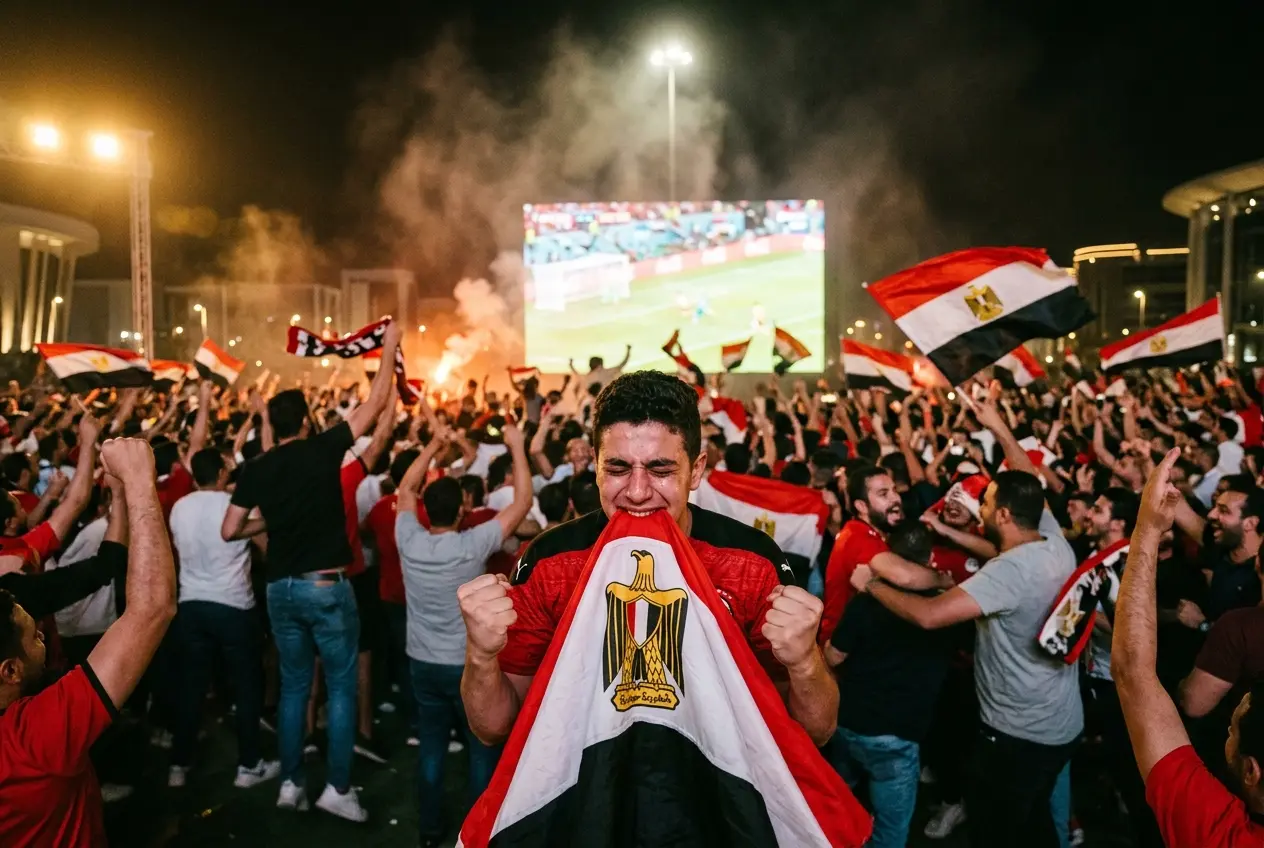
At a fan zone in Egypt’s New Administrative Capital east of Cairo on Friday night, the final whistle was almost drowned out by the roar of football fans who jumped from their seats, waved flags and embraced one another as their national team sealed a place in the World Cup round of 16. The match that triggered it ended 1-1 after extra time in Dallas, then went to penalties, and Egypt held its nerve to win 4-2 and reach the knockout stage for the first time in 92 years of World Cup football. President Abdel-Fattah al-Sisi called the players “the heroes of our national football team” and said they had “proven that faith in ability, competing with the true team spirit, and showing unwavering determination to win lead to great achievements,” in a statement released as the celebrations rolled past midnight.
Across the country the night turned into a national celebration. In cafes in Cairo and Giza and at outdoor viewing areas in other governorates, fans described the moment as historic. Ali Sayyid, a pharmaceutical company employee watching at a coffee shop in Giza, said the closing minutes and the shootout were tense, but “the tension quickly turned into relief and joy after Australia missed its first penalty.” The shorthand inside Egypt’s viewing halls was simple: this had never happened before.
It is a beautiful feeling, a joyful experience that has never happened before.
That was Mostafa Diab, an accountant at the New Administrative Capital fan zone, in remarks to Xinhua.
Inside the Shootout: How Egypt Beat Australia in Dallas
The round-of-32 tie was played on July 3 at Dallas Stadium, the AT&T Stadium in Arlington, Texas, and it was closer than the scoreline suggested. Emam Ashour put Egypt ahead in the 13th minute, heading home at the back post from a cross by Karim Hafez for his second goal of the tournament. Mohamed Hany then headed an in-swinging free kick into his own net to make it 1-1 in the second half, becoming, per France 24, the first player to score two own goals at a single World Cup. Australia’s 22-year-old goalkeeper Patrick Beach produced a fingertip save to deny Ramy Rabia what would have been an Egypt winner in stoppage time, sending the match to extra time.
The tie turned at 1-1. Australia’s coach Tony Popovic gambled at 119 minutes, hauling Beach off for the country’s longtime No. 1, Mathew Ryan, in case it went to penalties. The gamble didn’t pay. Souttar blazed Australia’s first kick over the bar. Salah chipped the next one down the middle as Ryan dived the wrong way, and Abdelmaguid buried Egypt’s fourth straight penalty to settle it. The full sequence:
- Souttar: missed, over the bar (Australia 0-1 Egypt)
- Egypt’s first taker: scored (1-1)
- Salah: scored, Panenka down the middle (2-1 Egypt)
- Australia’s second taker: scored (2-2)
- Egypt’s third taker: scored (3-2 Egypt)
- Herrington, 18-year-old Australia defender: hit the crossbar (3-2 Egypt)
- Abdelmaguid: scored the winning penalty (4-2 Egypt)
Three figures from the night, as kept by the tournament’s official records: Egypt 1-1 Australia (4-2 on penalties), Ashour 13′, Hany own-goal. Coach Hossam Hassan’s substitutions changed the course of the game, and Egypt’s record books moved with them. the round-of-32 match page at FIFA listing the 4-2 penalty score confirms the venue, the date and the result. The tactical detail behind the shootout, including Egypt’s use of a Real Madrid penalty clip to read Ryan’s lean, is laid out in the pre-shootout video session that exposed Mathew Ryan’s lean.
Salah’s Panenka, Decided on the Spot
Mohamed Salah walked to the spot with the tie level at 2-2 in the sequence and the Dallas crowd already groaning after Souttar’s miss. The 34-year-old had told his teammates in the dressing room, “I told the boys before the game that this is the biggest stage you can play on. Enjoy it and don’t let the pressure get to you,” per France 24, but on the pitch he had been a peripheral figure, hit a hamstring strain and gone the full 120 minutes. He stepped up to Egypt’s third penalty and floated it straight down the middle as Ryan guessed the wrong way.
Salah broke down in tears at full time. He had lost four previous major-tournament shootouts with Egypt, and the captaincy carried the weight of every one of them. Two minutes of the chip are remembered as a single, unhurried decision made on the spot.
If somebody was going to do it, it would be me. I am more experienced than others, and I wanted to give them confidence. I decided last minute, I had to do it.
That was the Egypt captain to France 24, after a finish the broadcaster described as a cool Panenka down the middle.
A 92-Year Wait for a Knockout Win
Egypt had been to a World Cup before. It had just never gotten past the group stage. The 2026 finals were the country’s fourth appearance, after 1934, 1990 and 2018, and the dossier of failure was long. Egypt returned in 1990 and drew with the Netherlands and Ireland before losing to England, then waited 28 years to come back. In 2018 it lost all three group matches, to Uruguay, Russia and Saudi Arabia. The first round in 1934 had been a single-match exit in Italy.
The group stage in 2026 had already shifted the story. Egypt finished as Group G runners-up, level on points with Belgium at five each, and advanced on goal difference, behind Belgium. The draw against the group favorites in Seattle had been earned, not gifted, and the 3-1 win over New Zealand in Vancouver was the country’s first-ever World Cup match victory at any level, 92 years on from its debut.
Beat reporters in Cairo and analysts on Egyptian television read the Australia win as the sum of those group-stage moments. Football analyst Ayman Younes, asked by Xinhua what had made the difference, was direct: “Composure, the beautiful spirit and the determination to win made the result. The match was going back and forth, but Hassan managed it successfully and his substitutions changed the course of the game.” A timeline of Egypt’s finals history now looks like this:
- 1934, Italy: first round, eliminated in a single match on debut
- 1990, Italy: drew Netherlands and Ireland, lost to England
- 2018, Russia: lost all three group matches (Uruguay, Russia, Saudi Arabia)
- 2026, USA/Canada/Mexico: first knockout-stage appearance and first knockout-stage win
The Group Stage That Earned the Run
Group G took shape across the West Coast of the United States and Canada, with matches at Lumen Field in Seattle, BC Place in Vancouver and SoFi Stadium in the Los Angeles area. Belgium, the rankings favorite, topped the group. Egypt, the third African side to come through qualifying, played its way into the round of 32 with a 1-1 opening draw against Belgium, in which Ashour put Egypt ahead in the 19th minute and a Lukaku-influenced Hany own goal drew Belgium level late on. The pivotal night was the second match.
Salah, Mostafa Ziko and Trézéguet scored in a 3-1 win over New Zealand in Vancouver, Egypt’s first World Cup match win of any kind. Mostafa Ziko’s second of the tournament, against Iran in the final group game in Seattle, helped produce a 1-1 draw. Egypt were runners-up on goal difference, and both Egypt and Belgium advanced to the round of 32. The Egypt-Iran broadcast drew an estimated 107.4 million viewers, the most-watched in the history of the Middle East and North Africa region.
Iran, who finished third with three draws, were eliminated after dropping to ninth place among third-placed teams, behind Senegal in the standings. New Zealand finished fourth and out. “a joyful experience that has never happened before” in Diab’s words at the fan zone was a direct echo of the group’s first-ever match win. The Xinhua report on Egypt’s knockout-stage qualification carries the Diab, Sayyid, Younes and Sisi passages in full.
Argentina Rally Ends Egypt’s Run in Atlanta
Four days later, in Atlanta, the run ended. Argentina beat Egypt 3-2 in the round of 16 on Tuesday, completing a comeback from 2-0 down with three unanswered goals from the 79th minute on. Yasser Ibrahim headed Egypt in front in the 15th minute from a Marwan Attia cross, and Mostafa Ziko finished a sweeping break in the 67th minute to make it 2-0, a goal that survived a long VAR review after a near-miss had earlier been chalked off.
Argentina’s response was immediate. Cristian Romero pulled one back with a header in the 79th. Messi, who had a first-half penalty saved by Mostafa Shobeir and another effort tipped onto the post, equalized in the 83rd with his eighth goal of the tournament and a record-extending 21st career World Cup goal. Enzo Fernandez completed the comeback in stoppage time, sending Argentina into the quarterfinals.
a 3-2 comeback in 11 minutes was Argentina’s, not Egypt’s. Hossam Hassan, the Egypt coach, said afterward: “We looked better compared to the reigning champions. We were better in everything, but the result.” On officiating, he was sharper still, telling reporters his side had been treated unfairly and adding, per AP: “I do not want to try to put it nicely here with beautiful wording, selected wording, and saying hard luck and so on and so forth. We have suffered injustice.” FIFA’s round-of-16 fixture page for the Atlanta match lists the 3-2 scoreline and Argentina’s path to a Saturday quarterfinal against Switzerland in Kansas City.
What Egypt Won, Even in Defeat
The defeat in Atlanta did not roll back the records set four days earlier. Egypt had reached the knockout stage of a World Cup for the first time. It had won a knockout-stage match for the first time. It had lifted its head above the 1934, 1990 and 2018 dossiers that had grown heavier every cycle. Mohamoud Diab’s phrase at the fan zone, “a joyful experience that has never happened before,” was true in Cairo when it was said, and is still true in the record books.
The continental framing matters too. Egypt’s run to the round of 16 in 2026 sat alongside Morocco in the same bracket, two African sides past the group stage at the same World Cup for the first time. Forward: Argentina face Switzerland in Kansas City on Saturday for a spot in the quarterfinals, per the AP report.
Frequently Asked Questions
Has Egypt ever reached the World Cup round of 16 before?
No. Egypt’s 2026 tournament was the country’s first time past the group stage. Egypt had appeared at the 1934, 1990 and 2018 World Cups and gone out in the group phase every previous time.
How did Egypt qualify for the round of 16 in 2026?
Egypt finished second in Group G behind Belgium on goal difference and advanced to the round of 32, where the team beat Australia 4-2 on penalties on July 3 at Dallas Stadium after a 1-1 draw in extra time.
Who coached Egypt at the 2026 World Cup?
Hossam Hassan, a former Egypt captain and one of the country’s most capped players, was the head coach of the 2026 squad.
What was Egypt’s result against Argentina in the round of 16?
Argentina won 3-2 in Atlanta on July 7, completing a comeback from 2-0 down with three unanswered goals from the 79th minute on.
Who scored Egypt’s goals against Argentina?
Yasser Ibrahim headed Egypt in front in the 15th minute from a Marwan Attia cross, and Mostafa Ziko finished a sweeping break in the 67th minute.
