
President Donald Trump signed a landmark nuclear cooperation agreement with Saudi Arabia last Wednesday. By Thursday, he had attached a condition that could freeze the whole thing in place: Riyadh must join the Abraham Accords first.
The reversal came a day after U.S. Energy Secretary Chris Wright signed the deal in Washington with Saudi Energy Minister Prince Abdulaziz bin Salman, capping years of on-and-off negotiations. Trump is now betting that Saudi Arabia’s anxiety over a rising Iran will finally break a Palestinian statehood demand Crown Prince Mohammed bin Salman has repeated, on the record, for years.
Wright and Prince Abdulaziz Sign a Decades-Long Pact
The agreement, known as a 123 Agreement after the section of the Atomic Energy Act that authorizes it, arrived alongside a separate bilateral safeguards agreement. Together they lay the legal groundwork for a decades-long civil nuclear partnership between the two governments, according to the Department of Energy.
The deal does not immediately hand Saudi Arabia the right to enrich uranium. Instead, Washington and Riyadh agreed to spend two years studying whether the kingdom actually needs its own enrichment capacity or can rely on imported reactor fuel. Nothing in the text bans enrichment or reprocessing outright.
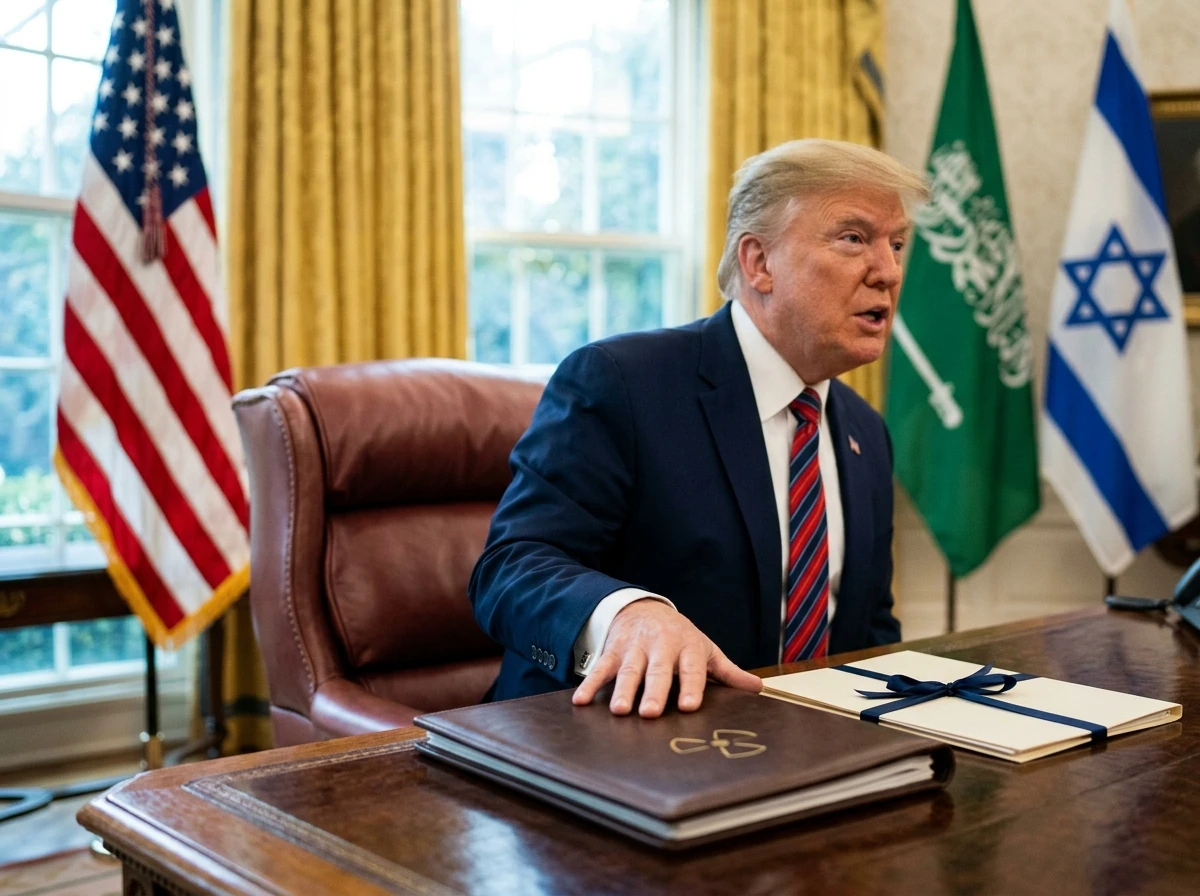
The Deal Skips Washington’s Usual Nonproliferation Rules
Nonproliferation specialists have a name for the standard Washington set in 2009, when the United Arab Emirates signed its own 123 Agreement and renounced uranium enrichment and spent-fuel reprocessing entirely. They call it the gold standard.
| Provision | UAE, 2009 Agreement | Saudi Arabia, 2026 Agreement |
|---|---|---|
| Uranium enrichment | Renounced entirely | Not banned; two-year study underway |
| Spent fuel reprocessing | Renounced entirely | Not banned |
| IAEA Additional Protocol | Required before U.S. exports | Not required |
| Political precondition | None | Abraham Accords membership, added one day after signing |
The Saudi agreement omits all three pillars of that gold standard, including any requirement that Riyadh ratify the International Atomic Energy Agency’s (IAEA, the United Nations’ nuclear watchdog) toughest inspection protocol before American exports begin. The administration had already dropped the enrichment and reprocessing bans in a policy shift back in November 2025, months before last week’s signing, so the openness was not a last-minute concession. A roundup of experts reading between the lines of the text found Riyadh got more room than any Arab state has gotten from Washington before.
Within 24 Hours, Trump Changes the Terms
That generosity did not survive Thursday intact. White House Press Secretary Karoline Leavitt told reporters that Trump had decided the Saudis must join the Abraham Accords, the 2020 normalization framework linking Israel with several Arab states, or “the deal is off,” the Associated Press reported.
Asked why the condition never came up when the Energy Department announced the signing a day earlier, Leavitt said it was because Trump “is always the final dealmaker.”
Israeli Prime Minister Benjamin Netanyahu’s office welcomed the opening. Saudi accession to the Abraham Accords, it said, “would be an historic leap forward for peace in the Middle East.”
On Truth Social, Trump added his own gloss: “there will be no enrichment of material,” though the United States remains “not opposed to Civil (Non-Enriched) Nuclear Facilities.” That leaves the enrichment question technically open for two years, even though Prince Abdulaziz had signed his name to the deal a day earlier with no Israel clause attached.
Why Won’t Saudi Arabia Just Join the Abraham Accords?
Saudi Arabia has held one condition for joining the Abraham Accords since talks began: a credible, binding path to Palestinian statehood. Mohammed bin Salman has said this to American officials directly, in public, more than once, and nothing in Thursday’s ultimatum changes that starting position.
We want also to be sure that we secure a clear path of two-state solution.
Mohammed bin Salman said that from the Oval Office, seated beside Trump, according to a Times of Israel report. He has separately told U.S. officials that Washington needs to guarantee negotiations toward Palestinian statehood within five years, Ynetnews reported, describing his public rejection of normalization without a Palestinian state as non-negotiable at home.
This is not new territory. Trump’s predecessor tried nearly the identical bundle, a peace deal, a defense treaty and civil nuclear cooperation, before the October 7, 2023 attack on Israel and the Gaza war that followed pushed the statehood demand out of reach. That package never recovered. Trump has now revived its nuclear piece while trying to reopen the political one from the opposite direction, offering the technology first and the ultimatum after.
The Regional Tripwires Around Riyadh
Saudi Arabia is not weighing this in a vacuum. Iran’s regional standing has been rising, and the kingdom is watching several flashpoints at once heading into any confrontation with Tehran:
- Iraq – Trump met with Iraqi Prime Minister Ali al-Zaidi on July 15, a sign Baghdad has become a frontline in the wider U.S.-Iran standoff.
- Pakistan – Islamabad has advised Tehran to steer clear of targeting Saudi Arabia, a signal of how far the tension has already spread.
- The Houthis – Yemen’s Houthi movement has threatened Saudi Arabia directly, reviving fears the kingdom faced during earlier years of cross-border missile and drone attacks.
- Bab el-Mandeb – The strait remains a potential chokepoint, and its closure would hit Saudi shipping along with everyone else’s.
The Houthi threat is not abstract. A blockade threat aimed at Saudi Arabia’s last open Red Sea oil route has already forced Riyadh to weigh how exposed its energy exports are if the standoff with Iran widens.
Congress Gets Ninety Days to Weigh In
The agreement now heads to Capitol Hill for a 90 session day review. Lawmakers cannot vote to approve it, only to oppose it, and a Congressional Research Service brief on possible Saudi-Israel agreements lays out how narrow that path to objection actually is.
Hudson Institute senior fellow Bryan Clark expects the deal to sit in limbo rather than collapse outright. The likely outcome, he said, is the agreement “staying in place and nothing substantive happening until Saudis agree to something” on Israel.
Other analysts read the fine print differently. A CSIS analysis frames whether the agreement proceeds at all as a genuinely open question, since so much of its substance, including the enrichment study, hinges on decisions still years away.
Netanyahu Decides Not to Play Spoiler
Iran looms over all of it. Mohammed bin Salman has said before that if Iran builds a nuclear weapon, Saudi Arabia would have to match it. That is the pressure Trump is counting on to eventually move Riyadh off its statehood demand, not the nuclear technology itself.
Netanyahu, for his part, has decided there is no reason right now to try to kill a deal still struggling to be born. Even a normalization framework already strained by three years of war in Gaza is, in his calculation, worth leaving intact on the chance Riyadh eventually says yes.
For now, Saudi Arabia has a nuclear agreement it has wanted for years, and Trump has a lever he did not have last Wednesday. Neither side has to move first.
Frequently Asked Questions
What is a 123 Agreement?
A 123 Agreement is a peaceful nuclear cooperation pact authorized under Section 123 of the U.S. Atomic Energy Act. It lets American companies export reactor technology, fuel and expertise to a partner government, but it only takes effect after a presidential determination and a congressional review period, the same process now underway for Saudi Arabia’s deal.
Which countries belong to the Abraham Accords today?
The United Arab Emirates and Bahrain signed the original Abraham Accords in September 2020, followed by Morocco and Sudan later that year. Saudi Arabia has never signed on, and Thursday’s condition from Trump is the most direct public push yet to change that.
How would a U.S. war with Iran affect Saudi Arabia’s nuclear talks?
Analysts close to the process expect any large-scale U.S. campaign against Iran to freeze nuclear diplomacy across the region, including talks Washington has separately floated with Tehran. Saudi Arabia would likely be pulled toward the war effort as a logistics and basing partner well before its own enrichment study is finished.
Are Israeli officials still uneasy about the Saudi nuclear deal?
Yes. Even after Trump attached the Abraham Accords condition, Israeli commentary has continued to flag the enrichment provisions as a risk Netanyahu’s welcome statement did not erase, since the underlying text still leaves Saudi Arabia’s long-term enrichment path open.
