
U.S. commanders in the Middle East are deliberately letting some Iranian missiles and drones fly past their defenses. Two senior U.S. officials told NBC News the practice conserves a dwindling supply of Patriot and THAAD interceptors, five months into the war. Bases in Bahrain and Kuwait have already absorbed billions of dollars in damage.
The two officials could not say whether any of the projectiles commanders chose not to shoot down have killed or wounded U.S. personnel or civilians. They said only that the approach carries risk the military is now willing to accept.
Commanders Quietly Rewrite the Rules of Engagement
NBC News broke the story, attributing it to two senior officials who described how the targeting calls are made. Commanders skip an interceptor shot whenever they judge an incoming missile or drone will not:
- Strike U.S. troops or personnel
- Cause significant damage to a critical U.S. facility
- Threaten a regional ally
That has been the standard since the war’s opening days on February 28, the officials said. It breaks from how the military operated earlier, when nearly every missile or drone capable of reaching a U.S. facility was intercepted regardless of what it was likely to hit.
The consequence shows up on the ground. Some Iranian munitions still get through, and military assessments generally find they strike abandoned buildings or empty stretches of a base rather than anything of value. In some cases, officials said, commanders have deliberately let a missile or drone hit a U.S. installation because no personnel were stationed there.
The same calculus extends beyond American troops. A missile or drone judged capable of hitting a regional partner still draws an interceptor, officials said, reflecting an effort to keep Gulf allies inside the same defensive umbrella even as the U.S. stockpile shrinks.
The Pentagon has not addressed the strategy on the record beyond what the two officials described to NBC News.
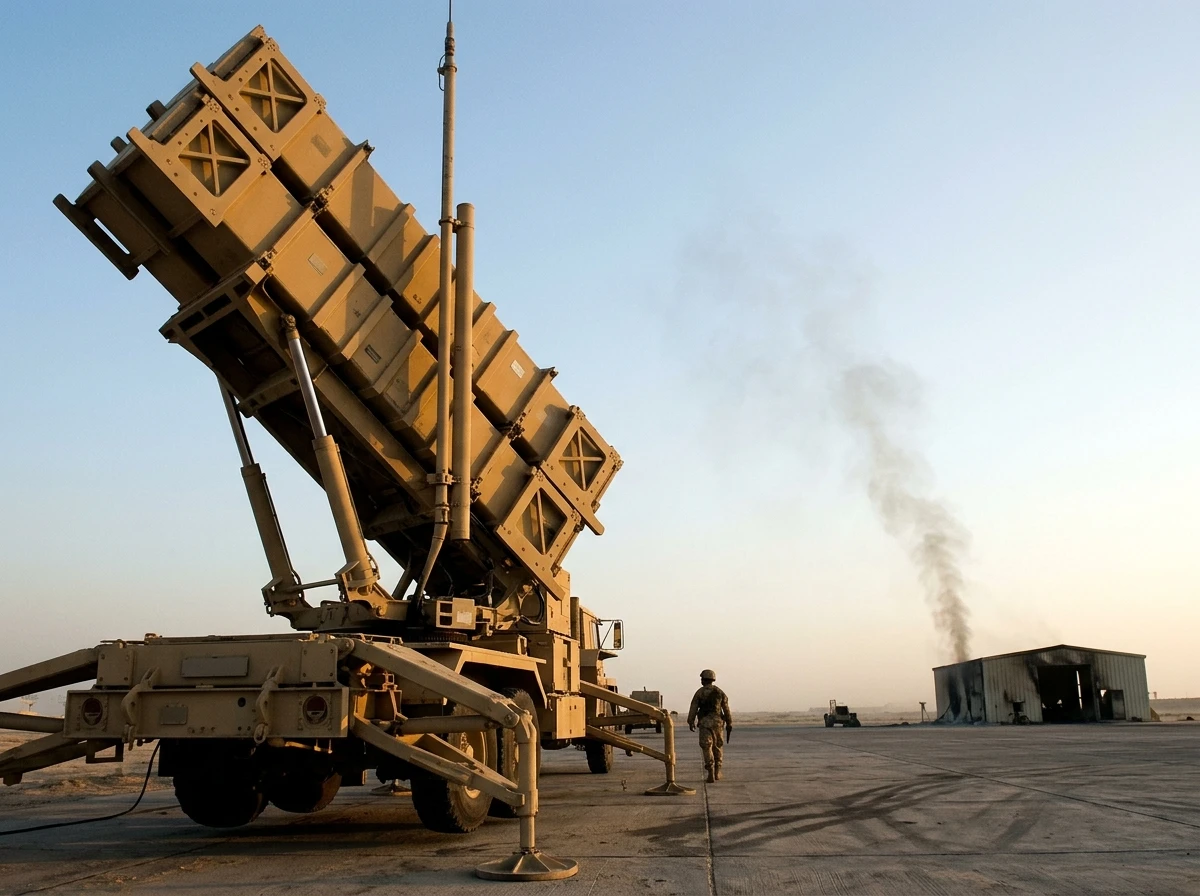
The Interceptor Math
The shift traces back to a production gap that predates this war. Patriot and Terminal High Altitude Area Defense (THAAD, the Army’s long range interceptor system) batteries take years to rebuild once emptied, and the Pentagon has been firing interceptors faster than factories can replace them.
One estimate puts Patriot use at more than 1,000 interceptors fired since February, with only about 172, roughly 17%, replaced so far. THAAD has fared little better. Independent estimates put the toll from the war’s opening phase alone at roughly a quarter to a third of the entire stockpile.
| System | Expended in the War | Stockpile Impact | Restock Timeline |
|---|---|---|---|
| Patriot interceptors | 1,000+ fired since February | Only about 172 replaced (17%) | Production ramp targets 2,000 a year; four to five years from order to delivery |
| THAAD interceptors | Roughly 150 fired in the war’s opening phase | About a quarter to a third of the stockpile | No new deliveries since July 2023; backlog begins arriving April 2027 |
| Navy SM-3 interceptors | 12 fired in a single October 2024 engagement | 2.5% of the 470 delivered by the end of that year | New Block IB production order placed to rebuild inventory |
The Pentagon has signed a production deal with Lockheed Martin to lift THAAD output from 96 to 400 interceptors a year and Patriot output from 600 to 2,000. Even so, an order placed today would not arrive for four or five years because of the existing backlog.
One U.S. official has said American forces lack enough THAAD interceptors to safely sustain the pace of the air campaign against Iran.
A Dozen Missiles Used to Be Enough
The scale of interceptor use in this war looks stark next to the last time American warships shot down Iranian missiles in anger. On October 1, 2024, USS Bulkeley and USS Cole fired about a dozen Standard Missile-3 (SM-3) interceptors at Iranian ballistic missiles bound for Israel.
A Washington research group, the Center for Strategic and International Studies (CSIS), found the engagement used just 2.5 percent of the SM-3s the Navy had received by the end of that year. It was treated at the time as a meaningful dent in a finite inventory. That October 2024 engagement, mounted in defense of Israel rather than U.S. troops directly, is still the reference point analysts reach for when they talk about interceptor economics.
Interceptors are not cheap. Defense cost analysts put the SM-3 Block IIA variant at $35 million to $40 million apiece, the older Block IB at $10 million to $15 million, and the SM-6 at nearly $4 million.
Multiply any of those figures by the more than 1,000 Patriots and roughly 150 THAADs this war has already consumed, and the dozen SM-3s fired in 2024 look like a rounding error.
Repair Bills Pile Up From Bahrain to Iraq
The physical damage from projectiles that were never intercepted is spread across the map. Iranian strikes hit at least nine U.S. military sites within the war’s first 48 hours, across Bahrain, Kuwait, Iraq, the United Arab Emirates and Qatar.
The heaviest single loss was the Navy’s Fifth Fleet headquarters in Manama, Bahrain, where repairs alone are estimated near $200 million. Kuwait’s Ali Al Salem Air Base was also struck. Reports of destruction, and in some cases casualties, have since emerged from Qatar, the UAE, Saudi Arabia, Jordan and Iraq as well.
The Pentagon estimated in March that just the war’s first six days cost more than $11.3 billion, a figure that does not include repairs.
Broader repair estimates vary widely. One runs to $5 billion for structural damage alone. A separate estimate puts the true cost closer to $40 billion to $50 billion once destroyed radar, aircraft and weapons systems are replaced.
So far, none of the host countries has disclosed a public reconstruction timeline. The American Enterprise Institute (AEI, a Washington think tank) has modeled the war’s toll on bases across the Gulf as part of what the Pentagon calls Operation Epic Fury.
Iran has kept pressure on the wider region too. The two countries have traded fire for three consecutive nights of strikes along the Strait of Hormuz, the narrow waterway that carries a large share of the world’s seaborne oil.
The Casualty Question Officials Won’t Answer
Asked directly, the two senior officials would not say whether any Iranian missile or drone let through the defenses has killed or injured a U.S. service member or civilian. They said only that the triage strategy carries risk.
That uncertainty hangs over every targeting call. A missile assessed as low risk can still miss its predicted impact point once it is already falling.
What We Know:
- Iranian strikes have caused significant destruction at U.S.-linked sites in Bahrain, Kuwait, Qatar, the UAE, Saudi Arabia, Jordan and Iraq.
- Some of that destruction is the direct result of commanders choosing not to spend an interceptor on a low-threat projectile.
What’s Unconfirmed:
- Whether any of the unintercepted missiles or drones have caused U.S. military or civilian casualties among the reports emerging from the region.
- The final repair bill, which separate estimates place anywhere from $5 billion to $50 billion depending on what is counted.
The gap between those two lists is where the risk in this strategy lives.
How Long Until the Interceptor Stockpile Refills?
Not soon. A Congressional Research Service (CRS, Congress’s nonpartisan research arm) report from March pegged full recovery in years, not months. Separate defense estimates say some interceptor lines will not return to pre-war stockpile levels before 2029, even with production increases already underway at Lockheed Martin’s plants.
The CRS published its March report on Iran war munitions and missile defense after lawmakers pressed the Pentagon for inventory details. Some members of Congress have raised alarms about shortfalls that could take months or years to fix. Others told the CRS that munitions levels are not an immediate concern.
The Payne Institute, an energy and security policy center, estimated the war has consumed close to a third of the THAAD stockpile, while annual production has yet to exceed roughly 100 interceptors a year. That gap between what is being fired and what is being built explains the Pentagon’s rationing decision.
Lockheed Martin’s plants need specialized components, trained technicians and new testing capacity to hit the Pentagon’s higher targets, additions that take years, not quarters.
One assessment of the region’s strategic balance after Operation Epic Fury argues the interceptor shortage will shape U.S. posture in the Gulf long after this war ends.
The war passed its five month mark this week. On the Pentagon’s own production math, the interceptors it is burning through now will not be fully restocked before 2029.
