
Saudi Arabia shot down a wave of drones aimed at its oil facilities and capital on Monday. It blamed Iran-backed militias operating from Iraq and vowed to respond at a time of its own choosing. Jordan intercepted two more drones the same day, and neither government has said who exactly is responsible for the second attack.
The country left holding the hardest question is Iraq. Baghdad has opened an investigation into a launch it says it never sanctioned, even as its prime minister spends his weeks courting Jordan and Washington to bankroll a pipeline that only works if the region stays calm.
Drones Fall Short of Riyadh and the Eastern Province
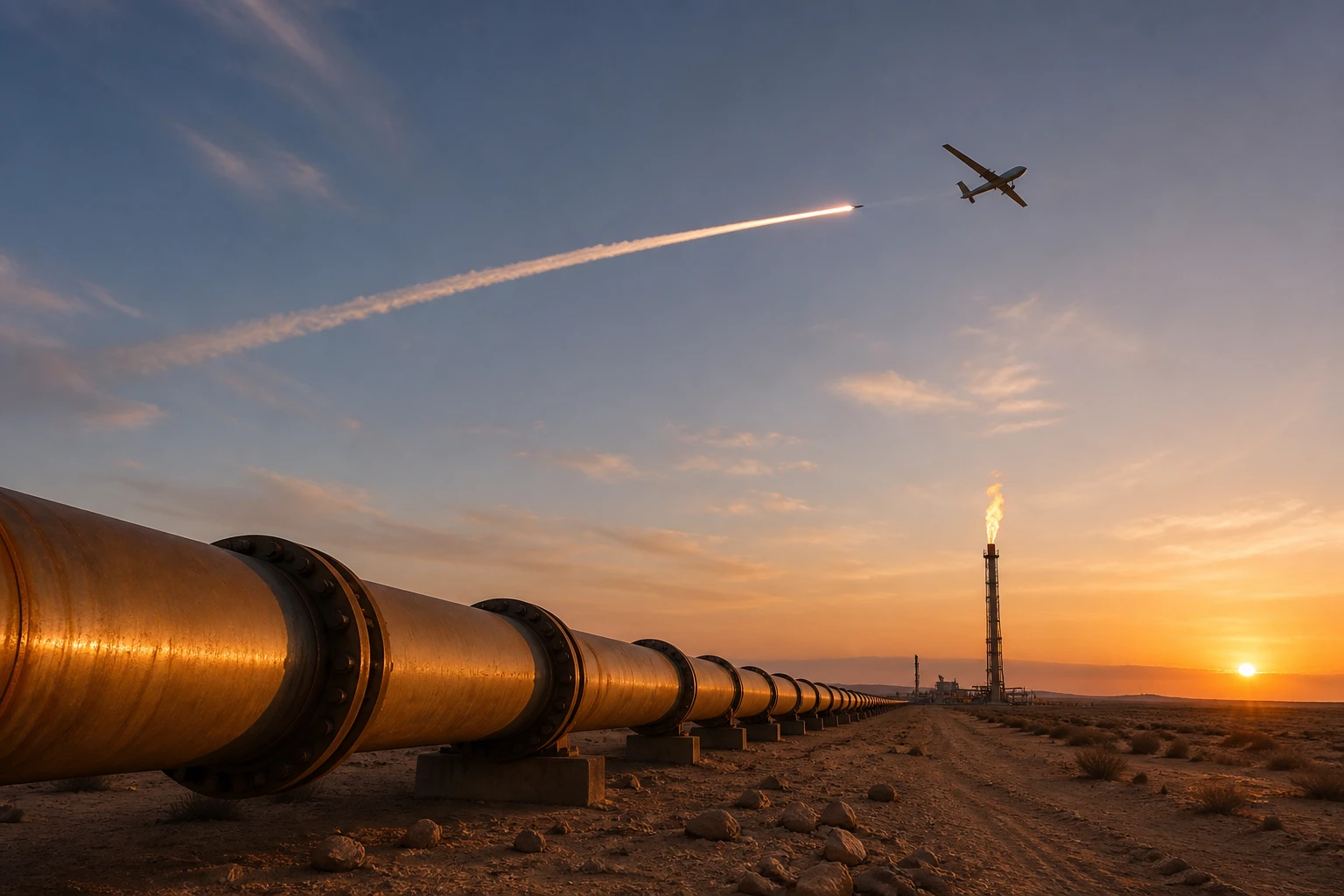
Saudi Arabia’s Ministry of Defence said its air defences intercepted and destroyed several drones targeting oil facilities in the Eastern Province and the capital, Riyadh, before they reached their targets. Military spokesman Maj Gen Turki Al Malki said the drones had been launched from Iraqi territory and blamed Iran-backed militias, calling the attempted strikes “terrorist” attacks on the kingdom’s energy infrastructure.
He said Saudi Arabia “reserves the right to defend itself and respond at the appropriate time and place.” Riyadh did not disclose how many drones were involved, and no casualties or damage were reported.
Hours later, Yemen’s Houthi rebels claimed a separate strike, saying they had targeted “a number of targets and sensitive points for the supply and transport of crude oil from eastern Saudi Arabia to Yanbu.” Houthi military spokesman Yahya Saree said the attack came “in response to the Saudi enemy’s drones breaching Yemeni airspace,” a new accusation that puts Riyadh, not just Tehran’s proxies, in the position of alleged aggressor. In Jordan, the Royal Jordanian Air Force shot down two drones over its territory. “The interception and downing operation resulted in no casualties or material damage,” a Jordanian military source told the Petra news agency, without naming a source for those drones.
| Incident | Drones Involved | Claimed Origin | Outcome |
|---|---|---|---|
| Riyadh and Eastern Province oil sites | Several, number undisclosed | Iraqi territory, Iran-backed militias (per Saudi Ministry of Defence) | Intercepted before reaching targets; no casualties or damage |
| Jordanian airspace | Two | Unidentified | Shot down by Royal Jordanian Air Force; no casualties or material damage |
| Crude corridor, eastern Saudi Arabia to Yanbu | Unspecified number | Houthi rebels, self-claimed | Targeted supply and transport points; no independent damage confirmed |
Three governments, three separate incidents, and by nightfall Monday, no one outside Iraq’s borders was taking responsibility for where the first set of drones came from.
Baghdad’s Investigation Runs Into Its Own Limits
Iraqi Prime Minister Ali Al Zaidi ordered an investigation soon after Saudi Arabia’s announcement. Military spokesman Sabah Al Numan said the government was “examining the available evidence” and would pursue legal action against anyone found to have been involved. Iraqi officials also reaffirmed what they describe as a constitutional commitment to good neighborliness and to keeping Iraqi territory from being used as a launching point against friendly states.
That pledge ran headlong into the same accusation it was meant to prevent. The group Saudi Arabia implicated pushed back hard.
Fabrications that serve only as an attempt to justify their inability to respond to the painful Yemeni strikes.
The Islamic Resistance in Iraq, an umbrella network of Iran-backed Shia militias that carries out attacks on US and Israeli targets while operating outside Iraq’s formal military chain of command, issued that denial once Riyadh named it as a suspect. Whether or not the group is proven responsible, the exchange makes a simple point: Baghdad can order a probe and promise prosecutions, but it does not control every armed actor with a drone and a grievance operating from within its own borders.
The Pipeline Iraq Cannot Afford to Lose
The timing is rough for Iraq on a second front too. Its own oil exports from southern fields have fallen by roughly 70 per cent during the wider regional war, according to an analysis by the Foundation for Defense of Democracies, a Washington policy institute. That collapse is precisely why Al Zaidi’s government has been pushing so hard to revive the long-dormant Basra-Aqaba pipeline, a roughly 1,600 kilometer line that would run from Basra through western Iraq to the Jordanian port of Aqaba and could carry up to 2.25 million barrels a day, according to Global Energy Monitor’s project tracking, at a cost estimated near $18 billion.
Earlier this month, Al Zaidi’s government hosted a Jordanian delegation to advance the Basra-Aqaba route, the same pipeline whose entire logic depends on Iraq being seen as a stable place to move oil through, not a place attacks are launched from.
- Militias outside its command. The Islamic Resistance in Iraq and allied factions operate beyond the formal military structure Baghdad answers for, even as the government pledges to stop Iraqi territory being used against neighbors.
- A customer it cannot afford to alienate. Saudi Arabia and Jordan are exactly the markets a Hormuz bypass pipeline needs on the other end of the pipe.
- An economy already bleeding. Southern export volumes have cratered since the wider war began, leaving Baghdad with less room to absorb a diplomatic rupture with Riyadh.
- A response it cannot predict. Saudi Arabia has not said where or how it intends to act on its warning, leaving Iraq to guess whether retaliation lands on militia positions, diplomatic channels, or something else entirely.
Not everyone agrees the pipeline itself will materialize on the timeline Iraq needs. Atlantic Council researchers argue the Hormuz shutdown means the corridor cannot wait much longer to be built. Foundation for Defense of Democracies analysts counter that Iraq has floated similar pipeline revivals before without delivering one, given the financing and security hurdles involved. Al Zaidi and Jordanian Foreign Minister Ayman Safadi are proceeding regardless, working through route details in meetings even as the drone investigation unfolds back home.
The Houthis Open a Second Front From the Sea
Saudi Arabia’s oil infrastructure was already under pressure before Monday’s drones. The Houthi rebels struck Aramco’s Jizan refinery and the Yanbu export terminal last Saturday, setting part of the Jizan complex ablaze days after declaring a blockade on Saudi shipping through the Bab Al Mandeb strait. The attack helped send Brent crude back above $100 a barrel, according to market reports.
Yanbu is not a peripheral target. It alone handled 92 per cent of the kingdom’s seaborne crude exports in June, The National reported, after Saudi Arabia spent months rerouting shipments west through the East-West Pipeline to escape Iran’s closure of the Strait of Hormuz. That bypass simply relocated the choke point: oil loaded at Yanbu still has to clear Bab Al Mandeb, which is exactly where the Houthis drew their blockade line. Saudi Arabia has since rerouted its Asia-bound cargoes through the Suez Canal instead, a detour that adds roughly a month of transit time. Egypt condemned the Houthi strikes on the Yanbu pipeline last week, a sign of how far the fallout from Saudi Arabia’s oil squeeze is already spreading beyond the Gulf.
Jordan Shoots Down Two Drones, Then Tests Its Sirens
Jordan’s interception on Monday was its second brush with unexplained drones in recent weeks, and Amman is not waiting to find out if a third is coming. The kingdom has also run a nationwide test of its emergency alert system across a number of governorates, part of a broader push to get the public ready for exactly this kind of escalation.
Jordanian authorities have not identified who sent the two drones its air force shot down. That silence, paired with the alert drills, suggests a government preparing for repeat incidents rather than treating Monday as an isolated event.
Is the Iran-US Pause Holding?
Barely. Iran and the US have not struck each other for three nights since a pause began Friday, and Washington says it is giving diplomacy room to work. But Iran still calls the Strait of Hormuz closed, proxy attacks on Saudi Arabia and Jordan have not stopped, and neither side describes any direct negotiation underway.
Iran’s military has suspended retaliatory operations against US forces in the region since the pause took hold. In the two weeks before it began, Tehran claimed attacks on American military assets in Kuwait, Bahrain and Jordan. Mike Waltz, the US ambassador to the United Nations, said President Donald Trump was giving diplomacy “some space,” while a White House spokesman said Washington still retained military options if Iran resumed attacks on shipping or regional allies.
Iranian Foreign Ministry spokesman Esmaeil Baghaei dismissed reports that Tehran had asked for talks with Washington in Pakistan or Qatar, calling the claims a recurring “news-making tactic” by opposing parties. “Such a thing is not in line with our approach at all,” he said, adding that mediators do sometimes “convey messages from the American side to us about the current developments in the region,” without that amounting to negotiation. Iranian and Omani officials did meet Friday and Saturday on maritime traffic management in the strait, Mr Baghaei said, but he insisted “the situation in the Strait of Hormuz has not changed and it remains closed, and these talks have nothing to do with the US.”
Iran’s Fars news agency reported Monday that six ships were turned back after allegedly trying to use an unauthorized route south of the strait with their navigation and positioning systems switched off, an attempt Tehran said was made at the encouragement of the US military. The vessels were returned to the Gulf under what Fars called the “management of Iran,” and one suffered an accident during the episode.
Baghdad has promised legal action against whoever is found responsible for Monday’s launches. It has not said when that investigation will conclude, or what would satisfy Riyadh before the kingdom decides what “the appropriate time and place” actually means.
Frequently Asked Questions
Why do attacks on Saudi Arabia keep originating from Iraqi territory?
Armed factions aligned with Iran, including the Islamic Resistance in Iraq, operate inside Iraq largely outside the government’s formal military command, giving Baghdad limited practical ability to stop launches even when it opposes them. It would not be the first such accusation: Iraq denied similar claims in September 2019, after Saudi oil facilities were struck and suspicion turned toward launch sites on Iraqi soil.
What is the Basra-Aqaba pipeline Iraq and Jordan are building?
It is a roughly 1,600 kilometer oil pipeline first approved in 2019 and left dormant for years before Iraq and Jordan revived talks this year as an alternative to shipping crude through the Strait of Hormuz. Atlantic Council analysts argue the corridor can no longer wait given the Hormuz shutdown, while Foundation for Defense of Democracies analysts call the current revival a pipe dream given Iraq’s record of unfinished pipeline plans.
Is the Strait of Hormuz still closed to shipping?
Iran says yes. June’s interim peace deal called on Tehran to “make arrangements using its best efforts” for safe passage of commercial vessels, language mediators are still trying to clarify because Iran and the US read it differently. Talks between Iranian and Omani officials in late July addressed shipping management in the strait but, according to Tehran, changed nothing about the closure itself.
What happens next in the Saudi-Iraq drone investigation?
Iraq has promised legal action against anyone found responsible but has given no timeline for concluding the probe. Saudi Arabia has said only that it reserves the right to respond “at the appropriate time and place,” leaving open whether any retaliation would target militia positions inside Iraq, diplomatic pressure on Baghdad, or another option entirely.
