
Yemen’s Houthi rebels vowed Monday to blockade Saudi Arabia’s Red Sea coast, the one oil corridor the kingdom built specifically to survive the shutdown of the Strait of Hormuz. The Saudi-led military coalition said it had already begun protecting ships in the Bab el-Mandeb Strait. Brent crude barely reacted, rising just 0.2% to $88.23 a barrel.
The calm in the oil market hid a sharper move underneath it. War-risk insurance for Red Sea voyages jumped within hours, and Saudi Arabia’s own export data shows exactly why insurers, not oil traders, blinked first: there is no longer a second route to fall back on.
Saree’s Video Meets a Coalition Vow to Respond by Force
The announcement came in a video posted Monday to the X account of Yahya Saree, the Houthi movement’s military spokesman. He said the maritime ban on Saudi vessels would take effect immediately.
We affirm the right of our great people to respond to the blockade with a blockade, and to respond to all escalation with all escalation.
Saree framed the move as retaliation for what the Houthis call Riyadh’s decade-long siege of Sana’a, the capital the group has held since 2014. That framing echoes an earlier Houthi vow to break the Saudi siege regardless of the cost, now converted into an actual shipping threat.
Turki Al-Malki, a spokesman for the Saudi-led coalition that has backed Yemen’s internationally recognized government since 2015, answered within hours on X. “All Houthi threats against transiting vessels will be dealt with swiftly and firmly,” Al-Malki said, adding that the coalition had begun operational measures to protect shipping in the Bab el-Mandeb Strait. Separately, Saudi Arabia’s Foreign Ministry said the kingdom would defend its vessels under international law and the 1982 United Nations Convention on the Law of the Sea, the treaty known as UNCLOS that governs passage rights on the high seas. Saudi energy officials did not respond to requests for comment.
How Two Airport Strikes Ended a Truce
Monday’s blockade did not appear out of nowhere. It capped a week that undid an informal truce Riyadh and the Houthis had held since 2022.
The spark was an airport, not a tanker. Houthi leaders were flying home from Tehran, where they had attended the funeral of Iran’s Supreme Leader, Ayatollah Ali Khamenei, when Sana’a’s airport came under attack. The Houthis blamed Saudi Arabia; Yemen’s internationally recognized government claimed responsibility itself, saying the strike was meant to stop the Iranian plane from landing. The aircraft diverted safely.
Days later, Houthi forces fired missiles and drones at Abha International Airport in southern Saudi Arabia, an escalation that ended the 2022 truce between Riyadh and the Houthis. It was the most direct confrontation between the two sides in years. Monday’s blockade vow was the next rung up.
- 2014: Houthi fighters seize Sana’a, starting Yemen’s civil war.
- 2015: A Saudi-led coalition intervenes on behalf of Yemen’s internationally recognized government.
- 2022: Riyadh and the Houthis settle into an informal truce.
- Last week: Sana’a’s airport is struck as Houthi leaders fly back from Khamenei’s funeral in Tehran.
- Days later: Houthi missiles and drones hit Abha International Airport.
- Monday, July 20: Saree announces the blockade; Al-Malki says protective measures are already underway.
Yanbu Was Supposed to Be the Insurance Policy
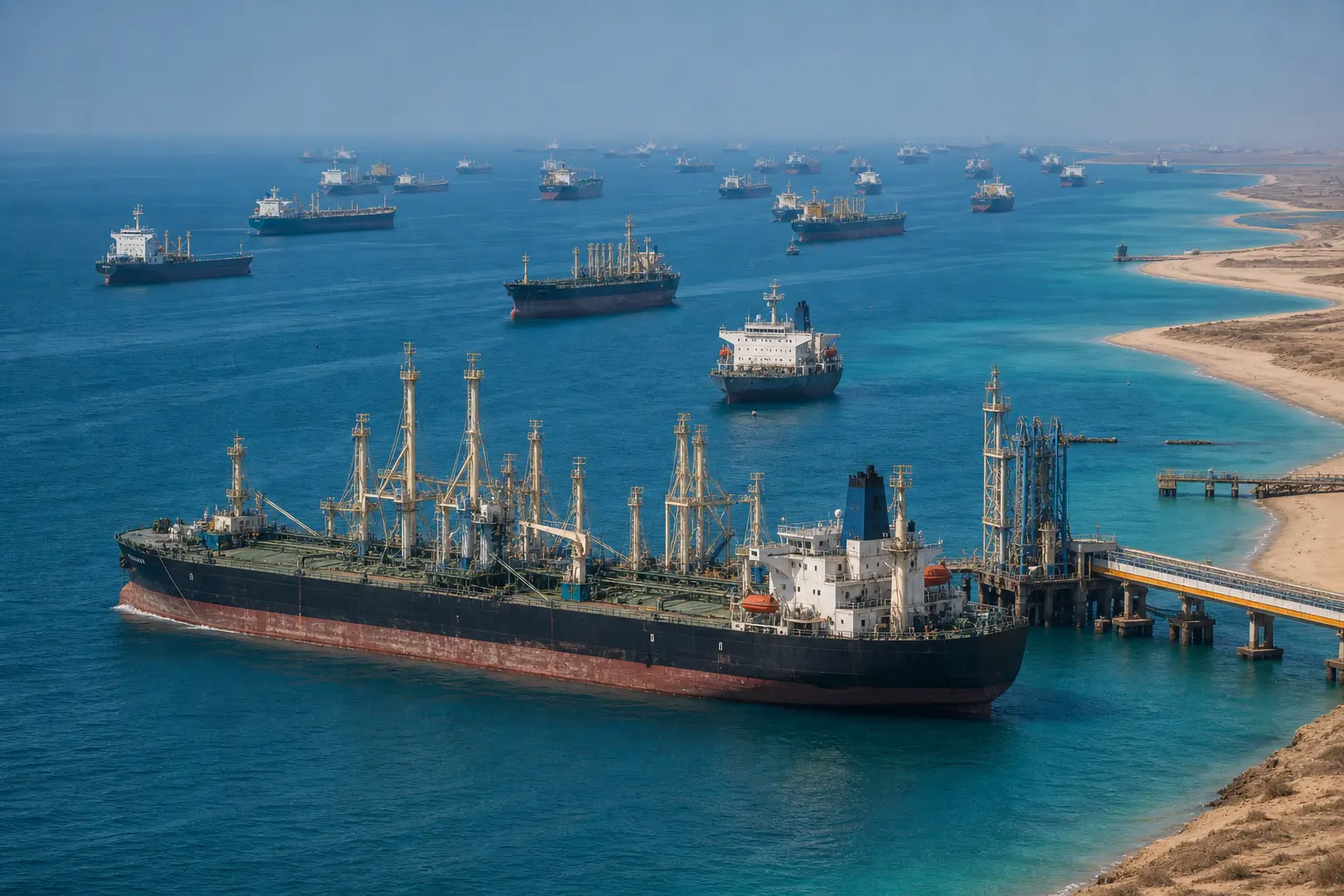
Since the U.S.-Israeli war with Iran began on February 28, Iran has effectively closed the Strait of Hormuz to much of Saudi Arabia’s crude. Saudi Aramco’s answer was to reroute barrels across the peninsula, through the East-West Pipeline, to the Red Sea terminal at Yanbu.
It worked, at least on paper. Yanbu shipments surged to a record 4.19 million barrels a day last month, a jump of roughly 185% from year-ago levels, according to market data shared on X by The Kobeissi Letter. By mid-July, loadings had climbed even further, touching close to 4.7 million barrels a day around July 13, near the port’s operating limit, as shipping trackers showed volumes averaging above four million barrels daily since June, up from around 973,000 barrels a day over the same stretch in 2025.
That surge has a hard ceiling. The pipeline can move up to 7 million barrels a day to Yanbu, but roughly 2 million of that supplies domestic refineries and desalination plants, leaving about 5 million barrels a day for export. Even running near maximum, Saudi Arabia’s total crude exports still sit about 2 million barrels a day below pre-war levels. Bab el-Mandeb went from a backup route to the only route in a matter of weeks, and industry sources had already flagged, before Monday’s announcement, that Yanbu could become a Houthi target.
| Period | Strait of Hormuz (million barrels/day) | Bab el-Mandeb Strait (million barrels/day) |
|---|---|---|
| 2022 | 21.9 | 8.0 |
| 2023 | 21.8 | 9.3 |
| 2024 | 20.7 | 4.1 |
| First half of 2025 | 20.9 | 4.2 |
The U.S. Energy Information Administration’s chokepoint data shows how much Bab el-Mandeb’s traffic had already collapsed before this year’s Iran war ever started, the legacy of the last Houthi campaign. Hormuz, by contrast, barely moved until this year. A separate reading of EIA figures by the Institute for Energy Research found Hormuz volumes fell almost 30% year over year, to 14.6 million barrels a day in the first quarter of 2026, before flows later slid toward the near standstill described by shippers this month.
The Number That Actually Moved Monday
Brent’s 0.2% tick was not where the real reaction showed up.
- 0.75% of a ship’s value: the war-risk premium quoted for Red Sea voyages Monday, insurance industry sources told Reuters, more than double the roughly 0.3% quoted the Friday before.
- $88.23 a barrel: where Brent crude settled Monday afternoon in London, up just 0.2%.
- 7%: the share of global oil supply that could vanish if Bab el-Mandeb fully closed, per the same Reuters sourcing.
- 4.7 million barrels a day: Yanbu’s loading rate in mid-July, near the terminal’s operating ceiling.
Even a small premium shift means real money. Reuters reported that the jump alone adds hundreds of thousands of dollars to a single seven-day voyage. Ambrey, a British maritime security firm, assessed Saudi-flagged, owned or operated vessels, along with any ship bound to or from Saudi Arabia’s Red Sea ports, as facing a high risk of Houthi attack. “The Houthis made mistakes during the 2024 Red Sea crisis in targeting shipping with out-of-date affiliations to companies. It is likely that vessels could be targeted for mistaken identities,” Ambrey said in its Monday assessment.
Red Sea Traffic Never Fully Recovered From Last Time
The last Houthi campaign against Red Sea shipping is the reason insurers reacted so fast this time. It never really ended.
Close to 100 ships were attacked or hijacked in the Red Sea after November 2023, when Houthi forces began targeting vessels linked to Israel, the United States and Britain over the Gaza war. Suez Canal transits fell between 51% and 64% by quarterly tonnage through 2025 compared with 2023 levels. Even after the Houthis declared an end to attacks in November 2025, 43 days after their last strike on a commercial vessel, Suez traffic in the first week of 2026 was still about 60% below the same week of 2023, according to BIMCO, the shipping industry association. War-risk premiums had only just ground back down to about 0.2% of hull value by December, the lowest since 2023, before Monday’s announcement erased that entire recovery in a single session.
That history is the backdrop against the earlier Houthi vow to shut Saudi Arabia’s last open oil route. Shippers who spent two years learning that a Red Sea disruption does not resolve itself quickly are not likely to wait around this time to find out.
What Happens if Both Chokepoints Shut at Once
The Houthis entered the broader Iran war in March and, by June, were already threatening to resume targeting Israel-linked vessels in the Red Sea. Monday’s threat against Saudi Arabia specifically is a new front layered on top of that one.
A senior Houthi official, quoted by Iran’s Press TV and cited by Time, warned that if tensions keep escalating, Hormuz and Bab el-Mandeb could both shut in what the official called an operational alliance, a scenario the official said could send oil to $200 a barrel. That claim comes from a single, Iran-aligned source and has not been independently confirmed. Analysts who spoke to Time separately cautioned against treating the Houthis as a simple extension of Tehran, noting the group has its own locally defined interests distinct from Iran’s.
Whichever framing holds, the mechanics are not in dispute. Saudi Arabia only has two routes for its crude: the Gulf route through Hormuz, and the Red Sea route through Yanbu and Bab el-Mandeb. One is already running at a fraction of capacity because of the Iran war. The other just had a blockade declared against it.
Oman has spent years mediating between Riyadh and the Houthis, and the United Nations still lists Hans Grundberg as its special envoy for Yemen. Neither stopped last week’s airport strikes, and neither has commented on Monday’s blockade.
Frequently Asked Questions
What Is the Bab el-Mandeb Strait?
It is a narrow passage between Yemen and the Horn of Africa that links the Red Sea to the Gulf of Aden, sometimes called the Gate of Tears. The strait is only 18 miles wide at its narrowest point, forcing tankers into two shipping channels just two miles across each.
What Does the 1982 Law of the Sea Convention Cover Here?
UNCLOS sets out rights of innocent passage through international straits and lays out when a coastal state can act to protect shipping and its own vessels. Saudi Arabia’s Foreign Ministry cited the treaty specifically to argue its protective measures for Red Sea shipping are legally grounded, separate from any coalition military action.
What Happens to Shipping if Bab el-Mandeb Closes Completely?
Tankers would have to divert around the Cape of Good Hope at Africa’s southern tip. The Energy Information Administration has estimated that a voyage between the Arabian Sea and the Netherlands takes 19 days via the Red Sea route versus 34 days around Africa, adding roughly two weeks and significant fuel costs to each trip.
Is This the First Time the Houthis Have Targeted Saudi Arabia’s Oil Route?
No, but it is the first time they have declared a blockade specifically aimed at Saudi vessels. Their 2023 to 2025 Red Sea campaign targeted ships linked to Israel, the United States and Britain over the Gaza war, not Saudi Arabia itself. Monday’s announcement reframes the Red Sea as a battleground between Riyadh and the Houthis directly, on top of whatever role it still plays in the wider Gaza-linked campaign.
