
Egypt’s ambassador to the United Nations told the Security Council this week that Gaza’s border crossings must open without delay and that rebuilding cannot wait any longer. He paired that appeal with a second warning aimed nearly 1,500 miles east, over the Strait of Hormuz.
The two demands share a root cause. Egypt’s own Suez Canal, a pillar of its foreign currency earnings, is still climbing out of a hole dug by the same regional violence now threatening the Gulf. Cairo knows exactly what a contested shipping chokepoint costs, because it has been paying that bill for two years.
Egypt’s Three-Point Ask
Ihab Moustafa Awad Moustafa, Egypt’s permanent representative to the UN, who presented his credentials to the UN chief in December, laid out three demands during the session. Gaza’s crossings need to open without obstruction. Rubble removal has to accelerate so rebuilding can actually start. And the international community needs to fund it.
Ambassador Moustafa described conditions inside the Strip as dire, with residents facing what he called extremely harsh living and health conditions. He said Cairo continues to run relief convoys through its own border points and pressed other governments to match that commitment with money, not just statements.
This is not new territory for Egyptian diplomacy at the UN. The Council’s own July forecast flagged a packed Middle East agenda, and Egypt has been a constant presence on it since the ceasefire framework took hold late last year.
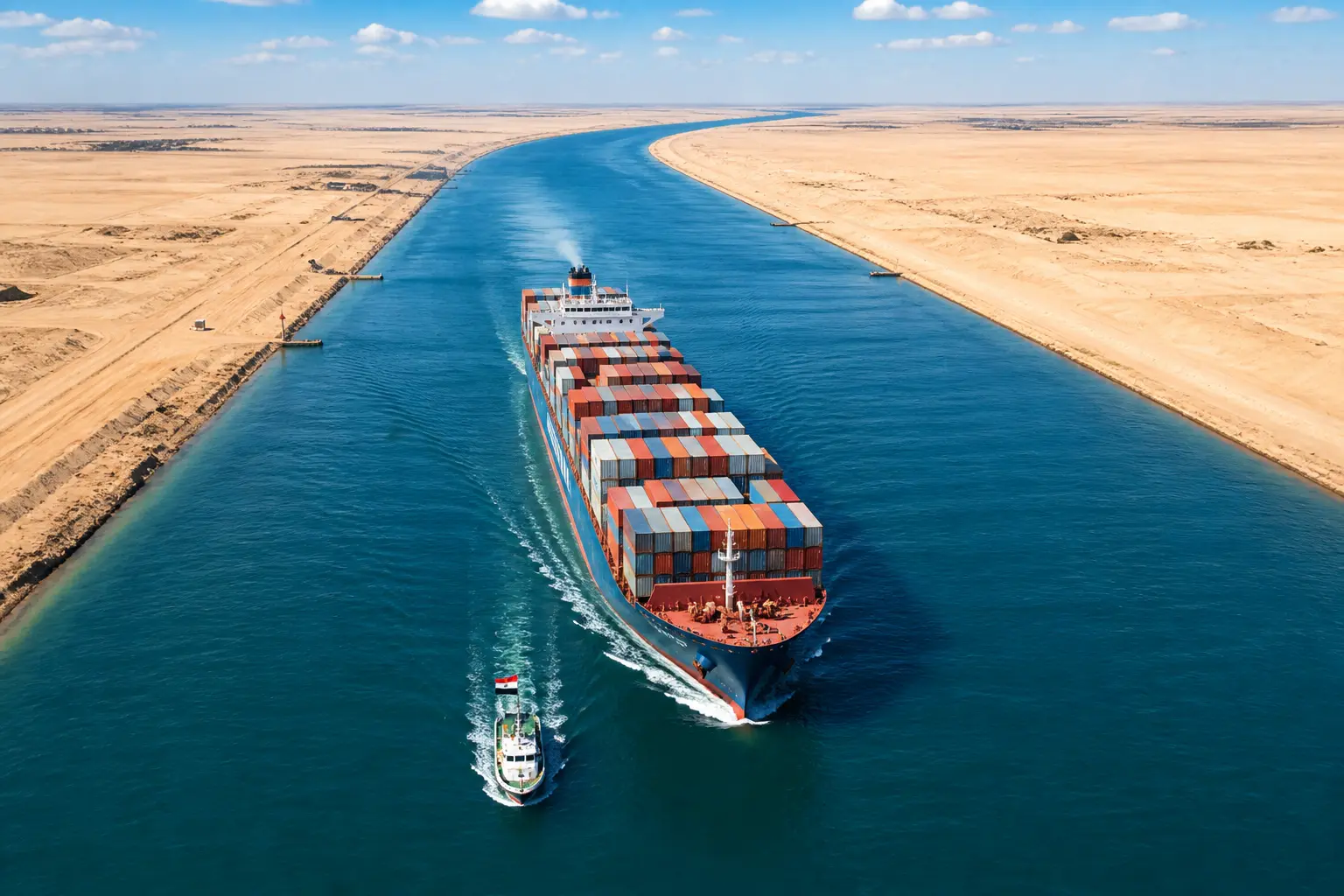
A Canal That Has Not Fully Healed
Here is the number that gives Egypt’s appeal its edge. President Abdel Fattah el-Sisi said in January that Houthi attacks on shipping through the Bab al Mandab Strait and the Red Sea cost Egypt roughly $9 billion in Suez Canal revenue over two years, as traffic collapsed more than 90 percent at points in 2024 and 2025. At the worst of it, the canal was losing about $800 million a month.
Early signs of recovery showed up this year. Canal data for the first six weeks of 2026 show real, if partial, improvement.
| Metric | Jan 1 to Feb 8, 2025 | Jan 1 to Feb 8, 2026 |
|---|---|---|
| Ships transited | 1,243 | 1,315 |
| Net tonnage | 47 million tons | 56 million tons |
| Canal revenue | $368 million | $449 million |
That is progress, not a fix. Egyptian officials expect further gains through the second half of 2026, but only if shipping lines that fled to the route around Africa decide the Red Sea is safe enough to come back for good. A canal that still has not recovered from one chokepoint crisis is watching a second one unfold in real time, in waters it does not control.
Iran’s Missiles Reach Six Arab and Gulf States
That second crisis is the one Egypt referenced when it condemned recent Iranian attacks on Arab nations and demanded an immediate halt to assaults on national sovereignty. Fighting between the United States, Israel and Iran escalated sharply in July, and Tehran has struck at least six Arab and Gulf states in retaliation for renewed American strikes on its territory.
Qatar took 203 missiles and 87 drones. Saudi Arabia was hit with at least 38 missiles and 435 drones. Jordan absorbed 204 missiles and drones combined. Oman took drone strikes on the ports of Salalah and Duqm and the towns of Sohar and Bukha, while Bahrain and Kuwait have also come under fire. At one stage, Iran shut the Strait of Hormuz entirely.
Egypt made a similar push for calm during an earlier pause in the Iran strikes before this round of fighting reignited. This time, Ambassador Moustafa told the Council that protecting freedom of navigation through Hormuz matters because the strait is a vital artery for global trade and international energy, language that applies just as directly to the canal Egypt operates a continent away.
Gaza’s Rebuild Now Carries a $71.4 Billion Tag
While the Gulf burns, Gaza’s damage bill has come into sharper focus. A joint World Bank, UN and European Union assessment put the territory’s recovery and reconstruction needs at $71.4 billion over the next decade, revising an earlier, lower estimate as the full scope of destruction became clear.
- $71.4 billion needed for Gaza’s recovery and reconstruction over the next decade, per the finalized Rapid Damage and Needs Assessment (RDNA)
- $26.3 billion required in just the first eighteen months to restore essential services and rebuild critical infrastructure
- 371,888 housing units destroyed or damaged across the Strip
- 84% contraction in Gaza’s economy since the war began
Physical infrastructure damage alone is put at $35.2 billion, with economic and social losses adding another $22.7 billion. More than half of Gaza’s hospitals are non-functional. The RDNA authors note the total rebuild will cost seven times what the 2008, 2014 and 2021 wars cost combined.
Oxfam, reacting to the same assessment, warned the rebuild will fail without Palestinians leading it. That is close to Egypt’s own position: Cairo has floated a 15-point roadmap with Qatar, Turkey and the United States for Gaza’s governance, and Foreign Minister Abdel-Aty has pushed to speed up work by the Palestinian committee meant to administer the Strip under the Security Council’s Resolution 2803, adopted last November.
Getting aid convoys through in the meantime is its own fight. Egypt has flagged new Israeli vetting requirements for aid organizations that critics warn could push the entire relief system toward collapse, which is part of why Cairo keeps hammering the crossings point in every UN appearance.
Cairo and Brussels Find Common Ground
Egypt used the same Council session to welcome the European Union’s move toward restricting trade with Israeli settlements, and to restate that peace is not achievable without a Palestinian state. The Egyptian Foreign Ministry wants what it calls imposed obstacles to comprehensive peace removed, and it is demanding a halt to settlement expansion in the occupied territories.
EU foreign ministers meeting on July 13 discussed three options for settlement goods: an import licensing regime, steeper tariffs, or an outright trade ban.
The option that got the most support was banning the trade with illegal settlements.
Kaja Kallas, the EU’s foreign policy chief, said that after the ministers’ meeting. The push follows a 2024 International Court of Justice (ICJ) advisory opinion that reminded member states of their obligation to avoid trade and investment that sustains settlements it deemed illegal. One prominent European think tank had already argued for a full settlement trade ban ahead of that meeting. Ireland, which holds the rotating EU Council presidency through December, is steering the debate toward a decision.
A Recovery That Cannot Absorb Another Shock
Egypt has run parallel maritime diplomacy before. Cairo worked two separate tracks earlier this year to help free the MT Eureka’s stranded crew off Somalia and Yemen, the same waters that feed traffic into the Suez Canal. The pattern is consistent: wherever Red Sea or Gulf shipping is threatened, Egypt shows up at the table, because its own recovery depends on the answer.
That recovery is still thin. A $449 million two-month haul is real money, but it sits far below what canal officials were counting on before Houthi attacks emptied the waterway of container traffic. Every week the Gulf conflict drags on is a week insurers keep war-risk premiums elevated and shipping lines keep routing around Africa instead of through Suez.
Egypt’s Security Council speech asked for money for Gaza, recognition for Palestinians and safety for Hormuz. Each request also protects the one asset Cairo cannot afford to lose twice.
Frequently Asked Questions
What Is Gaza’s Rapid Damage and Needs Assessment?
It is a joint report from the World Bank, the United Nations and the European Union that measures war damage and estimates what recovery will cost. The final version, released this year, put total reconstruction and recovery needs at $71.4 billion over the next decade, up from an earlier, lower estimate compiled before the full scope of destruction was assessed.
Why Does the Strait of Hormuz Matter to Egypt’s Own Economy?
Egypt does not control Hormuz, but it runs the Suez Canal, the other major chokepoint linking Gulf energy and Asian trade to Europe. Instability at one chokepoint pushes insurers to raise war-risk premiums and pushes shipping lines to reroute around Africa, which is exactly what emptied the Suez Canal of traffic during the Red Sea crisis.
Which Countries Has Iran Targeted Since the Fighting Escalated?
Iran has struck Qatar, Saudi Arabia, Jordan, Oman, Bahrain and Kuwait since renewed US strikes on its territory in July. US Central Command carried out strikes on Iran for 13 consecutive nights through July 23 and 24, with Iran retaliating each time. Shrapnel from one barrage injured three people, including a child, in Qatar.
Has Suez Canal Traffic Returned to Normal?
Not fully. Revenue reached $449 million in the first six weeks of 2026, up from $368 million a year earlier, and ship transits rose from 1,243 to 1,315 over the same window. Egyptian officials expect further improvement in the second half of 2026, but the canal is still recovering from a two-year loss Sisi put at roughly $9 billion.
