
Archaeologists in Egypt have pulled a fragment of Homer’s Iliad off the wrapped abdomen of a 1,600-year-old mummy, the first Greek literary text ever found deliberately built into an embalming. University of Barcelona researchers identified the passage as the “Catalogue of Ships” from Book II, the roster of Greek forces bound for Troy. They found it inside a Roman-era tomb at Oxyrhynchus, a site Victorian-era diggers had already combed for half a million papyrus scraps more than a century earlier.
Every Greek papyrus previously pulled from a mummy’s wrappings carried spells or funerary formulas, never poetry. This one did. It took a Spanish team that has worked the same stretch of desert for thirty-four years to find it.
A Papyrus Resting on a Mummy’s Abdomen
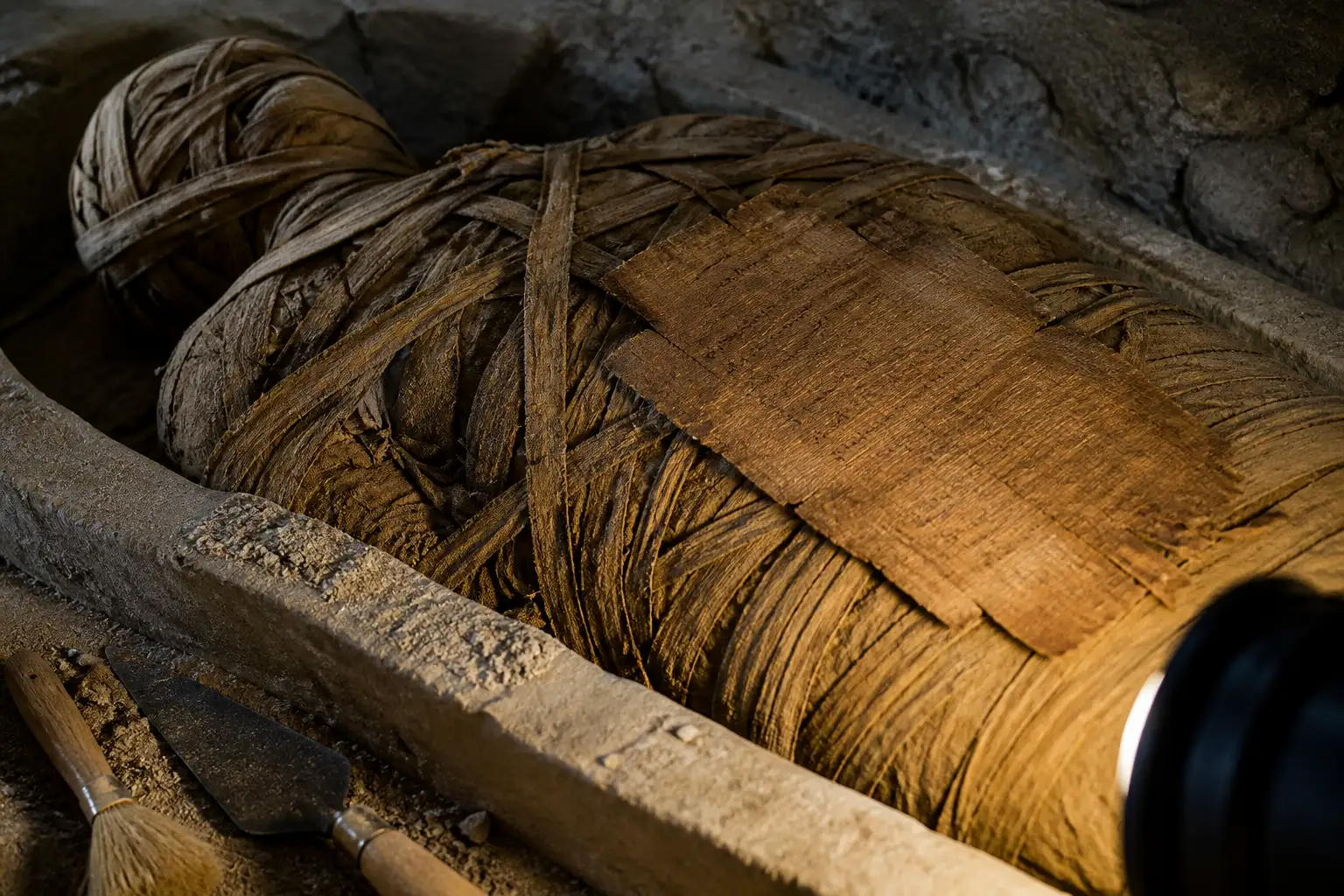
The tomb sits in sector 22 of the Al Bahnasa necropolis, tomb 65, excavated between November and December 2025. Inside, a Roman-era mummy lay with a papyrus fragment placed directly on its abdomen, positioned there on purpose during the embalming rather than tucked in as scrap wrapping.
A second research campaign in January and February 2026 brought conservators, papyrologists and classical philologists in to read the fragile sheet. The team confirmed the surviving handwriting matched Book II of the Iliad, specifically the passage listing Greek contingents and their ships massing for Troy, one of the poem’s most recognizable stretches.
Until this find, every Greek papyrus recovered from a mummy’s wrappings had carried magical or ritual text, formulas meant to protect or guide the dead through the underworld. Nothing resembling literature had turned up in that role in roughly 130 years of digging at Oxyrhynchus.
The Mission That Waited Three Decades
The Institute for Ancient Near East Studies at the University of Barcelona says the fragment is the first Greek literary text used this way. The discovery is credited to a mission Egyptologist Josep Padró founded in 1992.
Maite Mascort, an archaeologist with a doctorate from the University of Barcelona, and Esther Pons, curator of the Egyptian and Near Eastern Antiquities department at Spain’s National Archaeological Museum, now direct the work. Núria Castellano led the field team that opened tomb 65 in November and December 2025.
The mission has worked Oxyrhynchus every season since Padró’s first campaign, making it one of Spain’s longest-running archaeological commitments in Egypt. It operates with the backing of Egyptian antiquities authorities.
Two Digs, One Site, A Century Apart
Oxyrhynchus had been excavated before, just not gently. Bernard Grenfell and Arthur Hunt worked the site’s ancient rubbish mounds starting in 1896. Six digging seasons pulled roughly half a million papyrus fragments from the sand by 1907, most of them everyday paperwork the ancient town itself had thrown away: contracts, tax receipts, private letters, scattered among genuine literary works.
The table below sets the two campaigns side by side.
| Era | Led By | Years in the Field | Signature Find |
|---|---|---|---|
| Victorian rubbish-mound dig | Bernard Grenfell and Arthur Hunt | 1896 to 1907, six seasons | About half a million papyrus fragments, mostly everyday documents |
| University of Barcelona mission | Josep Padró, then Maite Mascort and Esther Pons | 1992 to 2026, ongoing | A funerary complex whose first examined mummy carried the Iliad |
Grenfell and Hunt were racing to save paper from decay and looting before it crumbled, and they succeeded at a scale no other Egyptian site has matched. What they were not doing was careful funerary archaeology. Tomb 65 required exactly that: controlled excavation of a burial context rather than a rubbish heap, the kind of work that takes decades to fund and staff.
Gold Tongues and the Tombs Next Door
Tomb 65 was not an isolated shaft. The 2025 and 2026 seasons opened a wider funerary complex cut into the necropolis bedrock, and the papyrus was only one part of what came out of it.
- Limestone burial chambers cut directly into the necropolis rock
- Roman-era mummies wrapped in decorated linen bandaging
- Painted wooden sarcophagi with surviving polychrome decoration
- Gold tongues placed in the mouths of several mummies, a known Greco-Roman Egyptian custom meant to let the dead speak before Osiris
- Clear signs that looters had already emptied other chambers in the same complex before archaeologists arrived
Whatever those looted tombs once held is gone now, sold off or destroyed long before this campaign began, with no record of what texts, if any, traveled with their occupants.
A Homeric Passage Carried Status Into the Grave
Researchers on the project describe the placement as deliberate rather than incidental. A funeral in Roman Egypt could fold a household’s education, status and religious hope into the objects buried with a body, and this one folded in literacy and Greek paideia (the classical ideal of a cultured education) as well.
The “Catalogue of Ships” names the contingents and commanders who sailed for Troy, among the most quoted passages of the entire epic. Placing it against a body suggests the text carried weight well beyond its story.
What we know:
- The fragment carries lines from the “Catalogue of Ships” in Book II, confirmed after the January and February 2026 analysis.
- It was placed on the mummy’s abdomen on purpose, not reused as packing material.
- No earlier Greek literary papyrus has been documented in that same funerary role, at Oxyrhynchus or anywhere else.
What is unconfirmed:
- The age, sex and social standing of the person inside the wrappings.
- Why this household, or the embalmer handling the burial, chose Homer’s war catalogue over any other text circulating in the city.
- Whether the looted chambers nearby once held comparable material that is now lost for good.
Egypt’s Ministry of Tourism and Antiquities has folded the find into its wider promotion of the country’s heritage sites. Minister Sherif Fathy called it part of a growing run of discoveries around Minya province that show the range of Egyptian civilization across eras, part of a tourism push that has also included the reopening of a previously closed New Kingdom tomb.
Could Oxyrhynchus Still Be Hiding More Homer?
Probably, though nobody can say where. Oxyrhynchus has been excavated for roughly 130 years and just produced a literary find nobody had documented before, with large sections of the funerary complex around tomb 65 still unexcavated. The Barcelona mission plans further seasons alongside Egyptian antiquities authorities on the chambers that remain.
Egyptian archaeology has had a run of these one-off firsts lately, including a cartouche linking Ramses III to a site in Jordan that reopened questions about the pharaoh’s reach. Grenfell and Hunt already proved Oxyrhynchus held papyri by the hundred thousand. The University of Barcelona team bet that slow, funerary-focused digging would eventually surface something those Victorian rubbish-mound seasons never touched. After thirty-four years, tomb 65 delivered exactly that.
Frequently Asked Questions
What is the Catalogue of Ships in Homer’s Iliad?
It is a long passage in Book II that lists the Greek kingdoms, commanders and ship counts that sailed for Troy, one of the most studied sections of the poem. Historians have long used it to argue about how the early Greek world organized itself into kingdoms and alliances. The Oxyrhynchus fragment preserves part of this same roll call.
Where exactly is Oxyrhynchus?
Oxyrhynchus lies beneath and around the modern town of Al Bahnasa in Minya governorate, about 190 kilometers south of Cairo. It served as a provincial capital in Greco-Roman Egypt, and its dry desert mounds have preserved Greek papyri since excavations began there in 1896.
Had literary papyri been found at Oxyrhynchus before this mummy?
Yes. The site has produced literary texts since Grenfell and Hunt’s original digs, alongside hundreds of thousands of everyday documents like tax receipts and letters. What is new is not the literature itself but the context: this is the first one ever documented as a deliberate part of a mummification rather than discarded rubbish.
How much of the Oxyrhynchus papyri collection is actually literature?
Literary texts make up only a fraction of the total haul, roughly one-tenth by most estimates. The rest is contracts, tax records, private letters and other everyday paperwork the ancient town discarded.
Why would a family bury a war epic with the dead?
Researchers on the project say Roman-era Egyptian funerals could fold a household’s education, status and religious hopes into the objects buried with a body. A Homeric passage, arguably among the most recognized texts in the Greek-speaking world at the time, would have carried that kind of symbolic weight well beyond its value as a story.
