
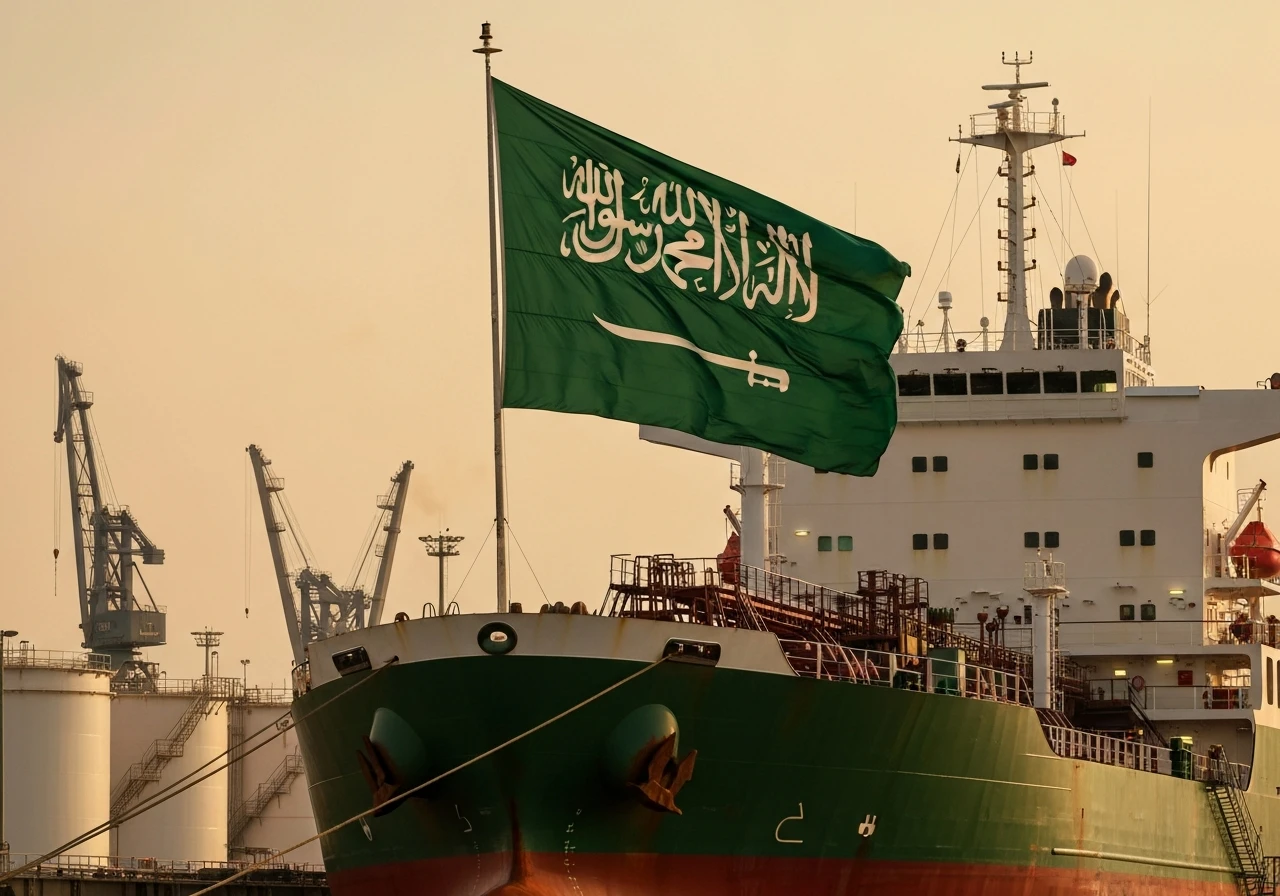
Saudi Arabia raised its national flag aboard two vessels on Monday, one at Ras Tanura Port on the Gulf coast and the other at Jeddah Islamic Port on the Red Sea, adding both hulls to a Saudi maritime fleet that already counts more than 400 ships. The Transport General Authority, the body that regulates the Kingdom’s land, rail and sea transport, oversaw both ceremonies.
Each event involved a single ship and a flag pole. Together they fit a longer campaign to move more vessels onto the Saudi flag and grow a registry that still sits far behind the open flags that handle most of the world’s cargo.
Two Ships, Two Coasts, One Authority
The eastern ceremony took place at Ras Tanura Port, the terminal that handles much of the crude pumped out of the Eastern Province. There the flag went up over a support vessel from the offshore support fleet operated by Rawabi Vallianz Offshore Services, a Dammam-based marine services company whose fleet runs to more than 200 vessels worldwide. The ship handles offshore support work and specialised marine services.
On the other side of the peninsula, at Jeddah Islamic Port on the Red Sea, the flag was raised over AL SAFA, an oil and chemical products tanker. Eng Essam Al-Ammari, the Transport General Authority’s acting deputy for the maritime sector, attended the event.
The authority cast the additions as evidence that owners trust its rulebook.
Raising the Saudi flag aboard the two vessels is a valuable addition to the national fleet and reflects growing confidence in the Saudi regulatory environment and maritime registry.
That language, carried by the Saudi Press Agency (SPA, the Kingdom’s state news service), is the tell. The ceremony is about the flag itself, not the steel underneath it.
Why a Flag-Raising Counts as Industrial Policy
A merchant ship can fly almost any country’s flag, no matter where its owner is based or where it was built. The country whose flag it flies, known as the flag state, sets the rules the vessel lives by. So when a ship is reflagged onto the Saudi register, it moves under Saudi law and Saudi inspection, and its tonnage starts counting toward the national fleet.
That is why a quiet pole-raising matters more than it looks. Reflagging keeps survey fees, registration charges and a slice of marine services inside the Kingdom rather than offshore. It also feeds demand for Saudi seafarers, classification work and the legal trade that grows up around a busy registry.
The flag a ship flies decides four things that owners weigh before they commit:
- The legal jurisdiction that governs the vessel and any dispute aboard it
- The safety, environmental and crewing standards the ship must meet
- The taxes, tonnage dues and registration fees the owner pays
- The diplomatic protection the vessel can claim if it is detained, attacked or stranded at sea
That last point has stopped being abstract. Renewed attacks on commercial shipping near the region, including the kind of incident that left crews held captive and pushed Cairo into talks with Somalia over hijacked sailors, have made the question of who answers for a ship at sea a live commercial concern. A national flag, backed by a coast guard and a navy, is part of what an owner buys. The Transport General Authority’s maritime registry rules are the product Riyadh is trying to sell against cheaper, looser alternatives.
The Fleet Behind the Two New Hulls
The two ships join a register that had already grown to a useful size. By 2022, the number of ships flying the Saudi flag had reached 426, with combined tonnage above 13.5 million tons, a mix of tankers, bulk carriers and offshore support craft.
Much of that weight sits with one operator. Bahri, the national shipping carrier, runs one of the larger crude tanker fleets in the world and anchors the Kingdom’s blue-water presence, while companies like Rawabi Vallianz supply the offshore vessels that service the oilfields. Against that base, two extra hulls barely move the total. The point is the direction of travel, not the size of the step.
Where the Saudi Flag Sits in the Global Order
To see why Riyadh treats each reflagging as a win, look at who dominates the business. World shipping tonnage is concentrated in a handful of open registries that sell their flags to foreign owners on price and convenience.
| Flag state | Share of world capacity (deadweight tons) | Position |
|---|---|---|
| Liberia | 17.4% | Largest registry |
| Panama | 15.2% | Second |
| Marshall Islands | 12.5% | Third |
| Top three combined | 46.5% | As of January 2025 |
Those three flags alone controlled 46.5 per cent of global capacity in deadweight tonnage (DWT, the weight a ship can safely carry) at the start of last year. They win that share by offering low fees, light tax and fewer strings, the classic flag of convenience (FOC) bargain that lets an owner register cheaply far from home.
The Saudi flag plays a different game. It is a national register tied to a real economy, real ports and a regulator that wants the sector to grow, not a mailbox in a small state. That makes the sell harder and slower, because owners have to be persuaded rather than simply offered the lowest invoice.
The Vision 2030 Targets Beneath the Ceremony
The flag campaign only makes sense against the numbers Riyadh has set for the next few years. The Kingdom wants transport and logistics to carry a far bigger share of a less oil-dependent economy, and the maritime sector is central to that bet.
The headline targets, drawn from the Kingdom’s logistics plans, are steep:
- 40 million TEU in annual container throughput by 2030, more than quadrupling current volumes, where TEU means twenty-foot equivalent unit, the standard container measure
- SAR 25 billion (about $6.7 billion) in maritime investment already being deployed across ports and services
- A place in the global top 10 on the Logistics Performance Index (LPI, the World Bank’s trade-efficiency ranking)
- Transport and logistics lifted to 10 per cent of gross domestic product, generating roughly SAR 45 billion a year in non-oil revenue
The plumbing is starting to show movement. In September 2025, Saudi ports handled 22.52 million tonnes of cargo, up 8.6 per cent on the same month a year earlier, as expansions at Jeddah Islamic Port and King Abdullah Port came online. The wider ambition, set out in the National Transport and Logistics Strategy targets, is to make the Kingdom the leading maritime and aviation hub in the Middle East.
Geography is the lever. With coasts on both the Gulf and the Red Sea, Saudi Arabia sits beside the trade lanes that feed Europe and Asia, the same logic behind the India-Middle East-Europe corridor and the wider logistics program goals under the 2030 plan. A growing home flag is one way to make sure some of the value from those routes stays onshore.
What the Registry Has to Prove Next
The hard part is winning tonnage from registries that have spent decades sharpening their offer. Open flags compete on cost and speed, and an owner reflagging to Saudi waters wants to know the paperwork, the inspections and the fees will not slow the ship down or price it out.
That is the test behind the confidence the authority keeps citing. Each vessel that switches is a small vote that the Saudi rulebook is workable, that detentions and surveys are predictable, and that the flag carries weight when a ship runs into trouble far from home.
The container and throughput goals are measurable and public, so progress there will be easy to score by the end of the decade. The registry’s growth is quieter and harder to track, ship by ship, flag pole by flag pole.
If the Kingdom can keep converting owners at a faster pace than two hulls at a time, the national fleet becomes a real instrument of trade policy. If reflaggings stay ceremonial and rare, the Saudi flag remains a symbol on a small fleet while the cargo keeps moving under someone else’s colours.
