
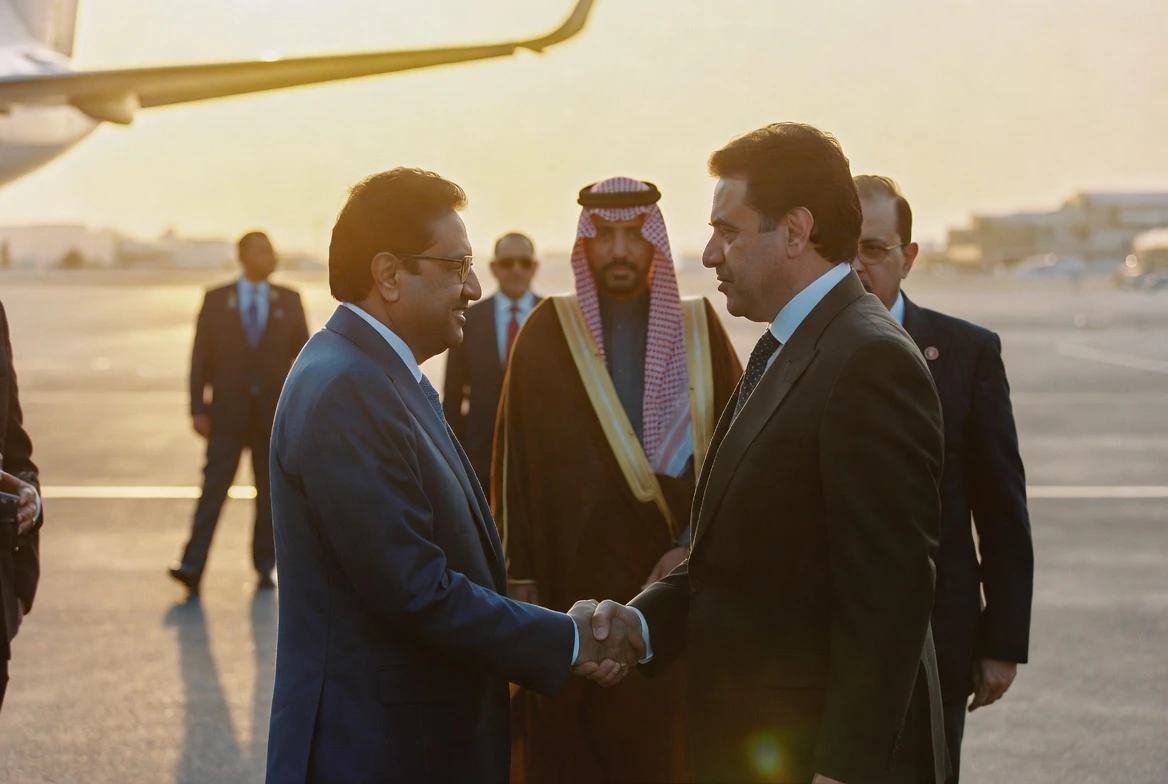
Pakistan’s Interior Minister Mohsin Raza Naqvi arrived in Riyadh on Tuesday for talks with his Saudi counterpart on internal security and counter-narcotics. The Saudi Press Agency reported the arrival at King Khalid International Airport, where Naqvi was received by Interior Minister Prince Abdulaziz bin Saud bin Naif bin Abdulaziz. The trip is the latest in a sequence of senior interior-ministry engagements that have stepped up since Pakistan and Saudi Arabia signed their Strategic Mutual Defence Agreement in September 2025.
According to SPA, the visit focuses on enhancing bilateral cooperation in internal security, counter-narcotics, and “other areas of mutual interest.” Naqvi was also welcomed at the airport by Deputy Governor of the Riyadh Region Prince Mohammed bin Abdulrahman bin Abdulaziz and Saudi Ambassador to Pakistan Nawaf bin Said Al-Malki. Reporting from The Diplomatic Insight says the meeting between the two interior ministers went deeper: it covered intelligence sharing, capacity building, and a coordinated response to emerging security threats. The two sides agreed to launch a training exchange program for police and paramilitary forces, and scheduled the next meeting of the Pakistan-Saudi Arabia Interior Ministries Working Group for the following month. Naqvi framed Saudi Arabia as a second home for Pakistanis and pitched the engagement as the operational follow-through on the September 2025 pact.
What the Two Interior Ministers Covered
The talks between Naqvi and Prince Abdulaziz ran past the pre-arrival agenda. The Saudi-hosted session covered intelligence sharing, capacity building, and coordinated efforts to counter emerging security threats, according to The Diplomatic Insight’s account of the meeting. Both ministers reaffirmed their commitment to expanding strategic cooperation between the two countries. Pakistan’s Interior Secretary Muhammad Khurram Agha, Ambassador to Saudi Arabia Ahmad Farooq, Commandant Federal Constabulary Nazir Gaara, and Commandant National Police Academy Muhammad Idrees attended alongside senior officials from the Saudi Interior Ministry.
A substantial portion of the meeting focused on the long-standing legal status of Rohingya Muslims residing in Saudi Arabia. Prince Abdulaziz thanked Naqvi for Pakistan’s continued support and efforts on the file. He also offered condolences over the recent attack on the Federal Constabulary Headquarters in Peshawar, acknowledging the service and sacrifice of the personnel killed.
The Riyadh session followed the higher-profile Strategic Mutual Defence Agreement that Pakistan and Saudi Arabia signed at Al-Yamamah Palace on September 17, 2025. The pact commits both countries to treating any act of aggression against one as an act against both. The interior ministries, which met in Riyadh, run the operational channels of training, intelligence sharing, and counter-narcotics enforcement. The Diplomatic Insight described the new training exchange as marking “a new phase of professional collaboration.” The meeting set a date for the next Pakistan-Saudi Interior Ministries Working Group, the standing channel between the two ministries.
A Training Exchange and a Working Group Schedule
The most concrete output of the Riyadh meeting is a training exchange program for police and paramilitary forces. The Diplomatic Insight reported that the two sides agreed to launch the program during Naqvi’s visit. The exchange marks what the publication called “a new phase of professional collaboration” between the two interior ministries.
A second commitment sets a calendar: the next meeting of the Pakistan-Saudi Arabia Interior Ministries Working Group will be held the following month. The working group is the standing bureaucratic channel through which the two interior ministries coordinate on training, intelligence sharing, and counter-narcotics operations. The structure has run beneath the public-facing SMDA since the September 2025 signing. The training exchange will run alongside it.
- Launch the police and paramilitary training exchange program
- Convene the next Pakistan-Saudi Interior Ministries Working Group meeting
- Continue intelligence-sharing and counter-narcotics coordination
- Follow up on the legal status of Rohingya Muslims in Saudi Arabia
The Defence Pact Hanging Over the Visit
The Strategic Mutual Defence Agreement signed on September 17, 2025 frames every Saudi-Pakistan security engagement now. The pact was signed at Al-Yamamah Palace in Riyadh by Saudi Crown Prince and Prime Minister Mohammed bin Salman and Pakistani Prime Minister Shehbaz Sharif during Sharif’s state visit. Under the agreement, both countries committed to treating any act of aggression against one as an act against both.
The Belfer Center for Science and International Affairs, in an analysis unpacking the strategic defence pact’s actual scope, called the agreement “primarily a political signal of solidarity and strategic cooperation, rather than an unconditional war guarantee.” Reuters, citing anonymous Pakistani government sources, said the pact provides for the possibility of up to 80,000 Pakistani troops being deployed to Saudi Arabia alongside Saudi forces. The text of the agreement has not been officially published. Pakistan has trained between 8,000 and 10,000 Saudi military personnel since the 1960s.
In 2026, during the Iran War, Saudi Arabia reportedly invoked the SMDA. Pakistan initially deployed at least 8,000 troops, along with 16 aircraft, and two squadrons of drones.
The interior ministry track predates the September 2025 pact. Counter-narcotics has long been a standing item on the Pakistan-Saudi security agenda. Naqvi’s role as Minister for Interior and Narcotics Control places the narcotics file inside the interior ministry portfolio, in line with the Saudi structure that runs the file from the Interior Ministry. The two outputs from the visit, the training exchange and the working group calendar, sit inside the SMDA’s bilateral cooperation framework. Pakistan has run joint training programmes with Saudi Arabia’s security services since the 1960s.
| Pillar | Before September 2025 | After September 2025 |
|---|---|---|
| Strategic commitment | Long-running military and economic cooperation | SMDA signed 17 September 2025; “aggression against one is aggression against both” |
| Troop deployments | Ad hoc training missions; 8,000 to 10,000 Saudis trained in Pakistan since the 1960s | Up to 80,000 Pakistani troops possible under pact; at least 8,000 deployed during 2026 Iran War |
| Interior ministry coordination | Bilateral drug and security pacts; working-level exchanges | Standing Pakistan-Saudi Interior Ministries Working Group; new training exchange programme |
Counter-Narcotics and the Rohingya Question
Counter-narcotics is one of the explicit pillars of the visit. The Business Recorder account of the trip lists “counter-narcotics” alongside internal security and “other areas of mutual interest” as the expected agenda.
The narcotics track sits inside the interior ministry portfolio in both capitals, a structural detail that explains why the file shares a meeting room with intelligence sharing and internal security work. Naqvi is Pakistan’s Minister for Interior and Narcotics Control, with narcotics enforcement housed in his portfolio rather than a separate agency. The Saudi Interior Ministry runs the kingdom’s drug enforcement apparatus, the structural counterpart. Saudi Arabia’s drug enforcement is housed inside the Interior Ministry in the same arrangement, so the file lives at the same bureaucratic level on both sides. The July 2026 meeting gives both sides a slot to update standing arrangements within the framework of the SMDA and the working group calendar.
The other substantive item on the agenda is the legal status of Rohingya Muslims residing in Saudi Arabia. The Diplomatic Insight reported that “a significant portion of the discussion” addressed the issue, with Prince Abdulaziz thanking Naqvi for Pakistan’s continued support and efforts on the matter. The Saudi interior ministry’s continued willingness to discuss the file gives Pakistan a direct channel for the question.
The Saudi Receiving Line
The Saudi receiving line at King Khalid International Airport listed Interior Minister Prince Abdulaziz bin Saud bin Naif bin Abdulaziz. Naqvi was welcomed by his Saudi counterpart at the airport. The ministers’ December 2024 meeting in Riyadh is on the record in a published readout of that session.
Also on the tarmac were Deputy Governor of the Riyadh Region Prince Mohammed bin Abdulrahman bin Abdulaziz and Saudi Ambassador to Pakistan Nawaf bin Said Al-Malki. The Business Recorder account listed “other senior officials” without naming them, and the Saudi Press Agency carried the photographs that Arab News published. The deputy governor represents the regional tier of Saudi governance, while Al-Malki carries the bilateral ambassadorial brief from Riyadh to Islamabad. The Saudi protocol placed the interior minister, the deputy governor, and the ambassador to Pakistan together for the arrival.
The Saudi counterpart’s condolence over the Peshawar Federal Constabulary Headquarters attack is also on the record. The Diplomatic Insight reported that Prince Abdulaziz expressed condolences to the families of personnel killed. He also acknowledged the service and sacrifice of the personnel, according to the meeting readout. Prince Abdulaziz’s condolence appears alongside the other agenda items in the meeting’s published account. The Federal Constabulary’s leadership attended the meeting on the Pakistani side, with Commandant Nazir Gaara listed among the delegation.
Naqvi spoke about the relationship between Pakistan and Saudi Arabia during the meeting. The visit took place under the SMDA framework Pakistan and Saudi Arabia signed in September 2025. Under the pact, Pakistani military and security personnel can be deployed to Saudi Arabia alongside Saudi forces.
a second home for every Pakistani
Naqvi described Saudi Arabia as a second home for every Pakistani during the Riyadh meeting, as reported by The Diplomatic Insight.
Why This Comes Now
The July 2026 interior ministry visit lands in a specific window. Saudi Arabia invoked the SMDA during the 2026 Iran War, and Pakistan deployed at least 8,000 troops, 16 aircraft, and two squadrons of drones to the kingdom. Reuters, reporting on the deployment, described the scale as more than a merely symbolic or advisory mission. An analysis of the pact’s extended deterrence implications describes it as setting a precedent for deterrence in the Gulf. The next Pakistan-Saudi Interior Ministries Working Group meeting is scheduled for the following month.
The September 2025 pact set the strategic commitment. The July 2026 interior ministry meeting set the training exchange and the working group calendar. The Diplomatic Insight called the meeting “a new phase of professional collaboration” between the two interior ministries.
