
At the Kololo Ceremonial Grounds in Kampala on Monday morning, Jacob Oboth-Oboth raised his right hand and accepted the gavel of Uganda’s 12th Parliament with 441 votes behind him, against 60 for the National Unity Platform’s Paul Mwiri and 15 for the Democratic Party’s Norbert Mao. Two weeks earlier the same chair belonged to Anita Among, the speaker who had run the previous house with a heavier whip than any of her predecessors.
Among’s exit took 13 days from the moment Gen. Muhoozi Kainerugaba, the country’s Chief of Defence Forces and chairman of the Patriotic League of Uganda (PLU, a political vehicle the general launched in February 2024), publicly rescinded his endorsement of her speakership bid. Ugandan analysts watching the sequence keep reaching for the same comparison: the script King Salman used in Riyadh between 2015 and 2017 to install his son Mohammed bin Salman (MBS) as crown prince.
Two Weeks That Rearranged Kampala
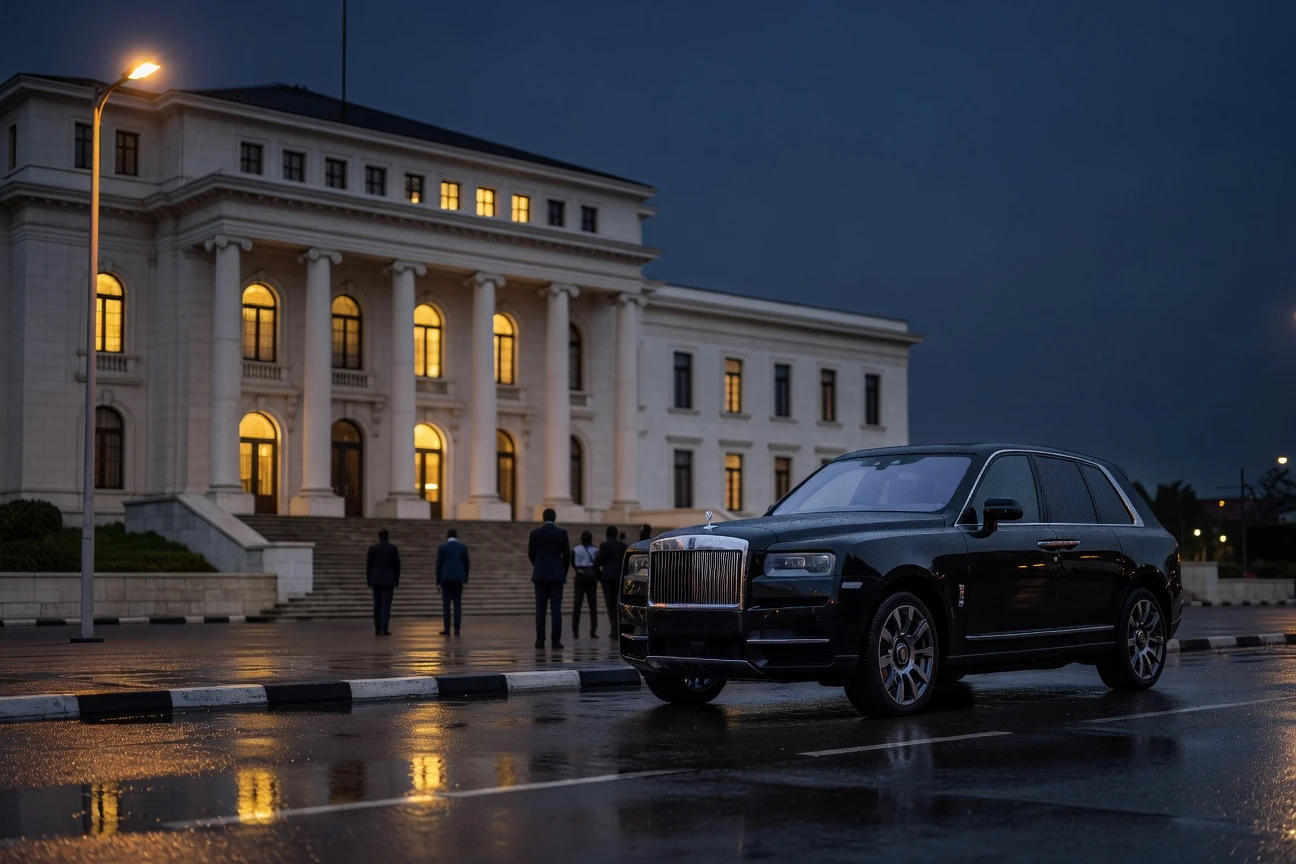
The trigger was a car. On May 12, two days after the Daily Monitor reported that Among had taken delivery of a Rolls-Royce Cullinan worth roughly half a million US dollars, the PLU released a statement withdrawing the endorsement it had handed Among and her deputy Thomas Tayebwa back on March 11. Muhoozi had previously told leaders associated with “extravagant lifestyles” that they were no longer welcome inside the league.
What followed was less a political negotiation than a coordinated takedown. Plainclothes detectives, backed by Crime Intelligence and Defence Intelligence operatives, fanned out across Among’s homes in Nakasero, Ntinda, Kigo and Bukedea, sealing rooms, towing vehicles, bagging cash and jewelry.
- May 12, 2026: PLU rescinds its March 11 endorsement of Among and Tayebwa for speaker and deputy speaker.
- May 16: Coordinated raids on four Among residences; police seize a Shs3.4 billion Rolls-Royce Cullinan and at least five other luxury vehicles.
- May 18: Among withdraws from the speakership race, citing the corruption probe.
- May 20: Muhoozi endorses Defence Minister Jacob Oboth-Oboth, calling him “the best minister in government for the last five years.”
- May 25: Oboth-Oboth elected speaker at Kololo with 441 of the votes cast, in a session attended by President Yoweri Museveni.
- May 26: Investigators extend the probe to bank accounts of cleaners, security guards and other Parliament staff close to the former speaker.
By the time Oboth-Oboth raised his hand on Monday, the chamber had a new speaker, a new pecking order, and a new understanding of who decides career mortality inside the ruling movement. The previous occupant of the chair had publicly endorsed Muhoozi for president of the National Resistance Movement (NRM) less than a year earlier.
The Saudi Script, Annotated
The book Blood and Oil, by American journalists Bradley Hope and Justin Scheck, traces the same arc inside the House of Saud across three discrete stages. None of the stages looks decisive on its own. Stacked, they form the template now being executed in Kampala.
The 2015 Soft Demotion
King Salman ascended the Saudi throne in January 2015 and within months installed his son MBS at the Defence Ministry at age 29, then made him deputy crown prince in April. The reigning crown prince at the time, Mohammed bin Nayef (MBN, the long-serving interior minister who had built Saudi counter-terror cooperation with Washington), kept his title and his portfolio. The hierarchy on paper was unchanged. The flow of files and the patronage that travelled with them quietly bent toward the deputy.
The June 2017 Switch
On June 21, 2017, the king signed a decree that named MBS crown prince and relieved Mohammed bin Nayef of all positions. There was no public protest, no rival faction inside the royal court ready to push back. President Donald Trump called Riyadh that day to congratulate the new heir. The senior generation of princes who might have objected had spent two years watching MBS accumulate the levers; by the time the formal swap arrived, the contest was already over.
The Ritz-Carlton Lesson
On November 4, 2017, Saudi security forces detained more than 200 princes, ministers and businesspeople, including the world’s richest Arab investor at the time, Prince Al-Waleed bin Talal. The detainees were held inside the Riyadh Ritz-Carlton hotel for weeks. The Saudi government later said the campaign recovered roughly $800 billion in assets and cash, a figure independent reporting could not verify, though no detained prince emerged with his old portfolio intact. The label on the program was anti-corruption; the operational effect was to remove every wealthy figure who could finance a future rival faction.
Where Muhoozi’s Climb Lines Up With Riyadh’s
Putting the two cases side by side surfaces a sequence unusually tight for political parallels, which tend to be loose by nature. The Ugandan timeline runs about a decade behind, but the staging order is recognisable to anyone who watched Riyadh in the mid-2010s.
| Dimension | Saudi Arabia (King Salman to MBS) | Uganda (Museveni to Muhoozi) |
|---|---|---|
| Patriarch in power since | January 2015 (heir to Al Saud rule from 1932) | January 1986 |
| Heir’s first major office | Defence Minister, 2015 (age 29) | Special Forces Command, 2008 |
| Heir’s apex military rank | Deputy PM, retained Defence portfolio | Chief of Defence Forces, March 21, 2024 |
| Pivotal rival displaced | Crown Prince Mohammed bin Nayef, June 2017 | Speaker Anita Among, May 2026 |
| Mechanism for displacement | Royal decree plus Ritz-Carlton detentions | PLU endorsement reversal plus corruption raids |
| Heir’s personal political vehicle | Court of the Crown Prince, expanded Royal Court | Patriotic League of Uganda, February 2024 |
The piece that does not yet exist in Uganda is the equivalent of the June 21, 2017 decree. Museveni won re-election in January 2026 for a term running to 2031, and he has not appointed a vice president from his own family, nor amended the constitution to ease the succession of a kin. The dispatching of Among is what political scientists call a precondition step; it clears the legislature of a figure who could have led an internal NRM bloc, without yet declaring the transfer of the top office itself.
Cultivating Washington and Jerusalem
The second piece of the Saudi script Muhoozi has copied with the most diligence is foreign-capital diplomacy. MBS spent the run-up to his elevation cultivating Western financial press, hosting receptions for Wall Street executives, and orchestrating set-piece visits to Washington that put him in framed photographs next to American presidents. The recent Jeddah talks with Italian Prime Minister Giorgia Meloni show the same instinct at work nearly a decade later. The Ugandan version runs through ambassadors and military attachés in Kampala.
It is hard to come across photos of Muhoozi meeting the ambassador of DRC or Nigeria in Uganda, or say the military attachés of these nations. However, there are tens of photos of him meeting ambassadors and other diplomats from Germany, the UK, the US.
That assessment is from Godwin Toko, a Kampala-based activist and political commentator, in remarks to The Independent. Muhoozi has hosted the German ambassador and the US embassy’s senior team at Mbuya barracks, and has normalised public ties with Israel to a degree no Ugandan predecessor attempted.
That last decision now carries cost. During the brief US and Israeli war with Iran in mid-2025, Muhoozi posted a barrage of statements on X offering up to 100,000 Ugandan troops to defend what he called the Holy Land, and threatening to cut diplomatic ties with Türkiye within 30 days. The Iranian embassy in Kampala filed a diplomatic note of protest. In Washington, Senator Jim Risch, chairman of the Senate Foreign Relations Committee, said the posts “crossed a red line” and signalled a review of US security cooperation with Uganda. None of those costs has yet hardened into sanctions, which is the gap MBS exploited a decade earlier and which Muhoozi appears to be betting will hold.
Where the Playbook Breaks Down
The parallel has limits, and they matter. Saudi Arabia is a monarchy whose constitution recognises only the House of Saud as the source of sovereign legitimacy. Uganda is, on paper, a republic whose 2017 constitutional amendment lowered the presidential age floor to 18 and theoretically opens the office to any citizen. The vehicle of transfer that the Saudi system supplies by default, Uganda has to manufacture.
Four divergence points are now visible:
- Electoral cover is required. Muhoozi cannot inherit without a vote of some kind, and the 2031 general election is the working deadline.
- The PLU is not yet the royal court. It functions as a pressure group inside the NRM, but does not control the cabinet, the treasury, or the security organs as fully as the Saudi crown prince’s office does in Riyadh.
- No oil-revenue backstop. First crude from the Lake Albert basin and the East African Crude Oil Pipeline is targeted for 2026 to 2027 first production, but at scale far below Saudi cash flows.
- Social-media volatility carries diplomatic costs MBS avoided. The “in my basement” admission about Bobi Wine’s bodyguard Eddie Mutwe in May 2025, and the Iran-war posts of mid-2025, generated friction the MBS operation kept off the wires through tighter message discipline.
Inside the NRM itself, survey work published in a 2026 paper in Oxford’s African Affairs journal on Ugandan attitudes to Muhoozi finds the general significantly less popular than his father across all regions and age groups. The patriarch’s personal brand is doing work the heir cannot yet replicate, which is the headline risk facing every dynastic transition the moment the elder figure exits the stage.
The 2026 Calendar Closes In
Museveni was sworn in for a sixth full term in May 2026 after winning the January poll, extending his time in office to a projected 45 years by 2031. He turns 87 that year. The succession question now sits inside a fixed window of roughly five years, in which the patriarch must either anoint Muhoozi formally, amend the constitution again to dissolve the term limit altogether, or stage-manage an interim figure.
The pieces moving in 2026 are the speakership, now settled with Oboth-Oboth’s election at the Parliament of Uganda, the cabinet reshuffle expected before the August recess, and the question of whether a vice-presidential vacancy is engineered for Muhoozi to fill. The president’s recent Cairo investment push to court Egyptian capital reads as continuity work the elder Museveni still personally controls. In Riyadh, the equivalent intermediate step was MBS’s appointment as deputy crown prince in April 2015, fourteen months before the formal swap of titles arrived.
If Museveni follows the King Salman timing, a vice-presidential appointment for Muhoozi before the end of 2027 puts the constitutional handover within reach of the next election cycle. If he hesitates, the PLU’s growing independence inside the NRM starts to read less as preparation for transition and more as a parallel sovereignty operating out of the defence-headquarters office at Mbuya. Either way, the next move sits with the patriarch, and the script he is reading from was written in Arabic.
