
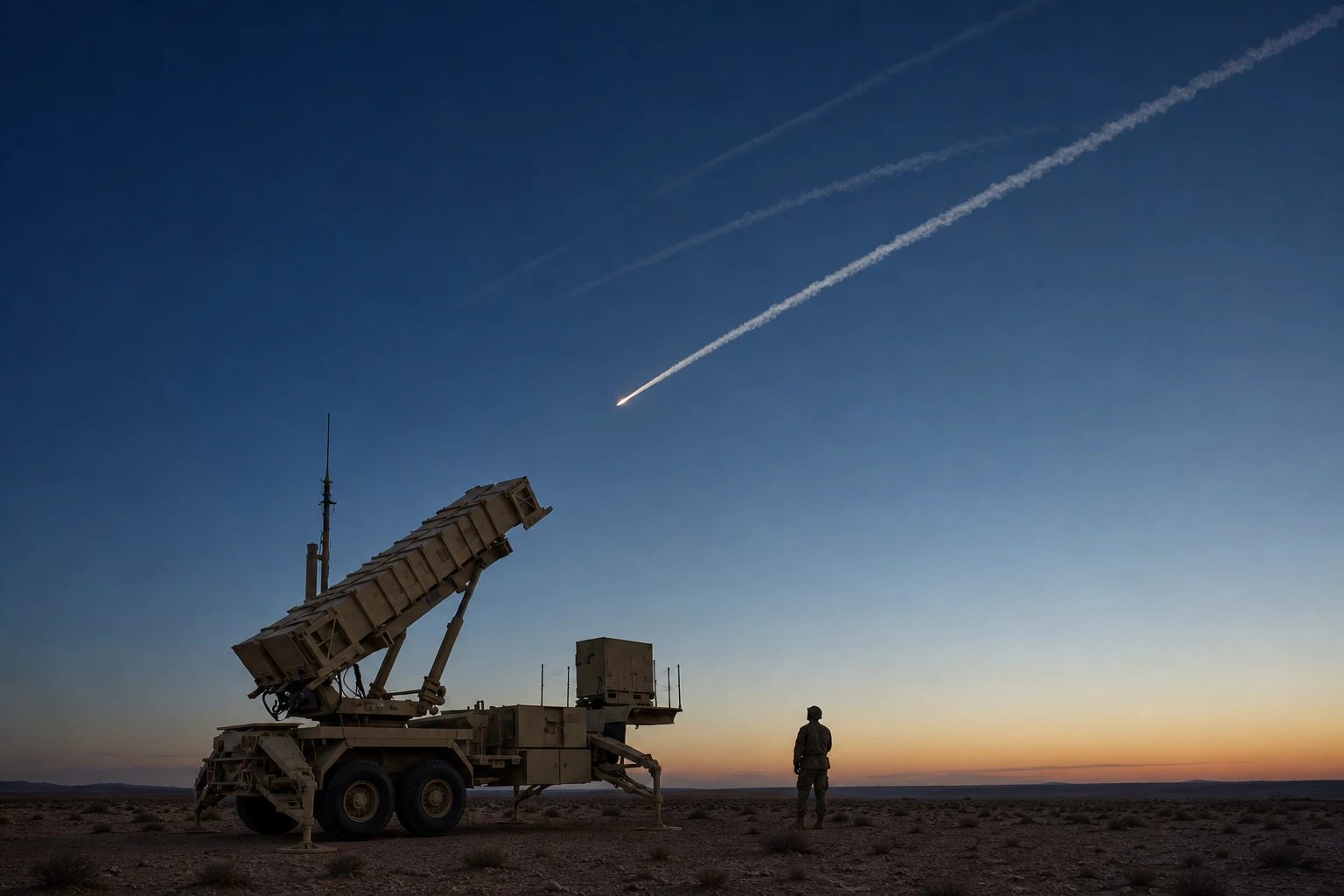
Jordan’s military said Friday it shot down three missiles fired from Iranian territory before dawn, the sixth interception the kingdom has disclosed in nine days. No injuries or damage were reported, according to a statement carried by the state-run Petra news agency and relayed by The Associated Press.
Six interceptions in nine days works out to roughly one every day and a half. Jordan has sustained that pace even though it insists it is not a party to the war between the United States and Iran. Each night’s shootdown looks routine on its own. Stacked together, they trace how deep Amman has been pulled into a fight it did not start.
Debris Over Amman, Again
The Jordan Armed Forces, known formally as the Arab Army, said air defense crews tracked the three missiles as soon as they crossed from Iranian airspace and destroyed them before impact. Royal Engineering Corps teams were sent to clear debris at several sites, the same procedure the military has followed after every interception this month.
Friday’s shootdown was the sixth Jordan has disclosed since July 9, when crews downed eight missiles that Iran’s Islamic Revolutionary Guard Corps (IRGC, the branch of Iran’s military that runs its ballistic missile and drone program) said it fired at the Muwaffaq Salti air base in Azraq, a facility that hosts American aircraft. Jordan said eight of the ten missiles Iran claimed to have launched were intercepted, with no casualties or damage.
| Date | What Jordan Reported | Casualties or Damage |
|---|---|---|
| July 9 | 8 of 10 missiles aimed at Azraq air base intercepted | None reported |
| July 12 | 3 missiles fell at several locations | None; minor material damage |
| July 14 | 4 missiles intercepted over Jordanian airspace | None reported |
| July 15 | 3 ballistic missiles intercepted before dawn | None reported |
| July 16 | 8 missiles intercepted before dawn | None reported |
| July 17 | 3 missiles intercepted before dawn | None reported |
Jordan’s military says it has intercepted more than 92 percent of the Iranian fire aimed at the kingdom since the war widened in late February, downing 261 of 281 projectiles by one tally of its own statements published July 9. The 20 that got through mostly fell as debris rather than hitting anything Jordan has been willing to describe publicly.
How a Fragile Ceasefire Fell Apart
The war traces back to February 28, when the United States and Israel opened a joint bombing campaign that killed Iran’s Supreme Leader on the conflict’s first day. Ayatollah Ali Khamenei’s death triggered months of retaliatory missile and drone fire across the region.
A truce held for about two weeks in April. A longer memorandum of understanding followed in June, signed by President Donald Trump and Iranian President Masoud Pezeshkian, but it began fraying almost immediately over who controls shipping through the Strait of Hormuz.
By July 8, the interim deal had collapsed outright after strikes from both sides. The United States reimposed a naval blockade on Iranian ports on July 14 and has since run consecutive nights of strikes, hitting dozens of targets in a single seven-hour mission, according to U.S. Central Command (CENTCOM, the military command overseeing American forces in the Middle East).
Iran’s Revolutionary Guard has answered by promising to keep hitting the bases the United States flies from, and Jordan hosts some of the busiest. The Soufan Center, a research group that tracks the conflict closely, said the standoff was likely to settle into a stalemate neither side can escalate out of, with both Washington and Tehran wary of returning to major combat. That stalemate is what keeps producing nights like Friday’s over Jordan.
Jordan Is Not Alone in the Blast Radius
The same week that produced Jordan’s three interceptions also brought strikes on four of its neighbors.
- Kuwait: a navy vessel was struck on July 14, wounding four sailors, while air defenses intercepted dozens of drones and missiles through the week.
- Bahrain: home to the headquarters of the U.S. Navy’s 5th Fleet, one of the region’s most frequently targeted sites since February.
- Qatar: hit for the first time since April, with Iran’s Revolutionary Guard claiming it destroyed a jet maintenance center and command facility.
- Oman: struck even as it hosts mediation talks between Washington and Tehran, prompting a formal protest to Iran’s ambassador.
Jordan’s own toll has stayed lighter than some of those neighbors’, but not costless. Petra’s March bookings fell to zero, the Jordan Times reported, as the war’s opening weeks scared off visitors. The kingdom has kept pushing civilian projects forward regardless, including the smart bus corridor it extended between Ma’an and Amman this year.
Why Won’t Jordan Say It Was Hit?
Jordan’s Foreign Ministry has repeatedly condemned Iranian strikes on the United Arab Emirates, Bahrain, Oman, Qatar and Kuwait as violations of sovereignty. In similar statements, it has not once mentioned the missiles landing inside Jordan itself, a gap Jordanian commentators say reflects the government’s effort to avoid being cast as a combatant in a war it calls someone else’s.
Officials frame every interception as ordinary self-defense, carried out in accordance with approved operational and defensive procedures that predate the war. Jordan’s military reaffirms after each one that it will not allow any violation of the kingdom’s airspace.
The American presence has made military installations inside Jordan legitimate targets in the eyes of Iran and its proxies.
AmmanNet editor-in-chief Mohammad Ersan said the government’s dilemma predates this week’s strikes. Veteran lawmaker Saleh al-Armouti has gone further, publicly demanding the government expel the bases altogether. Jordanian tribal leader Sheikh Mohammed Khalaf Hadid has pointed back to 1991, when the late King Hussein kept Jordan out of the American-led coalition against Iraq, calling that restraint a model this generation’s leadership abandoned.
The Kingdom Has Absorbed Other Wars Before
Jordan intercepting other countries’ missiles is not new. In April 2024, when Iran launched a barrage of drones and missiles at Israel after an Israeli strike on its consulate in Damascus, Jordan shot down dozens of the projectiles crossing its airspace, coordinating with the United States, Britain and France, Reuters reported at the time.
Jordan did the same in June 2025, during the Twelve-Day War between Israel and Iran, when Royal Jordanian Air Force jets again intercepted projectiles passing overhead toward Israel. In both cases, Jordan was mostly in the way of a fight aimed elsewhere.
This year is different. Since February, Iran has named Jordanian bases as targets in their own right, not just flight paths, and the IRGC has warned that other American installations in the region will not be spared if U.S. strikes continue. Jordan has gone from incidental flight path to named target.
What Gets Confirmed and What Doesn’t
Nearly every claim in this war arrives twice, once from Tehran and once from whoever got hit, and the two versions rarely match. Jordan’s case is no exception.
- Confirmed: Jordan’s military has issued near identical statements after each interception this month, each reporting zero casualties and describing debris cleared by Royal Engineering Corps teams.
- Confirmed: Iran’s Revolutionary Guard has publicly claimed responsibility for strikes on Jordanian bases, including Azraq, and has threatened further attacks if U.S. strikes continue.
- Unconfirmed: viral social media clips claiming Iranian missiles pierced Patriot defenses and struck King Faisal Air Base directly have not been independently geolocated.
- Unconfirmed: the full extent of any damage to U.S.-linked radar or command equipment inside Jordan, beyond an acknowledged Terminal High Altitude Area Defense (THAAD) radar the U.S. is replacing, remains undisclosed.
The Pentagon has kept quiet on specifics for its own reasons. At least 228 structures or pieces of equipment across the region’s American-linked bases have been damaged or destroyed since February, the Washington Post reported in May, a tally that predates weeks of additional strikes. Asked for specifics on Jordan, a Pentagon official told the Washington Examiner only that the department does not discuss battle damage assessments for operational security reasons.
The Interceptors Are Not Unlimited
Jordan has not disclosed how many interceptor missiles it has left, but the regional pattern is not encouraging. Saudi Arabia’s Patriot PAC-3 batteries, a system built specifically for ballistic missile defense rather than adapted to the role like Jordan’s Hawk batteries, were reported at roughly 86 percent depletion from pre-crisis inventory levels.
Former U.S. Central Command commander Joseph Votel told the Washington Examiner that Iran’s missile and drone reach was a known problem well before this war began. “We’ve known for some time that they were developing these missile and drone capabilities,” he said, adding that it would factor into how the Pentagon thinks about basing troops in the region going forward.
Analysts see little chance of a durable fix soon. Council on Foreign Relations senior fellow Ray Takeyh told NPR that a new truce would likely mean kicking the issue further down the road rather than resolving it, with the alternative being more of the same escalation. Mediators from Qatar, Pakistan and Oman are still trying to rebuild the collapsed agreement, with no new round of talks announced as of Friday.
Frequently Asked Questions
Is Jordan formally part of the US-Iran war?
No. Jordan describes itself as neutral and says it is not a party to the conflict. The government maintains it hosts no foreign bases as such, though roughly 4,000 U.S. troops operate from Jordanian facilities under existing defense cooperation agreements. Jordanian forces say they act only in self-defense when projectiles enter their airspace.
Why does Iran keep targeting Jordan specifically?
Iran’s Revolutionary Guard has said it is retaliating against the American aircraft and support operations based in the kingdom. Satellite images published by The New York Times showed more than 60 strike aircraft, including F-35 jets, along with 68 cargo planes massed at Jordan’s Muwaffaq Salti air base in the days before the war widened again in July.
Have any of the strikes on Jordan caused casualties?
The recent run of interceptions, from July 9 through July 17, has produced no reported deaths or injuries. Earlier in the war, Jordanian police told The Associated Press that five people were hurt by falling shrapnel after an interception in late February, showing the current stretch of clean shootdowns is not guaranteed to continue.
How has the war affected oil prices?
Prices spiked hard early on. Oil topped $100 a barrel in the war’s first weeks, up from roughly $67 to $71 before the conflict began, according to figures compiled by Time. Prices have since eased but remain well above pre-war levels as the Strait of Hormuz stays a flashpoint.
