
Four Egyptian princesses buried nearly 4,000 years ago carried bones built for drawing bows and gripping daggers, not for sitting quietly in a palace hallway. Researchers reported the finding on July 17 in Frontiers in Environmental Archaeology, after examining six mummies pulled from a forgotten museum crate following more than a century in storage.
The story traveled fast as a tale of real warrior princesses. Left out of most of that coverage: several bioarchaeologists who had no role in the study say the same bone changes could reflect ritual, age or genetics just as easily as combat or the hunt.
Muscle Scars Where a Bowstring Should Be
The mummies belong to Ita, Khenmet, Itaweret and, most likely, a fourth sister named Sathathormeryt, all believed to be daughters of the pharaoh Amenemhat II, plus two more royals, Princess Noub-Hotep and King Hor. Their arm, shoulder and hand bones were thickened and asymmetrical in the exact pattern archery leaves behind, with the drawing hand more developed than the other.
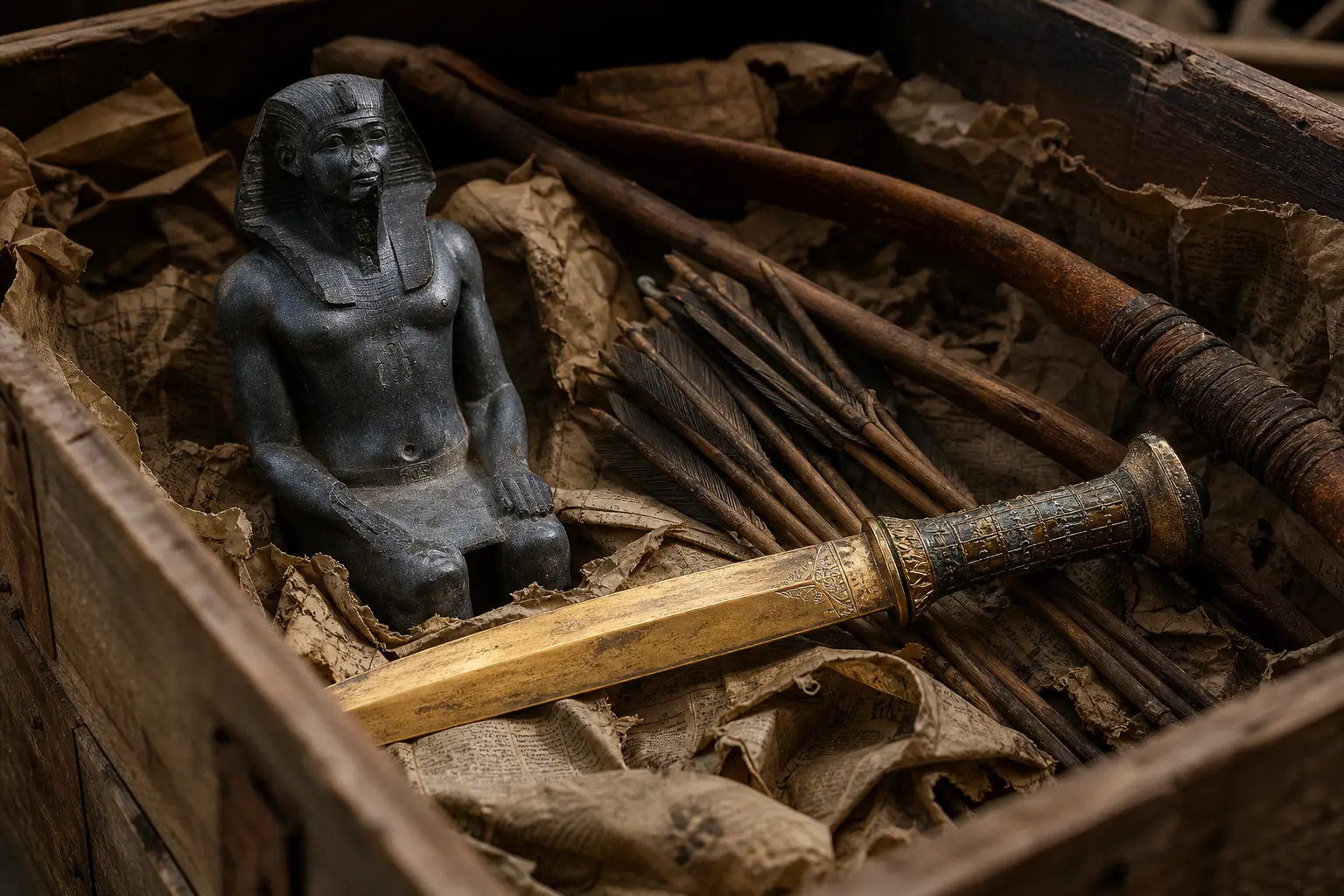
Princess Noub-Hotep’s forearm and hand bones carry the telltale wear of repeatedly gripping and drawing a bow, down to a palm bone slightly bowed from the strain, a detail that matches the arrows found in her tomb. Princess Itaweret’s collarbones and chest muscles show the same archer’s signature, and her skeleton also carries healed rib and foot fractures. Princess Ita’s grip was strong enough to suggest she habitually handled a weapon such as the ornate dagger buried beside her. Even King Hor, the one man in the group, shows the same lopsided arm development as someone trained with weapons.
“This directly explains the presence of bows, arrows, and maces in the women’s tombs,” said Zeinab Hashesh, a bioarchaeologist at Egypt’s Beni Suef University who led the research. Some Egyptologists had previously dismissed the weapons as token grave goods for the afterlife, but Hashesh says the skeletal wear tells a different story.
| Name | Likely Role | Age at Death | Key Skeletal Evidence |
|---|---|---|---|
| Princess Ita | Daughter of Amenemhat II | 28 to 34 | Strong upper-body attachments matching mace or dagger use |
| Princess Khenmet | Daughter of Amenemhat II | Late 30s to 40s | Thinning bone density, but robust ligament attachments |
| Princess Itaweret | Daughter of Amenemhat II | 20 to 34 | Archer’s arm and collarbone wear; healed rib and foot fractures |
| Princess Sathathormeryt | Tentatively a fourth sister | Not recorded | Identified through shared inherited spinal defects |
| Princess Noub-Hotep | Separate royal burial | Not recorded | Bowed palm bone and forearm wear from repeated bow draws |
| King Hor | 13th Dynasty pharaoh | Not recorded | Lopsided arm development; healed hand fracture and skull trauma |
Their tombs also held flails, a type of jointed club, along with maces, all catalogued at the original dig alongside the bows and daggers.
A Century Forgotten in a Museum Box
At the height of the 1890s craze for Egyptian antiquities, French archaeologist Jacques de Morgan uncovered the bodies inside the Dahshur pyramid complex, about 40 kilometers south of Cairo. The excavation ran through 1894 and 1895.
In 1915 the remains moved to the Egyptian Museum in Tahrir, where they sat inside a wooden box and were forgotten for over a hundred years. Their skulls, sent separately to a Cairo medical museum for study, vanished entirely in the early 20th century.
The royals resurfaced only in 2020, when museum curators working through the basement opened two wooden boxes and found the remains still wrapped in yellowed period newspaper used as packing. The bones themselves were marked in faded ink with hand-scrawled names, and Hashesh’s team confirmed those century-old identifications matched the handwritten excavation notes from the original dig.
A Shared Spinal Defect Ties the Sisters Together
All six mummies share a rare cluster of inherited spinal defects, a genetic fingerprint suggesting the group is related. The team hopes to run DNA testing to confirm it.
Three of the women, Ita, Khenmet and Itaweret, were probably daughters of the 12th Dynasty pharaoh Amenemhat II, who ruled Egypt roughly between 1929 and 1895 BC. A fourth mummy had no surviving notes at all, but researchers tentatively identified her as Sathathormeryt, a fourth sister. Little else is documented about the king himself; Egyptological profiles note his daughters are known mainly from graves next to the king’s pyramid at Dahshur, with scant record of his wives or the rest of his household.
King Hor belongs to a different, later royal line entirely. Excavation records for the wider Dahshur necropolis describe a well-preserved burial of the Thirteenth Dynasty king Hor found in a shaft tomb on the site’s north side, which is how his remains ended up grouped with the princesses despite belonging to a different dynasty.
Were the Weapons Real or Just for Show?
Egyptologists have argued for decades over whether bows and daggers in women’s tombs were real tools or funerary props. The new study says the muscle evidence settles it: the princesses trained and fought like the men of their era. Independent bioarchaeologists are not convinced bone wear alone can prove that.
Live Science, which surveyed outside researchers after the paper’s release, called it a controversial new study. Bioarchaeologists not involved in the work told the outlet that skeletal changes cannot reliably point to one specific activity, since age, body size, genetics and other repetitive movements can all leave similar marks.
Sébastien Villotte, an anthropologist at France’s National Center for Scientific Research (CNRS) who was not part of the study, told Live Science the buried weapons make active use plausible, but said the paper falls short of proving it, offering limited biomechanical evidence to back the claim. He added that “a more robust approach would involve comparing these individuals to non-elite contemporaries from the same region and period.” Without that comparison, he said, there is no way to know whether the bone changes are unique to the royal family or common in ordinary Egyptians who never touched a weapon.
Nicholas Brown, an Egyptologist at the University of Iowa who also had no role in the study, points to a different explanation. He notes that Egyptian princesses shot bows as part of a royal renewal ritual, loosing arrows toward the four cardinal directions during the Sed festival marking a king’s jubilee. Brown told Science News the underlying evidence is indirect: “The bones aren’t preserving the behavior directly, but the muscle attachments are clearly indicating some kind of habitual activity.”
- Zeinab Hashesh (Beni Suef University) – says the asymmetrical, thickened muscle attachments prove habitual weapon use during life, not merely symbolic burial goods.
- Sébastien Villotte (CNRS) – says the study lacks a comparison group of ordinary Egyptians, so the bone changes cannot be tied specifically to weapons.
- Nicholas Brown (University of Iowa) – says the same bow calluses could reflect a royal renewal ritual rather than hunting or combat.
The dispute echoes a much older visual record. Royal women posed with military symbolism stretches back through Egyptian art, including the smiting scene in which a ruler grasps an enemy’s hair while raising a weapon, imagery more often used for kings but occasionally extended to royal women.
The Paradox of Privilege
The most striking thread running through the study is not martial prowess. It is what the research team calls the paradox of privilege, the way royal life protected these people even as it exposed them to hardship.
Despite their status, the princesses show signs of childhood malnutrition, infections and healed fractures that reflect the physical demands of their lives. King Hor’s eye sockets carry potential signs of nutritional stress and infectious disease, the kind of marks left by childhood illness rather than adulthood combat.
What royal status bought them was medical care. Every fracture the researchers examined had healed cleanly, with no infection and no bones left crooked, a standard of treatment that was, for its era, exceptional.
That gap between royal image and lived hardship runs deep in Egyptian history. Historically, ordinary Egyptian women stayed out of combat entirely, while queens acting in the role of goddesses could claim aspects of a warring goddess that ordinary women never touched. Recent scholarship has pushed back hard against the idea that royal women were passive figures. A recent academic essay collection covering fresh research on women in ancient Egypt argues that women there could work outside the home, inherit property, initiate divorce and testify in court, exercising more legal and economic independence than their counterparts across the ancient world, even though that agency has often been downplayed.
DNA Tests and Isotope Analysis Could Fill the Gaps
The Dahshur six are not a closed case. Hashesh’s team has laid out a specific list of next steps meant to answer the exact criticism outside experts are raising.
- DNA sequencing to confirm the family ties the shared spinal defects only hint at
- Stable isotope analysis to check for nutritional deficiencies across each woman’s lifetime
- Bone histology to see whether the strain of drawing a bow eased with age, particularly in the older princesses, Khenmet and Noub-Hotep
- Comparisons with non-elite skeletons from the same period, the exact fix critics like Villotte are asking for
Hashesh has said the team’s real ambition goes well beyond identifying names, toward reconstructing full biographies, including family ties, health histories and political roles.
Yet, while archaeologists have long focused on preserving these treasures, the people themselves were often forgotten.
Hashesh said that, reflecting on the century the mummies spent boxed up while their jewelry and weapons drew scholarly attention instead.
Frequently Asked Questions
Who Were the Six Royals Found at Dahshur?
The group includes four probable sisters, Ita, Khenmet, Itaweret and Sathathormeryt, plus Princess Noub-Hotep and King Hor. The study behind the discovery, credited to Hashesh, Gabr and Walker and titled a bioarchaeological reassessment of Dahshur’s royal skeletal remains from the late Middle Kingdom, ran in Frontiers in Environmental Archaeology.
Is Princess Ita’s Dagger Still Around Today?
Yes. The ornate dagger buried with Princess Ita is now on public display at the Egypt Museum, one of the few complete weapons from the group to survive intact alongside its original owner’s identification.
Could Ordinary Egyptian Women Have Used Weapons Too?
Historical sources suggest not in the same way. Throughout Egyptian history, non-royal women remained non-combatants, with weapon use and troop command largely reserved for kings and, in rare cases, royal women whose status let them take on the imagery of warrior goddesses.
Why Were King Hor and Princess Noub-Hotep Examined First?
Early investigators prioritized rank. Scientific study of the burial complex began in 1895, focusing first on King Hor and Princess Noub-Hotep as the two highest-ranking royals in the group, decades before the rest of the mummies were formally reassessed.
What Happens to the Mummies Next?
Beyond further lab analysis, the research team wants to preserve the remains, produce 3D prints for teaching and virtual exhibitions, and eventually display the mummies alongside their original jewelry, weapons and funerary objects, presented ethically and with the same respect given at their original burial.
