
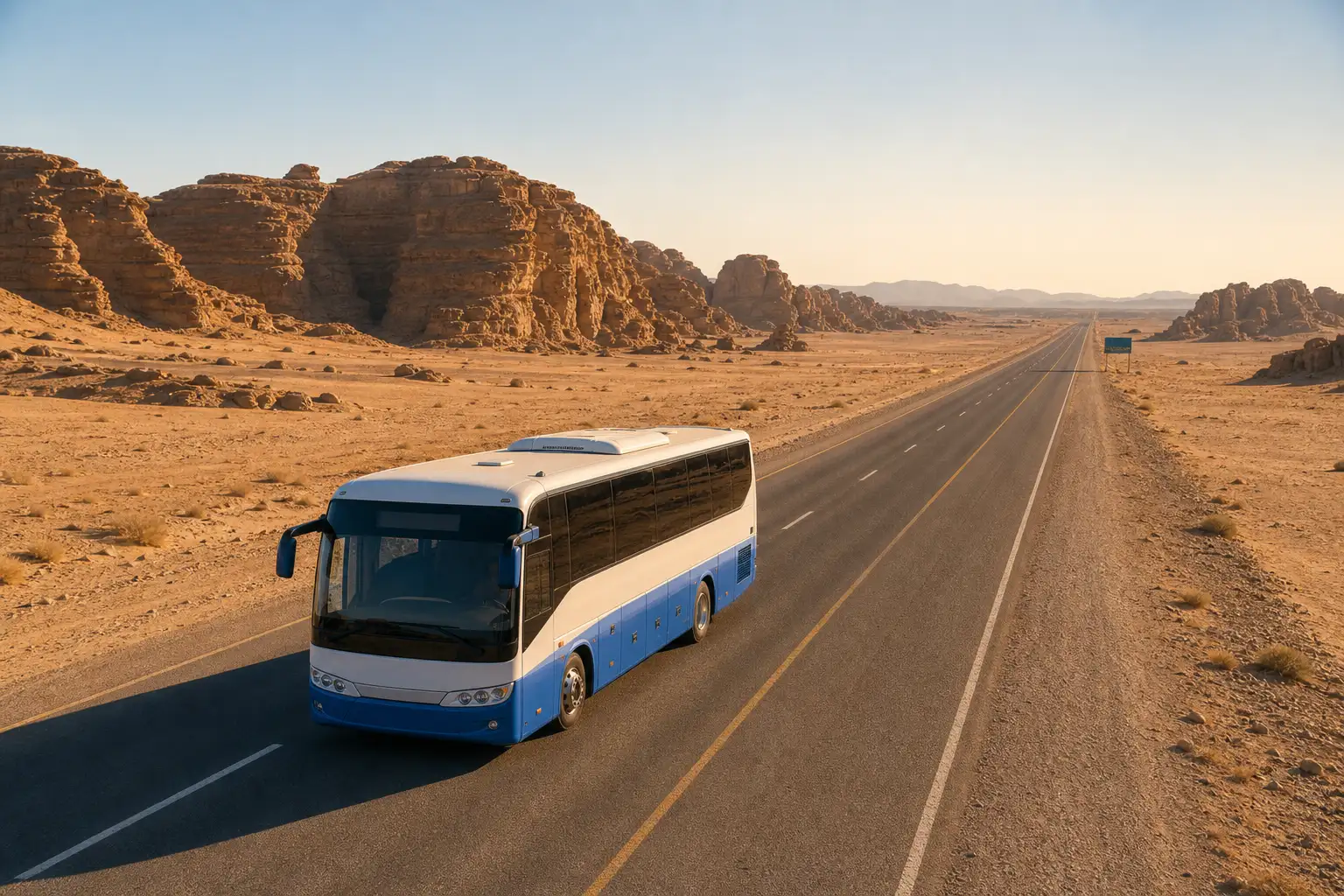
Jordan has started fitting GPS trackers, cameras and Wi-Fi routers onto buses running between Ma’an and Amman, the final corridor before a nine-route expansion launches this month. The Land Transport Regulatory Commission (LTRC) is working with Amman Vision Transport Company, the operator supplying the technology, to finish the install before the route opens to regular passengers.
The upgrade is one piece of a bigger bet. Jordan’s first phase came in under its own budget and carried more passengers than planners had banked on. Phase two now has to prove that discipline scales across nine routes and 210 buses, on corridors stretching into some of the country’s most thinly populated territory, against a transport culture that has resisted fixed schedules for decades.
GPS, Cameras and Wi-Fi Reach the Desert Route
The installed systems form a single package built around one idea: give the commission eyes on every bus, all the time. Electronic fare payment, GPS tracking, onboard CCTV surveillance and Wi-Fi connectivity are wired into the same onboard network, meant to improve service quality, strengthen safety oversight and make the ride itself less of a gamble.
Wi-Fi is the standout addition in phase two, concentrated on the longer routes, Ma’an-Amman among them. Onboard connectivity lets riders stay online through a multi-hour desert crossing, and it gives university students a way to reach coursework or online platforms mid-trip instead of losing the whole day to travel.
Two fully equipped technical stations are now installing the same systems on buses assigned to the rest of phase two’s corridors, a detail meant to keep the whole rollout on one timetable instead of letting individual routes slip. Petra, Jordan’s state news agency, reported that the wider rollout would move through procurement and installation starting in June, with pilot operations expected to reach full capacity by the end of July.
Nine Routes Now Share a Single Deadline
Phase two knits together seven originally approved corridors and two later additions into one network. The seven link Amman with Ma’an, Tafileh and Ajloun, plus cross-governorate services joining Irbid with Zarqa, Zarqa with Mafraq, and Jerash with both Irbid and Mafraq. A Cabinet decision folded in two more routes months later, connecting Karak with Zarqa and with Aqaba, backed by 15 additional buses on each line.
That single decision is why the fleet total moved. Phase two started out planned around 180 buses across seven corridors. The extra 30 buses tied to the two Karak routes pushed the fleet to 210 buses, all of it running on a shared timetable, central monitoring and electronic ticketing through one mobile app. The full route list:
- Amman to Ma’an
- Amman to Tafileh
- Amman to Ajloun
- Irbid to Zarqa
- Zarqa to Mafraq
- Jerash to Irbid
- Jerash to Mafraq
- Karak to Zarqa
- Karak to Aqaba
The commission has budgeted JD5.76 million (about $8.1 million) a year to run the expanded network, fully funded by the government, with a daily capacity of roughly 13,500 passengers once every route is live.
Why Does Wi-Fi Matter More for Ma’an’s Students?
Ma’an sits at the far southern end of the country, a multi-hour ride from Amman on a good day. Wi-Fi on the bus means a student can join a lecture, submit an assignment or read for an exam during that ride instead of losing the time outright, turning a dead travel block into study hours.
The commission has tried a version of this before. Earlier this year it signed a separate contract to fit smart systems across 376 university buses, a parallel program covering 29 dedicated campus routes at six public universities. The Ma’an line folds the same logic into the inter-governorate network rather than a standalone student shuttle.
Distance is the more basic problem Wi-Fi cannot fix by itself. A bus that runs late, breaks down or simply never fills up has always cost a student more than a lecture. GPS tracking and a fixed schedule on the new route are meant to close that gap too.
Phase One’s Numbers Set Up Phase Two’s Bet
Phase two is a scaled repeat of a formula phase one already tested. Here is how the two stages compare so far:
| Metric | Phase One (2025) | Phase Two (2026) |
|---|---|---|
| Governorates linked to Amman | Irbid, Jerash, Karak, Salt | Ma’an, Tafileh, Ajloun, plus Zarqa, Mafraq and Aqaba links |
| Main routes | Four corridors | Nine routes |
| Bus fleet | 121 buses, grown to 152 | 210 buses |
| Passengers logged | More than 1.6 million over 139,000 trips | Daily capacity of about 13,500 once live |
| Annual operating cost | JD868,000 spent against a JD2.038 million budget | JD5.76 million estimated |
Jordan’s public transport fleet is far larger than either phase alone. LTRC’s own tally counts 3,529 medium-sized buses nationwide, alongside 683 large buses and 990 service taxis spread across 1,950 routes. The inter-governorate project is a small, closely managed slice of a much bigger, older system.
The Budget Beat Itself Before the Buses Did
Phase one’s results are the reason officials feel confident scaling up. LTRC data reported through Petra describe a program that ran leaner and busier than planned.
- 95%: phase one’s operational performance rate across its four original corridors, according to LTRC figures.
- 1 bus per 2,500: Jordan’s current ratio of buses to residents nationwide, which the commission wants to shrink to 1 per 1,000.
- 100: electronic services LTRC is preparing to launch across the land transport sector, split evenly between passenger and freight operations.
Getting to a one-per-1,000 ratio means fleet growth well beyond 210 buses, a target officials have already folded into phase two’s longer-term math.
Jordan’s Buses Have Spent Decades Leaving ‘When Full’
None of this erases an older problem. A 2022 World Bank diagnostic found Jordan’s transport inefficiencies cost the economy about $3 billion a year, or roughly 6 percent of GDP, before counting the drag on women’s employment.
Women make up only about a third of Jordan’s public transport riders, and fewer than half the population uses the system at all, the same report found. Poor coverage, fragmented operators and unpredictable schedules were named as the core drivers, the exact complaints the smart-systems rollout is meant to answer route by route.
A country where minibuses have run without a timetable for decades, filling up before they move an inch, is now testing whether fixed schedules, GPS oversight and full state funding can hold at nine times the scale of one pilot corridor.
The Next Stop Is a Thousand-Bus Network
LTRC has treated 210 buses as a floor, not a ceiling. The commission has pointed to a longer-term target of roughly 1,000 buses nationwide, part of a push to move the service ratio toward one bus per 1,000 residents.
The next expansion is already lining up. Transport, industry and local administration officials met in May to discuss folding industrial zones into the network, including a plan to connect workers to the Hassan Industrial Estate. A Cabinet order tied to the newest Karak routes also requires the commission to file a performance report on those two lines by the end of December 2026, measured against set indicators.
Jordan’s transport ministry has made the same pitch abroad. At the Arab Union for Land Transport’s general assembly in Amman late last month, the country presented itself as a regional hub for exactly this kind of connectivity, the same forum where Iraq secured a third consecutive term as vice president.
For now, the test is smaller and closer to home. Whether a bus running Wi-Fi and GPS through the desert between Ma’an and Amman can hold to a timetable long after the cameras are switched on.
