
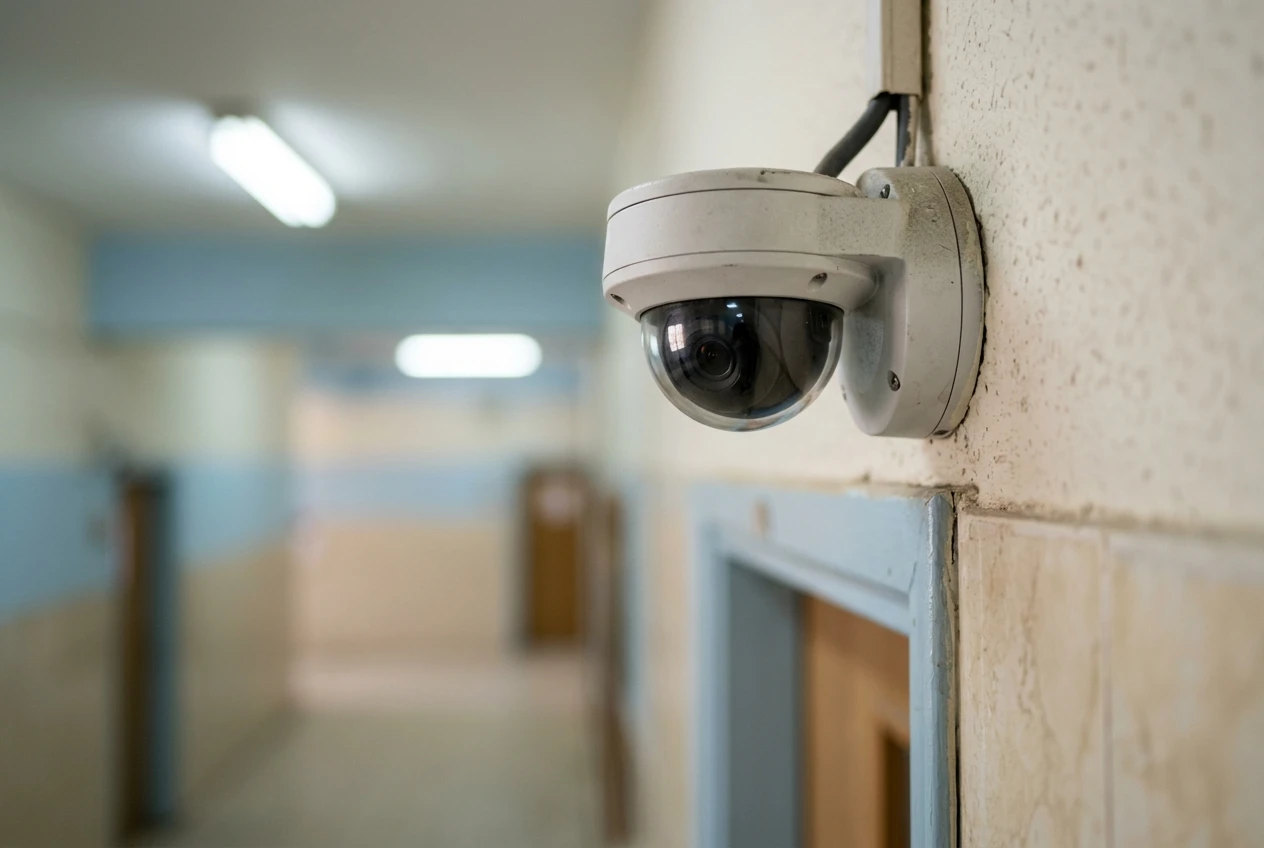
Amman is weighing facial recognition cameras at classroom doors to track student attendance, Education Minister Azmi Mahafzah said this week, in what would be the first such proposal from a country that already classifies the biometric data of minors as sensitive. The Ministry of Education is studying the system with telecommunications companies as part of broader efforts to improve school discipline before the new academic year, Mahafzah told a Sunday meeting of education directorate heads. Cameras mounted at classroom entrances would automatically record who showed up and who did not, replacing the manual logging schools use today. The proposal landed inside a routine administrative briefing that also covered vocational class sizes, school transport, and curriculum updates, per the school-year briefing that also covered those announcements. Parents and students, the parties whose faces would be scanned each morning, were not represented in the room.
The Plan: Cameras Mounted at Classroom Doors
Mahafzah told the Sunday meeting of educational planning and vocational education heads that the ministry is studying facial recognition cameras at classroom entrances for attendance and absenteeism monitoring. The cameras would be installed at the classroom door, not in hallways or building perimeters, and would feed attendance data automatically, the minister said. The system is being built with telecommunications companies, whose names the ministry has not disclosed. The stated rationale is discipline and accurate data ahead of the academic year.
Mahafzah, who was appointed education minister on 27 October 2022 after running the University of Jordan, leads a ministry that runs one of the most centralized school systems in the region. That centralization makes a classroom-by-classroom deployment easier to roll out, and harder to roll back. The proposal is still in the study phase, with no rollout date, no public consultation timeline, and no draft regulation published. The privacy implications land on a population that cannot, by law, consent for itself. For now, the ministry is framing this as a discipline problem, with the biometric-data question sitting outside the public framing.
A Larger School-Year Push That Bundled the Announcement
The facial recognition line was one item in a much longer school-year briefing. Mahafzah used the meeting to push vocational education, school transport, and curriculum updates in the same sitting. The breadth matters on its own: a biometric attendance system was announced inside a routine administrative meeting, with no dedicated policy release.
Vocational education is the ministry’s main growth lever this year. Jordan now has 977 vocational education classes, with vocational enrollment at 17%, the ministry said. Private-sector equivalents run between JD 5,000 and JD 6,000 per student, against free public provision. Around 2,000 university engineering seats sat vacant last year, a figure the ministry reads as room for vocational graduates. The pitch is that technical specializations open pathways to university and to military engineering colleges.
Ninth-grade students are already being routed through the choice. The ministry distributed an online form asking students to pick academic or vocational tracks, with placement running on preference first and grades seven through nine second. Each vocational class must hold at least 20 students to spread enrollments across specializations. Information technology, engineering, and hospitality were among the most popular fields; health alone accounts for 35% of vocational enrollment, five points above the 30% cap the ministry is now working to balance.
- 977 vocational education classes across Jordan
- 17% vocational enrollment share, rising
- JD 5,000 to JD 6,000 per student cost in the private sector
- ~2,000 vacant university engineering seats last year
What Jordan’s Privacy Law Already Says About a Child’s Face
Jordan’s Personal Data Protection Law, No. 24 of 2023, classifies biometric data as Sensitive Personal Data, per the statute’s definition of Sensitive Personal Data. That classification triggers stricter handling rules than ordinary personal data. The law took effect in stages and was fully operational from 17 March 2025.
The statute defines Sensitive Personal Data to include any data that can directly or indirectly reveal biometric information about an individual, alongside health, genetic, and criminal record data. Where the data subject lacks legal capacity, consent must come from a parent or legal guardian. If the parents cannot be reached, a judge may grant approval on the recommendation of the data protection unit, considering the best interests of the child. The controller, the ministry or the telecom partner it contracts with, must appoint a Data Protection Officer when processing data of individuals who lack legal capacity to consent. The purpose of the processing must be specific, lawful, and transparent, and data must not be retained beyond that purpose.
The law also sets hard clocks on breach response. A controller must notify affected data subjects within 24 hours of discovering a serious breach, and the data protection unit within 72 hours. A controller found guilty of gross negligence is liable to compensate the affected subjects. A breach inside a national attendance system would reach parents fast under these rules.
The gap between the law’s requirements and what has been publicly announced is the live question. The ministry has named the goal, which is monitoring attendance and absenteeism. It has not said who would hold the biometric templates, how long they would be kept, or whether parents could opt out. It has not named an age threshold at which students themselves could request deletion. The telecom partners building the system have not been disclosed, no Data Protection Officer for the project has been named, and no privacy impact assessment has been published.
| What the 2023 Law Requires | What the Ministry Has Said So Far |
|---|---|
| Biometric data classified as Sensitive Personal Data | Cameras would capture biometric data of minors |
| Consent from parent or legal guardian for those lacking legal capacity | Not addressed |
| Data Protection Officer required for processing minors’ data | Not addressed |
| Purpose must be specific, lawful, and transparent | Stated: monitoring attendance and absences |
| Data must not be retained beyond its purpose | Not addressed |
| Breach notice: 24 hours to subjects, 72 hours to authority | Not addressed |
Facial Recognition Has Reached Classrooms Before
Jordan would not be the first country to consider facial recognition for tracking student attendance. A 2025 study documented a pilot at a private Saudi medical college in Jeddah using the technology, while China has run broader deployments at universities and high schools.
The Chinese government announced plans to curb and regulate facial recognition in schools after reports that China Pharmaceutical University in Nanjing was using the technology at school gates and dormitories, per the Chinese pledge to curb school facial recognition. A Hangzhou high school had installed a network giving teachers real-time feedback on student concentration.
We need to be very careful when it comes to students’ personal information.
said Lei Chaozi, director of science and technology at China’s Ministry of Education. The ministry recommended that schools seek opinions of parents, students, and teachers before introducing the technology.
The Jordanian case differs on one count. The country’s 2023 privacy law already exists, with biometric data on minors treated as sensitive from the start. That framework pre-dates any deployment decision.
What the Ministry Has Said and What It Hasn’t
The ministry’s stated case for the system is operational, not punitive. Mahafzah framed attendance monitoring as a discipline and data-quality tool, alongside his call for accurate and timely information on school preparedness. He tied the proposal to the upcoming academic year, not to a broader surveillance architecture. The biometric angle was not the headline of the briefing; vocational education was.
The unanswered questions sit in operational detail. There is no public statement on the data retention period, the storage location, or whether templates would be hashed. There is no commitment on whether students could be excluded from the system without academic penalty. There is no timeline for parental consultation or for a Data Protection Officer appointment, both of which the 2023 law treats as conditions for processing minors’ biometric data.
The ministry is studying the system, not rolling it out, Mahafzah said, and that study phase is itself a window. Once cameras are mounted, the political cost of removing them rises with every school year of data. The questions worth asking now are the ones a Data Protection Officer would ask on day one: where the templates live, who can see them, how long they last, and what happens when a parent says no.
A Pilot Already in Motion
The ministry’s appetite for large student-data programs is already on display elsewhere. The first phase of a school transport project is live at a cost of JD 5 million, the minister said. Approximately 10,000 students from academic and vocational streams have registered. The system tracks which students ride which buses, when, and how often. The transport pilot does not use biometrics, but it shares the architecture of a centralized database built with a private operator for a public function.
A parallel curriculum overhaul is using a different lever. English-language vocational curricula will be updated with the National Center for Curriculum Development to align with technical specializations. Agricultural specialization will pick up biology, chemistry, and biochemistry so its graduates can meet veterinary medicine admission requirements. Vocational education teachers will be added to the Queen Rania Award.
Frequently Asked Questions
What does Jordan’s privacy law say about biometric data of minors?
Jordan’s 2023 Personal Data Protection Law treats biometric data as a sensitive category, separate from ordinary personal data. For anyone who cannot legally consent on their own, including minors, the law requires consent from a parent or legal guardian. A Data Protection Officer must be appointed whenever a controller processes data of those who lack legal capacity.
Has facial recognition been tried in other countries’ schools?
Saudi Arabia has piloted the technology at a private medical college in Jeddah, where a 2025 study found faculty using facial recognition across onsite, online, and remote sessions. China has run larger-scale deployments and then walked them back, with the country’s education ministry announcing plans to curb and regulate facial recognition in schools.
What attendance problem is the ministry trying to solve?
Mahafzah framed attendance monitoring as part of broader discipline and data-quality goals, without publishing specific absenteeism or attendance figures. The proposal was tied to preparations for the upcoming academic year, not to a wider surveillance architecture.
Will parents need to consent?
The 2023 statute requires parental or guardian consent for processing biometric data on anyone who cannot legally consent. If parents are unreachable, a judge can approve on the data protection unit’s request, with the child’s best interest as the test. The ministry has not said how consent would be gathered in practice or whether students could opt out without academic penalty.
Has a rollout date been announced?
Mahafzah said the system is still being studied, and the Sunday meeting produced no rollout date, no draft regulation, and no consultation schedule. The ministry has also not named the telecom firms building the system or any data protection officer for the project.
