
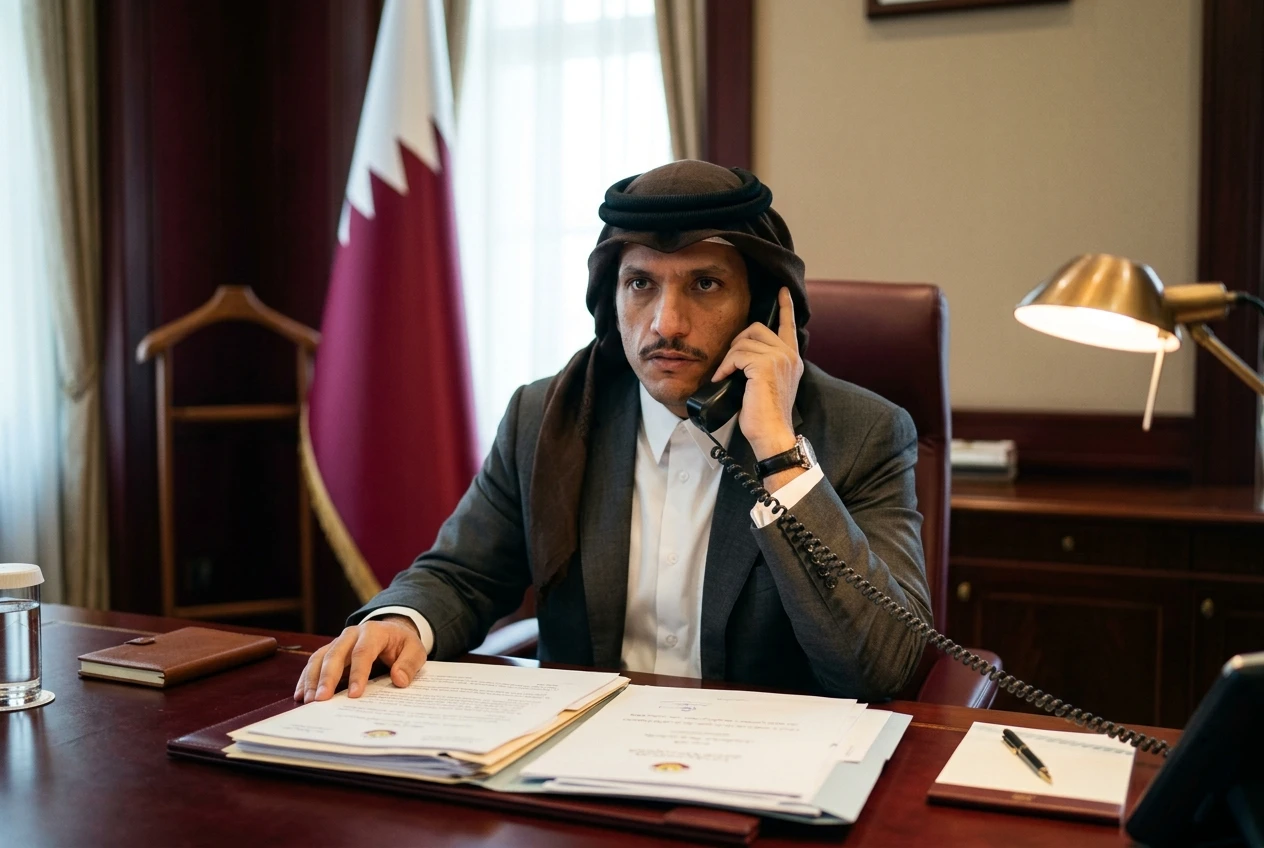
Qatar’s Prime Minister spoke with Jordan’s Deputy Prime Minister on Sunday, part of a same-day diplomatic sprint that also reached Türkiye, France and Ghana. The four calls centred on the US-Iran Memorandum of Understanding signed in June, and they position Doha as a regional convener while Washington and Tehran negotiate the deal’s final terms.
The conversation between Prime Minister and Minister of Foreign Affairs HE Sheikh Mohammed bin Abdulrahman bin Jassim Al Thani and Jordan’s Deputy Prime Minister and Minister of Foreign Affairs and Expatriates HE Dr Ayman Safadi came in a single Sunday window, according to the Qatari state news agency QNA. Doha followed it within hours with parallel calls to Ankara, Paris and Accra. The four counterparts who took the calls were Jordan’s HE Dr Ayman Safadi, Türkiye’s HE Hakan Fidan, France’s HE Jean-Noël Barrot and Ghana’s HE Samuel Okudzeto Ablakwa.
The Sunday Sprint Across Four Capitals
The Jordan call is the most prominent of the four. Sheikh Mohammed and Safadi reviewed bilateral relations and explored cooperation across various sectors, then turned to the latest regional developments. Their emphasis, per the QNA wire carried by Qatar Tribune, was on diplomatic efforts to enhance security and stability following the US-Iran memorandum signing. The Jordan conversation also addressed several other issues of common interest, per the same readout.
The three other calls followed the same pattern. Türkiye’s Minister of Foreign Affairs HE Hakan Fidan heard the Prime Minister reaffirm the close partnership between Doha and Ankara, with both men exchanging views on regional developments. France’s Minister for Europe and Foreign Affairs HE Jean-Noël Barrot discussed Lebanon specifically. Ghana’s Minister for Foreign Affairs HE Samuel Okudzeto Ablakwa received the same regional briefing, focused on bolstering security and stability after the US-Iran understanding. Türkiye and France are both NATO members; Ghana currently holds a non-permanent UN Security Council seat.
The four calls were not framed as a single coordinated announcement. QNA published them as separate wire items within hours of each other, and the recurring reference to the US-Iran memorandum is the only connective tissue. Each conversation was framed as bilateral.
The table below maps who Sheikh Mohammed spoke to, the counterpart’s formal title, and the public framing of each call.
| Country | Minister | Public framing of call |
|---|---|---|
| Jordan | HE Dr Ayman Safadi, Deputy PM and Minister of Foreign Affairs and Expatriates | Bilateral relations, regional developments, US-Iran MoU |
| Türkiye | HE Hakan Fidan, Minister of Foreign Affairs | Doha-Ankara partnership, regional stability after US-Iran agreement |
| France | HE Jean-Noël Barrot, Minister for Europe and Foreign Affairs | Lebanon developments, regional diplomatic efforts |
| Ghana | HE Samuel Okudzeto Ablakwa, Minister for Foreign Affairs | Bilateral cooperation, security after US-Iran understanding |
Three of the four capitals are in the Middle East or Europe, with Accra the only African capital in the group. France’s call is the only one with a country-specific public framing beyond the general regional-developments language. The geography stretches from Amman to Accra across three continents.
What the Memorandum Commits Both Sides To
The agreement Qatar is reacting to is the Islamabad Memorandum of Understanding between the United States and the Islamic Republic of Iran. The text was publicly released by the US on June 17, 2026, after outcry over its earlier secrecy, and it was due to be formally signed in Switzerland that Friday. CNN reported that the agreement had been digitally signed the prior Sunday by President Donald Trump, Vice President JD Vance and Iranian parliamentary speaker Mohammad Bagher Ghalibaf.
The deal has 14 points, as printed in the released memorandum text. Point 1 declares the immediate and permanent termination of military operations on all fronts, including in Lebanon. Point 4 commits the US to begin removing its naval blockade on Iran, with full removal within 30 days. Point 7 commits the US to terminate all types of sanctions, including UN Security Council resolutions and IAEA Board of Governors resolutions, on an agreed schedule tied to the final deal. Point 14 says the final deal will be endorsed by a binding UN Security Council resolution.
This is fundamentally an agreement that allows us to open the Strait of Hormuz immediately, commit the Iranians to destroying the nuclear dust, and then gives us a dial where if the Iranians dial up their good behavior, we respond by dialing up the kind of economic and sanctions relief that can make them a more prosperous country.
A senior US administration official gave that read-out after the memorandum text was released on June 17, 2026, in comments carried by CNN. The MoU also covers Iran’s safe-passage commitment for commercial vessels in the Strait of Hormuz, the disposition of Iran’s enriched uranium stockpile under IAEA supervision, and the release of frozen Iranian funds. The bullets below detail those additional commitments as printed in the memorandum text.
- Point 3 commits both sides to negotiate the final deal within 60 days, extendable by mutual consent.
- Point 5 covers Iran’s safe-passage commitment for commercial vessels in the Strait of Hormuz, with demining to be completed within 30 days.
- Point 6 carries the regional-partner reconstruction plan of at least $300 billion.
- Point 8 reaffirms Iran’s no-nuclear-weapons pledge and sets a mechanism for the disposition of enriched material under IAEA supervision.
- Point 10 commits the US Treasury to issue waivers for Iranian crude-oil exports during the sanctions-termination period.
- Point 11 covers the release of frozen Iranian funds upon mutual agreement during negotiations.
Why Jordan Anchored the Four-Country Pattern
Jordan is not the largest of Qatar’s regional partners by trade volume, but it is among the most politically aligned. Both monarchies have hosted diplomatic mediation tracks in past regional crises. Both share a stated interest in de-escalation between Washington and Tehran. The Amman call therefore doubles as the political anchor for the rest of the day’s outreach.
The choice of Jordan, Türkiye and France together signals the three diplomatic layers Doha is trying to convene. Jordan is the Arab monarchical partner with direct land borders to several conflict zones, Türkiye is the NATO member with its own parallel mediation tracks on Gaza and Syria, and France brings the EU’s diplomatic weight alongside a permanent UN Security Council seat. That last point matters: the final deal will require a binding UNSC resolution.
Ghana, the fourth caller, is the outlier on the list. Ghana currently sits on the UN Security Council as a non-permanent member, a status that gives Accra an outsized voice in the body that will eventually endorse or reject the final deal. The inclusion of an African capital in the same-day outreach is therefore not ceremonial. Three of the four countries are NATO or Gulf allies of Qatar, and Ghana sits outside both circles.
The four-country pattern excludes Saudi Arabia, Egypt, the United Arab Emirates and Iran itself, the direct signatories of the memorandum. Doha is convening the partners around the deal, while the deal’s two principals negotiate without Doha at the table.
Lebanon Surfaces in Two Calls and in the MoU’s First Point
Lebanon is the only country named by name in the public summaries of two separate Sunday calls. Point 1 of the memorandum declares the immediate and permanent termination of military operations on all fronts, including in Lebanon, and ties that commitment to the final deal. Sheikh Mohammed’s call with France’s Jean-Noël Barrot reviewed Lebanon developments alongside broader regional diplomacy after the US-Iran agreement, and Paris has historically been a leading external voice on Lebanese sovereignty.
France holds a permanent seat on the Security Council that will eventually endorse the final deal. Qatar’s separate inclusion of Lebanon in the Jordan and Türkiye conversations was less explicit in the QNA summaries. The recurring regional-developments framing across all four calls points to Lebanon as a recurring thread rather than a one-call item. A deal whose Point 1 binds the US and Iran to ensuring the territorial integrity and sovereignty of Lebanon puts Beirut at the centre of the verification architecture for the next 60 days.
The 60-Day Window Before the Final Deal
Point 3 of the memorandum commits the United States and Iran to “negotiating and achieving the final deal in maximum 60 days, extendable by mutual consent.” The two countries have until roughly mid-August 2026 to convert the memorandum’s 14 political points into a binding agreement. Point 14 demands UN Security Council endorsement of that final deal. The 60-day window is the structural reason Qatar’s outreach has shifted from quiet facilitation to active coordination. Doha is positioning itself for the verification, reconstruction financing and sanctions termination phases that follow.
Several MoU commitments remain conditional on the final deal. Sanctions termination under Point 7 is to occur “in an agreed upon schedule as part of the final deal.” The disposition of Iran’s enriched uranium stockpile under Point 8 is to be resolved “pursuant to a mechanism that will be mutually agreed upon,” and the release of frozen Iranian funds under Point 11 depends on mutual agreement during the negotiations.
Qatar’s four Sunday calls are best read as the start of a 60-day coordination effort. Each of the four readouts pointed to “sustained diplomatic efforts” as the next step, echoing language the MoU’s 60-day clock now requires. Under Point 14, the final deal will need to be endorsed by a binding UN Security Council resolution. Until that vote, the Qatar-Jordan call is the visible anchor of a regional conversation the memorandum itself did not directly convene.
