
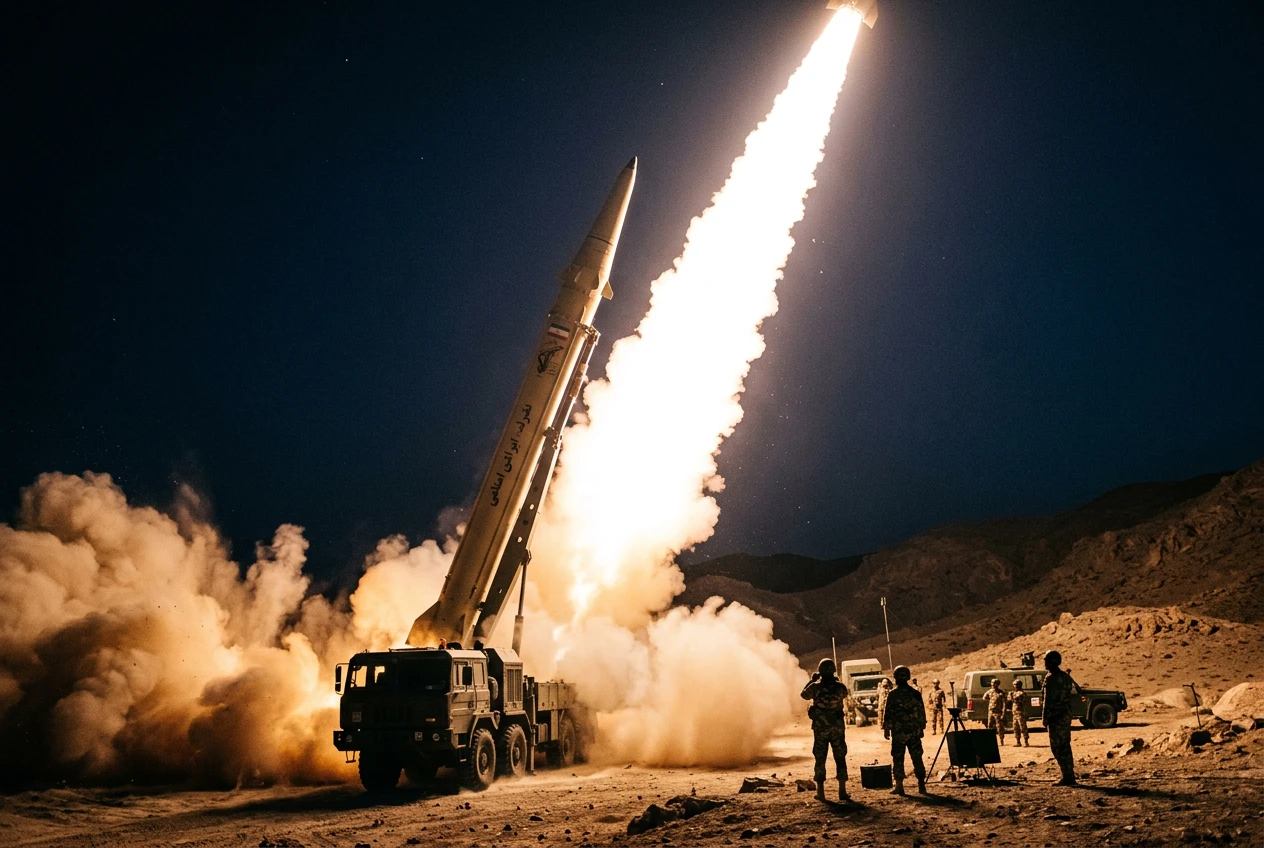
Iran launched retaliatory strikes on US bases in Bahrain, Kuwait and Jordan on June 10, 2026. The strikes came hours after American fighter jets hit Iranian air defenses and radar sites. The exchange marked a sharp break in the relative quiet that had held since the April 8 ceasefire was extended.
The exchange followed the downing of a US Army Apache helicopter off Oman, which Washington blamed on Iran. It came after President Donald Trump wrote on social media that Iran would “have to pay the price” for slow negotiations.
What Happened Overnight
Fighter jets from the US Air Force and Navy hit “air defense, ground control stations, and surveillance radar sites” in Iran, the US military’s Central Command said, with strikes acknowledged by Iran around Bandar Abbas and Qeshm Island. Within hours, Iran’s Islamic Revolutionary Guard Corps (IRGC) said it had attacked US bases in Bahrain, Kuwait and Jordan. The IRGC described the US strikes as “vicious.” Bahrain issued an air raid alert and said Iranian attacks had been repelled; Kuwait’s army said it was intercepting an attack.
Iran’s Foreign Minister Abbas Araghchi said on X that Iranian forces “will leave no attack or threat unanswered.” “Leave our region if you want to be safe,” he wrote. The escalation unfolded a day after Israel and Iran exchanged fire across their border for the first time since the April 8 truce.
The night’s events, in sequence:
- Monday, June 8: A US Army AH-64 Apache attack helicopter goes down off the coast of Oman while patrolling the Strait of Hormuz.
- A US Navy drone boat called a Corsair, built by Saronic Technologies, rescues the two crew members in what CENTCOM called the first known such operation by the American military.
- June 9: Trump, in a social media post, accuses Iran of shooting down the helicopter and says the US “must, of necessity, respond.”
- US Air Force and Navy fighter jets strike Iranian air defense, ground control stations and surveillance radar near the Strait of Hormuz, including targets around Bandar Abbas and Qeshm Island.
- Iran’s IRGC launches retaliatory strikes on US bases in Bahrain, Kuwait and Jordan, claiming 21 targets hit across the region.
- Jordan’s armed forces say they shot down 5 Iranian missiles headed for Azraq Air Base; no casualties are reported.
- Trump posts that Iran “will have to pay the price” for taking “too long” to negotiate a deal, giving no further details on what that price might be.
Why the US Struck
The US framed the operation as retaliation for the helicopter downing, though the cause of the crash remains under investigation. A US official, speaking on condition of anonymity, told the BBC’s US partner CBS News that the helicopter was brought down by an Iranian drone. It was not clear whether the collision was intentional, and Iran’s semi-official Mehr News Agency reported that Tehran had not claimed responsibility for the aircraft. Trump had said earlier on social media that Iran had shot down the aircraft while it was on patrol over the strait and declared the US “must, of necessity, respond to this attack.”
CENTCOM called the operation “a proportional response to recent attacks on US forces and international commercial ships transiting regional waters.” The targets hit near the Strait of Hormuz included naval bases in Sirik and Jask, air defenses in Bandar Abbas, and missile batteries in Qeshm, according to CENTCOM.
Trump had told reporters on Tuesday that negotiations with Iran were in their “final throes” and could be wrapped up in “two or three days.” Hours later, he was accusing Iran of downing the American helicopter. The shift came after Iran and Israel exchanged fire over the weekend for the first time since the April 8 truce, an exchange Trump publicly demanded both sides stop.
Iran’s Retaliatory Strikes
Iran’s IRGC said it struck 21 targets at US bases in the region, a claim the US did not immediately confirm and which the extent of damage could not be verified. Iran said it specifically targeted the Muwaffaq Salti Air Base in Jordan, an installation that has hosted US F-35 fighter jets. Bahrain and Kuwait both sounded alerts and fired air defences in response. US officials had not yet commented on the reports of attacks on its bases.
Jordan’s armed forces said air defences shot down five missiles fired from Iran toward Azraq Air Base, with no injuries reported. “We intercepted and shot down five missiles launched from Iran towards Azraq. The interception resulted in debris falling, but there were no casualties,” the military said in a statement carried by the state-run Petra news agency, and Jordan’s air defenses were also seen downing Iranian missiles over Zarqa. Earlier, an air raid alert was issued in Bahrain, according to local authorities who said Iranian attacks had been repelled.
Foreign forces in proximity to our territory are at constant risk on account of their own human errors, plain accidents, or potentially being caught in crossfire. To reduce risk, best solution is for them to leave.
Araghchi wrote that on X on Tuesday, after the helicopter went down and before the US strikes. The BBC attributed the same warning to him on Wednesday in the wake of the US operation. His post framed the escalation as part of a broader Iranian posture toward foreign forces in the region.
Key figures from the overnight exchange:
- 21 targets Iran says it hit at US bases across the region
- 5 Iranian missiles Jordan’s air defenses shot down over Azraq
- $780,000 to $830,000 in initial damage estimates for two water reservoirs struck in Iran
- 20,000 residents cut off from drinking water in Sirik County, southern Iran
- 2 US Apache crew members rescued by a drone boat in what CENTCOM called the first known US operation of its kind
Civilian Infrastructure Hit in Iran
The US said it hit military targets, but Iran’s IRGC and state media said two water reservoirs in Sirik County, in the southern Hormozgan Province, were also destroyed. The reservoirs supplied drinking water to more than 20,000 residents in the city of Kouhestak and 10 surrounding villages, according to Iran’s West Asia News Agency, in a report on why these water strikes are so significant. Iran was already in the grip of a multiyear drought, the fifth in a row as of 2025. In November 2025, Tehran’s Amir Kabir Dam held only 8 percent of its capacity and 19 major dams had run dry.
WANA reported initial damage estimates of $780,000 to $830,000 for the two reservoirs, which sit in the Bamani district of Sirik County, about 1,012 km from Tehran. The IRGC listed Sirik, Jask, Minab, Qeshm Island and the port of Bandar Abbas among the locations struck, and said a telecommunications tower in Sirik was also destroyed.
Isa Bozorgzadeh, spokesman for Iran’s water industry, called the strike on the reservoirs a war crime, WANA reported. International humanitarian law classifies water installations as civilian property and not a legitimate target. The Berlin Rules on Water Resources, adopted by the International Law Association in 2004, prohibit countries at war from destroying water installations when the action would cause disproportionate suffering to civilians.
Trump’s ‘Pay the Price’ Warning
On Wednesday, Trump wrote on social media that Iran has “taken too long to negotiate a deal” and that it will “have to pay the price.” He gave no further details on what that price might be. The post marked a sharp reversal from a day earlier, when Trump told reporters the negotiations were in their “final throes” and could be wrapped up in “two or three days.” The Strait of Hormuz, Trump said Tuesday, would open immediately after a deal.
Iran’s top negotiator in the talks, Mohammad Baqer Qalibaf, posted his own warning before Trump’s accusation of the helicopter downing. “We prefer the language of diplomacy, but we speak other languages far more fluently. Break your commitments, and we’ll switch to what we speak best,” Qalibaf wrote. US House Speaker Mike Johnson said he was in the room with Trump when the decision to resume US attacks on Iran was made, telling reporters “we lament that it became necessary.”
Tehran Says Diplomacy Is Damaged
Iran’s foreign ministry said the US is “damaging” the diplomatic track through ceasefire violations. Spokesman Esmaeil Baghaei said on Wednesday that the situation required “reassessment” of the talks mediated by Pakistan and Qatar.
“Unfortunately, the United States, through the contradictory messages it sends, the repeated changes in its positions and demands, and, worst of all, repeated violations of the ceasefire, is harming the diplomatic process,” Baghaei told reporters. He said any diplomatic process required a “minimum of stability” and that the recent strikes had undermined that. He also accused Israel of ceasefire violations in Lebanon, though he did not detail specific alleged violations. The remarks point to a diplomatic review that could delay the indirect talks that mediators, led predominantly by Pakistan, have been trying for weeks to bring across the line.
Diplomacy and the battlefield are not separate from one another; they operate alongside each other to protect Iran’s interests and security.
That was Baghaei, the Iranian Foreign Ministry spokesperson, speaking on Wednesday in remarks covered in Baghaei’s full statement on ceasefire violations. He said Iran’s armed forces “will not hesitate in defending the country” and that various branches of government were using diplomatic channels or military force as the situation demanded. Pakistan and Qatar have been shuttling messages, with the two sides remaining far apart on Iran’s nuclear program, sanctions relief and the reopening of the Strait of Hormuz.
The US wants Iran to give up its stockpile of highly enriched uranium, which US officials say is entombed in the aftermath of American airstrikes in 2025. Iran is refusing and is demanding sanctions relief and the release of frozen assets even before a final agreement, conditions Trump has rejected. Lebanon’s army chief, General Rodolphe Haykal, traveled to Pakistan on Tuesday to meet Field Marshal Asim Munir, a key figure in the Iran-US talks. Haykal’s visit comes as Lebanon’s government takes an increasingly hard line on Hezbollah but remains unable to disarm the powerful militia.
The Ceasefire’s Path to Here
The April 8 ceasefire was announced by Trump on social media after Pakistan mediated a deal between Washington and Tehran. The initial two-week arrangement included the reopening of the Strait of Hormuz and was later extended. The agreement was brokered after mediators, led predominantly by Pakistan, had spent weeks trying to bring the two sides to a halt.
The current flare-up is the most direct US-Iran confrontation since the April 8 agreement was extended. Officials have been unable to turn the April arrangement into a permanent deal, particularly as Israel has expanded its military campaign in Lebanon against the Iranian-backed Hezbollah militia.
Since the US and Israel began striking Iran on February 28, the war has shaken the global economy, driven up energy prices and made many basics, including food, more expensive, the Associated Press reported. The rescue of the two Apache crew members happened at 3:30 a.m. local time Tuesday, about two hours after the helicopter went down during a patrol off the coast of Oman, in what CENTCOM called the first known such operation by the American military. The 24-foot drone boat that performed the rescue, a vessel called a Corsair, is manufactured by Saronic Technologies and is assigned to the Navy’s Task Force 59, established in 2021 as the Navy’s first uncrewed and artificial intelligence unit. Capt. Tim Hawkins, a CENTCOM spokesman, said the drone initially took the two aviators to shore before an updated timeline placed them on another vessel first.
The Wider War Around the Strait
The strikes come against a backdrop of near-paralysis in the Strait of Hormuz, through which one-fifth of the world’s oil and LNG shipments normally pass. The waterway has been effectively closed since the war on Iran began on February 28. Tehran has stopped almost all cargo traffic through the strait, while the US has imposed its own blockade on Iranian vessels and ports.
On the same day as the strikes, the engine room of a tanker off the coast of Oman near the Strait of Hormuz caught fire, with one casualty and two crew members missing, the UK Maritime Trade Operations (UKMTO) agency said. British maritime security company Vanguard Tech said the Palau-flagged tanker Settebello had transmitted a distress call stating its engine room had been “struck by a missile” while operating off Sohar in the Gulf of Oman. UKMTO did not report the cause of the fire, and it was not immediately clear who was behind the reported strike. The incident occurred 20 nautical miles northeast of Sohar.
