
Trump’s Board of Peace told Israeli Prime Minister Benjamin Netanyahu on Monday that the IDF will withdraw beyond Gaza’s Yellow Line only after Hamas completes full weapons decommissioning. The assurance followed objections from Netanyahu’s office and two far-right security cabinet ministers who wanted the deal torn up.
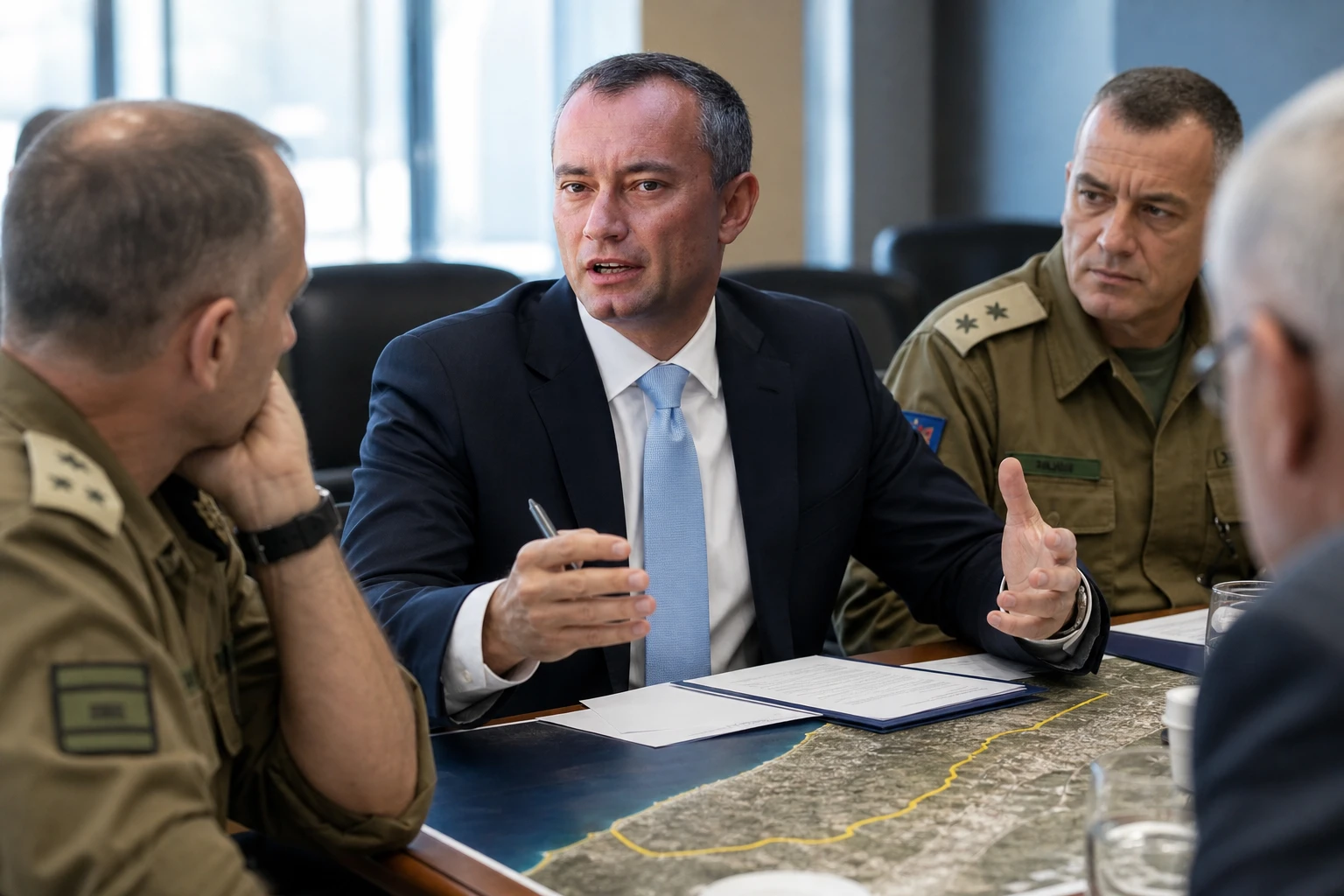
High Representative Nickolay Mladenov met Netanyahu for what both sides called difficult but constructive talks. The board said the two sides now share a common understanding of objectives. The move calms an immediate political fire in Jerusalem while rewriting the practical sequencing of the second-phase roadmap that Hamas accepted days earlier.
The Monday Clarification After Cabinet Pushback
Far-right Finance Minister Bezalel Smotrich and a cabinet colleague had demanded an immediate new vote. They said the public text calling for phased Israeli withdrawal looked “completely different” from what the security cabinet had seen. Netanyahu’s spokesman Doron Spielman told AFP that Israel had conveyed its comments and concerns to American counterparts and that the public version “does not reflect Israel’s positions.”
Trump had hailed Hamas’s agreement to hand weapons to a nascent Palestinian governing committee as a “major milestone” and claimed Israel was “very happy.” The gap was obvious. After the meeting the board posted its position.
Contrary to inaccurate reports, we note that the withdrawal of the IDF beyond the Yellow Line will take place only once decommissioning is complete, as Hamas committed to the mediators. This applies to light weapons, heavy weapons, and the tunnels alike.
That is the Board of Peace Monday statement on X. Implementation, it added, will be overseen by the International Stabilisation Force and the Implementation Verification Committee on which the United States and the board sit. Progress depends on each side fulfilling obligations.
Mladenov had spent the prior days urging de-escalation after Israeli strikes. On Sunday he wrote that two days of strikes had killed civilians and destroyed medical supplies that people depend on, coming right after the roadmap agreement. Sources familiar with Monday’s meeting said he again pressed Netanyahu to halt attacks so a 14-day window for starting demilitarization could open.
What the Released Roadmap Laid Out
On Friday the board had released the full text of the 15-point roadmap that Hamas approved. Trump called it historic. The document reaffirms commitment to Trump’s Comprehensive Plan and UN Security Council Resolution 2803 (2025). It aims at complete Israeli withdrawal, Palestinian governance via a National Committee for the Administration of Gaza (NCAG), reconstruction, and a political path toward self-determination.
Key security language links the processes rather than stacking them as pure preconditions.
| Roadmap Element | Stated Sequencing | Verification |
|---|---|---|
| Heavy weapons, production sites, depots, tunnels | Decommissioning begins after Sharm Sheikh remaining commitments, NCAG entry and ISF deployment; gradual, sequential, time-bound; linked to Israeli withdrawal in phases | IVC monitors and certifies; ISF supports; no weapons handed to Israel or non-Palestinian parties |
| Israeli forces phased withdrawal | According to agreed timetable consistent with the decommissioning article and the Comprehensive Peace Plan | IVC certifies prior phase completion before next |
| NCAG entry and civilian governance | After timetable and mechanisms prepared (14 days, extendable); factions hand over all civilian and security functions | IVC certifies both parties fulfill commitments |
| Personal and militia weapons | Subject to Palestinian law under NCAG; militias decommissioned and stored under NCAG; members not integrated into police | IVC certifies |
Article 8 explicitly ties the decommissioning process to an Israeli withdrawal in phases from areas under its control. Article 13 repeats that Israeli forces complete phased withdrawal according to a timetable consistent with that article. Progression between phases is contingent on verified completion of the prior one. The Monday statement elevates “only once decommissioning is complete” for any move beyond the Yellow Line, a sharper gate than the linked language many read in the public text.
Yellow Line Control and the Phases Still on Paper
The Yellow Line dates to the October 2025 ceasefire that opened phase one of Trump’s plan. In that first phase the IDF pulled back to a line leaving it in control of roughly 53 percent of the enclave, with few Gazans living in the retained zone. Later stages sketched withdrawals toward 40 percent then 15 percent, with a final security perimeter until the area is judged secure from resurgent threats. A CFR guide to the twenty-point plan lays out the structure, the Board of Peace architecture (Trump as lifetime chair, executive tier including Jared Kushner and Tony Blair, full board, and a Palestinian technocrat committee), funding pledges, and the International Stabilization Force concept of up to 20,000 troops plus police.
Satellite claims have suggested the physical markers of the line have shifted deeper into Gaza at times; the IDF has rejected that. Under the current ceasefire Israel still conducts strikes it describes as targeting remaining fighters. Palestinian civil defence and health figures put deaths since the October truce above 1,200, with dozens more after the disarmament announcement. Mediators Egypt, Qatar and Turkey condemned “ongoing Israeli violations,” especially hits on health facilities and infrastructure and civilian casualties including women and children.
- Phase one baseline: Ceasefire, hostage remains returned, IDF to Yellow Line holding ~53%.
- Phase two ambitions: NCAG entry, ISF deployment, decommissioning, further phased IDF pullback, reconstruction under Board of Peace and NCAG oversight.
- Monday lock: No IDF move past Yellow Line until full light, heavy and tunnel decommissioning certified complete.
Even a completed withdrawal under the plan would still leave Israel with significant security control in large parts of Gaza for an extended period.
Hardliners Forced the Clarification
Smotrich and allies have long drawn red lines against any Palestinian Authority role, any hint of a state pathway, and any loss of Israeli security dominance. Netanyahu faces a difficult re-election fight in October and has heavily promoted his relationship with Trump, including a recent Washington meeting. The public roadmap’s language on self-determination and statehood, plus the linked rather than strictly sequential withdrawal, gave hardliners an opening to demand a fresh cabinet vote and threaten the entire package.
Israeli President Isaac Herzog struck a more positive note, calling the latest development a very positive step with the clear caveat that Hamas must be disarmed. That caveat is now the board’s public line. Mohammad Dahlan, a senior Palestinian figure involved in the plan, initially posted that Jared Kushner had told him Israel would end strikes effective Sunday, then revised to say Kushner was working with the Israeli side to halt attacks, and later accused Netanyahu of obstructing the most promising opportunity to begin ending the war.
The second-order effect is structural. Once the board publicly concedes that full decommissioning is the absolute precondition for any further territorial move, every future timetable, verification dispute or incomplete tunnel find becomes a potential freeze point that cabinet hardliners can exploit without needing to scrap the deal outright.
Hamas Unease and Mediator Warnings
Hamas said late Monday it was adhering to what was agreed on the second phase of the ceasefire, including commitments of all parties, and was awaiting a clear and official response from Mladenov and the mediators. By Tuesday the group voiced “unease” over the post-meeting comments and called for clarifications. It has insisted the deal cannot proceed unless Israel fulfills its own obligations, including on strikes and the parallel character of steps.
That collision is the core risk. The roadmap’s design assumes mutual, verified steps so NCAG can enter, police can be vetted and trained, and the ISF can separate forces without creating a vacuum Hamas or other factions immediately fill. A pure sequence that demands complete decommissioning first, while strikes continue and Israel retains the Yellow Line zone, removes the reciprocal incentives that made the Friday text acceptable to the Palestinian factions.
Crowd reaction on X quickly labeled the board statement a rewrite or a cave to Netanyahu. Analysts noted the tension with Mladenov’s own earlier public line that withdrawal must move in lockstep with decommissioning. The board now frames any contrary reading as “inaccurate reports.”
How the Sequential Trap Meets the Election Clock
Netanyahu’s October election and the need to show security gains to his base sit on one side of the clock. On the other sit the 14-day window for preparing implementation timetables after roadmap approval, the planned NCAG entry, ISF sector-by-sector expansion starting from Rafah, and the broader reconstruction funding that has already shrunk from full-territory ambition toward smaller pilots in earlier Board of Peace adjustments.
Continued Israeli strikes after the announcement, including one Monday evening that killed two Palestinians in a vehicle west of Gaza City according to civil defence (the IDF said it targeted fighters), keep the temperature high. Mediators have already issued joint condemnation. If Hamas withholds further practical steps pending the “clear response” it seeks, or if verification of tunnels and light weapons becomes contested, the second phase can stall indefinitely while the board and United States insist both sides must fulfill obligations.
- 31 July 2026: Board releases 15-point roadmap; Trump hails complete disarmament agreement as historic milestone.
- 1-2 August: Israeli strikes kill civilians and destroy medical supplies; Mladenov publicly laments the violence and urges de-escalation.
- 3 August: Mladenov meets Netanyahu; board issues statement making full decommissioning the precondition for any Yellow Line withdrawal; Hamas seeks clarification.
- Ongoing: Far-right ministers press for new cabinet vote; mediators condemn violations; election campaign pressure rises toward October.
Earlier diplomacy around the same peace architecture, including earlier Cairo talks on the Gaza peace plan, already showed how quickly sequencing disputes and on-the-ground violence can freeze progress. The Monday clarification removes one Israeli political crisis. It also installs a harder gate that every subsequent dispute can slam shut.
The board, Israel and Hamas still all claim commitment to the ultimate objectives of demilitarized civilian governance and security. The practical path from the Yellow Line to that outcome now runs through a single, fully completed decommissioning process whose verification and reciprocity remain contested. That is the trap the second-order sequencing choice has set.
