
The Greeks of Alexandria shaped Egypt’s second-largest city into one of the Mediterranean’s most cosmopolitan ports. At its peak in the early 1950s, as many as 200,000 Greeks lived in Alexandria, the largest single foreign community in a city that mixed Egyptians, Italians, French, and Levantines. Today, only several hundred people still hold Greek nationality, and the broader ethnic Greek community has fallen below 1,000.
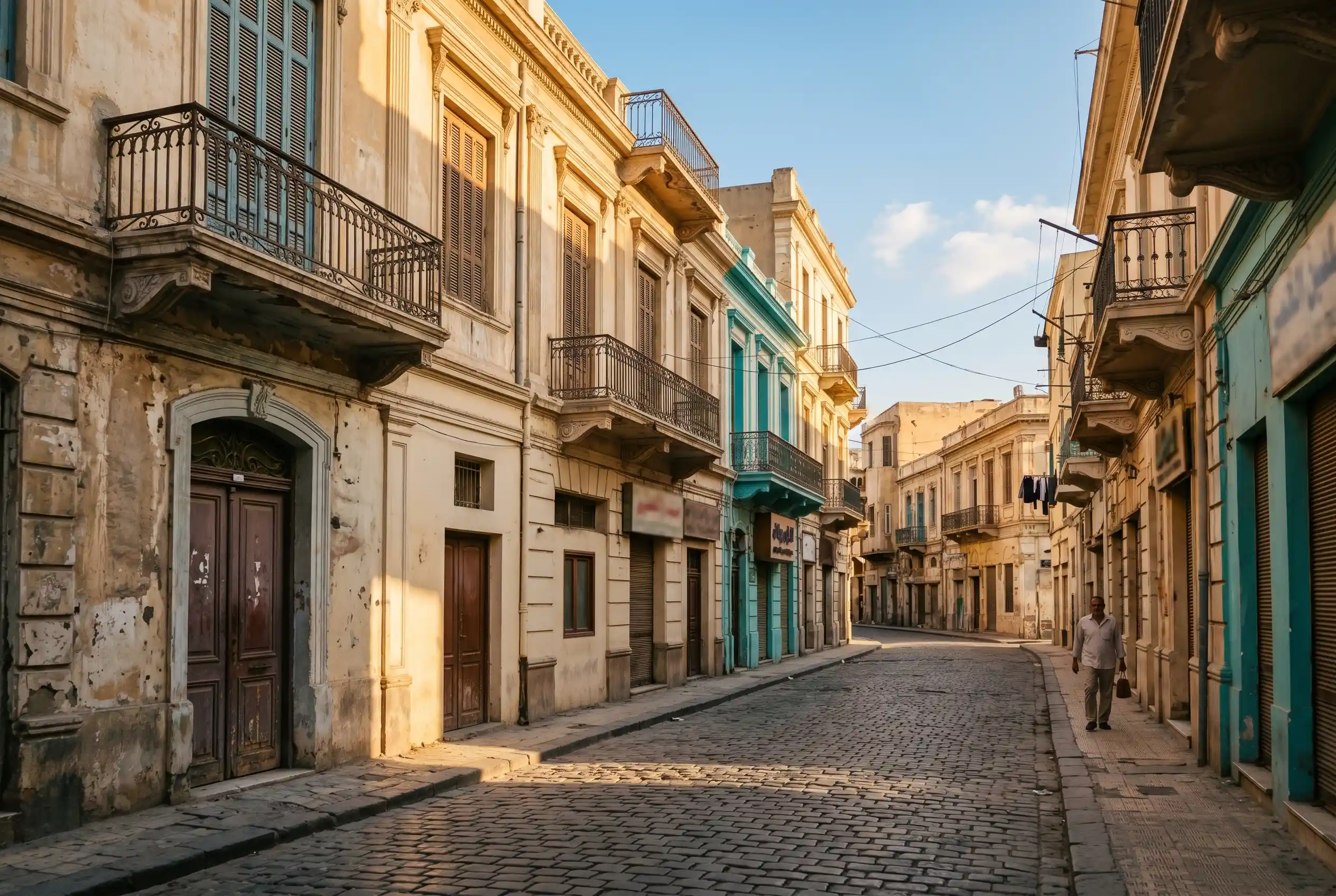
The collapse happened inside a single generation, triggered by the 1952 Egyptian revolution and the nationalization drive that followed. Alexandria still carries Greek shop signs, neoclassical facades, and a street named for the poet Constantine Cavafy, but the bouzouki clubs of Ibrahimia are quiet.
A Greek City Built on Egyptian Sand
Alexander the Great placed the first stone of Alexandria in 331 BC, laying out the city’s first street as part of a new capital for his empire. The Hellenistic city that grew around that line became the second-most powerful in the ancient Mediterranean, behind Rome. The Greek presence in Alexandria is as old as the city itself, embedded in its founding charter, in its royal line, and in its most famous landmarks.
Three monuments came to define Hellenistic Alexandria. The Pharos lighthouse of ancient Alexandria was one of the Seven Wonders of the Ancient World. The Great Library of ancient Alexandria was the largest in the ancient world. The Necropolis, on the western edge of the city, became one of the Seven Wonders of the Middle Ages. The Ptolemaic dynasty that ruled Egypt for the next three centuries was Macedonian Greek, and Cleopatra VII, the last pharaoh, was a Greek-speaking descendant of Ptolemy I Soter. The Greek and Egyptian ties before Alexander, through Naucratis and the Delta, had been running for centuries, but the new city made those ties dynastic.
The Modern Community Takes Shape
Modern Greek Alexandria, however, is a 19th-century construction. The community’s formal life began on April 25, 1843, when Greek businessmen gathered at the Monastery of Saint Sava. They voted to make membership compulsory, fund a school, and run a hospital, per the EKA’s 1843 founding record at Saint Sava. Michael Tositsas, a Greek consul and major donor, was elected the first president.
Another wave arrived after the Greek War of Independence in 1821. This marked what community members call the start of Alexandria’s ‘European era.’ Mohammed Ali Pasha’s economic opening made the port a magnet for Greek merchants, drawing cotton traders, shipowners, and bankers. By the early twentieth century, more than 120,000 Greeks were living in Alexandria, forming the largest single foreign community in the city.
The community’s growth extended beyond Alexandria. In Cairo, the first organized Greek community was founded in 1856, with members clustered in three neighborhoods: Tzouonia, Haret el Roum, and Hamzaoui. The Greek Orthodox Patriarchate of Alexandria and All Africa was based in Cairo’s Saint Nicholas Greek Orthodox Cathedral, in the Hamzaoui quarter. Over time, the community spread to Port Said, Tanta, Mansoura, and Zagazig, as well as to fifteen smaller centers across Egypt.
Greek Alexandrians soon built out the institutions of a self-sustaining diaspora. The community’s staple institutions anchored Alexandrian Greek life:
- Greek schools, including the Tositsa School, which opened in 1853 and ran for 114 years
- A Greek hospital and clinic system founded at Saint Sava
- Social clubs, sailing clubs, and sports clubs across the city
- A Greek literary press that published poets and journalists in Greek
- A Greek cemetery whose neoclassical gravestones are works of art in their own right
The Golden Age of Hellenic Alexandria
The neighborhood of Ibrahimia, in central Alexandria, was the heart of Greek life. The Greek quarter, as Eleni Konidi remembers it, was known as “Little Paris.” It was a place of bouzouki nightclubs and mixed crowds. Aggeliki Niarou lists the landmarks of that world: the Enosis sailing club, the Delices patisserie, and the shops that lined the streets, mostly Greek or Italian.
The community’s economic footprint extended well beyond its own quarter. Greek agriculturists were the first to systematically cultivate Egyptian cotton, and Greek merchants dominated cotton and tobacco exports. The first banks in Egypt were Greek-founded, including the Anglo-Egyptian Bank, founded by the Sunadinos family, and the General Bank of Alexandria. About 150 Greek printing presses operated in the city, publishing poets, newspapers, and novels.
A handful of Greek families came to dominate Alexandria’s commercial and civic life. The Benakis, Averoffs, and Gianclises became extraordinarily wealthy. Three legacies still stand:
| Family | Trade | Lasting mark |
|---|---|---|
| Benakis | Cotton | Benaki Museum in Athens, founded 1930; now 10 venues around Athens and beyond |
| Voulgarakis | Commerce | Built a tram station in Alexandria |
| Aslanidis | Cinema | Still owns the Odeon cinema, built 1950 to 1952 |
A Turn of the Wheel
The community’s peak came in the early 1950s. Paris Macris, a board member of the Greek Community of Alexandria, said the Greek population of Alexandria may have reached 200,000 in those years. By any measure, Greeks were Alexandria’s largest foreign community, controlling major sectors of trade, light industry, real estate, and the professions. Then came the Free Officers’ revolution of July 1952, which brought Gamal Abdel Nasser to power and installed a nationalist, socialist regime. Within a decade, Nasser’s nationalization laws swept businesses, banks, and insurance companies into state hands, with foreign-owned and minority-run firms among the most exposed.
For Alexandrian Greeks, the laws hit at the heart of the community. Many saw their businesses nationalized or lost their jobs, particularly in the public sector. Greece was emerging from its own civil war, and many Greeks chose to leave for their homeland or for the Greek diaspora in Australia, the United States, and South Africa. A 2018 Al-Monitor report found the community numbered fewer than 1,000, while the Greek Community of Alexandria says only several hundred people still hold Greek nationality in the city today.
What Remains
Only several hundred people in Alexandria still hold Greek nationality, per the Greek Community of Alexandria. The 1952 revolution’s effects on the community are still visible in the institutions the diaspora built.
We who are left behind, love [the city] because Alexandria gave us so much. She made us who we are. We feel at home, let’s say.
Paris Macris, a board member of the Greek Community of Alexandria, is one of the remaining voices of the diaspora. The EKA continues to run Greek schools, a gymnasium, a nursing home, and a cemetery whose neoclassical gravestones are themselves a record of the diaspora. Nikolaos Katsimpris, the EKA’s general secretary, told Kathimerini that the community does not have the resources to renovate most of the Greek monuments in Alexandria and is “waiting to find a donor from abroad.” A new channel opened in 2018, when Egyptian President Abdel Fattah el-Sisi launched the Roots Revival initiative, an effort to engage the children and grandchildren of Greeks who had left. Even the EKA’s newer ventures, like the new Greek Club branch in Dahab, point to a community now defined by cultural diplomacy rather than demographic weight.
The EKA’s role has shifted from serving a diaspora of hundreds of thousands to maintaining a cultural footprint. Katsimpris told Kathimerini the EKA is actively trying to attract the children and grandchildren of Greeks who left to visit as tourists, and then perhaps start projects in Egypt. The community is no longer defined by demographic weight.
A Heritage That Will Not Stay Silent
The cultural legacy of Alexandria’s Greek community still defines the city. A street in central Alexandria still bears the name of the Greek poet Constantine Cavafy.
The community’s cultural output stretched well beyond Cavafy. The writer Penelope Delta, the artist Nelly Mazloum, the couturier Jean Desses, the actor and director Nikos Tsiforos, the painter Maria Giatra Lemou, and the composer Jani Christou all came from the Greek community of Egypt. Their work is part of why the EKA still argues that Alexandria’s Greek heritage deserves protection.
The Benaki Museum in Athens, founded in 1930 by the Benakis family, big cotton traders, has grown into 10 venues around Athens and beyond. The Aslanidis family, who still owns Alexandria’s Odeon cinema, is one of several Greek families whose names remain stamped on the city’s architecture, a piece of Alexandria’s culture, cuisine, and literature that persists to this day.
That heritage is the EKA’s strongest argument for renovation support. Katsimpris warned that the community’s institutional footprint could shrink further without donor support. The EKA’s work, as Katsimpris put it to Kathimerini, is to keep alive the memory of a community that once stood at the center of Alexandria. Greek Alexandrian cultural figures include:
- Constantine Cavafy: poet
- Penelope Delta: writer
- Nelly Mazloum: artist
- Jean Desses: couturier
- Nikos Tsiforos: actor and director
- Maria Giatra Lemou: painter
- Jani Christou: composer
Frequently Asked Questions
How many Greeks live in Alexandria today?
Fewer than 1,000 people of Greek origin remained in Alexandria as of a 2018 Al-Monitor report that cited the Greek Community of Alexandria. Of those, only several hundred still hold Greek nationality, per the EKA. The rest are now counted as Egyptians after officially changing their nationality.
When was the Greek Community of Alexandria founded?
The Greek Community of Alexandria was formally founded on April 25, 1843, at the Monastery of Saint Sava, per the EKA’s own founding record. Tositsas, a Greek consul and major donor, became the community’s first president.
Why did Greeks leave Egypt?
The Egyptian revolution of 1952 brought Gamal Abdel Nasser to power and installed a nationalist, socialist regime. Nasser’s nationalization decrees swept businesses, banks, and insurance companies into state hands. Many Alexandrian Greeks saw their businesses nationalized or lost their jobs, particularly in the public sector, and chose to leave for Greece, Australia, the United States, or South Africa.
Who were the most famous Greeks of Alexandria?
The Greek community of Alexandria produced the writers Penelope Delta and Constantine Cavafy, and the artists Nelly Mazloum, Jean Desses, Nikos Tsiforos, Maria Giatra Lemou, and Jani Christou. The Benakis family, cotton traders who became extraordinarily wealthy in Alexandria, founded the Benaki Museum in Athens in 1930, which has since grown to 10 venues around Athens and beyond.
What does the Greek Community of Alexandria do today?
The EKA still operates a network of Greek schools, a gymnasium, a nursing home, and a cemetery. The community also engages with Egyptian society through the Roots Revival initiative, launched by President Abdel Fattah el-Sisi in 2018, and through newer cultural ventures like a Greek Club branch in the Egyptian resort town of Dahab.
What happened to the Greek-owned businesses in Alexandria?
Greek-owned cotton and tobacco trading firms, banks, and shops were nationalized under the Free Officers’ regime after the 1952 revolution. Many of the families who ran them, including the Benakis, the Averoffs, and the Gianclises, left Egypt for Greece, Europe, or the broader Greek diaspora in Australia, the United States, and South Africa.
