
On June 9, 2026, Türkiye and Saudi Arabia signed two memorandums of understanding in Riyadh to revive the historic Hejaz Railway and add a parallel terrestrial fiber-optic line, with a joint feasibility study due before the end of the year. The freight story is the headline, but the consequential element is the data layer running beside it, a 21st-century test of whether bundled freight, energy, and information can be rerouted around the maritime chokepoints of the Red Sea and the Strait of Hormuz.
The corridor sits inside a wider strategy Ankara has been assembling for more than a decade. INRAIL, formally the Istanbul Northern Railway Corridor Project, is under construction with $6.75 billion in coordinated multilateral financing. The Iraq-Türkiye Development Road is moving from memorandum to feasibility, and the Zangezur connection is being built on the Turkish side. Read as a single architecture, the Hejaz revival closes a circle that turns Anatolia into the only landmass through which Gulf, Red Sea, and Central Asian flows can reach Europe.
Two memorandums signed in Riyadh
Turkish Transport Minister Abdulkadir Uraloglu and Saudi Minister of Transport and Logistic Services Saleh bin Nasser al-Jasser put their names to the two memorandums in the Saudi capital on Tuesday June 9, as described in coverage of the railway and logistics agreements signed in June 2026. The first agreement covers logistics centers, operations, expertise-sharing, and joint activities. The second covers railway standards, technologies, training, and human resources.
Uraloglu framed the moment as a strategic opening. “At this sensitive time our region is going through, the uninterrupted functioning of trade and the logistics chain has become more critical than ever. In this period, removing the obstacles facing the transportation sector is a strategic necessity,” he said during the ceremony, per the two Hejaz memorandums signed in Riyadh. Two test runs starting from Türkiye and reaching Saudi Arabia via Iraq had demonstrated the route’s feasibility, he added, and Ankara’s longer aim is to reactivate transport corridors through Syria, Jordan, and Iraq as a single system.
A trilateral memorandum signed in Amman in April between Türkiye, Syria, and Jordan had already laid the groundwork. The Atlantic Council reports that Türkiye has committed to rebuilding about thirty kilometers of destroyed track inside Syria as the first concrete step.
A redundant north-south spine
The Hejaz revival is the second arm of a north-south freight axis designed to be deliberately redundant. The first arm is the Iraq-Türkiye Development Road, a $17 billion to $20 billion project spanning 1,200 kilometers of high-speed rail and multi-lane highway that will link Iraq’s Grand Faw Port on the Persian Gulf to the Turkish border at Fishkabore.
Iraq, Türkiye, Qatar, and the UAE signed a quadrilateral memorandum on the project in April 2024. The corridor is being built in three stages targeting 2028, 2033, and 2050, and is intended to cut transit times between Asia and Europe by up to 11 days compared with the Suez Canal route. Trial shipments from Poland to the UAE via Türkiye and Iraq have been completed in 12 days, against 21 days via the Red Sea, and the trilateral context for the wider revival is laid out in the earlier trilateral Hejaz agreement in Amman.
The revived Hejaz line adds a parallel arm. Its first stage connects Türkiye to Aleppo, then uses the existing Aleppo-Damascus-Jordan network before integrating with the Saudi network toward Riyadh. In the long term, the line is envisioned to extend as far as Oman and the Indian Ocean, an alternative trade corridor designed to bypass the Strait of Hormuz. The strait has been effectively closed by Iranian forces since at least March 2026, per Congressional Research Service reporting. Al Jazeera reported in June 2026 that the closure was still in force.
A disruption on either arm leaves the axis intact, an engineering principle borrowed from network design and applied to geopolitics. The Hejaz revival binds four economies, Türkiye, Syria, Jordan, and Saudi Arabia, into a single web of shared material interest. Each restored kilometer of track converts diplomatic normalization into sunk cost, and sunk cost is the most durable form of commitment in international politics.
Crossing at the Bosphorus bottleneck
The vertical axis meets the horizontal Middle Corridor, the East-West route that carries Chinese and Central Asian trade through the Caspian and the Caucasus into Türkiye. The Zangezur corridor, the 43-kilometer connection through Armenia’s Syunik region linking Türkiye’s Kars to Azerbaijan’s Nakhchivan exclave, is under construction on the Turkish side and will compress what has been the Middle Corridor’s most fragile segment. The two axes cross at a single geographic point: the Bosphorus. The INRAIL project will build a 127-kilometer electrified railway using the rail-ready Yavuz Sultan Selim Bridge to provide a new overland rail crossing of the Istanbul Strait, bypassing the metropolitan area.
| Corridor | Span | Status |
|---|---|---|
| Middle Corridor (Trans-Caspian) | China to Türkiye via Central Asia and the Caucasus | Operating, with the Zangezur connection under construction on the Turkish side |
| Iraq-Türkiye Development Road | Grand Faw Port to Fishkabore border crossing (1,200 km) | Quadrilateral MoU signed April 2024; staged completion through 2050 |
| Hejaz Railway revival | Türkiye to Saudi Arabia via Syria and Jordan, with a long-term vision to Oman and the Indian Ocean | Two MoUs signed June 9, 2026; feasibility study due before end-2026 |
| INRAIL (Istanbul North Rail Crossing) | 127 km electrified railway across the Bosphorus, with the Yavuz Sultan Selim Bridge as the rail-ready crossing | $2 billion World Bank loan approved March 31, 2026; $6.75 billion in coordinated MDB financing |
Once operational, the World Bank expects rail freight capacity across the Bosphorus to rise from around 3 million tons per year to up to 50 million tons. The project’s total cost is approximately $8.3 billion, and a coordinated package of six multilateral development banks is providing $6.75 billion, led by a $2 billion World Bank loan approved on March 31, 2026, per the $2 billion Bosphorus crossing loan. About half the alignment will run through tunnels, reducing exposure to extreme heat, flooding, strong winds, and wildfires.
International capital is now pricing the node at this scale, the $2 billion World Bank loan sitting inside a coordinated $6.75 billion MDB package. The same INRAIL alignment is designed to connect to the Trans-Caspian, the Türkiye-EU corridor, and the Iraq Development Road simultaneously, three of the international rail corridors that touch Turkish soil. The development banks are pricing the corridor as a single system, with each project designed to feed the same architecture.
Data, the consequential cargo
What distinguishes this generation of corridors from the 20th-century railway model is the third cargo. Alongside freight and energy, the new arteries are engineered to carry data, where vulnerability is even more concentrated than in shipping. Over 90% of all Europe-Asia capacity is carried by submarine cables in the Red Sea, and a 2024 incident off Yemen degraded an estimated 25% of that traffic in a single event.
The exposure has become existential for the Gulf. Hyperscale data centers being built to anchor Gulf AI ambitions connect to the world through the same threatened waters as the oil tankers. The scale of that buildout explains the urgency of the land alternative:
- Microsoft has committed $15.2 billion in the UAE for cloud and AI capacity
- AWS is investing $5.3 billion in a new Saudi cloud region expected to launch by 2026
- Google has partnered with Saudi Arabia’s Public Investment Fund on data center buildouts
- Saudi Arabia, the UAE, and Qatar are collectively planning 8 to 10 GW of AI-related compute capacity, per the Middle East Institute
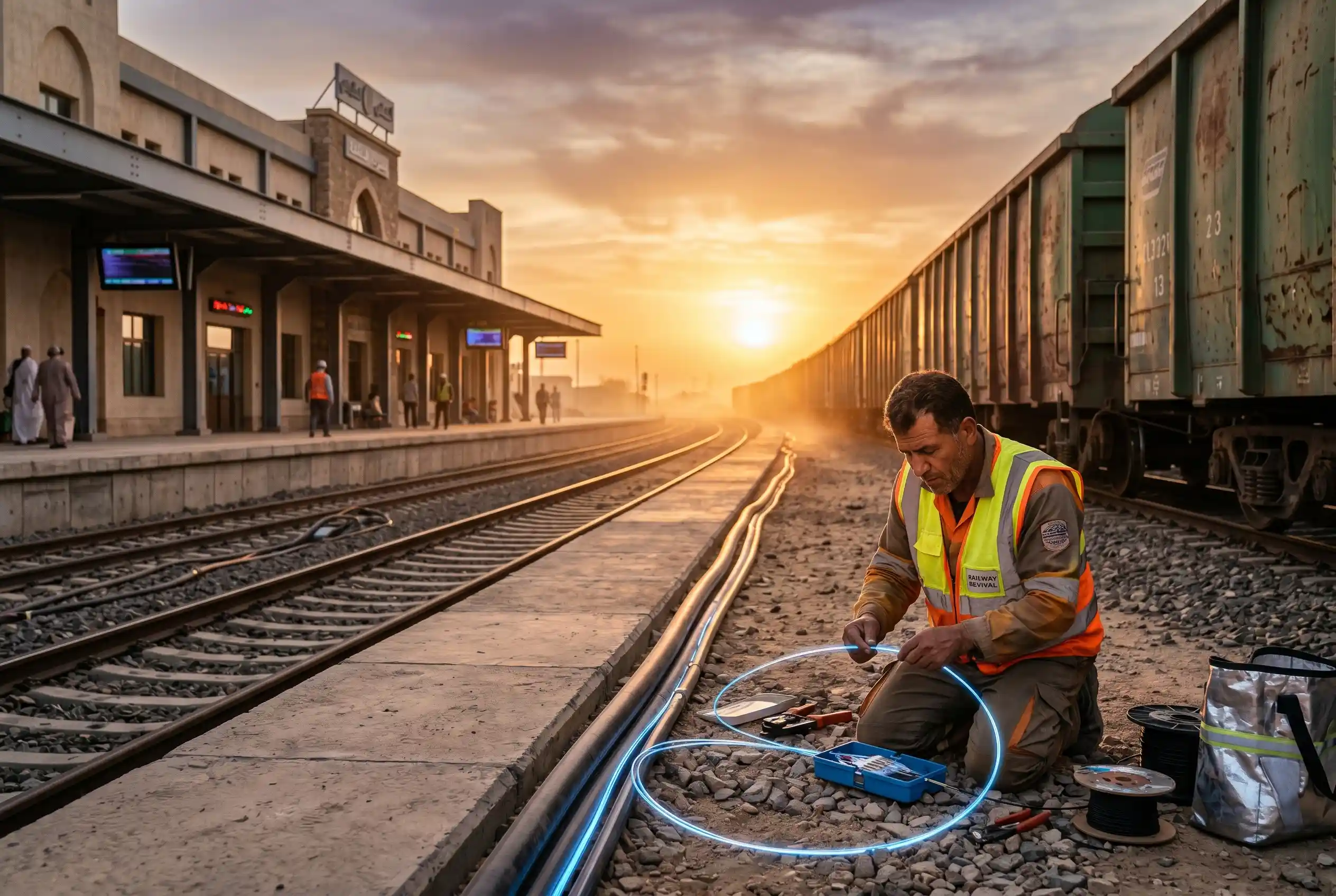
The Riyadh agreements recognize this. The logistics memorandum is paired with plans for a terrestrial fiber-optic route along the same Hejaz geography, running in parallel with the railway, a buildout covered in reporting on Gulf states racing to build overland data cables to Europe. The most advanced of the regional fiber projects is an $800 million contract signed by Saudi Arabia’s STC Group on February 7, 2026, to build 4,500 kilometers of fiber across Syria, replacing an earlier plan to route the link through Israel.
A state that can guarantee the flow of data between Asia and Europe wields an influence that pipelines alone never conferred. The deal treats the fiber and the railway as a single, bundled asset, built to carry freight, energy, and information along the same Anatolian geography.
The waiting mirror, IMEC
IMEC, the India-Middle East-Europe Economic Corridor announced at the G20 summit in New Delhi in September 2023, is the design’s mirror image, and the contrast sharpens the point. Its Northern Corridor links Gulf countries to Europe through an overland railway network spanning the UAE, Saudi Arabia, Jordan, and Israel, followed by maritime transit across the Mediterranean Sea to Greece and on to Europe. The rail spine terminates at Haifa, which makes Saudi-Israeli normalization a load-bearing precondition. France, Germany, Italy, and the European Union signed the memorandum alongside India, the United States, the UAE, and Saudi Arabia, with Israel and Jordan unofficially included because the proposed route passes through their territory.
| Feature | Türkiye-centered design | IMEC |
|---|---|---|
| Founding | Staged since 2024, with the June 9, 2026 Hejaz MoUs the latest piece | Announced September 2023 at the G20 in New Delhi |
| Path to Europe | Continuous land bridge via Türkiye | Land to Haifa, then maritime across the Mediterranean |
| Political precondition | Active Turkish-Saudi rapprochement | Saudi-Israeli normalization, frozen since October 2023 |
| Funding | $2 billion World Bank loan for INRAIL inside a $6.75 billion coordinated MDB package | 2023 MoU still functions as a broad declaration of intent, lacking a detailed overarching funding plan |
| Data layer | Parallel terrestrial fiber-optic route, including an $800 million STC contract to build 4,500 km of fiber across Syria | Planned digital infrastructure component, not yet under construction |
That political foundation has been frozen since October 2023, and the ship-to-rail-to-ship architecture reintroduces transshipment frictions that land corridors exist to eliminate. The 2023 memorandum, as a public stocktake of the project puts it, “still functions as a broad declaration of intent, since it still lacks a detailed overarching funding plan or concrete implementation mechanism.” The geographic stakes for the rival design are explained in the Atlantic Council’s framing of how Jordan’s regional connectivity is being rebuilt in Riyadh.
The Türkiye-centered design inverts each weakness. It requires no diplomatic breakthrough not already underway, advancing along the axis of an active Turkish-Saudi rapprochement. It offers a continuous land bridge, and it is moving from memoranda to feasibility studies to tenders on a visible timeline, anchored in part by a coordinated MDB package that the rival design has not yet attracted.
The financing is the conviction
Behind the loan, a coordinated system of six multilateral development banks. The $2 billion World Bank loan for INRAIL is the largest single piece. The package also includes the Asian Development Bank, the Asian Infrastructure Investment Bank, the European Bank for Reconstruction and Development, the Islamic Development Bank, and the OPEC Fund for International Development.
All six are working through a single, streamlined procurement approach led by the World Bank, a deliberate choice to keep the project’s structure coherent across financiers. The bank explicitly tied the financing to the corridor logic.
By removing a critical rail bottleneck at the Istanbul Strait and enhancing the resilience and efficiency of rail infrastructure, Türkiye is boosting its competitiveness and reinforcing its role as a logistic hub.
That was Humberto Lopez, the World Bank’s country director for Türkiye, in the bank’s March 31, 2026 statement on the INRAIL approval. International development banks are not in the habit of pricing aspirations. The market test has so far been passed, and the remaining test is execution: whether the layered MOUs, the in-flight construction, and the new fiber contracts are stitched into a single operating system that ships freight, electrons, and bits on the same backbone.
Where the corridor remains exposed
The corridor’s design assumes stable security in the geographies it threads. That assumption has not been stress-tested in operation.
The route runs through parts of Syria that have only recently come under a new political settlement. It crosses a Jordan still absorbing regional shocks. It ends at a Bosphorus rail crossing whose components are under construction. The freight and fiber flows also depend on a single node where the two axes meet, the same geography examined in the bypass-Israel logic of the railway deal.
The Strait of Hormuz closure, in place since at least March 2026, has compressed the timeline for alternatives and concentrated traffic on whatever land paths can be brought online first. The MOU is the headline. The next twelve months will be defined by the feasibility study, the tender pipeline, and whether the bundled freight-fiber architecture holds together as a single operating system. The corridor’s remaining test is execution: whether the new infrastructure ships freight, electrons, and bits on the same backbone.
Frequently Asked Questions
What is the Hejaz Railway?
The Hejaz Railway was an Ottoman-era narrow-gauge line built between 1900 and 1908 under Sultan Abdulhamid II, running from Damascus south to Medina, with a branch reaching Haifa. It was damaged in World War I and never fully restored across its original length. The current revival aims to rebuild and extend the route into a continuous freight and data corridor from Türkiye through Syria, Jordan, and Saudi Arabia, with a long-term vision reaching Oman and the Indian Ocean.
What did Türkiye and Saudi Arabia actually sign on June 9, 2026?
Two memorandums of understanding. The first covers cooperation in the railway sector: standards, technologies, training, and human resources. The second covers logistics services: logistics centers, operations management, expertise-sharing, and joint activities. The deal is not a construction contract; a joint feasibility study is due before the end of 2026.
Why does the Hejaz revival include a fiber-optic cable?
Submarine cables in the Red Sea carry over 90% of Europe-Asia data capacity, and a 2024 cable cut off Yemen degraded an estimated 25% of that traffic in a single incident. Gulf hyperscale data centers being built for AI workloads need a land-based fallback, and the Hejaz geography is the shortest available. The Riyadh agreement pairs the railway with a parallel terrestrial fiber route, treating the two as components of a single corridor.
How does this corridor compare to IMEC?
IMEC, the India-Middle East-Europe Economic Corridor announced in September 2023, is planned to run from India through the UAE, Saudi Arabia, Jordan, and Israel to the Mediterranean, then by sea to Europe. Its rail spine terminates at Haifa, which makes Saudi-Israeli normalization a precondition. The Hejaz-centered design avoids that dependency and offers a continuous land bridge, but it does not include India or a Mediterranean maritime link.
What is the Iraq-Türkiye Development Road?
The Development Road is a $17 billion to $20 billion project running 1,200 kilometers from Iraq’s Grand Faw Port on the Persian Gulf to the Turkish border at Fishkabore, with high-speed rail and multi-lane highway. A quadrilateral memorandum on the project was signed by Iraq, Türkiye, Qatar, and the UAE in April 2024, and full project completion is targeted in three stages through 2028, 2033, and 2050.
How much is being financed for the INRAIL crossing?
The INRAIL project carries a total estimated cost of approximately $8.3 billion, financed through a coordinated package of $6.75 billion from six multilateral development banks, led by a $2 billion World Bank loan approved on March 31, 2026. Once operational, the project is expected to raise rail freight capacity across the Bosphorus from around 3 million tons per year to up to 50 million tons.
