
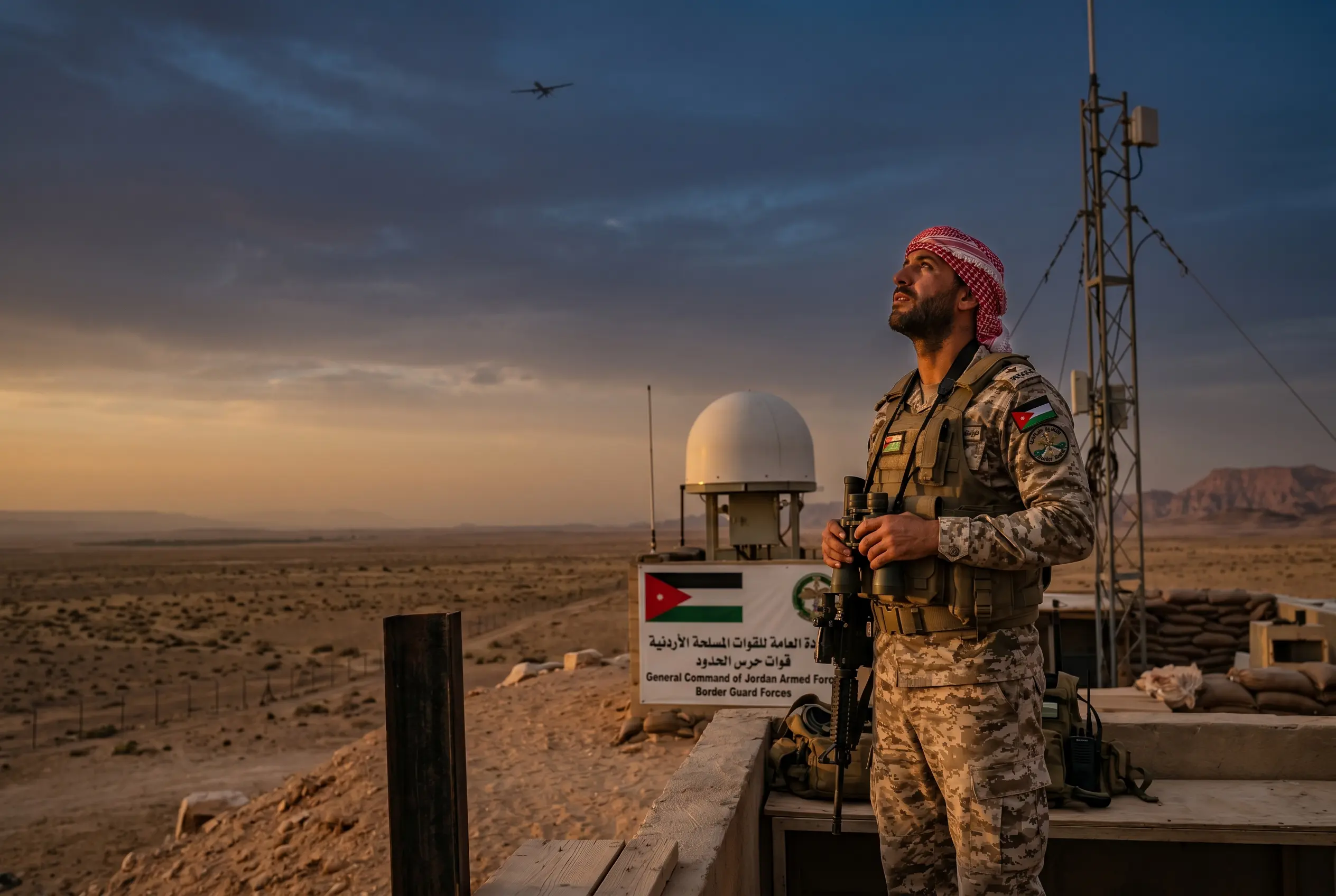
Two drug-smuggling drones attempting to cross into Jordan were intercepted by the kingdom’s armed forces, the military said. Border Guard units, working with security and military agencies, detected the two aircraft, applied the rules of engagement, and shot them down before they reached their targets inside Jordanian territory. The seized narcotics were transferred to the relevant authorities for legal action.
The interception is the latest move in a multiyear wave of drone smuggling attempts that has put Jordan’s border units on a near-weekly footing. The armed forces say they continue to use the latest surveillance technology to monitor any infiltration attempts, with the country’s position as a regional transit hub keeping the pressure high. The pattern has become routine enough that the army’s public statements now follow a familiar template: detection, engagement, transfer, and investigation. The two-drone incident is the visible edge of an escalation that has reshaped the kingdom’s defense posture.
How Border Guards Brought Down the Drones
A responsible military source said border guard forces detected the two drones as they attempted to cross the border, in coordination with the relevant security and military agencies. The forces engaged them according to the established rules of engagement and shot them down before the aircraft reached their targets within the Kingdom. The source added that inspections of the drones resulted in the seizure of quantities of narcotics being carried aboard. The seized items were then transferred to the relevant authorities to take the necessary legal measures. The military did not specify which border the drones approached from, nor the type or quantity of the narcotics they carried.
The competent authorities are continuing their investigation into the incident, the source said, a standard formulation in army communiqués on similar operations. The Jordanian Armed Forces framed the operation as part of a wider effort to combat smuggling along the kingdom’s borders and protect border security in Jordan. The same statement said the armed forces continue to utilize the latest technologies and surveillance systems to monitor any infiltration or smuggling attempts, and to coordinate across the relevant security and military agencies. The commitment, the source added, is to deal firmly with any attempts targeting the Kingdom’s security and stability.
The rules of engagement cited in the statement are the standing directive that allows border units to use force against incoming aircraft that violate Jordanian airspace. The directive has been cited in repeated army statements over the past year, applied to drones, electronically guided balloons, and other unmanned devices that have crossed from neighboring territory. In this operation, the application of the rules led to both aircraft being brought down inside Jordanian territory, before they could deliver their cargo.
The Multiyear Wave Behind the Interception
The interception landed against the backdrop of a multiyear escalation in cross-border drone smuggling. Per state news agency Petra, the Jordanian armed forces intercepted an average of 51 drones each month between January and mid-July 2025, a pace that works out to nearly two per day. The figure was reported by Arab News and confirmed by military sources quoted in the same period. The shift to unmanned aircraft as a smuggling tool has accelerated over the past several years, with Jordan’s western and eastern borders both seeing repeated attempts.
From January until mid-July, Jordanian armed forces have intercepted an average of 51 drones each month, nearly two per day, all carrying narcotics destined for the kingdom.
The figure came from state news agency Petra, as reported by Arab News, and was confirmed by military sources quoted in the same period. The kingdom’s geography, sharing land borders with Syria, Iraq, Saudi Arabia, and Israel and the Palestinian territories, has made it a recurring target for organized networks moving narcotics through the Levant. The volume of attempts has, in turn, forced the armed forces to expand the resources they devote to border surveillance. That expansion has come alongside closer coordination with the Anti-Narcotics Department, the civilian security body that handles drug-related cases in Jordan. It has also produced a steady drumbeat of public statements aimed at showing the public the threat is being met, with each interception framed as evidence the system is working. At the same time, the frequency of the attempts suggests the smugglers have not been deterred by the interceptions.
Each interception, in the smugglers’ calculus, is a calculated loss, and the networks behind the attempts retain the capacity to absorb such losses. The latest two-drone incident is a snapshot of an ongoing contest between the kingdom’s border units and a smuggling industry that has scaled to a near-daily cadence. The military has signalled that the response will continue to scale with the threat, with the rules of engagement applied to every incoming aircraft that crosses the border.
The pressure on the networks comes from the cost of replacing downed aircraft and lost cargo, a small but compounding effect on the economics of the trade. The cost, in the smugglers’ calculus, is the price of staying in the trade at scale, with the volume of attempts reflecting a market that has absorbed repeated losses and kept operating. The multiyear wave of attempts is a sign of the resources the smugglers are willing to commit, and the corresponding investment the armed forces have made in keeping the pressure on. The contest, measured across years, has become a feature of the kingdom’s border operations.
Where the Seized Cargo Goes
The narcotics recovered from the two drones were transferred to the relevant authorities to take the necessary legal measures, the military source said. The competent authorities are continuing their investigation into the incident, the source added, without detailing the specific substances or quantities involved. The army’s statement framed the handover as the standard end of an interception operation, with the same language recurring across similar communiqués in recent months. The seized material, once handed over, typically moves into a chain of custody that runs from the military to civilian security bodies, with the Anti-Narcotics Department the most frequent endpoint. The process is designed to preserve the evidentiary value of the cargo for any prosecution that follows.
In cases where suspects are detained, the military hands them to civilian prosecutors, who handle the legal process under Jordanian counter-narcotics law. The army’s role, in that sense, ends with the interception; the rest sits with the courts. The Anti-Narcotics Department, named alongside the Border Guard in most army statements on smuggling attempts, coordinates the follow-up investigation with military security agencies.
Why Jordan Stays a Key Transit Country
Jordan’s role as a transit corridor for narcotics is anchored in geography. The country shares land borders with Syria and Iraq to the north and east, Saudi Arabia to the south, and Israel and the Palestinian territories to the west. That makes it both a destination and a waypoint for smugglers moving drugs through the Levant, with the kingdom’s own consumption a smaller part of the equation than the regional trade it sits on top of. The military source framed Jordan as a “key transit country in the region” in its statement on the latest interception, language that captures both the scale of the threat and the limits of any purely domestic response.
The same statement noted that the armed forces continue to use the latest technologies and surveillance systems to monitor any infiltration or smuggling attempts, and that Jordan’s borders remain under strict, round-the-clock surveillance. The commitment, the source said, is to deal firmly with any attempts targeting the Kingdom’s security and stability, with operations coordinated across the relevant security and military agencies. The defence build-up has external backing. The US security cooperation programme covering border and counter-drone work is one of several channels through which Amman has acquired surveillance and counter-drone capabilities. Regional forums, including a dedicated counter-UAS conference hosted in Amman, have also positioned Jordan as a centre of gravity for the technology.
The mix of domestic investment and external partnership has, in turn, shaped the rules of engagement the border units now apply to incoming aircraft on a near-daily basis. The response scales with the threat, with the same standing directive applied to drones, electronically guided balloons, and other unmanned devices. The statement’s reference to the latest technologies points to a continuous upgrade cycle, with new detection and interception tools added as the smuggling networks adapt their own methods. The result is a posture that the military describes as ongoing and determined, even as the volume of attempts continues to rise.
Balloons Are Now Part of the Pattern
Drones are not the only unmanned method now in use by smuggling networks. The Jordan Armed Forces has documented a parallel stream of attempts using electronically guided balloons, with multiple interceptions recorded in the same week as recent drone operations. The army’s statement described the pattern in a single communique that named both methods, underscoring the multi-tool nature of the smuggling campaign.
The balloon method offers smugglers a different trade-off than drones, with the devices cheaper, able to carry heavier payloads, and harder to track on radar. They are also slower and more vulnerable to visual detection in daylight, and have been the subject of separate army statements on the eastern border. Drones, by contrast, are more expensive, more precisely targeted, and more visible to electronic surveillance, but harder to bring down without risking the cargo. Similar techniques are now being tested by militaries elsewhere: the US military, for instance, has been using the southern border as a testing ground for counter-drone technology as cartel surveillance flights have grown.
| Method | Direction of origin | Jordanian response |
|---|---|---|
| Drone | Western and eastern borders | Tracked, rules of engagement applied, shot down inside Jordanian territory |
| Electronically guided balloon | Eastern Military Zone | Detected at low altitude, cargo intercepted, narcotics transferred to authorities |
The military’s response to the multi-method threat is to apply a single set of standing rules: detect, track, apply the rules of engagement, and bring the device down inside Jordanian territory. The seized narcotics are then transferred to the competent authorities for further legal action, in coordination with the Anti-Narcotics Department. The approach has been consistent across drone, balloon, and other attempts, with the army’s statements suggesting no operational preference between methods. The pressure, in any case, is on the smuggling networks to keep adapting their tools and tactics, with the cost of replacement aircraft and lost cargo now a fixed feature of the trade. The military has said the response will continue to scale with the threat.
The Investigations That Follow
The competent authorities are continuing their investigation into the incident, the military source said, a sentence that recurs across army statements on similar operations. The investigation typically includes forensic work on the downed drones, tracing of components, and coordination with the Anti-Narcotics Department on the seized narcotics. The results of those investigations are rarely disclosed in public statements, with the army typically reporting only the outcome of the interception itself.
In cases where suspects are detained, the military hands them to civilian prosecutors, who handle the legal process under Jordanian counter-narcotics law. The army’s role, in that sense, ends with the interception; the rest sits with the courts. The Anti-Narcotics Department, named alongside the Border Guard in most army statements on smuggling attempts, coordinates the follow-up investigation with military security agencies. Public disclosure of charges, convictions, or sentences in such cases tends to come from the courts or the Department of Public Prosecution, rather than from the army itself.
Frequently Asked Questions
What happened in Jordan’s latest drone interception?
The latest interception was carried out under the army’s standing rules of engagement, with Border Guard units detecting the two drug-smuggling drones and shooting them down inside Jordanian territory. The seized narcotics were transferred to the relevant authorities, the military said.
How many drones has Jordan intercepted recently?
State news agency Petra reported an average of 51 drone interceptions per month in the first half of 2025, all carrying narcotics. The most recent operation brought down two more drones, both shot down inside Jordanian territory.
What kinds of drugs are smuggled across Jordan’s borders?
Army statements on similar interceptions have referenced large quantities of narcotics without specifying the type in the most recent announcement. The Anti-Narcotics Department handles the seized material in coordination with military security agencies, with the legal process that follows typically sitting with civilian prosecutors.
Where do the drones come from?
The military has not specified the origin of the drones in the most recent incident, and an investigation is ongoing. Previous army statements have named the kingdom’s western and eastern borders as the most frequent points of approach for both drone and balloon attempts.
How does Jordan detect the drones?
The military says it uses the latest surveillance systems and round-the-clock monitoring, with detection typically followed by tracking and the application of standing rules of engagement. Specifics of the technology are not disclosed in public statements, and the army has pointed to a continuous upgrade cycle as the smuggling networks adapt their methods.
The military has framed the response as ongoing and the threat as one it is determined to meet.
