
The relationship between ancient Greece and Egypt did not start with Alexander the Great or Cleopatra. It began roughly three centuries earlier, when Greek soldiers fought for Egyptian kings, traders settled the Nile Delta port of Naucratis around 620 BC, and the two peoples started borrowing each other’s gods, art and stories.
That is the argument veteran Egyptian archaeologist and former antiquities minister Zahi Hawass put to Greek Reporter, the Athens-based outlet covering Greek heritage, in a recent interview. The bond between the two civilizations, he said, was a long two-way exchange through trade, religion and military service. The famous names sit late in that story, and reading them without the earlier centuries leaves most of it out.
Before Alexander, Greeks Already Worked the Nile
Egyptian awareness of the Aegean world is older than most timelines suggest. Texts and wall paintings from the New Kingdom, the era of Egypt’s imperial pharaohs more than a thousand years before Alexander, already record peoples from across the sea. By the eighth and seventh centuries BC, under the Saite kings of the 26th Dynasty, the contact had turned into something steady and organized.
The exchange ran along four main channels:
- Military service – Greek and Carian mercenaries filled the ranks of Egyptian armies.
- Trade – Greek merchants moved silver, wine and oil under royal protection.
- Settlement – Greek communities put down roots in the Delta.
- Worship – Greek settlers prayed in Egyptian temples and mapped local gods onto their own.
Aegean Echoes in the New Kingdom
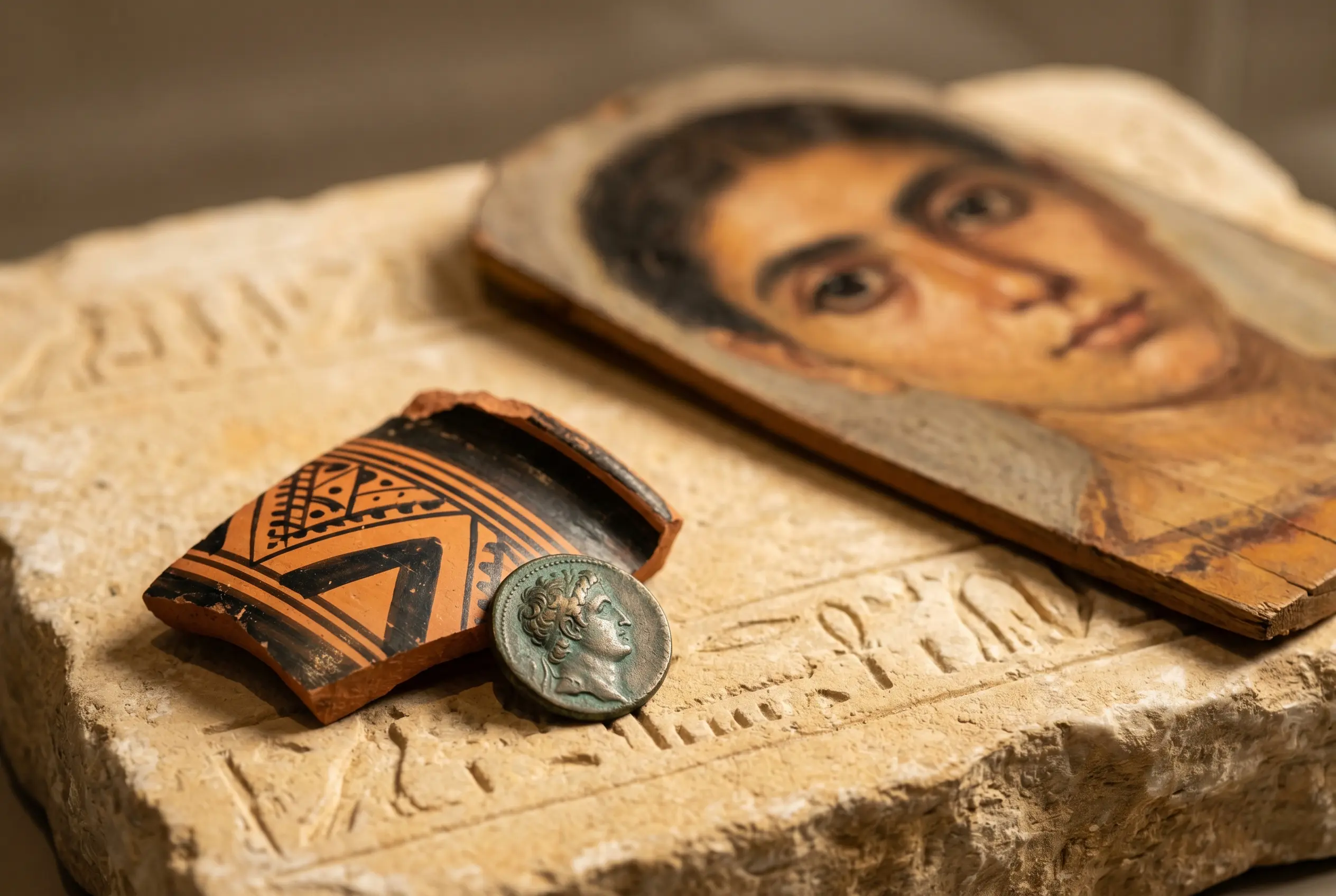
The material record backs the texts. Mycenaean pottery, and later Greek ceramics, turn up at Egyptian sites, marking maritime traffic between the Nile and the Aegean centuries before any Greek dynasty ruled Egypt. Hawass points to this layer as proof that the two worlds were trading partners and neighbors long before they were political subjects of the same crown.
Mercenaries Who Signed a Pharaoh’s Statue
One of the sharpest pieces of evidence sits on a leg of the colossal Ramesses II statue at Abu Simbel. Around 593 BC, Greek-speaking soldiers in the army of Psamtik II carved their names there after a campaign south into Nubia. The graffiti names men from East Greek cities such as Teos and Kolophon, alongside Carians and Phoenicians. These were working soldiers on a pharaoh’s payroll, leaving the ancient equivalent of a signature on the job.
Naucratis, the Delta Port That Handled the Trade
If one place anchors this older relationship, it is Naucratis. Founded around 620 BC during the reign of Psamtik I, the town sat on the Canopic branch of the Nile and ran as the main licensed harbor for Greek commerce in Egypt for most of two centuries, until Alexandria eclipsed it.
Settlers from Miletus and other Greek cities traded there under royal patronage. Greek silver, wine and olive oil came in; Egyptian grain, papyrus, linen and natron, the salt used in mummification, went out. Work at the site by the British Museum’s Naukratis excavation project has logged more than 10,000 objects, from Greek temple dedications to imported pottery and even timber from Greek ships.
For Hawass, Naucratis is the clearest single answer to anyone who dates the relationship to 332 BC. The town shows Egypt plugged into the Greek economy, military and religious life generations before the Macedonians arrived. By the time Alexander founded Alexandria a short distance away, Greeks had been living and trading in the Delta for close to three hundred years.
How Did Greek and Egyptian Gods Blend?
The exchange reached past goods and soldiers into religion. Greek visitors and settlers tended to recognize their own gods in Egyptian ones, a habit scholars call interpretatio graeca, and the matches stuck. Zeus was identified with Amun, producing the combined Zeus-Ammon, and the same oracle of Amun-Zeus at Siwa later proclaimed Alexander a son of the god. Isis was linked with Demeter and Aphrodite, and Thoth with Hermes.
| Greek figure | Egyptian god | Result of the pairing |
|---|---|---|
| Zeus | Amun | Zeus-Ammon, worshipped at the Siwa oracle |
| Demeter and Aphrodite | Isis | An expanded Isis cult that spread across the Mediterranean |
| Hermes | Thoth | A blended figure tied to writing and wisdom |
| Osiris and Apis | Apis bull cult | Serapis, a deliberately new god |
The boldest case is Serapis, a god built on purpose. Under Ptolemy I Soter, the first Macedonian ruler of Egypt, priests and advisers fused the Egyptian Osiris-Apis with Greek divine forms to create a deity both communities could accept. The history of the Serapis cult shows it spreading from Alexandria across the Roman world, often standing beside Isis in temples far from Egypt.
The Art That Answered to Both Courts
Visual culture followed the same pattern of doubling. On temple walls, Ptolemaic kings appeared as traditional pharaohs, carved in the frontal, timeless Egyptian style that had barely changed in millennia. On their coins, the same rulers showed up as Hellenistic monarchs, with realistic Greek portrait heads and Greek political symbols. One ruler, two visual languages, picked for two audiences.
The fusion is sharpest in the Fayum mummy portraits, painted in Roman-era Egypt between roughly the first and third centuries AD. Artists used the Greek encaustic technique, pigment mixed into hot beeswax, to paint strikingly lifelike faces with Greek-style shading and depth, then fixed those panels over mummies prepared by ancient Egyptian embalming rites. About 900 survive, many with their color almost intact. The Met’s study of the Fayum funerary portraits reads them as Greek painting in service of Egyptian belief about the afterlife.
Reading Cleopatra Past the Roman Script
No figure carries this entangled history like Cleopatra, and none has been distorted more. Hawass notes that the main surviving accounts of her were written by Roman authors after the Battle of Actium in 31 BC, the sea fight that ended her alliance with Mark Antony and handed Rome to Octavian. Those writers had reason to paint her as a foreign temptress, a symbol of Eastern excess threatening Roman order.
The physical evidence reads differently. Coins, inscriptions, temple reliefs and administrative papyri show an educated Hellenistic monarch who also worked hard to look Egyptian. She came from the Macedonian Greek Ptolemaic line, and Koine Greek was her first language. Yet ancient writers credit her as the only Ptolemaic ruler known to have learned the Egyptian language, and Plutarch lists a string of other tongues she handled without an interpreter. Her command of languages, as recent scholarship on Cleopatra’s multilingual court argues, was a tool of rule, letting her speak to Greek officials and Egyptian priests alike.
The documents give a sharper picture than the Roman caricature: a Greek queen who ruled as an Egyptian pharaoh, using both inheritances because both still carried real power in her hands.
Why the Greek-Egyptian Bond Still Draws Crowds
The story has a long afterlife, and it is being retold now for new audiences. Filmmaker and Egyptologist Curtis Ryan Woodside has screened documentaries in Athens that push past the two names everyone knows. One, on the Greek woman Rhodopis, traces her tale, set in Egypt under the Saite pharaohs Psamtik, Apries and Amasis, back to one of the earliest known versions of the Cinderella story, first written down by a Greek.
Ancient Egypt and Ancient Greece have always shared a history, even way before the arrival of Alexander the Great.
That is Woodside, speaking to Greek Reporter about why he made the films. A second documentary, co-produced with Hawass, follows Nefertari, the principal wife of Ramesses II, and probes possible links between her world around 1300 BC and the early Greek sphere.
For Hawass, this is also a matter of diplomacy. Joint excavations and shared exhibitions in the Delta, Alexandria and the oases, where Greek, Egyptian and Roman layers sit in the same ground, are how he wants the two countries to handle a past they hold in common rather than fight over.
Frequently Asked Questions
When did contact between ancient Greece and Egypt begin?
Well before Alexander the Great. Egyptian texts and wall paintings from the New Kingdom already noted Aegean peoples, and Mycenaean pottery confirms sea trade. Organized, regular contact, with mercenaries, traders and Greek settlers, was in place by the eighth and seventh centuries BC under the Saite pharaohs.
What was Naucratis?
Naucratis was a Greek trading town in the western Nile Delta, founded around 620 BC under Pharaoh Psamtik I. Settlers from Miletus and other cities ran it as the main licensed port for Greek commerce in Egypt until Alexandria took over that role, leaving behind temples, dedications and thousands of imported objects.
Was Cleopatra Greek or Egyptian?
Both, in effect. Cleopatra VII descended from the Macedonian Greek Ptolemaic dynasty, and her first language was Koine Greek. She also presented herself as an Egyptian pharaoh and was the only Ptolemaic ruler known to have learned the Egyptian language, using both identities to hold her throne.
Who was the god Serapis?
Serapis was a syncretic deity created under Ptolemy I Soter in the third century BC. He fused the Egyptian Osiris-Apis with Greek divine forms so that both Greek and Egyptian subjects could worship him. His cult spread from Alexandria across the Mediterranean and the Roman world.
What are the Fayum mummy portraits?
They are painted wooden portraits placed over mummies in Roman-era Egypt, made roughly between the first and third centuries AD. Artists used the Greek encaustic method of pigment in hot wax to create lifelike faces, then attached them to bodies prepared by Egyptian embalming. About 900 are known today.
Did the Cinderella story come from Egypt?
One early version did. The tale of Rhodopis, a Greek woman living in Egypt under the Saite pharaohs, is among the oldest known Cinderella-type stories and was first written by a Greek. Filmmaker Curtis Ryan Woodside built a documentary around it to show the depth of Greek-Egyptian ties.
