
Tourist arrivals to Egypt rose 4% between January and the first week of June 2026, Tourism and Antiquities Minister Sherif Fathy said on June 16 at a press conference organized by the Egyptian Tourism Federation. The growth came "despite regional tensions and challenges facing the global travel industry," Fathy said, with transportation costs and rising fuel prices adding pressure across the sector. Egypt has rolled out incentive programs aimed at maintaining inbound flows and air traffic, Fathy added, and the measures helped preserve tourism even as "some booking cancellations linked to current regional developments" cut into demand. The result puts Egypt on the right side of a regional split that is pulling visitors away from Gulf destinations. Egypt’s 4% tourism growth announcement at the ETF outlined the package of incentives supporting the growth.
The 4% year-to-date figure sits on top of a year that was, until April, running hot. Q1 2026 inbound arrivals were up 15.6% year on year, the minister said in late May, while a UN Tourism report published June 2 put Egypt’s Q1 growth at 16% as the broader Middle East fell 14%. April alone told a different story, with arrivals down roughly 16% against the same month in 2025. Egypt’s first four months still came in 7% ahead of 2025, with 6.1 million visitors against 5.7 million, according to government figures reported on June 11.
The 4% That Outran a 16% April
Egypt ended the first five and a half months of 2026 with 4% more tourists than the same stretch of 2025, Fathy told reporters at the Egyptian Tourism Federation. He tied the result to a series of incentive programs and infrastructure investments, and acknowledged that higher global fuel prices and airline decisions to trim flight frequencies were adding cost across the industry. Tourism, Fathy said, is now expanding in Egypt while airlines and tour operators face a more expensive and less predictable operating environment.
The headline number almost hides what happened in April. Fathy, speaking to Asharq News on the sidelines of a solar power station inauguration at the Grand Egyptian Museum, said April 2026 arrivals were down about 16% year on year.
The first quarter had set a much louder tempo. The minister’s own figures, reported on May 23, put Q1 2026 arrivals up 15.6% on the same quarter in 2025, with around 5.6 million visitors and revenue near $5.1 billion. A UN Tourism report dated June 2 logged Egypt at 16% growth in Q1 while the wider Middle East contracted by 14%. Egypt’s growth in that report came from inbound tourism redirected away from the Gulf and from regional carriers using Egyptian airports after several neighbors closed their own airspace, and the rerouting showed up in Egypt’s first quarter numbers.
- Egypt arrivals, Jan to early June 2026: +4% (Fathy, ETF, June 16, 2026)
- Egypt arrivals, April 2026 alone: -16% (Fathy to Asharq News)
- Egypt arrivals, Q1 2026: +15.6% YoY (Daily News Egypt, May 23, 2026)
- Middle East arrivals, Q1 2026: -14% (UN Tourism, June 2, 2026)
- Egypt arrivals, Jan to April 2026: +7% (6.1m vs 5.7m, Skift citing Egyptian government, June 11, 2026)
Egypt’s Incentive Stack for Airlines and Tour Operators
Egypt has layered a stack of measures aimed at keeping airlines, tour operators, and visitors flowing in. The aviation incentive program was updated in May to keep flight operations running through the fuel-cost spike, and the cabinet has approved reductions in airport charges and ground handling fees for carriers that grow their seat capacity.
Beyond pricing, the ministry has spent the past two months hosting international influencers, bloggers, familiarization trips, and meetings with major tour operators, Fathy said at the ETF event. The WTTC meetings held in Egypt generated positive international exposure, he added, and the Egypt Vibes campaign showcased visitor experiences across multiple nationalities. The ministry is also working with the ETF and stakeholders on flexible marketing plans that adapt quickly to changing market conditions. Fathy pointed to a wider infrastructure push, including roads, bridges, and transportation networks linking tourist destinations.
- Updated aviation incentive program and cabinet-approved reductions in airport and ground handling fees
- Hosting of influencers, bloggers, familiarization trips, and major tour operators over the past two months
- WTTC meetings hosted in Egypt for international exposure
- Egypt Vibes promotional campaign showcasing visitor experiences across multiple nationalities
- Infrastructure investments in roads, bridges, and transportation networks linking tourist destinations
Where the Cancellations Hit Hardest
The cancellations Fathy acknowledged have not landed evenly. The 4% year-to-date figure is a national average that papers over sharper pain at the resort and operator level. The government line, delivered by Egyptian Tourism Authority CEO Ahmed Youssef in late March, was that less than 5% of visitors had cancelled their bookings as a result of the Middle East conflict.
Other figures in the industry tell a different story. Mohamed Nabil, co-founder of destination management company Rove World, said 70% of its bookings had been cancelled.
Local media reports put hotel occupancy down 20-25% year on year, and Hurghada and Marsa Alam ran at around 80% occupancy, down from higher recent levels. The UK budget carrier EasyJet publicly stated that bookings to Egypt were down, with holidaymakers preferring western Mediterranean destinations further from the conflict. The US State Department included Egypt in a 2 March "DEPART NOW" alert covering 14 countries, an advisory the department has since relaxed for Egypt specifically. Red Sea hotel and tour operator pressure documented in April paints a more uneven picture, per the outlet’s April reporting.
- Hotel occupancy down 20-25% year on year in local media reports
- Rove World reports 70% of its bookings cancelled
- EasyJet publicly states bookings to Egypt are down
- Hurghada and Marsa Alam occupancy fell to around 80%
The Edges Egypt Still Holds
The advantage Egypt still has is structural, not promotional. The country sits on the outside of the conflict zone, did not come under attack, and does not host US military bases.
Egypt was one of the few Middle East countries to keep its airspace open during the Iran war that began in late February and escalated through March, and the national carrier continued operating to most destinations. Several regional carriers rerouted through Egyptian airports in that period, and the rerouting added to Q1 arrivals. The decision let the country function as a regional air bridge at the moment other hubs were shut, and the country’s open airspace made Egypt a stable alternative for travelers in a region where the Gulf absorbed the worst of the conflict’s travel fallout. Fathy cited the rerouting as one reason Egypt outpaced the regional average in Q1.
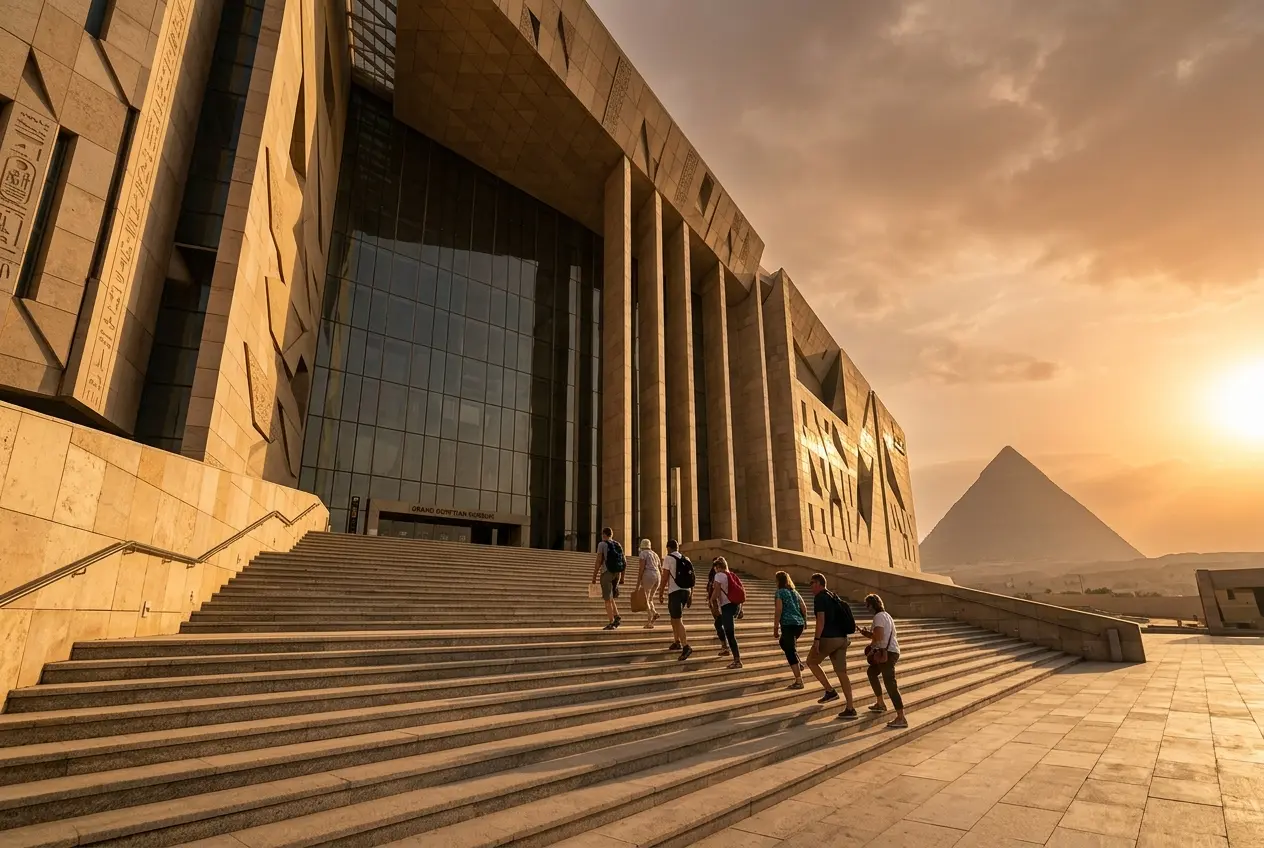
Two other structural factors are pulling visitors across. The Grand Egyptian Museum, which opened in November 2025 with 100,000 artefacts and a projected 8 million visitors a year, gave the country a fresh cultural anchor at the moment it needed one, and finds such as the Aphrodite head as a tourism bet at Beni Suef have kept the country’s archaeological pipeline in the international press. The 2024 devaluation of the Egyptian pound lowered costs for foreign visitors at a time when rival destinations were becoming more expensive, and the country has been working to convert that affordability into repeat visits, the minister said.
The redistribution shows up in the headline numbers. Tourist arrivals in the Middle East fell 14% in Q1 2026, a UN Tourism report published June 2 showed, while Egypt posted 16% growth in the same window. The WTTC puts the sector’s contribution to Egypt’s economy at EGP 1.4 trillion in 2024, or 8.5% of GDP, with 4.9% growth forecast for 2025 and employment rising to 2.9 million jobs, 22.3% above 2019, per the body’s record tourism data for Egypt. Tourism sustains almost 3 million jobs and brings in more than $15 billion a year, government figures show.
Some countries benefit when others do not.
Haitham Mattar, managing director for India, Middle East and Africa, framed the shift in Skift’s June 11 report, "Egypt Emerges as the Winner in the Middle East’s Travel Shake-Up." The 4% year-to-date figure Fathy announced five days later is the first Egyptian confirmation of the same dynamic, with Fathy’s own numbers now lining up with the UN Tourism data.
Hitting 30 Million Tourists by 2030
Fathy’s June 16 remarks ended on a longer target. Egypt is aiming for 30 million tourists a year by 2030, the same figure the State Information Service has carried in recent months and the target the minister reiterated on a New York visit in May. The path is steep: Egypt had about 19 million visitors in 2025, a 21% rise on 2024, and is targeting roughly 21 million in 2026, a 10.5% gain. Closing the gap to 30 million by the end of the decade will require growth at a pace the country has not yet sustained for a full year, and the 4% YTD growth is the first quarter of that challenge.
The sector’s underlying economics give the target room to run. The WTTC projects that 2025 will set a new all-time high for travel and tourism’s contribution to Egypt’s economy, with a forecast 4.9% annual growth and a rise in the sector’s share of GDP to 8.6%.
The preconditions for hitting 30 million include expanding hotel capacity, including projects like the Triumph Pyramids Hotel project near the Grand Egyptian Museum, regulating the vacation apartments model under strict quality and safety standards, and keeping flight capacity flowing. Fathy’s aviation incentive package and the cabinet-approved reductions in airport fees target the last of those, while cultural and infrastructure investments try to widen Egypt’s appeal beyond beach tourism. The 4% year-to-date growth, in the minister’s framing, is the early proof that the incentive stack can hold under regional pressure, and the 30 million target is where the same stack has to keep working for four more years.
