
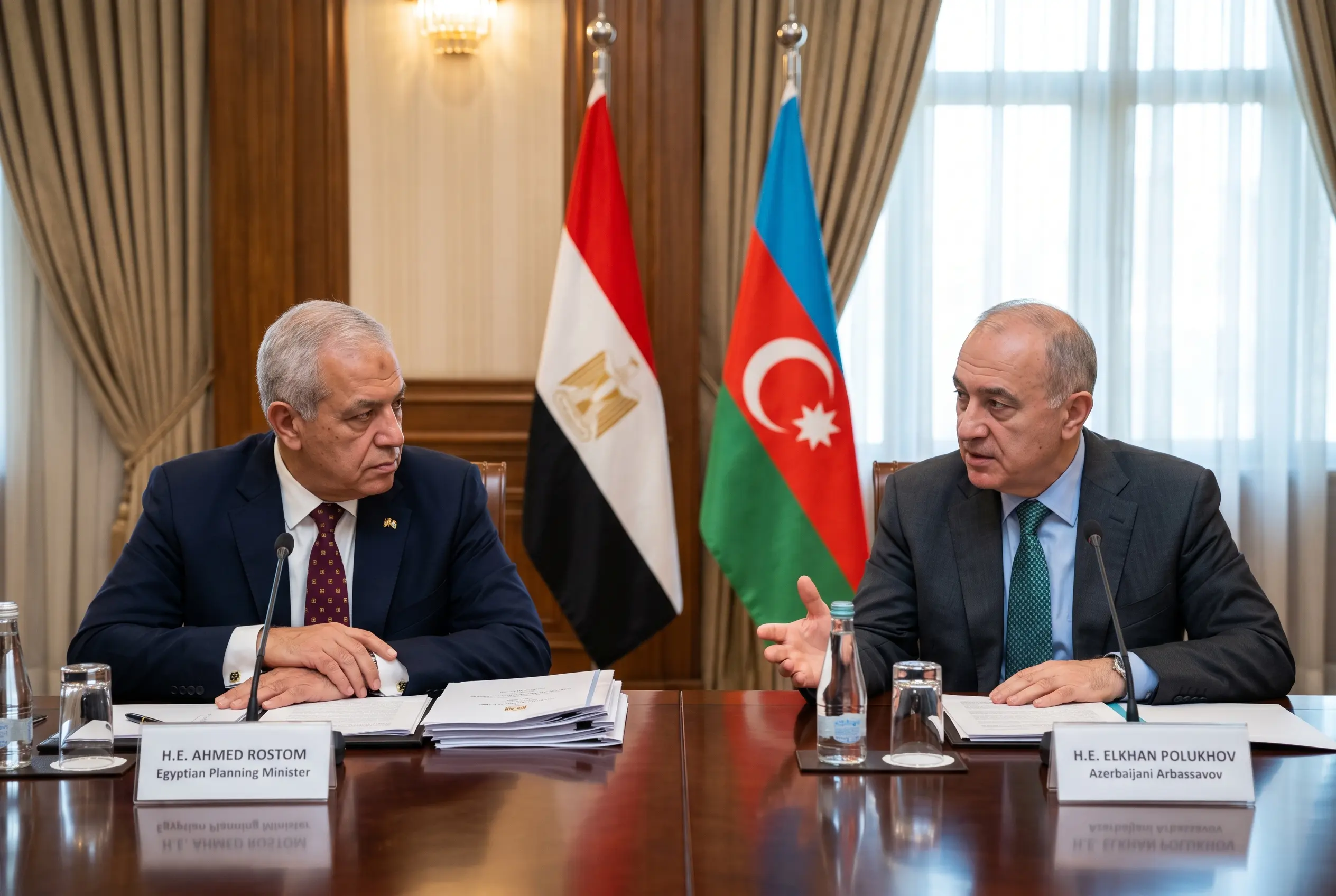
Egypt’s Planning Minister Ahmed Rostom and Azerbaijan’s ambassador to Cairo, Elkhan Polukhov, met on Sunday, June 14, 2026, to map a new phase of Egypt and Azerbaijan economic cooperation spanning sustainable development, trade, and infrastructure. The session in Cairo came two days before Azerbaijan hosts the Islamic Development Bank Group’s annual meetings in Baku from June 16 to 19, an event both sides flagged as a chance to convert bilateral talk into joint projects. Polukhov, in the meeting, pointed to Azerbaijan’s hosting of the upcoming Organisation of Islamic Cooperation (OIC) summit as a parallel window to push the same agenda.
According to the readout from Egypt’s State Information Service, Rostom praised the strategic and longstanding partnership and outlined a workplan with Azerbaijan’s Ministry of Economy to shape a new phase of cooperation. Polukhov highlighted direct flights between Baku and Cairo launched earlier this year, describing them as a path to facilitate bilateral trade and broaden development cooperation beyond its traditional framework. The two officials also discussed Egypt’s expertise in smart cities and green-economy infrastructure, a track Polukhov said Azerbaijan is keen to tap into. The meeting reflects the political momentum that has built since President Abdel Fattah El-Sisi’s visit to Baku and President Ilham Aliyev’s reciprocal trip to Cairo.
What the Cairo meeting set out to do
Rostom used the meeting to position Egypt as a partner with both institutional weight and operational know-how, according to the Egyptian government’s full readout of the meeting and a June 14 readout of the Rostom-Polukhov meeting published by Daily News Egypt. He told Polukhov he wanted to work with Azerbaijan’s Ministry of Economy to exchange perspectives and shape a new phase of cooperation that supports development in both countries. Egypt’s pitch, he said, rests on its accumulated experience in structural reform, its ability to maintain macroeconomic stability, and a national development vision aimed at empowering the private sector.
Polukhov, in turn, reaffirmed Azerbaijan’s strong appreciation for its longstanding ties with Egypt and emphasised the commitment of both countries’ leaderships to strengthen cooperation in line with current priorities. He particularly highlighted the positive outcomes of El-Sisi’s visit to Baku and Aliyev’s visit to Cairo, calling them a turning point for the relationship. He also pointed to the launch of direct flights between Baku and Cairo earlier this year, framing them as a practical foundation for trade, business community engagement, and investment flows. The political signal of those visits has begun to convert into sector-level work, most recently the sixth joint committee session in Cairo in October 2025.
The meeting’s substance was as much about smart cities and green infrastructure as about trade. Polukhov said Azerbaijan wants to draw on Egypt’s pioneering experience in developing smart cities and infrastructure that supports a green-economy transition, areas the readout named as priorities for the next phase of cooperation. Egypt, for its part, pointed to its adoption of advanced digital mechanisms to monitor progress toward the Sustainable Development Goals, a track Rostom highlighted in his remarks.
- June 2024: Azerbaijani President Ilham Aliyev visits Cairo; seven documents are signed in economic development, digital transformation, and investment promotion.
- October 2025: The sixth session of the Egyptian-Azerbaijani Joint Committee convenes in Cairo, co-chaired by Egypt’s then-minister Rania Al-Mashat and Azerbaijan’s Minister of Digital Development and Transport Rashad Nabiyev.
- June 14, 2026: Rostom and Polukhov meet in Cairo to frame a new phase of cooperation.
- June 16 to 19, 2026: The Islamic Development Bank Group annual meetings open in Baku, followed by Azerbaijan’s hosting of the upcoming OIC summit.
Azerbaijan’s two summits in one week
Azerbaijan is hosting back-to-back multilateral gatherings in the same week. The Islamic Development Bank Group’s annual meetings run in Baku from June 16 to 19, 2026, and Azerbaijan will then host the upcoming summit of the Organisation of Islamic Cooperation (OIC). Polukhov, in his Cairo meeting with Rostom, said the two events are expected to discuss and endorse major regional and international development initiatives. Polukhov framed the OIC summit in particular as a parallel window to push the Egypt-Azerbaijan cooperation agenda. Cairo is sending a senior delegation to both.
Egypt is the Islamic Development Bank’s second-largest beneficiary among partner countries, with cumulative approvals of approximately $28.9 billion as of March 2026, according to data cited by Ahram Online. The country also runs an annual cooperation programme with the bank worth up to $1.5 billion to support food security, energy needs, and essential commodities. Rostom’s pitch, that Egypt can offer reform experience, smart-cities know-how, and a working relationship with the Islamic Development Bank, is the offer he is bringing to the multilateral floor in Baku.
Egypt’s negotiating hand
Egypt is not arriving at the Baku meetings empty-handed. Its two-decade relationship with the Islamic Development Bank is the cornerstone of that hand. As of March 2026, cumulative IsDB approvals for Egypt reached approximately $28.9 billion, the bank’s second-largest beneficiary among partner countries. That gives Cairo institutional standing when it asks Baku and other capitals to back its priorities.
The bank is also a working partner, not just a financier. Egypt and the IsDB have an annual cooperation programme worth up to $1.5 billion covering food security, energy needs, and essential commodities. Rostom used the Cairo meeting to tell Polukhov that Egypt’s experience with structural economic reform and macroeconomic stability should count for something in joint projects. He also pointed to Egypt’s adoption of advanced digital mechanisms to monitor progress toward the Sustainable Development Goals.
The smart-cities track is the most concrete on offer. Polukhov told Rostom that Azerbaijan is keen to benefit from Egyptian expertise in developing smart cities and infrastructure that supports a green-economy transition. The fit is mutual: both countries are looking for project pipelines that can be co-financed through the Islamic Development Bank.
Rostom also offered Egypt as a stable partner at a moment of regional volatility. The State Information Service readout said he “underscored the country’s success in maintaining macroeconomic stability and implementing a flexible national vision aimed at empowering the private sector and attracting investment despite ongoing regional and global geopolitical challenges.” The pitch is timed to a year when Egypt’s headline inflation eased to 14.6% in May 2026, down from 14.9% in April, according to official data. The trade balance is less reassuring: Egypt’s trade deficit widened by 53.9% year-on-year to $15.48 billion in the first quarter of 2026, a result the readout did not address.
Trade flows that lag the rhetoric
The political relationship is older than the trade one. According to financial analytics platform Trading Economics via Ahram Online, the two-way flow of goods between Egypt and Azerbaijan in 2025 was a fraction of Egypt’s bilateral trade with Turkey, Italy, or Saudi Arabia. The June 14 meeting did not announce a specific trade target or a new bilateral investment vehicle. The conversation, on the readout evidence, stayed at the level of joint committees, working groups, and private-sector forums.
Direct cargo flights launched earlier this year between Cairo and Baku add a logistics layer to the relationship. Polukhov, in the meeting, framed the flights as a way to facilitate bilateral trade and support business communities and investment companies. Ahram Online reported the cargo link was launched with the explicit aim of giving the business community and investment partners a working logistics channel. No data is yet available on the cargo volumes the new route has moved.
- Egyptian exports to Azerbaijan, 2025: approximately $101.1 million (Trading Economics via Ahram Online)
- Egyptian imports from Azerbaijan, 2025: approximately $4.74 million (Trading Economics via Ahram Online)
- Egypt headline inflation, May 2026: 14.6%, down from 14.9% in April (CAPMAS via Ahram Online)
- Egypt trade deficit, Q1 2026: $15.48 billion, up 53.9% year-on-year (Ahram Online)
- Documents signed during Aliyev’s June 2024 Cairo visit: seven (Daily News Egypt, September 2025)
The next major venue is the IsDB annual meetings in Baku, opening June 16. Rostom has framed joint projects with Azerbaijan, whether in transport, renewable energy, or smart-city infrastructure, as fitting the IsDB’s regional integration theme. The private sector is also queued: in September 2025, Al-Mashat, then minister of planning, economic development and international cooperation, told Azerbaijan’s Deputy Foreign Minister Yalchin Rafiyev in Cairo that an Egyptian-Azerbaijani business forum would be held alongside the joint committee. The next joint committee session will be the next scheduled step in the workplan.
Sectoral tracks already in motion
The June 14 meeting did not open new tracks; it reinforced existing ones. Egyptian and Azerbaijani officials have spent the past year building a sectoral pipeline that spans energy, transport, healthcare, and digital infrastructure. The most recent public readout lists at least four tracks where the two countries are already working together. Several of those tracks have dates attached.
- Oil and gas: Egyptian Petroleum Minister Karim Badawi met Azerbaijani Energy Minister Parviz Shahbazov on the sidelines of Baku Energy Week earlier this month, with oil and gas infrastructure on the agenda.
- Transport and logistics: Direct passenger and cargo flights between Baku and Cairo launched earlier this year, intended as a working channel for the business community.
- Smart cities and green infrastructure: Polukhov told Rostom Azerbaijan wants to draw on Egypt’s experience in developing smart cities and infrastructure for the green economy.
- Renewables, health, culture, and investment: The sixth session of the Egyptian-Azerbaijani Joint Committee in October 2025 in Cairo covered all four sectors, co-chaired by Rania Al-Mashat and Rashad Nabiyev, Azerbaijan’s Minister of Digital Development and Transport.
The October 2025 joint committee in Cairo produced a detailed institutional readout of the bilateral pipeline. It was co-chaired by Al-Mashat and Nabiyev and was designed to advance economic, trade, and tourism cooperation across renewable energy, oil and gas, culture, health, and investment. The committee also set up work streams: joint projects in pharmaceutical manufacturing at Azerbaijan’s Alat Free Economic Zone, transfer of Egyptian expertise in green hydrogen and ammonia, and cooperation on rehabilitation and maintenance of power plants. Al-Mashat pointed to the launch of “Egypt’s Narrative for Economic Development,” a framework positioning Egypt as an export-oriented investment destination. The two sides also reviewed the outcomes of the COP29 climate conference hosted by Azerbaijan.
The pharmaceutical and green-hydrogen tracks got the most specific commitments in the October 2025 meeting. The Alat Free Economic Zone gives Egyptian pharmaceutical manufacturers a Caspian-region platform they do not currently have, and green hydrogen and ammonia are areas where Egyptian ministries have signed memoranda with counterparts in the region. Polukhov’s smart-cities pitch is consistent with that pattern.
The October 2025 committee’s outcomes set a public benchmark. The next session of the joint committee will be the first formal opportunity to compare that benchmark against fresh output, and the Baku summits will set the timing.
What the Baku week will measure
The next major milestone is in Baku. The IsDB annual meetings run June 16 to 19, 2026, and Azerbaijan’s OIC summit follows, with the IsDB Group annual meetings programme already published. Both events will give Rostom and his Azerbaijani counterparts a chance to announce a joint project, a co-financed programme, or a sector-specific working group. The political signal is already in place: El-Sisi’s visit to Baku and Aliyev’s reciprocal visit to Cairo, plus the parliamentary exchanges documented in 2023 and 2025, give the relationship a public spine. The trade signal is still in five figures on the export side.
The October 2025 session in Cairo produced a sectoral workplan and a business forum. The offer is on the table: reform experience, smart-cities know-how, and a working relationship with the Islamic Development Bank. Azerbaijan and Egypt’s parliamentary partnership history shows the political floor has held. The next measurement of the economic ceiling is the Baku week.
