
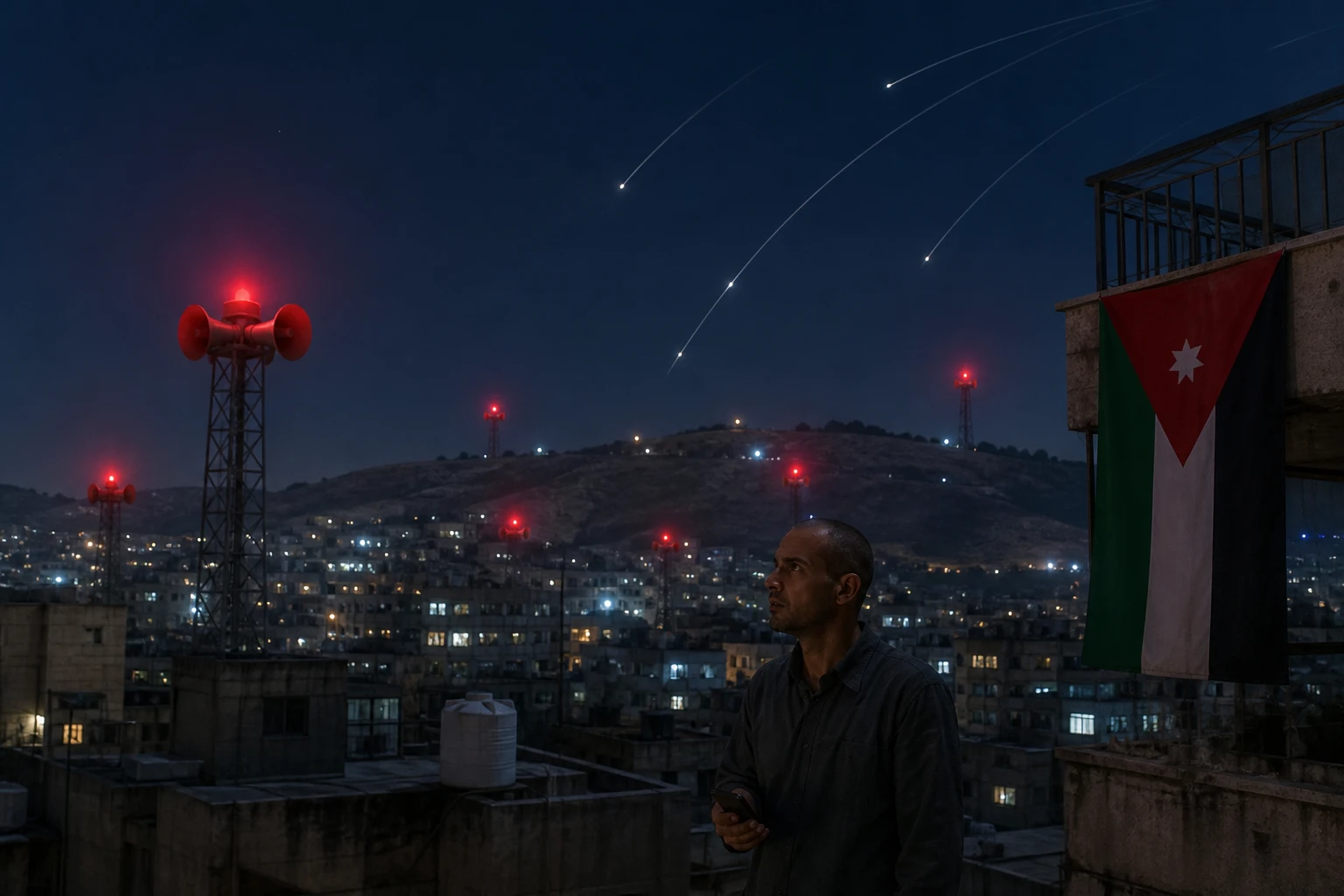
Air-raid sirens blared across Amman on July 20 as four Iranian missiles streaked toward Jordan. The army said they were intercepted or fell in empty ground. That night was one more entry in a grim tally: Tehran has launched at least 60 missiles and drones at the kingdom since July 8.
The projectiles aim mainly at bases hosting some 4,000 U.S. troops. Three American service members died on July 17 at Muwaffaq Salti Air Base near Azraq. No Jordanians have been killed by the direct strikes, yet the kingdom that markets itself as a stable oasis now lives with sirens, flight cancellations and a rare public argument over its American shield.
Sixty Projectiles and Three American Dead
The latest wave began after the U.S.-Iran ceasefire frayed. Jordanian and U.S. defenses have intercepted most incoming weapons. Debris and the few that got through still leave scars.
On July 17, ballistic missiles and drones hit Muwaffaq Salti. CENTCOM statement on the July 17 losses confirmed two service members killed in action, one missing (later identified among the dead), four medically evacuated to Jordanian hospitals and later discharged, and others treated for minor injuries. Total U.S. casualties from the July strikes reached three killed and roughly 29 injured. Iranian claims of dozens of American dead and multiple destroyed aircraft remain unverified propaganda.
- July 9: IRGC claimed 10 ballistic missiles at Muwaffaq Salti; Jordan said eight intercepted, no casualties.
- July 12: Iran claimed hits on command centers and MQ-9 hangars at Prince Hassan Air Base.
- July 17: Deadly strike on Muwaffaq Salti; three U.S. dead, helicopters damaged.
- July 19-20: Claims against King Hussein Airport near Aqaba and more Amman sirens; Jordan intercepted most.
- Late July: Continued intercepts of missiles and drones over the eastern desert, including five on July 29.
Earlier phases of the war that began in late February already saw dozens of projectiles cross Jordanian airspace, some aimed at Israel and others at U.S. sites. Jordanian air defenses, working with partners, have downed the large majority. Satellite analysis later confirmed damage to a THAAD-related radar and structures at Azraq and Tower 22.
| Date / Period | Key Target or Claim | Outcome |
|---|---|---|
| July 8 onward | U.S. facilities at Azraq and other bases | At least 60 missiles/drones; most intercepted |
| July 17 | Muwaffaq Salti Air Base | 3 U.S. killed, ~29 injured; aircraft/heli damage |
| July 19 | King Hussein Airport / Aqaba area | Iran claimed aircraft damage; debris reports |
| Full war to date | Multiple bases + airspace transit | 29 Jordanian civilians injured (mostly debris) |
The pattern is clear. Iran treats Jordan as a convenient pressure point because American aircraft and personnel sit on Jordanian soil.
The Security Umbrella That Draws the Fire
Jordan’s entire security architecture rests on the United States. Washington supplied $1.65 billion in economic and military aid last year, above the $1.45 billion annual baseline in the 2022 seven-year Memorandum of Understanding. The two countries also signed a 2021 Defense Cooperation Agreement and multi-year aid framework that gives U.S. forces access to multiple Jordanian facilities, including air bases, without calling them American bases.
- $1.65 billion U.S. aid delivered last year
- $1.45 billion annual MOU commitment through FY2029
- 4,000 U.S. troops currently hosted
- Major Non-NATO Ally status since 1996 plus FMF, IMET and border-security programs
Foreign Minister Ayman Safadi has repeated the formula: there are no U.S. bases, only Jordanian bases with American troops under the defense agreement for counterterrorism and joint work. The distinction matters for domestic politics. It does not stop Iranian targeting.
Thomas Juneau of Chatham House and the University of Ottawa calls Jordan’s vulnerability extreme. The kingdom imports 95 percent of its oil, lacks major natural resources, and sits between Syria’s unfinished war, Iraqi militias, Israel and the West Bank. “Jordan’s entire security architecture is built on its close relationship with the U.S. It made that decision long ago and has always been clear that the benefits outweigh the risks,” he said.
The irony is sharp. The same umbrella that deters conventional threats now paints a target on the bases. Since June, Israel has faced fewer of these direct salvos even though it helped launch the wider war. Jordan, the quieter partner, absorbs more of the volume.
Three Hundred Names on an Open Letter
The attacks have produced something unusual in a country that tightly manages speech: public pushback. Roughly 300 Jordanians, among them former parliamentarians, activists and tribal leaders from leftist, pan-Arabist and Islamist circles, signed an open letter demanding “withdrawal of all foreign forces from Jordanian territory.”
Jordan is not part of this war and its people should not suffer its consequences.
The letter argues the presence raises the odds of being dragged into a conflict that is not Jordan’s and creates security, political and economic risks with no national payoff. Jordanian media largely ignored it. The Muslim Brotherhood was banned last year after rocket-plot accusations, and the king passed over the Islamist-linked election winner for prime minister. Self-censorship is the norm. The letter broke through anyway.
Iran’s Revolutionary Guard Corps thanked “the noble Jordanian people” for solidarity and claimed “precise information” from inside the country helped kill “dozens” of U.S. soldiers. The numbers do not match verified U.S. figures, but the psychological jab landed. President Trump later complained that “they did slip something through in Jordan” and that other operators might have prevented it.
Who Carries the Real Cost
No Jordanian deaths from the Iranian strikes themselves. That fact is cold comfort. Tourism supplies about 18 percent of revenue. The sector already posted a 4 percent year-on-year drop to $1.6 billion in the first quarter of 2026 as the wider war bit into bookings and flights. Sirens and cancellations deepen the hit.
Ordinary life now includes alerts. Flight schedules wobble. The delicate demographic balance between East Bank tribes and Palestinians, many of whom watch events in Gaza and the West Bank with raw anger, grows more brittle. Saud Al-Sharafat, a former intelligence brigadier who runs a terrorism studies center in Amman, reads the Iranian campaign as deliberate polarization: raise the costs for U.S. partners, paint the government as Washington’s or Israel’s agent, and chip away at long-term intelligence and training ties.
- Tourism revenue pressure and flight disruptions
- Domestic political polarization and rare open criticism
- Debris and interceptor fallout risks to civilians
- Strain on the image of Jordan as a regional calm zone
Relations with Israel, sealed by the 1994 peace treaty, sit at a low point. Jordan has helped intercept missiles headed for Israel in earlier rounds. Far-right Israeli voices still talk of transferring West Bank Palestinians eastward. That nightmare scenario hangs over Amman even when the missiles are Iranian.
Tehran’s Calculated Pressure Campaign
Iran’s defense minister argued recently that Middle East countries must provide their own security because foreign forces breed distrust. The armed forces commander warned Muslim states they would “burn in the fire of war” if they acted as America’s shield. The message is consistent: raise the price of the U.S. presence until partners flinch.
The strategy has produced earlier reporting on the cost of hosting US troops across the Gulf and Jordan. Kuwait has also been hit. Gulf states have more oil money and different leverage. Jordan does not. Its geography and poverty make the American relationship non-negotiable in the eyes of the palace and most of the security establishment.
Juneau notes two threads running together. Resentment at a distant war launched by the Trump administration that dumps frontline risk on neighbors sits beside the cold calculation that no alternative partner exists. The attacks, he says, only reinforce that reality.
Why the Alliance Holds Anyway
Critics at home and Iranian spokesmen abroad keep calling for rethinking the U.S. tie. The government response has been steady. Safadi condemns the attacks as unjustified, denies the existence of American bases, and keeps the channels open. King Abdullah’s circle treats the partnership as existential.
History backs the instinct. The relationship dates to the 1950s. Jordan has taken U.S. training, equipment, border systems and budget support through every regional storm. It is a Major Non-NATO Ally. Over 6,000 Jordanian officers have trained in the United States. The same bases that draw Iranian fire also give Jordan advanced air defenses and intelligence it could not field alone.
The EU view of Jordan as trusted partner adds another layer of external validation, yet European support cannot replace American military weight. Syria to the north remains unstable. Iraqi militias to the northeast answer to Tehran. Israel to the west is both peace partner and permanent source of domestic tension. Without the U.S. umbrella, the kingdom’s options shrink fast.
No Clean Exit From the Crosshairs
Jordan will keep intercepting what it can. Prior Iranian missile intercepts over Jordan show the air force and partners remain effective. U.S. forces will stay. The open letter will not rewrite policy. Tourism will recover only when the alerts stop.
The deeper bind is structural. A resource-poor buffer state chose the strongest available protector decades ago. That choice delivered stability through wars and refugee waves. It now delivers sirens in the capital and funerals for American troops on Jordanian soil. Iran has found the pressure point. Amman has found no better shield. The unwanted focal point remains exactly where the alliance put it.
