
Joint US-Saudi airstrikes killed at least 20 Popular Mobilisation Forces fighters across six Iraqi provinces on July 29 as Houthi missiles hit Saudi Aramco sites and Iran fired ballistics at US bases in Jordan. A Ukrainian drone strike days earlier sank an Iranian vessel in the Caspian and killed a sailor. The new fronts are locking separate conflicts together.
President Trump’s campaign to pressure Iran now faces simultaneous heat on the Red Sea, the Iraq-Syria corridor and Eurasia’s inland sea. De-escalation options shrink with every added theater.
Iraq and Yemen Open Fresh Lines of Fire
Saudi Arabia and US Central Command hit logistics and weapons sites of Iran-aligned groups in Baghdad, Wasit, Nineveh, Basra, Kirkuk, Karbala and Diyala. The PMF, known as Hash’d al-Shaabi, reported 20 dead and 32 wounded. Riyadh framed the action as payback for drone attacks on its energy infrastructure that it blamed on Iraqi territory.
Hash’d strongly denied launching those drones. Iraq’s presidency called the raids a blatant sovereignty violation. Iran’s foreign ministry condemned them as aggression against Iraqi integrity.
| Front | Key actors | Late July trigger | Immediate toll |
|---|---|---|---|
| Iraq PMF | US, Saudi, Hash’d | Joint airstrikes Jul 29 | 20 killed, 32 wounded |
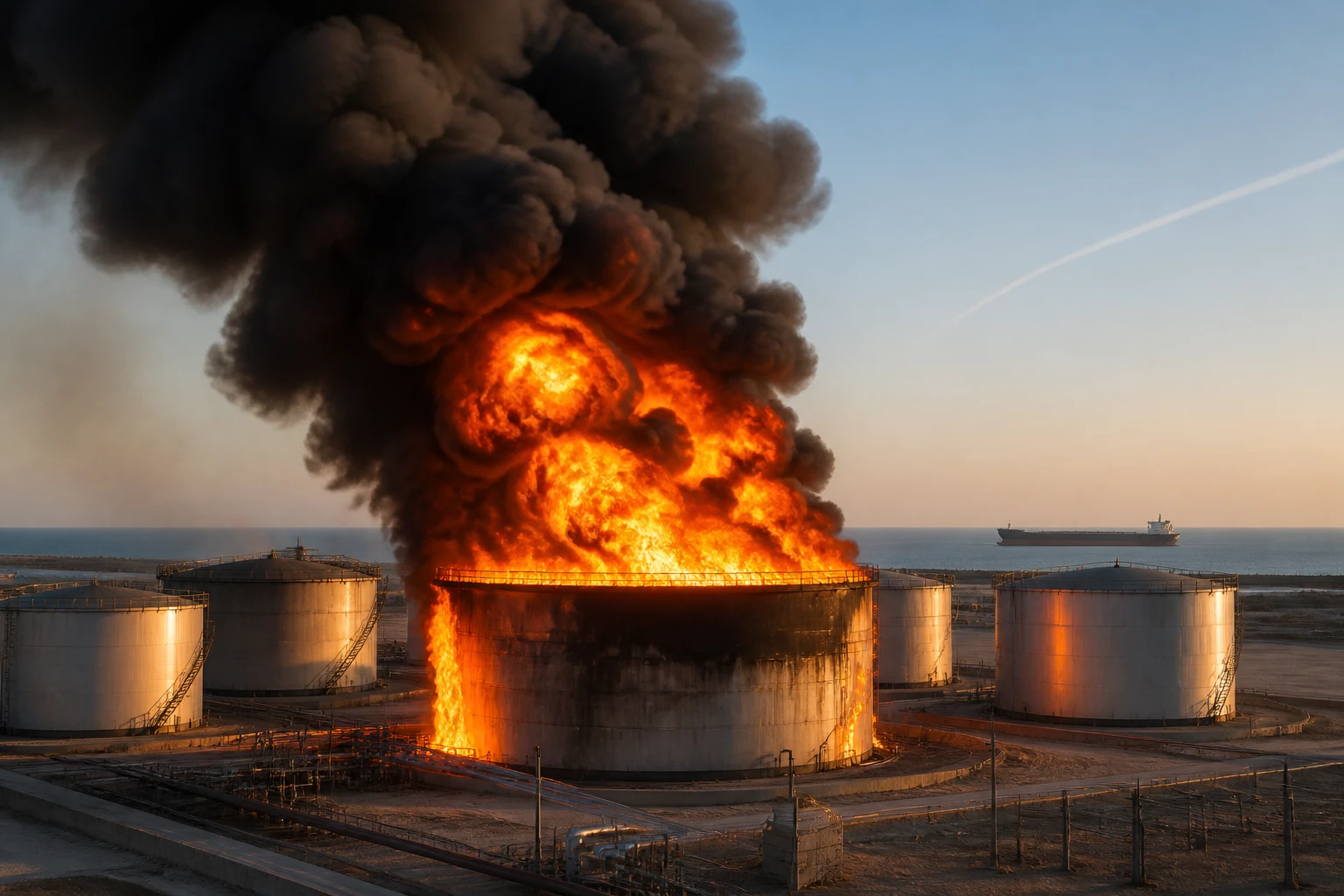
| Yemen-Saudi | Houthis, Aramco, Riyadh | Missiles/drones on Yanbu, Jazan, pipeline | Fires, pipeline disruption |
| Jordan bases | IRGC, US forces | Ballistic barrage post-Iraq hits | All intercepted per CENTCOM |
| Caspian | Ukraine, Iran vessel | Drone strike Jul 25 | 1 Iranian sailor killed |
Why hit Hash’d rather than the Houthis directly? AnsarAllah has already shown it can reach remaining Saudi oil infrastructure with missiles. Riyadh calculated that striking Iraqi proxies carried lower immediate retaliation risk while still answering the energy hits.
- Houthi “siege for siege” declaration on Saudi air and sea ports preceded the Aramco strikes.
- Satellite images confirmed tank fires at Jazan and later Abqaiq processing sites.
- Saudi east-west pipeline to the Red Sea hub at Yanbu became the new choke point after Hormuz shipping risks rose.
- Iran treated the US-Saudi action on one Axis member as an attack on all and answered with the Jordan barrage.
These steps pull Saudi Arabia deeper into open conflict alongside CENTCOM and add the PMF as an active Iraqi front. The region’s fragile balances erode faster than any single deal can restore them. Earlier Middle East power grid interconnections under Red Sea risk already flagged how energy arteries amplify every local clash.
The Caspian Strike Fuses Two Wars
On July 25 Ukraine struck an Iranian commercial vessel in the Caspian Sea near Russian waters. One sailor died. Kyiv said the ships carried military cargo linked to Iran-Russia transfers and also hit a Russian warship. Tehran called it a commercial iron freighter and an act of aggression.
- July 24-25: US missiles damaged an IRGC Navy headquarters at Ziba Kenar in Gilan province on the Caspian coast.
- July 25: Ukrainian drones hit the Iranian vessel; sailor killed; Kyiv claims responsibility for military-linked targets.
- July 26-28: Iranian FM Abbas Araghchi demands restitution and warns the strike “cannot go unanswered”; Peskov calls it an attack on Iran itself and labels Kyiv’s expanding reach “terrorist.”
- Same window: NYT and WSJ note the episode portends merger of the Ukraine-Russia and US-Israel-Iran wars.
Bandar Anzali functions for Tehran much as Odessa does for Kyiv: a critical northern supply node. Hitting it or vessels using it turns a stable Eurasian waterway into a spillover zone. The IRGC has already threatened retaliation against the UK and Cyprus for growing involvement. Europe continues long-range strikes into Russia while treating Russian warnings as bluff. That ratchet now has a Caspian tooth.
Crowd reaction on X treated the ship hit as deliberate messaging. High-engagement posts noted Iran’s foreign minister promising a response and flagged the three-way escalation risk. The practical effect is that Ukraine can force attention back onto its theater whenever the Iran war monopolizes Western bandwidth.
Israel Drifts While Interceptors Run Thin
Netanyahu’s late-July Oval Office visit produced no public red carpet and closed-door talks described by the White House as productive. Images showed smiling leaders yet no extended one-on-one. Differences over how to finish the Iran fight have widened after five months of grinding conflict that began with joint US-Israeli strikes in February.
Former IDF Ombudsman Maj. Gen. Yitzhak Brik warned in Ma’ariv on 26 July that the intercept inventory crisis “is only the prelude to the catastrophe that is looming over us.” He projected that future rounds with Iran would multiply the ballistic threat tenfold until interception becomes impossible, with missiles landing on population centers, infrastructure, hospitals and industry.
In the coming wars with Iran, the threat will increase tenfold to the point of a complete loss of the ability to intercept Iranian ballistic missiles. These missiles are expected to hit us: in population centers, strategic targets, production and economic infrastructure, science and technology institutes, educational institutions, hospitals and vital industries, and completely crush us.
Brik’s assessment tracks the source reporting. Israeli Defence Minister Israel Katz has boasted that 24 Lebanese villages hundreds of years old were leveled, with 15,000 to 20,000 homes destroyed across them, while 70 percent of Gaza lies in ruins. National Security Minister Itamar Ben Gvir has promised to ignite settler action in the West Bank ahead of Israeli elections to force “voluntary” Palestinian exodus from entire villages. The Greater Israel project now lacks both troops and coherence.
Northern border friction continues to produce Israel sirens and Trump Iran Hormuz warnings that keep local populations on edge.
Oil Tempos Break and Markets Snap
Iran has refused to let Washington keep its old cycle: kinetic pressure mid-week followed by “imminent deal” talk on Mondays to move oil and stocks. A short dump last Monday knocked Brent roughly 7 percent after Trump paused further strikes and spoke of talks. That matched the source figure of 7.7 percent closely enough for market purposes.
Stats snapshot
- ~7% Brent drop on Aug 3 after pause-and-talks signals.
- Hormuz shipping already disrupted; Saudi crude rerouted via east-west pipeline to Yanbu.
- Houthi Red Sea blockade threats plus Aramco hits raise second chokepoint risk.
- Aramco profit still rose sharply earlier on war-driven prices, but physical infrastructure now burns.
Every new front multiplies the chance that a single miscalculation closes more barrels. Traders no longer treat the Iran file as a clean binary of strike-or-deal. The tempo now belongs more to Tehran and its partners than to Oval Office calendar management.
Washington’s Political Pivot and the MAGA Split
All the military currents converged with Lindsey Graham’s funeral and lying-in-state. Zelensky flew in, met Trump, and discussed Patriot production licenses and other support. At the same moment Laura Loomer, a MAGA influencer with Trump’s ear, completed a public 180 after visiting Kyiv and sitting with Zelensky. She said she had been “bamboozled” by Russian propaganda and now promotes Ukraine.
Long-time Trump biographer Michael Wolff noted the Loomer shift already gaining traction, Zelensky’s presence, and Trump’s need for a foreign-policy success after the Iran campaign and Russia alignment both look like bad calls. Death can become a PR coup. The push to recast Ukraine as winning, even if the battlefield data remains contested, is aimed at the Fox-watching older base where Loomer still lands. Younger MAGA remains largely unmoved.
The framing tries to square intervention with America First. Any such shift is welcomed in Israel. Whether Trump listens to Loomer’s promised briefing or simply notes it and moves on remains open. The deeper effect is that domestic politics now reward looking tough across multiple theaters at once.
India has already held India talks with Israel on West Asia tensions that show how non-Western powers track the same risks without joining the kinetic spiral.
What the Linkage Now Means for Damage Control
The original goal of crushing Iranian capacity has inverted. Trump appears to grasp that further digging deepens the hole. Iran shapes the pace and refuses the Monday-deal theater. China shows no sign of yielding to parallel sanction pressure. Europe keeps feeding longer-range strikes into Russia while the Middle East quietly catches fire.
What we know
- US-Saudi strikes, Houthi Aramco hits, Iran Jordan barrage and Caspian ship strike all occurred inside one late-July week.
- PMF casualties and Iranian sailor death are confirmed by the respective parties.
- Oil markets snap on every pause-or-talk signal while physical export routes take damage.
- Israeli interceptor stress and settler-West Bank rhetoric continue in parallel.
What remains unconfirmed
- Exact degree of US coordination or green light for the Ukrainian Caspian strike.
- Whether Loomer’s conversion produces lasting MAGA policy change or fades.
- Scale of any Iranian or Axis retaliation still being prepared.
- Whether Saudi will sustain joint operations with CENTCOM inside Iraq.
No clean military solution sits on the table. The best available move is to stop the separate conflicts from agglutinated into one global war. Every new front makes that harder. Regional employment already faces pressure; the same crisis that hits energy grids also puts Arab women employment threatened by regional crisis under direct threat as investment freezes and mobility collapses.
The blaze now has its own oxygen. Containing it requires admitting the second-order linkages rather than treating each theater as a discrete file that can be paused on command.
