
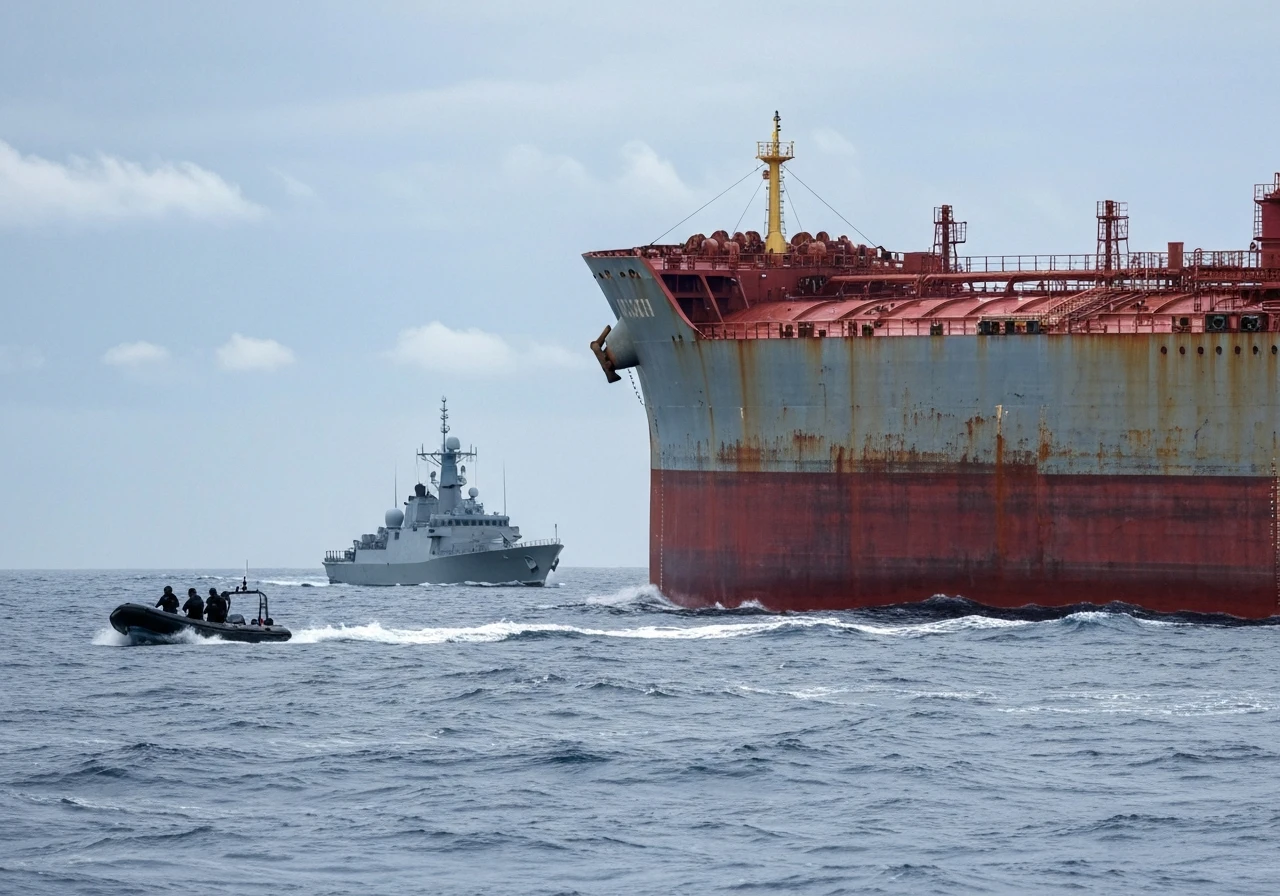
France seized the Tagor, a sanctioned tanker hauling Russian crude, in the Atlantic roughly 400 nautical miles west of Brittany on Sunday morning, President Emmanuel Macron said on June 1. It was the third known interception of a Russian shadow fleet vessel by a European or allied navy in recent months, and the boarding happened in international waters, far beyond any country’s territorial sea.
Read in isolation, it reads as one French operation and a routine Kremlin protest. Stretch the timeline back to winter and a different shape appears. European coastal states have moved from sanctions on paper to a standing pattern of high-seas boardings, and they are doing it through one narrow opening in the law of the sea.
The Tagor Stop, 400 Nautical Miles off Brittany
The Tagor was held on Sunday morning in international waters with help from Britain and other partners, Macron said in a social media post the next day. He framed the operation as enforcement of existing sanctions rather than a new escalation, stressing that it was carried out in line with maritime law.
The vessel itself fits the now-familiar profile of a sanctions-busting ship. It was registered in Madagascar, sailing under a Cameroonian flag it was not entitled to fly, and had set out from a Russian Arctic port bound for Limbe, a coastal town in Cameroon. That mismatch between paper identity and real ownership is the feature that French forces leaned on.
Macron drew the line directly to the war.
“It is unacceptable for ships to circumvent international sanctions, violate the law of the sea, and fund the war that Russia has been waging against Ukraine for more than four years,” he wrote, tying the boarding to the revenue stream that keeps Moscow’s campaign funded.
From Symbolic Boardings to a Standing Campaign
The Tagor is not the first ship pulled over this year. In early January, the United States Coast Guard intercepted a tanker near Iceland. In March, the Belgian navy seized another suspected sanctions-buster in the North Sea, with French support. Each operation targeted a vessel flying a flag of convenience and carrying Russian oil or products.
The progression matters more than any single ship. As a March analysis of coastal-state enforcement put it, European states are shifting from one-off symbolic boardings toward sustained maritime law enforcement designed to raise the running cost of evasion. The boardings now sit alongside the EU’s restrictive measures targeting Russia’s shadow fleet, which have placed hundreds of named tankers on designation lists.
| Vessel | When | Seizing force | Flag claimed | Location |
|---|---|---|---|---|
| Bella 1 (renamed Marinera) | January | US Coast Guard | Stateless | Near Iceland |
| Ethera | March | Belgian navy, French support | Guinea | North Sea |
| Tagor | May 31 | French navy, UK support | Cameroon | Atlantic, off Brittany |
The Statelessness Loophole Doing the Heavy Lifting
The legal engine behind all three seizures is the United Nations Convention on the Law of the Sea (UNCLOS, the treaty that governs rights and duties at sea). On the high seas, beyond the 200-nautical-mile exclusive economic zone, the flag state normally holds sole authority over a ship. Other governments cannot simply board a foreign merchant vessel for breaking their own sanctions.
There is one narrow door, set out in Article 110. A warship may stop and board a vessel on the high seas if that ship is stateless, and a ship loses its nationality the moment its flag turns out to be fraudulent. The high-seas boarding rules in the Law of the Sea convention treat a falsely flagged ship as enjoying no flag-state protection at all.
A vessel counts as stateless when it meets any of these tests:
- It is not validly registered with any state.
- It sails under two or more flags, switching them for convenience.
- It flies a flag it has no legal right to use.
The Tagor, on paper a Madagascar ship waving a Cameroonian flag, slotted neatly into the third category. That is why the boarding could be framed as lawful rather than as the seizure of a protected foreign vessel, and why the false-flag habit that hides shadow tankers has become their biggest legal vulnerability.
What the Shadow Fleet Moves for Moscow
The reason Europe bothers is the scale of the trade these ships carry. The shadow fleet is the aging, opaquely owned set of tankers that move Russian oil outside Western insurance and shipping channels, and it has quietly become a structural part of the global oil market.
Tracking by the Kyiv School of Economics shadow fleet tracker shows the system both growing and hardening. One striking shift is how openly Russia now flags its own ships, a sign that operators feel less need to hide as the fleet matures. The same data explains why a single seizure stings but does not break the model.
- 109 unique tankers moved Russian crude in February, and 72% of them were shadow fleet vessels.
- The Russian-flag share of shadow tankers jumped from 3% to 21% in nine months, a roughly sevenfold rise.
- 96% of shadow crude tankers are more than 15 years old, well past the age most insurers will touch.
- The broader fleet runs to 600 to 800 tankers, around 10 to 15 percent of global tanker capacity.
By one Middle East Institute estimate, sanctioned crude moving by sea now accounts for close to 18 percent of global tanker capacity and 6 to 7 percent of total petroleum flows. That trade has drawn buyers far beyond Russia’s traditional partners, with even Saudi imports of Russian fuel oil drawing US tariff threats earlier in the cycle.
Moscow Calls It Piracy, and Shadows the Seizures
The Kremlin rejected the legal framing outright. Spokesman Dmitry Peskov said Moscow viewed the Atlantic boarding as a breach of international law and likened it to robbery at sea.
We consider these acts as illegal, they border on international piracy.
Peskov, the Kremlin’s chief spokesman, added that Russia was taking measures to ensure the safety of its cargo, language that hints at a willingness to escort or protect future shipments rather than absorb the losses quietly.
That threat is not abstract. Reporting on recent operations noted Russian naval vessels shadowing seizures from a distance, a presence that turns each boarding into a potential flashpoint between warships. The word piracy does real work here, because it lets Moscow argue that any future use of force to defend a tanker would be self-defense.
The legal dispute, in other words, is not a footnote. It is the ground on which the next confrontation could be fought.
The Baltic and the Danish Straits Are the Next Test
The Atlantic is the easy theater. The harder one is closer to home, in the Baltic Sea and the narrow Danish Straits that funnel a large share of Russia’s seaborne crude past NATO coastlines. KSE data already shows the Russian-flag share of tankers in the Baltic climbing from 1 percent last summer to 14 percent by February, a sign that more cargo is moving through waters where European navies operate at close quarters. A parallel diplomatic push for direct Russia-Ukraine talks has done nothing to slow the oil trade in the meantime.
If the boardings stay in distant international waters and keep targeting clearly false-flagged ships, Europe can hold the legal high ground and the campaign becomes a slow squeeze on Moscow’s revenue. If they move into the crowded Baltic, where Russian escorts are minutes rather than days away, the same statelessness argument that justifies a clean Atlantic seizure will be tested against a navy that has already called the practice piracy.
Disclaimer: This article is for informational purposes only and does not constitute legal, financial, or geopolitical-risk advice. Maritime seizures and sanctions enforcement involve contested and evolving legal questions; readers should consult qualified professionals before acting on any related matter. Figures are accurate as of publication on June 1, 2026.
