
The Royal Hashemite Court released a new official portrait of Crown Prince Hussein and Princess Rajwa of Jordan on Monday, June 1, marking the couple’s third wedding anniversary. The photograph shows Rajwa, 32, in a petrol-blue gown and Hussein with his arm around her waist, both framed against a matching backdrop that reads less like a snapshot and more like a state document. Behind the affection sits a deliberate piece of dynastic communication.
A Petrol-Blue Portrait Built to Be Read
Every element in the new image looks chosen rather than caught. Rajwa stands in profile, one hand resting on her husband in a gesture of support, wearing long diamond earrings and an Arabic-style diamond ring. Hussein faces the camera directly with a broad smile. The play of light and shadow gives the frame the depth of a painted canvas, the kind of composition palaces commission rather than improvise.
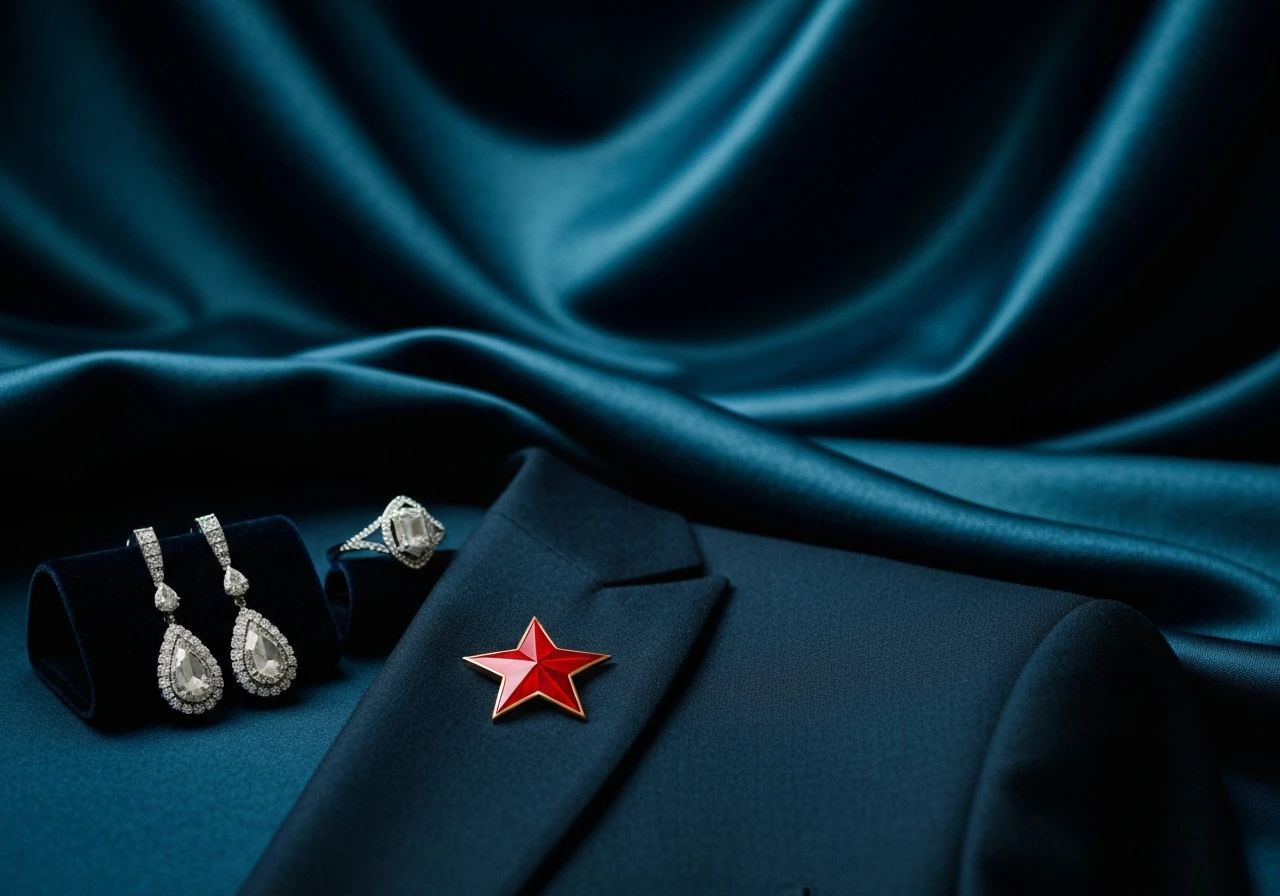
The single colour does the heavy lifting. Petrol blue runs through Rajwa’s dress, Hussein’s tie and the backdrop itself, binding the pair into one visual unit. On his lapel sits a multi-pointed red star, the same emblem carried on Jordan’s national flag, a small badge that turns a couple’s portrait into a statement about country.
The detail is consistent with how this household uses imagery. Hussein has leaned on the flag’s iconography before, including a Flag Day salute documented in the Crown Prince’s Jordanian Flag Day message, and the new anniversary frame sits within the same catalogue of curated releases on the Royal Hashemite Court’s official channels. The symbols a reader can pick out at a glance:
- Petrol blue shared across both outfits and the set, signalling unity and a single editorial vision.
- The red star insignia tying Hussein personally to the Jordanian flag and the state.
- Rajwa’s protective, side-on posture, casting her as steady support rather than ornament.
- Painterly studio lighting that lifts the image from family album to official record.
The Slow Construction of Jordan’s Next King
Anniversary portraits are only the soft edge of a much larger project. The eldest son of King Abdullah II and Queen Rania has spent the past two years stepping visibly into the role of heir, and the palace has documented every move.
He has served repeatedly as regent, deputising for his father at home and abroad. He delivered Jordan’s national address at the COP29 climate summit in Baku, met the European Union’s commissioner for the Mediterranean, and attended regional talks in Nicosia, each appearance logged and circulated by the court.
That cadence of duty matters because Jordan sits in one of the world’s most contested neighbourhoods, custodian of Muslim and Christian holy sites in Jerusalem and a fixed point of stability prized by Western capitals. A monarchy in that position cannot afford an unknown successor. It needs the next king to feel familiar long before he is crowned.
So the portraits and the podiums work as two halves of the same message. One shows a husband and father the public can warm to; the other shows a head of state in training. The anniversary image is the gentler instrument, but it is pointed at the same goal: continuity that looks effortless.
Three Anniversaries and a Tightening Visual Script
Compare the couple’s public milestones since their engagement and a pattern emerges. Each release is more polished and more official than the last, moving from spectacle toward statecraft.
| Milestone | Date | Public marker |
|---|---|---|
| Royal wedding | June 1, 2023 | 1,700 guests at Zahran Palace, global royal turnout |
| Birth of first child | August 3, 2024 | First grandchild for King Abdullah and Queen Rania |
| Second anniversary | June 2025 | First anniversary portrait released as parents |
| Third anniversary | June 1, 2026 | Petrol-blue official portrait with flag insignia |
The arc is unmistakable. What began as one of the decade’s grandest royal weddings has settled into a rhythm of measured, single-image releases, each one a small reaffirmation that the line of succession is healthy, photogenic and on schedule.
What the June 2023 Wedding Still Signals
The starting point of all this image-building was the ceremony at Zahran Palace in Amman. It drew royalty from across Europe and the Gulf.
Prince William and Catherine, Princess of Wales, attended. So did King Willem-Alexander and Queen Maxima of the Netherlands with their daughter, Princess Amalia, alongside King Philippe and Queen Mathilde of Belgium with Princess Elisabeth, and Spain’s former king Juan Carlos and Queen Sofia.
Rajwa, a Saudi-born architect, wore an Elie Saab gown with an asymmetric neckline, long sleeves and a detachable train, then changed into a second white gown for the banquet, keeping the same tiara throughout. The scale of it all set the bar the household has been managing expectations against ever since.
The headline figures still frame the dynasty’s public story:
- 1,700 guests travelled to Amman for the ceremony.
- Two bridal looks, the ceremony gown and a white banquet dress, both anchored by one tiara.
- 14 months later, the couple’s first child arrived, turning the King and Queen into grandparents.
Read together, those numbers explain why the anniversary portraits now feel so controlled. After a wedding that big, every later image is an exercise in showing the marriage settling into the quieter, more durable work of monarchy.
The Orphan Fund Behind the Family’s Public Joy
The household has also learned to attach a cause to its happiest moments. When the couple welcomed their daughter, they asked that gifts, flowers and well-wishes be redirected as donations to the Al-Aman Fund for the Future of Orphans, a Jordanian charity supporting young people leaving state care.
It was a small instruction with a large message. A private celebration, reported in iAqaba’s coverage of how the Crown Prince and Princess welcomed baby girl Iman, became a public act of charity, folding the family’s joy into the monarchy’s wider claim to serve ordinary Jordanians.
That instinct, turning personal milestones into national gestures, is the same one on display in the anniversary portrait. The petrol-blue frame and the orphan-fund request are different tools doing one job: keeping the heir’s family visible, sympathetic and bound to the country it expects to lead.
Princess Iman and the Throne She Cannot Inherit
There is one part of this picture the celebratory coverage rarely lingers on. The couple’s daughter, named after her aunt, was born on August 3, 2024, the first child of the heir apparent, yet she has no place in the line of succession.
Jordan’s throne passes by agnatic primogeniture, inheritance through the male line only. Under Article 28 of Jordan’s constitution, only legitimate male descendants of King Abdullah I, born to Muslim parents, can take the throne. A daughter, however senior her parents, is outside the chain entirely.
That makes the pressure on this marriage plain. For the dynasty to continue along its established path, the couple are expected to produce a son, a reality that hangs quietly behind every warm portrait. Analysts have long noted how narrow the eligible pool can become, a point examined in an analysis of succession prospects in Jordan.
So the third-anniversary image carries more weight than its soft lighting suggests. It celebrates three years of marriage and one young daughter, while the larger story it is part of, the orderly handover of a strategically vital throne, still waits on a chapter the portrait does not show.
