
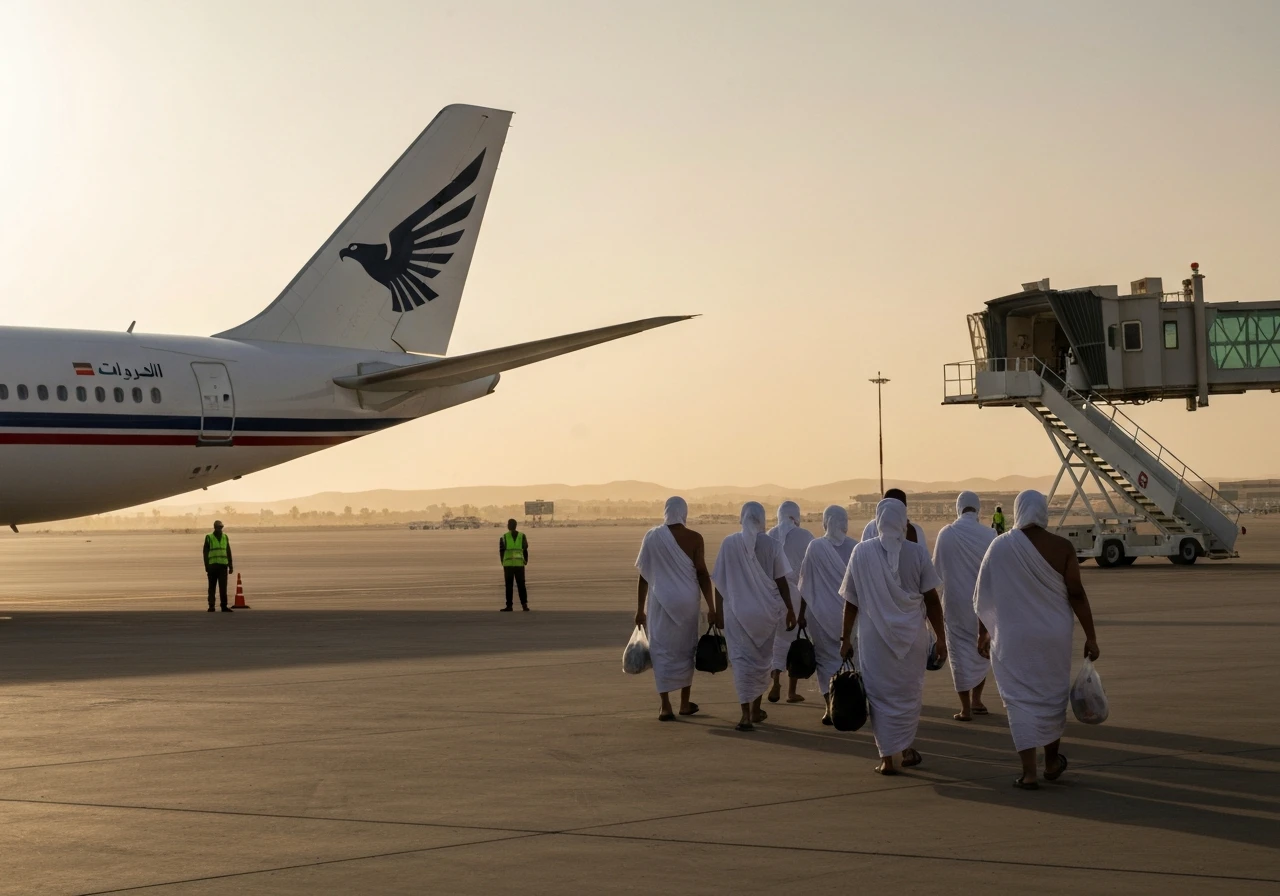
EgyptAir began flying Hajj pilgrims home from Saudi Arabia this week, opening a return airlift that runs through June 15 and will carry roughly 35,000 Egyptian travelers back from Jeddah and Medina. The first full day put 16 flights in the air, including a dozen out of Jeddah alone.
Every passenger on those manifests is a registered pilgrim, a detail that traces straight back to 2024, when extreme heat killed more than 1,300 people during the pilgrimage, most of them traveling without official permits.
EgyptAir’s Return Flights Leave Jeddah and Medina
The carrier’s first day of returns sent 16 flights toward Egypt. Twelve left Jeddah carrying about 3,000 pilgrims, a mix of lottery winners, ministerial and institutional delegations, transit and individual travelers, foreign groups, and people holding work or residency visas. Three more departed Medina for Cairo International Airport, and a single flight linked Medina to Alexandria.
Ahmed Adel, chairman and chief executive of the Holding Company for EgyptAir, told staff to provide “maximum care for pilgrims during their return phase to ensure smooth operations and swift procedures,” according to Egypt’s official statement on the return airlift. He said the airline had committed its full operational and technical capacity to keep the schedule regular and coordinated with authorities in both Saudi Arabia and at Cairo International Airport.
On the ground, the mission is led by Amin Afifi, assistant head of the commercial affairs sector for stations, whose teams handle logistics for pilgrims moving through Jeddah and Medina back to Egyptian airports. The bulk of that work lands now. Returns started just after Egypt’s six-day Eid al-Adha break, and the airline expects to keep flights rolling until the season closes in mid-June.
The Air Bridge That Carried 67,000 Out
The return leg mirrors a much larger push in the other direction. Between May 8 and May 16, EgyptAir flew about 67,000 pilgrims to Saudi Arabia across 277 outbound flights, 150 of them to Jeddah and 127 to Madinah. That outbound surge is what the airline is now unwinding, one return wave at a time, with daily flight counts swinging as different groups finish the rituals.
EgyptAir’s traffic is one slice of a far bigger crowd. More than 1.7 million people joined the pilgrimage this season, and the dispersal home stretches transport networks across the region for weeks. Carriers from dozens of countries run the same compressed schedule, all trying to clear their nationals through Jeddah and Medina in the narrow window after the rites end.
| Phase | Window | Flights | Pilgrims |
|---|---|---|---|
| Outbound air bridge | May 8 to May 16 | 277 (150 Jeddah, 127 Madinah) | About 67,000 |
| Return airlift | Through June 15 | Rolling daily waves | About 35,000 tourist pilgrims |
The figure framing the return covers Egyptian tourist pilgrims booked through licensed programs. Official delegations, transit passengers and visa-category travelers fill out the rest of the manifests, which is why a single day can mix government groups with private lottery winners on flights routed to two different Egyptian cities.
More Than 1.7 Million Performed the 1447 AH Rituals
Saudi Arabia’s General Authority for Statistics (GASTAT, the kingdom’s official data agency) put the Hajj 1447 AH headcount at 1,707,301. Pilgrims arriving from abroad made up the overwhelming share, while citizens and residents inside the kingdom accounted for the rest. The numbers below come from the official Hajj 1447 AH pilgrim breakdown.
- 1,707,301 total pilgrims recorded for the season
- 1,546,655 arrived from outside the kingdom, against 160,646 domestic pilgrims
- 1,485,729 entered by air, with 54,429 by road and 6,497 by sea
- 893,396 men and 813,905 women across the combined total
Why Every Egyptian on These Flights Is Registered
The tightly documented system moving pilgrims home this June did not exist in its current form two years ago. It was rebuilt after the deadliest Hajj in recent memory, and the orderly return now underway is the back half of that rebuild.
The Heat That Killed Hundreds
During the 2024 pilgrimage, more than 1,300 people died as temperatures climbed past 50 degrees Celsius. Agence France-Presse (AFP) reported that over 600 of the dead were Egyptians, while The Wall Street Journal put the Egyptian toll at 680. Saudi authorities said roughly 83 percent of those who died had no official Hajj permit.
Unregistered pilgrims were the most exposed. Without permits, they could not reach the air-conditioned tents, shuttle buses and medical points reserved for registered groups, so many walked long distances in open heat. The trips had often been sold on visas that did not authorize the pilgrimage at all.
The Crackdown That Followed
Egypt’s response was swift. Prime Minister Moustafa Madbouly ordered penalties against tour operators that had funneled people to Mecca outside the official channel.
- Licenses revoked for 16 tourism companies tied to the unregistered trips
- Company officials referred to the public prosecution
- Fines imposed to help compensate the families of the dead
- Registration funneled through Saudi Arabia’s centralized Nusuk platform, which ties every quota to a verified visa
Those rules carry into 2026. Quotas now sit with a fixed set of authorized providers, and a manifest seat means little without a matching Nusuk visa, the mechanism that lets Saudi and Egyptian officials account for every traveler boarding a return flight.
Rising Costs Keep the Informal Route Tempting
The reforms close one risk and open another. Registered Hajj is expensive, and this season pushed prices higher rather than lower.
Some Egyptian packages approached $6,000 per person this year. Program prices had been trimmed by 2 to 5 percent, but a sharp rise in airfares wiped out most of that saving. Saudi Arabia has also widened its Nusuk system and kept the global quota near its pre-pandemic ceiling of about 1.8 million, which leaves little slack for cut-rate workarounds.
That cost gap is exactly what once fed the informal pipeline. When a permitted trip runs several thousand dollars more than an unofficial one, the cheaper route keeps its pull, and resisting that pull is the whole point of Egypt’s enforcement. If the registered-only system holds through this return season without the scenes of two years ago, the reforms will look like they worked. If costs keep climbing while enforcement eases, the same temptation that proved deadly will still be waiting at the next Hajj.
Frequently Asked Questions
When do EgyptAir’s Hajj return flights run in 2026?
The return airlift runs from June 2 to June 15, after outbound flights operated from May 8 to May 16. The first full day of returns featured 16 flights from Saudi Arabia to Egypt.
Which airports handle the returning pilgrims?
Pilgrims depart from Jeddah and Medina and land mainly at Cairo International Airport, with at least one flight routed from Medina to Alexandria Airport to ease pressure on Cairo.
How many pilgrims is EgyptAir bringing back?
About 35,000 Egyptian tourist pilgrims are being returned. EgyptAir carried roughly 67,000 people to Saudi Arabia in total across 277 outbound flights, including official delegations and visa-category travelers.
How expensive was Hajj 2026 for Egyptian pilgrims?
Some Egyptian packages neared $6,000 per person. Operators trimmed program prices by 2 to 5 percent, but higher airfares erased most of that reduction.
Why are only registered pilgrims on the EgyptAir flights?
After more than 1,300 deaths at the 2024 Hajj, most among unregistered pilgrims, Egypt revoked licenses for 16 tour companies and tied all travel to Saudi Arabia’s Nusuk visa system, so only documented pilgrims board.
