
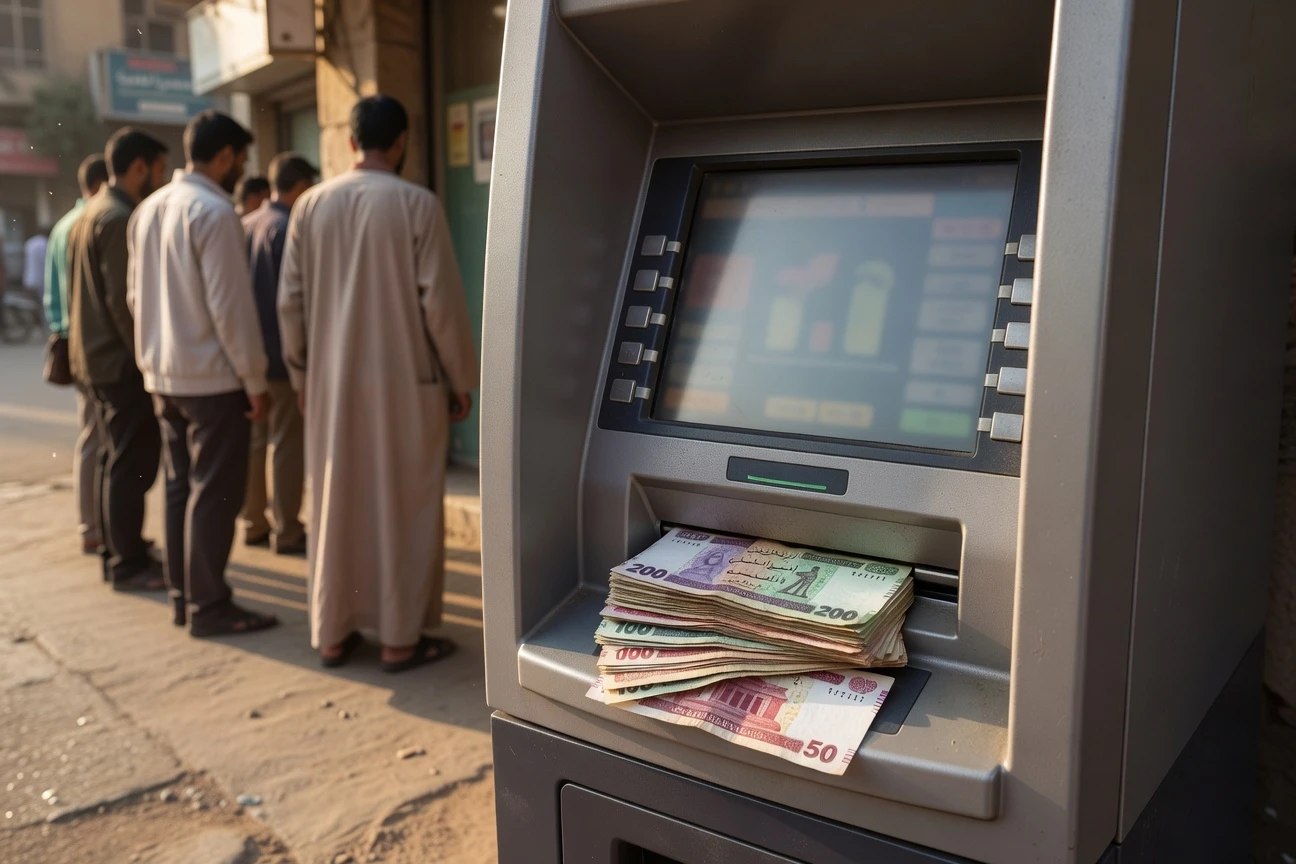
Egyptian banks are racing to refill the country’s 26,000 cash machines after the National Bank of Egypt alone saw customers pull nearly 9 billion Egyptian pounds (about $180 million) from its ATMs in two days, more than four times the lender’s normal daily pace, as households front-loaded spending before the Eid Al-Adha holiday.
The Central Bank of Egypt has directed commercial banks to keep replenishing the network on a “regular basis” through the six-day shutdown, after queues built across Cairo and several mobile banking apps glitched. Branches reopen Monday, June 1; until then, the ATM grid is carrying the workload of a closed banking system.
The Cash Push Behind 26,000 ATMs
Egyptian lenders began stepping up cash injections into machines days before the Tuesday closure, working off a coordinated plan with the Central Bank, a senior banking official told the local press. The instruction is straightforward: no machine left empty during the break, regardless of governorate, and refills run continuously rather than on the standard route schedule that normally governs a regular working day.
That is harder than it sounds. Branches across the country closed on May 26 and stay shut through May 31, the longest cluster of working days off the calendar outside the late-year holiday block. Every routine cash request, from pensioner withdrawals to small-merchant float to last-minute livestock-market settlement, has to clear the ATM network for the duration, and the only safety valve is the post office’s parallel cash-handling system.
The contrast between business as usual and holiday mode shows up clearly in the numbers banks have released this week, with the largest state-owned lender’s figures setting the reference point for the rest of the sector.
| Indicator | Normal pace | Eid week 2026 |
|---|---|---|
| NBE average ATM withdrawal volume | About EGP 2 billion daily | About EGP 4.5 billion daily (two-day average) |
| Refill cadence | Routine top-ups by route | Daily replenishment under CBE plan |
| Branch counter availability | Full working hours | Closed May 26 to May 31 |
| App and gateway uptime | Stable | Outages reported on several apps |
The Two-Day Spike at National Bank of Egypt
Mohamed El-Etreby, who heads both the Federation of Egyptian Banks and the National Bank of Egypt (NBE, the country’s largest state-owned lender), said in televised remarks that the spike caught the system by surprise even after holiday-prep planning.
“Under ordinary circumstances, withdrawals average around 2 billion pounds,” El-Etreby said. “We have injected substantial amounts of cash into the machines.”
Together, NBE and Banque Misr operate about 13,000 ATMs, or roughly half the national grid. When demand at those machines runs at quadruple the norm, the queue is telling a bigger story about how much retail banking flow funnels through one channel during the break.
- EGP 9 billion withdrawn from NBE machines in two days
- 4x the lender’s normal daily withdrawal pace
- About 13,000 machines run by NBE and Banque Misr combined
- About 26,000 ATMs in the national network
The shape of the surge was the bigger surprise. Volumes climbed almost from the opening of the working day on Sunday and stayed elevated through Monday’s close, never settling back into the normal afternoon dip that ATM operators usually use as a refill window. That uneven curve is part of why customer-facing apps stuttered during the same two days; when authorization systems take more transactions in compressed minutes, even short gateway slowdowns translate into visible app errors on the screens that customers see.
Why the Queues Keep Coming Back
Egypt has been here before. The shape of these holiday cash crunches is familiar enough that analysts now describe them as a recurring feature of the calendar.
Banking expert Hany Abou El Fotouh told local broadcasters that the pressure placed on ATM networks during holiday periods often produces both cash shortages and technical failures, with concentrated withdrawal activity in short windows overwhelming machines that work fine the rest of the year. He added that insufficient maintenance at some sites worsens disruption during peak seasons, even with the national grid operating more than 26,000 machines. His point lands harder once you look at where the machines actually sit: the network is heavily skewed toward central Cairo, Alexandria, and the canal cities, leaving Upper Egypt and parts of the Delta noticeably thinner per capita.
The recurring drivers are well rehearsed:
- Withdrawal windows compress into the 48 hours before any major religious holiday, pulling weeks of normal demand into two days
- Branch closures during the six-day break shift all foot traffic to ATMs, with no overflow valve at the counter
- Maintenance and refill logistics outside dense urban governorates lag the city network, leaving rural machines empty hours earlier than their Cairo counterparts
- Pensioners and elderly customers, who hold a disproportionate share of cash-heavy accounts, cannot pivot to digital wallets quickly
- Inflation-elevated cash needs for the livestock, food, and gift spending tied to Eid Al-Adha lift average withdrawal sizes, not just transaction counts
Egypt’s ATM density on World Bank financial-access data has tracked well below upper-middle-income peers for more than a decade, and even with active rollout under the Central Bank’s payment-systems framework, the per-capita machine count remains thin for a country of around 105 million people. That is the structural backdrop against which any Eid spike unfolds; a denser grid would absorb the same demand without the queues.
Lawmakers and Hosts Pile On
The political response landed fast. Ahmed Mousa, the Sada Elbalad television host who runs the nightly “On My Responsibility” program and is among the most-watched commentators on state-aligned cable, used his slot this week to attack what he called a holiday crisis the banking sector had failed to head off, and pressed the Central Bank to intervene directly rather than rely on commercial banks’ own scheduling.
People are talking about the ATM crisis and citizens standing in front of cash machines without being able to access money. With banks entering the holiday break, what are people supposed to do? This is a crisis that requires immediate action.
Mousa, a strong supporter of the Sisi administration, also pointed to outages on several banking apps, framing those as a connected complaint rather than isolated faults. “The problem must be solved today, not tomorrow,” he added on the same broadcast. “People are standing in long lines in front of ATMs that have no cash. Citizens have obligations and Eid expenses, and there must be a rapid response.” The escalation from queue footage to direct Central Bank pressure on prime-time television is the part bankers will be watching most carefully.
Parliament joined in. MP Ashraf Saad called for accelerated ATM rollout in densely populated districts and rural governorates, telling a television interviewer that “the scenes of people waiting in long lines only to discover machines are empty have become a repeated problem, especially before holidays.” The Federation of Egyptian Banks did not announce a new procurement figure in response, and the parliamentary committees with banking oversight remain in recess until after the break.
The Digital Channel Built for This, but Not Trusted Yet
On paper, the country has a fast-growing alternative. Mobile wallet transactions in Egypt grew 72% year on year in the second quarter of 2025, with total value hitting roughly $19.63 billion, according to industry data circulated by payments specialists. Vodafone Cash, the largest provider, holds around 55% of wallets, 78% of transactions, and 81% of transaction value.
The Central Bank’s own numbers tell a steadier version of the same story. Financial inclusion rose to 76.3% of adults in June 2025, up from 27.4% in 2016, and a second phase of the Central Bank’s financial inclusion strategy through 2030 went into formal drafting this year. The regulator’s payment-systems team has also continued its national ATM standards work, including uptime targets and interoperability rules across acquirers.
None of that solved the Eid Al-Adha problem. The holiday is structured around livestock purchases that still settle in cash, particularly outside Cairo and Alexandria, and the older customers most likely to be buying are the demographic least likely to have an active mobile wallet.
Banks have, separately, been working through a broader cash-discounting episode in the property market that signals how much liquidity is shifting outside formal channels. When developers offer 55% off list price for cash settlement, the cash is going somewhere, and a meaningful portion of it is the same notes pulling out of the ATM grid this week.
The result is a digital infrastructure growing fast enough to look impressive in annual reports, but slowly enough on the ground that the next major holiday will probably produce another round of queue videos. Wallets carry a rising share of weekly groceries and ride payments; they carry almost nothing of the sheep, cattle, and goat trade that drives Eid demand in the governorates.
What Happens When Branches Reopen on June 1
The immediate test is operational. If banks can keep the network refilled through Sunday without a second wave of viral queue videos, the Central Bank’s directive will read as a vindication of holiday-period coordination, even after the rough open. If a single governorate runs dry on May 30 or 31, the political pressure that built around Mousa’s broadcast will be back inside the chamber when Parliament reconvenes.
The medium-term test is structural. Ashraf Saad’s call for more machines, the recurring nature of the cash crunch, and the broader Gulf capital reshaping Egypt’s investment story all point toward the same question: whether the national machine count moves meaningfully above its current level in the next budget cycle, or whether the Central Bank chooses to push harder on the digital wallet rails it has spent the past decade building.
There is also a labor dimension. Cash-cassette logistics rely on small armies of cash-in-transit crews and night-shift technicians, and the same six-day break that closes branches also compresses their refill and maintenance windows. The system that fills the machines is on holiday too, which is part of why the queues showed up where they did.
For the next four working days, the metric is binary. Each transaction at the country’s machines either clears or it fails, and the failure count between now and Monday morning is what will tell the Central Bank whether its holiday plan held.
