
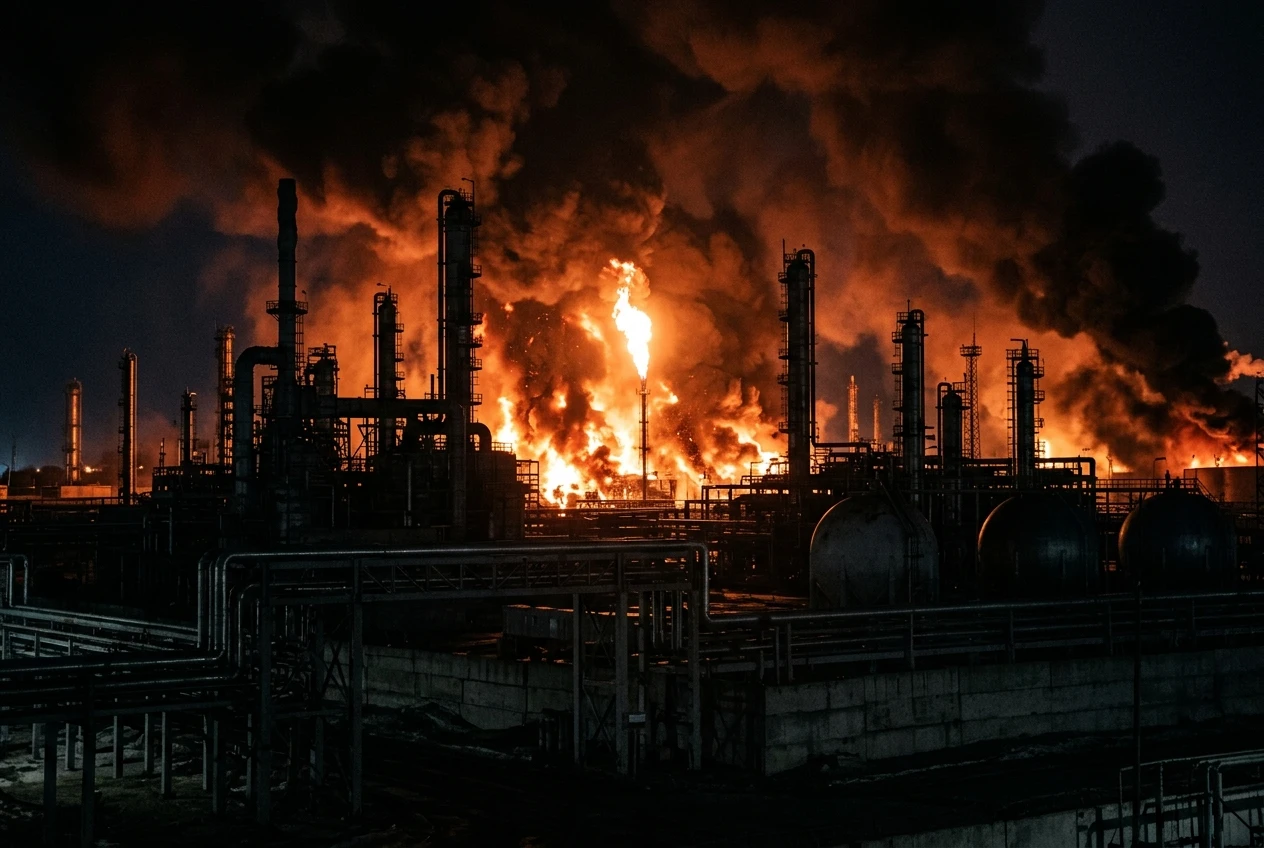
Ukraine struck Russia’s largest oil refinery, the Omsk facility in Siberia, with long-range drones on July 6, 2026, the Ukrainian military said. The attack, roughly 2,700 km from Kyiv-held territory, is the deepest strike of the war.
Russia’s Omsk region governor confirmed the hit and said emergency services were at the scene. No casualties were reported. The strike came on the eve of a NATO summit in Turkey where Donald Trump was set to meet President Volodymyr Zelenskyy.
An Important Achievement, and a Fire in Siberia
Ukrainian drones reached the Omsk refinery in the early hours of July 6, sparking a fire that NASA satellites later recorded as multiple hotspots. The attack landed on the ELOU-AVT-11 primary processing unit, a distillation section with a design capacity of 8.4 million tons of oil per year.
Ukraine’s General Staff said in a statement that an impact with subsequent fire was recorded at the facility and that the extent of the damage was being verified. The same statement called the Omsk site ‘the last of the 11 largest gasoline producers in Russia that have been hit,’ a claim that frames the strike as the closing entry on a target list Kyiv has been working through for more than a year. Politico reported that the hit on ELOU-AVT-11 was independently confirmed by the Ukrainian open-source intelligence project Dnipro. Russia’s Gazprom Neft, the state-owned subsidiary that operates Omsk, has not published a damage estimate.
Omsk region governor Vitaly Khotsenko confirmed the strike on the Russian messaging app Max. He said Ukrainian drones had broken through layers of Russian air defense and that air defenses had destroyed most of the drones involved. Khotsenko added that there were no casualties and that emergency services were working at the scene.
President Volodymyr Zelenskyy told his nightly video audience that the strike marked a major success for the armed forces, a remark aimed as much at domestic Ukrainian morale as at external audiences. His address framed the attack as the opening move in a new phase of the war, with Kyiv showing it can hit Russian energy assets thousands of kilometers from the front line. That language is the sharpest public claim Kyiv has made about its own deep-strike reach. It landed in the same news cycle as Russian missiles hitting apartment buildings in Kyiv for the second time in a week, a strike that killed at least 21 people, according to Ukrainian authorities. The Omsk fire also coincided with NATO summit preparations in Turkey, where Trump was due to hold talks with Zelenskyy in what both sides described as a renewed push for peace. The Carnegie Endowment’s Russia Eurasia Center has been tracking how drone attacks are reshaping Russia’s refining map, and the Omsk strike fits its analysis that Ukraine’s campaign is now stretching Russian resilience thin.
Siberia, too, is now within reach of Ukrainian precision strikes.
Volodymyr Zelenskyy, president of Ukraine, in his nightly video address on July 6, 2026.
Why Omsk Was the Last Refiner Standing
The ‘last of the 11’ framing matters because it puts a number on how much of Russia’s gasoline-production base has now been touched. Kyiv has been moving through the country’s refinery hierarchy since the spring, hitting storage tanks at export terminals in March and then rotating toward primary refining and cracking units in April and May. Omsk is the largest entry on that list by a wide margin.
Sources told Reuters that the Omsk refinery processed around 23 million metric tons of oil last year, while Politico’s reporting places the figure above 22 million tons per year and identifies it as around 10 percent of all the oil refined in Russia. The facility sits on the northern outskirts of the city of Omsk, near Russia’s border with Kazakhstan, and is operated by Gazprom Neft, a subsidiary of state-owned Gazprom. Militarnyi, a Ukrainian outlet, noted before the strike that Omsk was one of only two top-10 Russian refineries never hit by a Ukrainian drone, with the other being the Angarsk Petrochemical Company in the Irkutsk region. That same outlet pointed to a feature of Omsk that adds strategic weight: it is the only Russian refinery that produces cracking catalysts used by other facilities for secondary oil refining.
| Refinery | Operator | Status after July 6, 2026 |
|---|---|---|
| Omsk (Siberia) | Gazprom Neft | First-ever strike; ELOU-AVT-11 unit hit |
| Angarsk Petrochemical (Irkutsk) | Rosneft | Still untouched |
| Slavneft-Yanos (Yaroslavl) | Slavneft | Struck by HUR same day |
The Drone That Made It 2,700 Kilometers
The weapon Kyiv has put on the front of this campaign is the FP-1, a propeller-driven one-way attack drone built by the Ukrainian defence technology company Fire Point. The Guardian reported that the company said its upgraded variant carried out the Omsk attack, calling the strike ‘a record for strike drones not only in Ukraine, but worldwide.’ According to the Carnegie Endowment’s Sergey Vakulenko, Fire Point currently produces about 100 of these drones a day, of which about 10 percent reach their targets. The company’s own statements suggest the upgraded variant can now reach targets at distances previously considered outside Ukraine’s envelope.
Fire Point’s CEO, Denys Shtilierman, posted a video of the strike to X with a one-line caption. The post is the first public claim of authorship from one of Ukraine’s deep-strike drone makers.
Omsk Refinery meets the new FP1.
Denys Shtilierman, chief executive of Fire Point, on X, July 6, 2026.
The FP-1’s role in this campaign is structural. The Financial Times, citing the Polish analytical group Rochan Consulting, reported that Russian refineries have been hit at unprecedented rates since the start of 2026, an 11-fold increase from the same period in 2025. The Guardian’s briefing noted that the Omsk strike came on a day when Ukraine’s military intelligence agency HUR also hit the Slavneft-Yanos refinery in Yaroslavl, around 700 km from the border, and that Ukrainian forces separately struck Novatek’s Ust-Luga complex on the Baltic. The FT analysis also reported that U.S. intelligence has helped Ukraine select optimal flight routes for its drones and avoid Russian air defenses. Stefan Meister, head of the Eurasia program at the German Council on Foreign Relations, told the FT that Ukraine had achieved a technological breakthrough enabling it to scale up long-range drone production.
A Fuel Crisis Putin Has Now Admitted
The Omsk fire lands on a fuel system that is already under severe strain. Russian President Vladimir Putin acknowledged on state television on Sunday, July 5, that ‘we are currently seeing certain shortages, although they are not critical.’ The BBC described the remarks as Putin’s first explicit acknowledgment of fuel pressure since the campaign began.
Putin went further in the same interview, conceding that Ukraine’s attacks were ‘obviously creating problems’ for both motorists and businesses. The remarks, reported by the BBC, are unusual for a leader who has for years insisted that the war effort is on track. Independent Russian outlet Mediazona counts 56 Russian regions currently enforcing fuel restrictions.
Commodities intelligence firm Kpler estimates Russian gasoline production is running about 20 percent below domestic demand, with refinery runs at multi-year lows. Lead analyst Sumit Ritolia told CNN that the current disruption is hitting ‘at the start of the high-demand season’ in Russia, which typically runs until September. Sergey Vakulenko, a senior fellow at the Carnegie Russia Eurasia Center who spent 25 years in the Russian oil and gas industry, warned in a recent analysis that ‘the Russian oil industry’s resilience is being stretched dangerously thin.’ If previously damaged refineries cannot quickly restore output, Vakulenko wrote, Russia’s loss of refining capacity might reach 28 percent below previous-year levels.
The macro arc behind that pressure is sharp. A Financial Times analysis of data from the Polish analytical group Rochan Consulting found that Russian refineries have been hit at least 194 times since the start of 2026, an 11-fold increase over the same period in 2025. May alone set a record, with 16 successful strikes, more than double the monthly totals of January and February. Ukraine’s General Staff said last month that its forces had disabled more than 30 percent of Russia’s oil refining capacity between January and June. The pressure is arriving at the worst possible moment for the Kremlin, with the high-demand summer driving season just starting and the central bank already noting ‘a temporary contraction in motor fuel production’ as a fresh inflationary force.
- 194 – successful Ukrainian refinery strikes in H1 2026 (Financial Times, via Ukrinform).
- ~20% – Kpler’s estimate of how far Russian gasoline production sits below domestic demand (CNN).
- 56 – Russian regions currently enforcing fuel restrictions (Mediazona, via BBC).
A Strike on the Eve of a NATO Summit
The strike hit on the political eve of a NATO summit in Turkey, where Trump and Zelenskyy were scheduled to hold talks in what both governments framed as a renewed push for peace. Trump said on Monday that a resolution to the war was ‘getting closer than people realise.’ Zelenskyy used the same platform to make the Omsk strike the centerpiece of his case for more air-defense help.
The diplomatic timing is underscored by what Russia did to Kyiv the same day. Russian missiles and drones struck apartment buildings in the Ukrainian capital for the second time in a week, killing at least 21 people, according to Ukrainian authorities. Rescue crews pulled bodies from the rubble of a high-rise ripped open by the latest bombardment. Kyiv’s mayor and air force said the attack exposed a critical shortage of U.S.-made Patriot interceptors. The Russian Defense Ministry claimed to have intercepted hundreds of Ukrainian drones over Russian and Russian-occupied territory in the same period, with more than 17,000 reported shot down in June alone.
Zelenskyy, speaking after the Russian strikes, said it was ‘simply absurd that in the modern world, production has still not been organised to the extent that is necessary to protect people from ballistic terror.’ He said Kyiv expected ‘decisions’ on Ukrainian air defense from the Ankara summit. NATO chief Mark Rutte responded that ‘allies and Nato partners must continue to ensure Ukraine gets what it needs.’ Ukraine has signed ‘drone deals’ with six NATO countries in recent months and is working toward similar agreements with at least seven more by year-end, according to a top Ukrainian official.
What Is Confirmed, and What Remains Unclear
What is confirmed: a fire at Omsk, the first strike on the facility and on the Omsk region since the 2022 invasion, and a claim from both Kyiv and Fire Point that upgraded FP-1 drones reached the target after flying deep into Siberia from the closest point of Ukrainian-held territory. Khotsenko’s confirmation on Max and the General Staff’s confirmation on Facebook line up. NASA FIRMS satellite data shows multiple fire hotspots at the site. What remains unclear is the extent of the damage to the ELOU-AVT-11 unit and the cracking-catalyst production line that other Russian refineries depend on. Gazprom Neft has not published a damage estimate, and no independent refinery-side source has provided one. Downtime at Omsk, like downtime at other struck Russian refineries this year, will be measured in weeks or months rather than days.
The strategic picture is also unfinished. The Angarsk Petrochemical Company in Irkutsk remains, with one or two smaller Far East sites, the only major Russian refining asset that has not been hit. Militarnyi’s reporting noted that high hopes had been pinned on Omsk to help alleviate Russia’s fuel crisis, and Carnegie’s analysis suggests Russia’s options for absorbing further damage are narrowing. Putin, asked about the situation on Sunday, told state television that the most urgent task was ‘to rapidly and significantly increase production of the air defense systems.’ That sentence, more than any claim from Kyiv, hints at where the next phase of the campaign will be decided.
Frequently Asked Questions
How far is the Omsk refinery from Ukraine?
The Omsk refinery sits around 2,700 km from Ukrainian-controlled territory, according to Reuters reporting cited by multiple outlets. Ukraine’s General Staff statement described the facility as almost 2,500 km from the country’s border with Russia.
Which drones struck the Omsk refinery?
Fire Point, a Ukrainian defence technology company, said its upgraded FP-1 drones carried out the attack. Fire Point’s CEO, Denys Shtilierman, posted a video of the strike to X with a one-line caption.
Has Russia admitted a fuel crisis?
President Vladimir Putin said on Russian state television on July 5 that Russia was seeing ‘certain shortages, although they are not critical,’ a rare public reference to the pressure on motorists and businesses. He also called Ukraine’s attacks ‘obviously creating problems,’ according to the BBC. Independent Russian outlet Mediazona counts 56 Russian regions currently enforcing fuel restrictions.
How many Russian refineries has Ukraine struck in 2026?
At least 194 successful strikes since the start of 2026, according to a Financial Times analysis of data from the Polish analytical group Rochan Consulting, an 11-fold increase over the same period in 2025. May 2026 alone set a monthly record with 16 strikes.
