
Turkey and Saudi Arabia signed two memorandums of understanding in Riyadh on Tuesday to revive the Ottoman-era Hejaz railway and stitch together an overland trade corridor that, in its most ambitious form, would run from Istanbul to the Indian Ocean. The deal, dated June 9, 2026, is also a deliberate political signal: a route that bypasses Israel, and a workaround for a Strait of Hormuz closed by war.
Turkish Transport Minister Abdulkadir Uraloglu put his name to the two agreements in the Saudi capital with Saudi Minister of Transport and Logistic Services Saleh al-Jasser. The same day, in Gaziantep, Turkish Trade Minister Omer Bolat framed the project as a regional reset, telling a summit with Syria’s economy minister that the corridor would reduce Israel’s regional influence. A separate trilateral signed in Amman in April, between Turkey, Syria and Jordan, had already laid the groundwork. Ankara’s longer aim is to extend the line toward Oman and the Arabian Sea.
What Turkey and Saudi Arabia Just Signed
The two memorandums cover railway cooperation and logistics services, the Saudi state-aligned Saudi Gazette reported. A separate statement from Uraloglu’s ministry, posted on X, included photos of his Riyadh visit, including an inspection of work at King Khalid International Airport and the Laban Valley Bridge project. The Saudi transport ministry did not immediately publish a cost estimate or a construction start date for the line.
The two sides had previewed the deal weeks earlier. Saudi Minister al-Jasser told Al Arabiya in an interview published April 22 that joint feasibility studies for the railway were expected to be completed by the end of the year. Turkish authorities have already begun restoring railway lines near the Syrian border that have been out of service for nearly 15 years, the Saudi Gazette added. Two trial runs, starting in Turkey and continuing to Saudi Arabia via Iraq, “have clearly demonstrated the feasibility of this route,” Uraloglu said at the signing ceremony in Riyadh.
The wider initiative rests on a trilateral transport memorandum signed in Amman on April 4 by Turkey, Syria, and Jordan, which set out a four to five year roadmap to rehabilitate cross-border transport infrastructure. The eventual corridor is planned to extend from Turkey through Aleppo and Damascus to Amman and Jordan’s Red Sea port of Aqaba, then south into Saudi Arabia, and, in Ankara’s longer-term plan, on to Oman and the Indian Ocean.
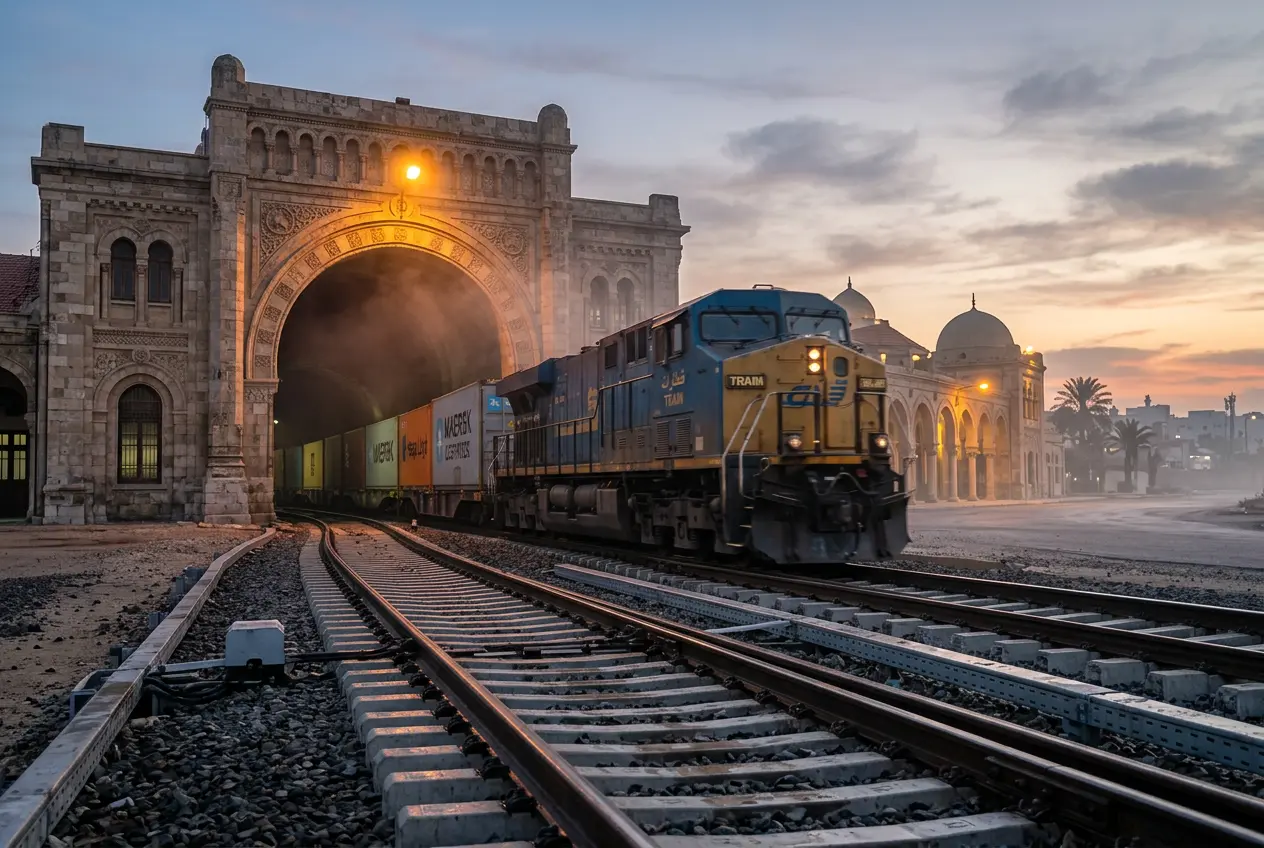
A Hejaz Railway, Rebuilt for the Gulf
The new project is a modern extension of the Hejaz railway, ordered by Ottoman Sultan Abdul Hamid II in March 1900 and first operating in 1908, per the Hejaz railway’s full Ottoman-era history. The original line ran from Damascus to Medina through what is now Jordan and northern Saudi Arabia, with a branch to Haifa on the Mediterranean coast. The completed Damascus-to-Medina section was roughly 1,300 kilometres, and the Hejaz railway was the only railway built and operated by the Ottoman Empire, according to an encyclopedia entry on the line. It was severely damaged during World War I and never reached Mecca, falling 400 kilometres short. The revived corridor is meant to tie into the Gulf railway network once operational.
Ankara has been laying the diplomatic groundwork for months. At an event hosted by the International Institute for Strategic Studies in Singapore on June 2, Turkish Foreign Minister Hakan Fidan said disruptions to maritime trade and rising shipping costs after Iran’s de facto closure of the Strait of Hormuz had increased the need for stable overland alternatives. He added that such routes could carry energy, trade, food, and goods between the region and global markets, and Saudi officials had signalled their interest in April, when al-Jasser gave his Al Arabiya interview.
Why Now, With Hormuz Under Lock
The trigger sits in the Persian Gulf. The United States and Israel have been at war with Iran and its regional allies since February 28, 2026, per an encyclopedia article on the 2026 Iran war, and Iran retaliated by enforcing a closure of the Strait of Hormuz. A temporary ceasefire brokered by Pakistan took hold on April 8, but Iran has refused to reopen the waterway.
The Trump administration announced a naval blockade of Iran from April 13, leaving a “dual blockade” of the gulf by Iran and of Iran by the US. The closure has produced the largest-ever supply disruption of the global oil market, with shipping insurance costs and tanker routing bending around the chokepoint. Energy and food importers in the Gulf, including Saudi Arabia and the United Arab Emirates, have been looking for overland workarounds. Uraloglu made the urgency explicit in Riyadh: “At this sensitive time our region is going through, the uninterrupted functioning of trade and the logistics chain has become more critical than ever,” he said.
The maritime choke point is not the only one. Earlier in the war sparked by Hamas’s October 7, 2023 attack on Israel, Yemen’s Iran-backed Houthis imposed a chokehold on the strategic Bab al-Mandab Strait in the Red Sea, disrupting container traffic to Israeli ports. Smaller Israeli cargoes had been running through Saudi Arabia to bypass that chokepoint, according to the Times of Israel.
Uraloglu and the Saudi side are also watching their own domestic balance sheets. The four to five year infrastructure roadmap agreed in Amman in April covers road, rail, maritime, air, and multimodal transport, plus digital harmonisation and private-sector participation. Turkish authorities are restoring the cross-border line near the Syrian border that has been out of service for nearly 15 years, according to the Saudi Gazette. Once revitalized, the railway is expected to “connect with the Gulf railway network to help regional states overcome transportation disruptions,” al-Monitor reported. Ankara’s longer-term goal, the Saudi-Turkish statements said, is to extend the line toward Oman and the Arabian Sea, a vision that has accompanied a wider Turkish opening to Egypt and the Gulf.
Bypass Israel, by Design
Ankara did not hide the political message. At the AA City Economies Summit in Gaziantep on Tuesday, Turkish Trade Minister Omer Bolat framed the railway as a regional reset that would bring economic prosperity across the Middle East while reducing Israel’s regional influence, al-Monitor reported. Bolat spoke alongside Syrian Economy and Industry Minister Mohammad Nidal al-Shaar, with whom he discussed the next phase of Turkish-Syrian economic and transport ties; the Saudi-Turkish partnership is also widening, with reported Saudi interest in Turkey’s Kaan stealth fighter.
The reduction of Israel’s influence in the region, together with increased political and economic solidarity among us, will bring economic prosperity, peace and stability to the Middle East, the Gulf and Türkiye’s southern borders.
Omer Bolat, the Turkish trade minister, said this at the AA City Economies Summit in Gaziantep on June 9, 2026, in remarks carried by al-Monitor. He spoke alongside Syrian Economy and Industry Minister Mohammad Nidal al-Shaar.
Reaction from former US diplomats followed within hours. Hady Amr, a former US diplomat, wrote on X that the new Saudi-Turkey agreement “demonstrates not only economic vision but is a political statement” that “deliberately bypasses Israel and the UAE,” per Hady Amr’s post on the deal. The Times of Israel, reporting on the deal, said observers described the initiative as a blow to Israel and to its plans for an India-to-Europe rail corridor passing through the Jewish state. The wider context is the stalled Israeli-Saudi normalization: Saudi Arabia has demanded irreversible progress toward establishing a Palestinian state as a precondition, while Prime Minister Benjamin Netanyahu’s hard-right government has rejected this out of hand.
Why the Construction Will Take Years
The deal is a memorandum of understanding, and a finished railway is years from completion. The four to five years roadmap agreed in Amman in April sets a horizon, not a calendar, and joint feasibility studies are not expected to be completed until the end of 2026.
Even on the optimistic schedule, the corridor runs through a country at war. Syria’s rail network has been out of service for nearly 15 years, since the early years of the country’s civil war, and restoring the line from Turkey to Aleppo is the first stated phase. The wider initiative is exposed to the same Hormuz-driven volatility it is trying to bypass, with a “temporary” ceasefire in the Iran war in place since April 8, 2026, and a US naval blockade of Iran in place since April 13.
- No cost estimate, financing arrangement, or construction start date has been announced.
- No private operator, consortium, or rail gauge standard has been named in the published documents.
- No published route map for the modern Hejaz revival has been released.
- No customs or border-passing framework for the Syria-Jordan-Saudi stretch has been agreed.
IMEC, the Rival That Has Stalled
The Saudi-Turkish deal also reframes the rival corridor. IMEC, the India-Middle East-Europe Economic Corridor, was announced on September 9, 2023, at the G20 Summit in New Delhi, with the United States, India, Saudi Arabia, the United Arab Emirates, France, Germany, Italy, and the European Union as the original backers, per the IMEC corridor’s founding framework. The plan was a rail and shipping network linking India, the UAE, Saudi Arabia, Jordan, Israel, and Europe. It was billed as a 21st-century Silk Road that would let container cargo bypass both the Suez Canal and the chokepoints at Hormuz and Bab al-Mandab. The corridor’s political precondition, Israeli-Saudi normalization, has not been met.
The normalization track stalled because the two sides do not agree on the Palestinian question. Saudi Arabia has demanded irreversible progress toward establishing a Palestinian state as a precondition, and Prime Minister Benjamin Netanyahu’s hard-right government has rejected this out of hand, the Times of Israel reported. With the wider Middle East crisis deepening, US-led mediation efforts have produced no breakthrough, and there is no announced route to a deal.
Both corridors are answers to the same problem: the Houthi Bab al-Mandab chokehold that pushed Israeli firms to route smaller cargoes through Saudi Arabia, the Times of Israel noted, and the 2026 Iran war’s Hormuz chokehold that has reshaped tanker and container insurance rates worldwide.
| Attribute | Hejaz revival | IMEC |
|---|---|---|
| Signed | June 9, 2026 (2 MoUs) | September 9, 2023 (framework) |
| Route | Turkey to Syria to Jordan to Saudi Arabia to Oman (and Aqaba) | India to UAE to Saudi Arabia to Jordan to Israel to Europe |
| Key states | Turkey, Saudi Arabia, Syria, Jordan | India, UAE, Saudi Arabia, Jordan, Israel, US, EU |
| Status as of June 2026 | Joint feasibility studies targeted by end of 2026; two trial runs via Iraq completed | Awaiting Israeli-Saudi normalization; no construction start |
| Key constraint | War-damaged Syria; active US-Iran war | Stalled Israeli-Saudi normalization over Palestinian state question |
The Saudi-Turkish deal is the more concrete of the two. There is a signed MoU, two trial runs via Iraq, a four to five year construction roadmap, and an end-of-2026 target for joint feasibility studies. IMEC, by contrast, is still a framework awaiting a political breakthrough that has not arrived. The Hejaz revival is also the more politically expensive: Ankara has openly framed the project as reducing Israel’s regional influence, and Saudi Arabia is now signed up to two rival corridors. The build will have to clear the war, the Syrian rebuild, and the political risks of running through a contested border zone.
Frequently Asked Questions
When will the Turkey-Saudi Hejaz railway open?
A four to five year infrastructure roadmap was agreed in Amman in April 2026, but joint feasibility studies are not expected to be completed until the end of 2026. No cost estimate or construction start date has been announced.
How does the new railway bypass Israel?
The new corridor revives the historic Hejaz railway route, which ran from Damascus to Medina through Jordan and northern Saudi Arabia, with a branch to Haifa. The planned path runs from Turkey through Syria and Jordan to Saudi Arabia and, in Ankara’s longer-term plan, Oman. It does not pass through Israel.
Why is the Hejaz railway being revived now?
The 2026 Iran war, which began on February 28, 2026, has closed the Strait of Hormuz. Turkish and Saudi officials have said an overland route is needed to keep trade, food, and goods moving in the face of the maritime disruption.
What is IMEC, and how does it compare?
IMEC, the India-Middle East-Europe Economic Corridor, was announced on September 9, 2023, at the G20 Summit in New Delhi. It would link India, the UAE, Saudi Arabia, Jordan, Israel, and Europe through rail and shipping. It remains a framework awaiting an Israeli-Saudi normalization deal, with Saudi Arabia demanding irreversible progress toward a Palestinian state as a precondition.
Is the Strait of Hormuz still closed?
Iran enforced a closure of the Strait of Hormuz in retaliation for the US-Israeli strikes at the start of the 2026 Iran war. A temporary ceasefire took hold on April 8, 2026, but Iran has refused to reopen the strait. The US has had a naval blockade of Iran in place since April 13, 2026.
