
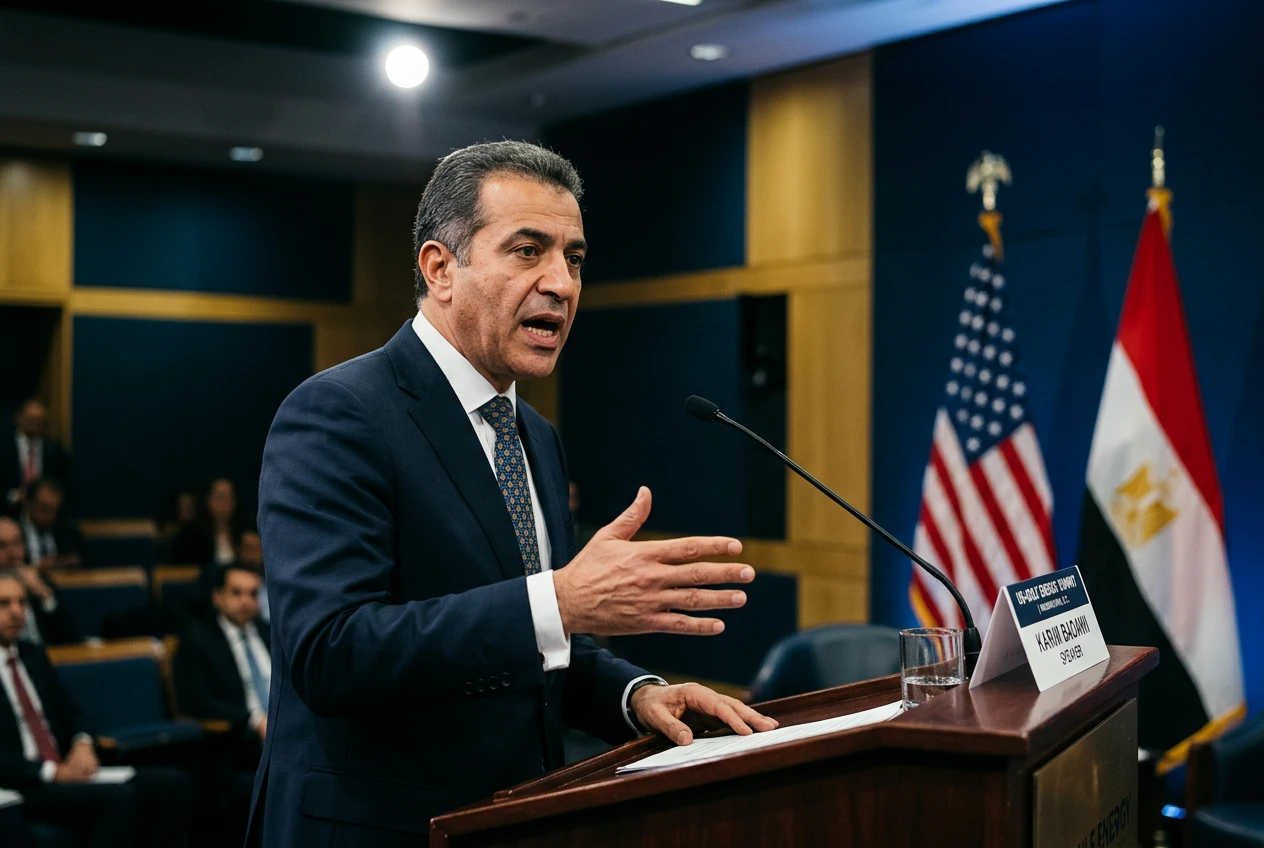
Egypt’s Minister of Petroleum and Mineral Resources Karim Badawi told the US-Gulf Energy Infrastructure Summit in Washington on June 9 that his country offers integrated strategic solutions for linking energy producers with consumers. He pointed to LNG export facilities on the Mediterranean coast, refining and petrochemical projects, and a national gas grid of 8,264 kilometers as the infrastructure Egypt places at the service of regional and global markets. The pitch came at the start of a Washington energy week that also included the 10th Atlantic Council Global Energy Forum and the East Mediterranean Gas Forum.
The summit was organized by the Atlantic Council’s Global Energy Center in partnership with the US Department of Energy and inaugurated by US Secretary of Energy Chris Wright and Atlantic Council President and CEO Frederick Kempe. Egypt is the only country in the Eastern Mediterranean with operational LNG export infrastructure, a fact the Ministry of Petroleum and Mineral Resources has spent years converting into a brand. The pitch lands as production from the offshore Zohr field has dropped from 2.7 bcf/day to 1.9 bcf/day, with Egypt importing more LNG than it exports. Badawi told the audience that Egypt’s location ‘strengthens its role as a regional energy hub connecting producers with consumers and European and global markets.’ He made the same case a second time on the same day, in a parallel session of the East Mediterranean Gas Forum, also held in Washington.
Egypt Pitches a Two-Sea Energy Corridor in Washington
Badawi opened the Washington session by listing the assets his ministry controls and the role it wants them to play. He named LNG export facilities on the Mediterranean coast, refining and petrochemical projects, crude oil and petroleum product storage and handling systems, gas transmission networks, and regional interconnection projects as the backbone of an Egyptian offer. The country’s position at the intersection of the Mediterranean and Red seas and between Africa and the Middle East, he said, reinforces its claim to sit between producers and consumers.
He framed Egypt as offering integrated strategic solutions for linking energy producers with consumers through an infrastructure network capable of meeting domestic demand while serving regional and international markets. The two LNG terminals at Idku and Damietta can liquefy gas from neighboring producers for export via the global spot market, giving buyers access that is not tied to long-term pipeline contracts. That optionality is the core of the pitch, and the Ministry of Petroleum and Mineral Resources has spent years building the diplomatic scaffolding around it. Egypt is a founding member and host of the East Mediterranean Gas Forum, the regional body that coordinates production, transit, and consumption policy among the basin’s countries. The forum’s June 9 meeting in Washington gave Badawi a second stage on the same day to make the same case.
Egypt offers integrated strategic solutions for linking energy producers with consumers through a robust infrastructure network capable of meeting domestic demand while serving regional and international markets.
Badawi delivered the line to ministers, energy executives, and infrastructure investors at the US-Gulf Energy Infrastructure Summit in Washington on June 9. He used the same address to call for stronger public-private partnerships, innovative financing solutions, and a stable investment climate to support long-dated energy projects. the Egyptian government’s full remarks to the summit are published by the State Information Service.
What the Ministry Says Egypt Brings to the Table
Egypt’s two LNG export terminals, Idku and Damietta, sit on the Mediterranean coast and together form the only operating LNG export infrastructure in the Eastern Mediterranean. Idku has been operational since 2005 with two liquefaction trains and a combined capacity of 7.2 million mt/year, per S&P Global. Damietta’s sea terminal is rated for 5.5 million tons of LNG per year, per the Weitz Company’s project record, and the two together give Egypt a combined LNG capacity of 12.7 million tons per year, per the Arab Center for Washington DC Studies. The country has spent more than a decade building the diplomatic scaffolding around that single fact. The Ministry of Petroleum and Mineral Resources has also added refining and petrochemical capacity to the same coastal footprint.
| Asset | Location | Capacity |
|---|---|---|
| Idku LNG | Beheira, Mediterranean coast | 7.2 million mt/year, two trains, operational since 2005 |
| Damietta LNG | Damietta, Mediterranean coast | 5.5 million tons of LNG per year |
| National gas grid | Nationwide | 8,264 km, 262 mmcm/d (2023) |
| Arab Gas Pipeline | Egypt, Jordan, Syria, Lebanon | 10 bcm/y, 1,200 km |
Beyond the terminals, the 8,264-kilometer national gas grid carries 262 mmcm/d in capacity, per the American Chamber of Commerce in Egypt, linking producing regions in the Western Desert, the Nile Delta, and the Gulf of Suez to coastal terminals. The same grid feeds the Arab Gas Pipeline, which connects Egypt, Jordan, Syria, and Lebanon with a total capacity of 10 bcm/y. Egypt’s location also gives it a Suez Canal position that few other Mediterranean states can match, with 12% of total seaborne crude oil trade and 8% of global LNG trade passing through the canal in 2023 before Red Sea disruptions pushed some shippers to the Cape of Good Hope. Egypt’s pitch to the Washington summit is that those assets are regional infrastructure, with the country acting as operator for the Eastern Mediterranean basin.
The Production Math That Was Not on the Podium
The Ministry’s pitch rests on assets that are real, but the gas volumes feeding them are shrinking. Production from the Zohr field, the cornerstone of Egypt’s domestic supply, has fallen from 2.7 bcf/day to 1.9 bcf/day. The decline has pushed Egypt back into the LNG import market to keep power plants running and meet summer demand. Egypt’s Sinai offshore fields posting a 9-year output high show a similar pattern in the upstream sector.
The squeeze shows up in Egypt’s own trade balance. Egypt was a net LNG exporter in the early 2020s, and its exports to Europe generated $8.4 billion during the post-Ukraine price spike, per industry tracker RBAC. Domestic demand has since overtaken production capacity, and LNG exports fell 50% year-on-year in 2023 with local and imported gas diverted to the Egyptian market. Egypt has been a net LNG importer for parts of 2025 and 2026 as a result. The Ministry of Petroleum and Mineral Resources has responded by bringing the Zohr-6 well online to slow the decline, but new wells offset it rather than reverse it.
Egypt has filled part of the gap by importing the very gas it used to liquefy and re-export. A $35 billion deal to bring an additional 130 bcm of Israeli gas shows how dependent the hub has become on gas that flows in through the East Mediterranean Gas (EMG) Pipeline.
The structural reality is that Egypt’s two terminals can still liquefy regional gas for Europe; the constraint sits on the upstream side, in Egyptian and partner fields. The 120 trillion cubic feet of recoverable gas estimated for the Levant Basin has not yet translated into new LNG supply at scale. Cyprus’s Aphrodite and Cronos fields are likely candidates to flow into Egyptian terminals, but no operational Cypriot LNG infrastructure exists and timelines remain uncertain. The hub pitch leans on terminal capacity, not on whose gas fills them.
How the Hub Fits Into Europe’s Energy Map
Europe’s demand for non-Russian gas has reshaped what Egypt’s terminals are worth. Between 2021 and 2025, the continent cut Russian gas imports by 90% and is working to phase them out fully by November 2027, a structural shift that has turned every operational LNG terminal on Europe’s periphery into a strategic asset. The Eastern Mediterranean holds an estimated 120 trillion cubic feet of recoverable gas in the Levant Basin alone, and the gas Cyprus and Israel plan to bring to market is expected to flow through Egypt’s existing facilities rather than new build. Atlantic Council analysis frames the basin not as a Russian-gas replacement but as Europe’s energy shock absorber, providing incremental supply during market stress. Estimates suggest the region could support approximately 30 to 40 bcm of annual exports to Europe under favorable conditions. the Eastern Mediterranean’s role as Europe’s energy shock absorber is detailed in the think tank’s analysis.
The pitch also lands in a region whose own gas corridors have been shaken. Red Sea disruptions pushed shippers to the Cape of Good Hope, and tensions around the Strait of Hormuz have shown the cost of relying on a single chokepoint for global LNG flows. Egypt’s two terminals sit on the Mediterranean, away from the Red Sea shipping lanes, and its Suez-Mediterranean pipeline network gives buyers a route that does not require the strait.
The Money the Minister Is Asking For
Badawi’s Washington speech was as much a financing call as an infrastructure pitch. He said the next phase of energy development in the region should be driven by increased investment through stronger public-private partnerships, innovative financing solutions, and a stable investment climate. The Ministry of Petroleum and Mineral Resources has been framing investment as a precondition for output, not a reward for it. Public-private partnerships and project finance were the two policy tools he named.
He described them as the path to long-term capital inflows, language that travels well with the Gulf wealth funds, the multilateral lenders, and the US and European oil majors who attended the summit. Egypt’s ministry has been running an ongoing financial and contractual review to channel capital to fast-track field development, per the ministry’s own statement. The pitch to Washington is for partners, not charity. Badawi used the same Washington trip to meet Sheikh Nawaf Saud Al-Sabah, Deputy Chairman and CEO of Kuwait Petroleum Corporation, to discuss Kuwaiti investment in Egypt’s petroleum sector, per the State Information Service. The ministry is also in active dialogue with Qatar, the UAE, and Saudi Arabia over energy investments and infrastructure partnerships.
The financing asks line up with a clear hierarchy of capital sources. Egypt wants Gulf state money and US government backing to anchor political risk cover, project finance from multilateral lenders to underwrite infrastructure, and Gulf-Asian equity to take operational stakes in the field. Badawi’s wider Washington trip gave him a chance to set each ask in motion, with the Kuwaiti meeting the first of several planned. Badawi’s wider Washington itinerary in June 2026 shows the full list of his Washington meetings.
- Public-private partnerships to co-finance LNG and pipeline projects
- Innovative financing structures for long-dated infrastructure
- A stable investment climate to draw long-term capital
- Gulf state and US government partnerships to anchor political risk
Why the Pitch Lands in Washington Right Now
Washington has been the natural venue for Egypt’s energy diplomacy since 2019, when the two governments launched the US-Egypt Strategic Energy Dialogue. The framework covers oil and gas development, electricity, clean coal technology, carbon capture, and renewable energy cooperation. The June summit is part of the same engagement track, and the choice of venue gives the Egyptian pitch the implicit US endorsement that opens doors with US private capital. Egypt’s energy hub ambition runs in parallel with a Russian track, with Moscow proposing a grain and energy logistics center in Cairo. The 2019 launch of the US-Egypt Strategic Energy Dialogue is the bilateral framework both sides are working through.
The visit comes as Egypt’s energy policy is being remade at home. The 2026 budget cut energy subsidies to about EGP 120 billion, a sharp fiscal shift tied to the country’s IMF program, and the government has been tightening subsidies as gas shortfalls grow. Those moves raise the cost of domestic consumption, but they also create the fiscal headroom Egypt needs to argue it can repay long-term infrastructure investors. Putin’s proposed grain and energy logistics hub in Egypt is a parallel sign of how many capitals are pitching Cairo on the same geography.
Frequently Asked Questions
What is the US-Gulf Energy Infrastructure Summit?
It is a forum organized by the Atlantic Council’s Global Energy Center in partnership with the US Department of Energy. US Secretary of Energy Chris Wright and Atlantic Council President and CEO Frederick Kempe inaugurated the June 9 session in Washington, and the event gathered ministers, senior government officials, energy executives, and infrastructure investors from the United States and the Gulf.
Why is Egypt pitching itself as a regional energy hub now?
Egypt’s ministry of petroleum argues that the country’s two Mediterranean LNG terminals, refining capacity, and 8,264-kilometer gas grid place it at the physical center of trade between Gulf producers, African suppliers, and European consumers. The pitch lands as Europe works to phase out Russian gas by November 2027 and as Eastern Mediterranean gas becomes a meaningful source of incremental supply.
How much LNG can Egypt actually export?
Egypt has two operational LNG export terminals at Idku and Damietta, on the Mediterranean coast, with a combined capacity of 12.7 million tons per year, per the Arab Center for Washington DC Studies. Egypt is the only country in the Eastern Mediterranean with operating LNG export infrastructure.
Is Egypt a net LNG exporter?
Egypt was a net LNG exporter in the early 2020s, and its exports to Europe generated $8.4 billion during the post-Ukraine price spike, per industry tracker RBAC. Domestic demand has since overtaken production, and Egypt has been a net LNG importer for parts of 2025 and 2026.
Which Gulf states is Egypt courting for energy investment?
Badawi used the same Washington trip to meet Sheikh Nawaf Saud Al-Sabah, Deputy Chairman and CEO of Kuwait Petroleum Corporation, per the State Information Service. The Ministry of Petroleum and Mineral Resources is also in active dialogue with Qatar, the UAE, and Saudi Arabia over energy investments and infrastructure partnerships. The pitch to the US-Gulf summit in Washington is the public face of those conversations.
