
Egyptian archaeologists have uncovered new sections of a 26th Dynasty temple at the Old Palace site in Egypt’s Bahariya Oasis. The latest excavation season revealed a sandstone hypostyle hall, inscribed blocks bearing the names of Pharaoh Psamtik I, and reliefs naming ancient Egyptian deities. An Egyptian archaeological mission from the Supreme Council of Antiquities has worked the site since 2014. The new finds are sharpening the picture of a desert settlement that combined religious and administrative functions across centuries.
Beyond the temple itself, the finds reshape a longer story. A stone stela of Amenhotep II places the oasis’s sacred history 800 years earlier than the structure itself, and evidence of occupation runs into the fourth and fifth centuries AD.
What the team uncovered at Old Palace
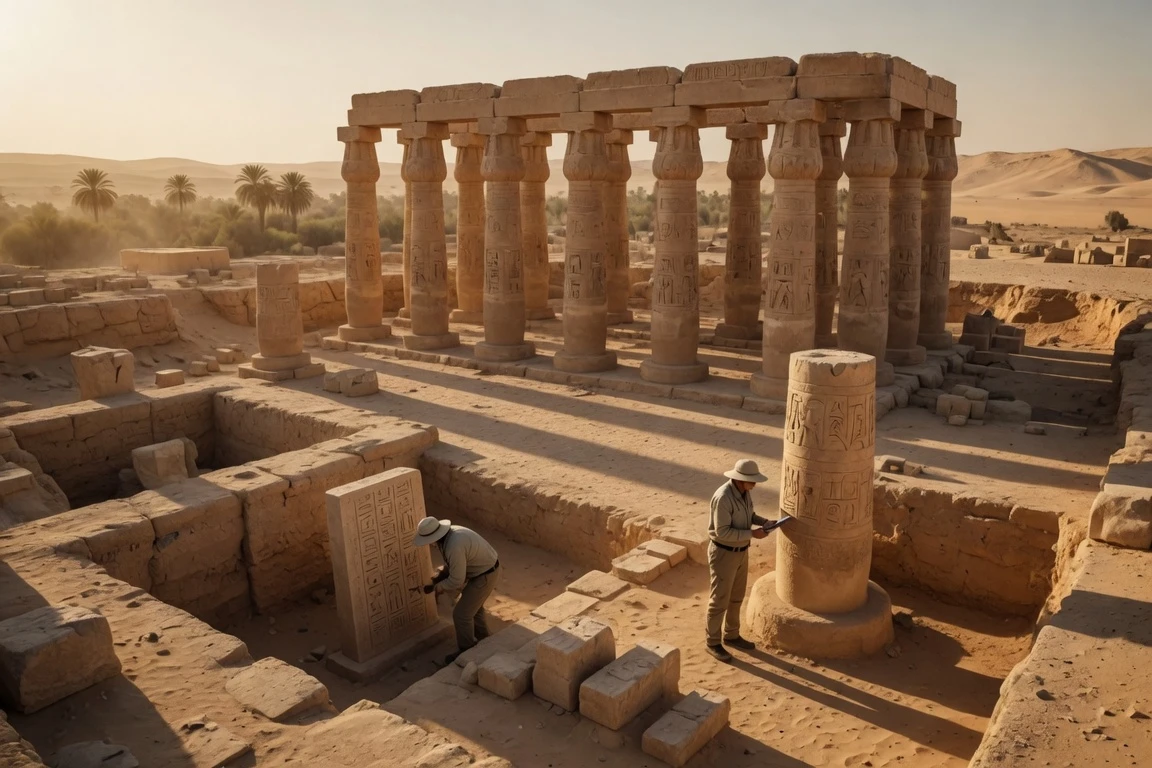
At the Old Palace site in the village of Al-Qasr, an Egyptian mission from the Supreme Council of Antiquities has been working since 2014. The current season added fresh architectural pieces to a temple whose outline researchers have been filling in for years. The new finds include a hypostyle hall built around 16 sandstone columns, a series of adjoining rooms and chapels, several inscribed stone blocks carrying the names and royal titles of Psamtik I, and decorated reliefs with hieroglyphic inscriptions naming Egyptian deities:
- Amun-Re
- Amunet
- Khonsu
Mohamed Abdel-Badie, head of the Egyptian Antiquities Sector at the SCA, said the hall began under Psamtik I and was completed under later 26th Dynasty rulers. Three kings oversaw the work.
The temple’s name, recovered from a metal seal
The temple’s original name had been lost before a previous season’s dig turned up a metal seal inside the complex. Kotb Fawzy, head of the Central Administration of Cairo and Giza Antiquities, said the seal preserved the name “Ib-Set,” often translated as “House of the Heart” or “Seat of the Heart.” Fawzy called it the first identification of the sanctuary.
Earlier seasons had also produced a statue of the god Thoth, a bronze figure of Osiris, a bronze amulet of Ra-Horakhty, and the head of a statue believed to depict a senior priest or official connected to the oasis. A shrine belonging to Pa-di-Iset, a local governor and priest of the Late Period, was found at the same time.
Eight centuries before the temple was built
The 26th Dynasty dates from 664 to 525 BC, and the new finds point to a much older sacred footprint beneath the temple. A stone stela recovered from the site dates to the reign of Amenhotep II of the 18th Dynasty, roughly 800 years earlier than the structure itself. The inscription confirms close ties between the Bahariya Oasis and the Egyptian state during the New Kingdom period.
Artifacts connected to the reign of the pharaoh Ramesses II suggest religious and settlement activity at Al-Qasr that long predated the Saite-period temple. Archaeology Magazine reports the earlier cult center that stood before the temple was later rebuilt and expanded by the Saite rulers of the 26th Dynasty. That dynasty has been described as one of the final native dynasties of ancient Egypt. Inscribed blocks naming the Saite rulers are turning up across the excavation in current seasons, Ahram Online adds.
Earlier excavation seasons had already turned up Coptic and Latin inscriptions, ostraca, and industrial installations at the site, all indicators of use well beyond the pharaonic era. The current finds extend that record of continuous activity by adding fresh 26th Dynasty architectural elements. Ahram Online reports the work has run continuously since 2014.
Five timeline anchors place the new pieces in context. Each one comes from sources reporting the latest excavation season.
- 26th Dynasty (664-525 BC): the temple’s founding era
- 16 sandstone columns: the hypostyle hall’s defining feature
- 800 years earlier: a stone stela of Amenhotep II links the oasis to the New Kingdom state
- Since 2014: Egyptian archaeologists have worked each season at the Old Palace site
- 4th and 5th centuries AD: latest evidence of continuous occupation
Built across three Saite kings
Construction of the temple began during the reign of Psamtik I and continued under his successors. Ahram Online details the construction sequence across three Saite kings, including Apries (also called Wahibre) and Amasis II (also called Ahmose II) under whom the work was completed. The dynasty ended in 525 BC.
The Old Palace site served as the regional capital during the Late Period, Heritage Daily reports. Egypt Today notes the Saite timeline runs across three reigns.
A site that outlived the pharaohs
The Old Palace site did not stop being used when the last pharaoh died. Sabry Farag, Director General of Bahariya Oasis Antiquities, said evidence from the site confirms continuous activity during the Greek and Roman periods and into the fourth and fifth centuries AD. Egypt Today lists ostraca and texts written in Coptic and Latin among the finds that document that later occupation. Farag oversees the local antiquities office.
Among the late finds that map this long afterlife are industrial installations, basins used for wine and oil production, and designated storage areas. Egypt Today ties the finds to the Greek, Roman, and late antique phases of the site.
- Coptic and Latin inscriptions and ostraca
- Industrial installations
- Storage facilities
- Basins used in wine and oil production
What the officials are saying
Sherif Fathy, Egypt’s Minister of Tourism and Antiquities, praised the work of Egyptian archaeological missions and said the discoveries strengthen the country’s position as a cultural tourism destination. Egypt Today reports Fathy added that the finds contribute to a deeper understanding of ancient Egyptian civilization. He said they reinforce Egypt’s standing as a leading cultural tourism destination.
Dr. Hisham El-Leithy, Secretary-General of the Supreme Council of Antiquities, took a longer historical view than Fathy did. He pointed to the temple’s role as a religious and administrative centre through successive historical periods.
His words:
the discovery as further evidence of the historical significance of the Old Palace site, which served as an important religious and administrative centre for centuries
Dr. El-Leithy made the remarks in a statement carried by Heritage Daily. The Ministry was the original source.
Why this find matters for the region
The Old Palace site is considered one of the most important archaeological locations in the Bahariya Oasis, having served as the region’s capital during the Late Period. The new architectural pieces add details to a temple whose outline researchers have been filling in since the SCA mission began work at Al-Qasr in 2014. Egypt Today reports the discoveries contribute to a clearer picture of the temple’s architectural layout and historical development.
Sherif Fathy, the tourism minister, said the country’s archaeological wealth “still holds many undiscovered treasures.” Egypt Today reports Fathy also credited Egyptian archaeological missions with “unveiling new chapters of the nation’s rich history.” He framed the discoveries as part of what makes Egypt a leading cultural tourism destination. Both points were carried in the SCA’s official statement.
The find ties together evidence from multiple eras. The New Kingdom stela of Amenhotep II and the Ramesses II artifacts now sit alongside a Saite temple complex, giving researchers a continuous thread from the New Kingdom through the Christian era. Archaeology Magazine reports researchers now believe an earlier cult center at Al-Qasr was rebuilt and expanded under the Saite rulers of the 26th Dynasty.
Frequently Asked Questions
What was the 26th Dynasty?
Egypt’s 26th Dynasty, also known as the Saite Dynasty, ruled from 664 to 525 BC. Archaeology Magazine describes it as one of the final native dynasties of ancient Egypt. The temple at Al-Qasr was founded during this period, under Pharaoh Psamtik I.
Where is the Bahariya Oasis?
The Bahariya Oasis is a depression in Egypt’s Western Desert. It contains several villages and archaeological sites, including the Old Palace temple in the village of Al-Qasr, and has been part of travel and trade routes through the Western Desert for centuries.
Why is the stone stela of Amenhotep II significant?
Archaeology Magazine reports the discovery of a stela from the reign of Amenhotep II, an 18th Dynasty pharaoh, places the Bahariya Oasis in contact with the Egyptian state roughly 800 years before the temple at Al-Qasr was built.
What was the temple’s ancient name, Ib-Set?
“Ib-Set” is translated as “House of the Heart” or “Seat of the Heart.” The name was recovered from a metal seal found at the site in an earlier excavation season, Egypt Today reports, and was the first identification of the sanctuary by its original Egyptian name.
How long was the Old Palace site occupied?
Archaeologists have found evidence of use at the Old Palace site from the New Kingdom through the fourth and fifth centuries AD. The sequence runs from the Amenhotep II stela, to artifacts from the reign of Ramesses II, to the 26th Dynasty temple built under Psamtik I and expanded under Apries and Amasis II, to Greek, Roman, and late antique occupation marked by Coptic and Latin inscriptions.
