
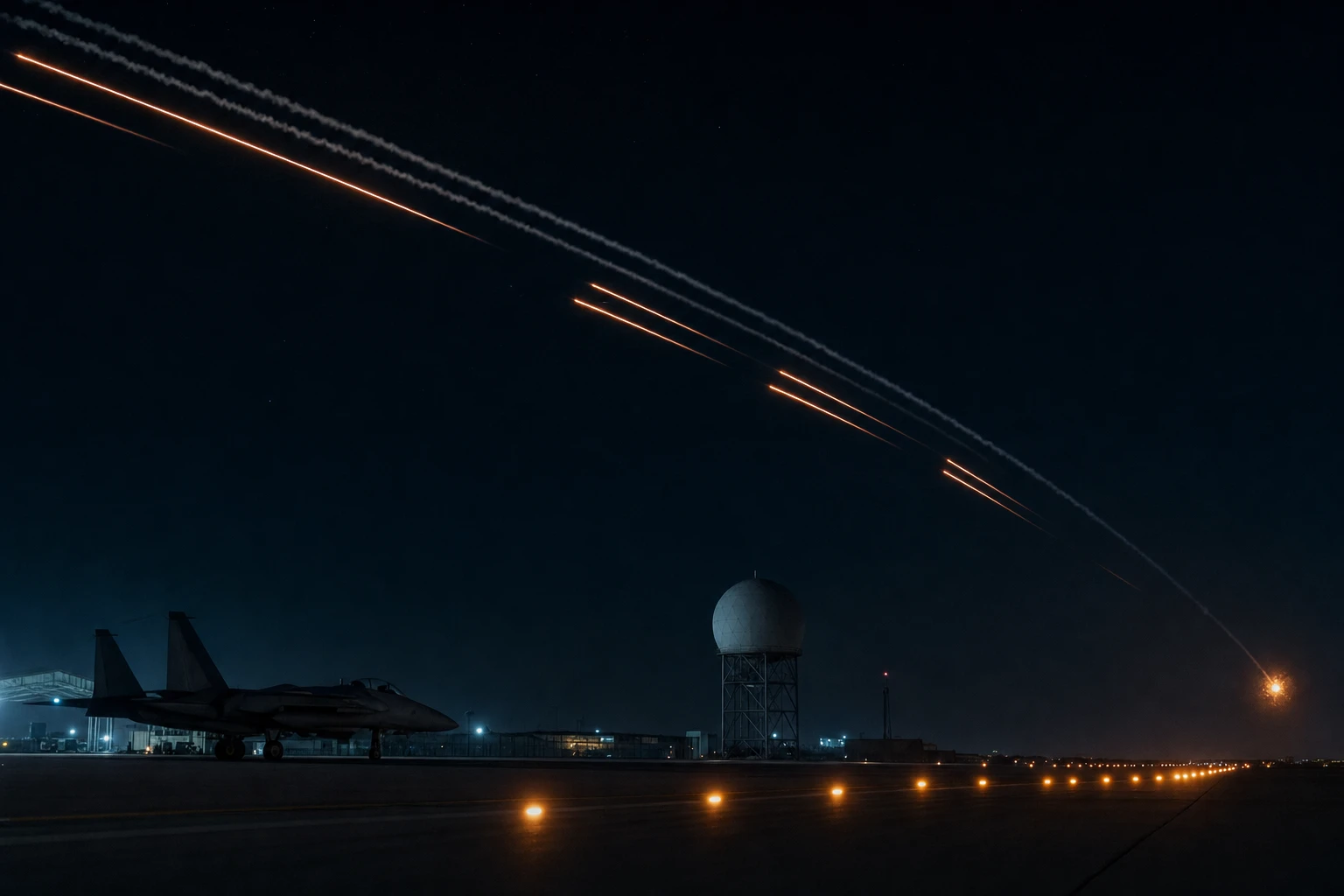
Iran fired missiles and drones at US military bases in Kuwait, Bahrain and Jordan on Thursday night, retaliating for a fresh wave of American airstrikes on southern Iran. The Islamic Revolutionary Guard Corps (IRGC) said its naval and aerospace units carried out the joint attack, hitting radar systems, a satellite communications hub, fuel depots and a naval wharf at bases the United States has relied on for years.
None of the three countries hit are combatants in the war between Washington and Tehran. They host American forces, and that alone puts them in Iran’s line of fire every time the US strikes back. A ceasefire signed five weeks ago was meant to prevent this.
Iran Hits Three US Bases in a Single Night
The Guard said in a statement carried by its Sepah News outlet that its forces launched a coordinated missile and drone campaign hours after the US wrapped up a new round of strikes on Iranian soil. Iran’s army said separately that it deployed domestically built Arash drones as part of the barrage.
| Country | Base or Site | What Iran Says It Hit | Weapon Used |
|---|---|---|---|
| Kuwait | Ali Al Salem Air Base | Radar system, satellite communications hub, assembly site, Patriot battery, oil depots | Missiles and Arash drones |
| Kuwait | Shuaiba Port | Naval wharf | IRGC naval strike |
| Jordan | Al Azraq Air Base | Fighter jet ramp, command center | Long-range ballistic missiles |
| Bahrain | Sheikh Isa Air Base | Communications and radar facilities | Arash drones |
Iran’s military separately said it shot down a US MQ-9 drone over Andimeshk, a city in the southwestern province of Khuzestan. The Guard said the strikes on Jordan answered what it called an American attack near a children’s cancer hospital inside Iran, a justification Washington has not directly addressed.
Euronews and other outlets confirmed the broad shape of the night’s fighting: two waves of ballistic missiles aimed at the Jordanian base and drone strikes against Kuwait and Bahrain, targeting air defence systems, fuel storage and radar installations. US Central Command said its own strikes hours earlier hit “Iranian command centers, air defense sites, missile and drone capabilities, and coastal surveillance facilities” at multiple locations including Bandar Abbas. Iran’s health ministry says at least 35 people have been killed and more than 300 wounded in the American strikes of recent days.
The Ceasefire Barely Survived a Month
Trump and Iranian President Masoud Pezeshkian signed the Islamabad Memorandum on June 17, a 14-point framework meant to end the war on all fronts, reopen the Strait of Hormuz toll-free for 60 days, lift the US naval blockade of Iranian ports and extend the ceasefire 60 days to negotiate a final deal. The agreement was expected to hold until roughly Aug. 18.
It hasn’t worked that way. Only two days of direct, high-level talks have actually taken place since the signing, even as lower-level technical negotiations continued until this week’s flare-up. No official text of the memorandum has ever been published. A House of Commons Library briefing on the deal notes that the versions briefed to journalists and released by Iran only roughly match, leaving room to dispute what was actually agreed.
Much of that dispute centers on a single clause about the Strait of Hormuz, the narrow waterway carrying a large share of the world’s oil. Iran treats the clause as authority to manage Hormuz traffic. Washington calls it a straightforward reopening. Neither side has budged.
The Gulf States Caught in Someone Else’s War
Kuwait, Bahrain and Jordan are not parties to the Islamabad Memorandum. Bahrain alone hosts both the US Navy’s Fifth Fleet and the Sheikh Isa Air Base that took drone fire Thursday. Kuwait and Jordan have hosted American air power for decades, and that infrastructure is now absorbing hit after hit regardless of what any ceasefire says on paper.
The list of what keeps getting targeted has become familiar:
- Radar and air-defense systems meant to track incoming missiles and drones
- Communications antennas and satellite links tied to coalition operations
- Fuel and oil depots that supply coalition aircraft
- Port wharves and naval facilities used to resupply US ships
UN human rights experts raised the underlying legal question when the war first broke out, warning that force used in self-defense must satisfy strict necessity and proportionality requirements. That standard gets harder to apply with every new round of strikes on host countries that never declared war on anyone.
Jordan has spent the past year building a reputation as one of the region’s steadiest partners, recently earning recognition as the EU’s most trusted Middle East partner. That standing hasn’t stopped Al Azraq from taking missile fire twice in the past month. Qatar, which has served as a mediator throughout the conflict, intercepted its own missile attack early Friday and has not said who fired it.
Why Do US Partners in the Gulf Keep Absorbing the Strikes?
Kuwait, Bahrain and Jordan keep getting hit because Washington has stationed forces there for decades, and Iran wants to punish the United States without striking American soil directly. Ali Al Salem, Al Azraq and Sheikh Isa sit close enough to Iran to hit with drones and missiles, and far enough from Iran’s own cities to count, in Tehran’s telling, as fair retaliation for US bombing runs.
Andreas Böhm, a lecturer in international affairs at Switzerland’s University of St. Gallen, said the standoff has become “tricky” to resolve. Trump is “stuck in a mess of his own (and Israel’s) making and can’t find a face-saving way out of it,” Böhm said, while Iran keeps testing how far it can push before Washington’s patience runs out.
Egypt, watching its neighbors absorb the fallout, condemned the strikes on Arab states and pivoted toward mediation efforts rather than picking a side militarily, a pattern most Middle East governments have followed since the war began.
The Same Bases, Hit Again and Again
Ali Al Salem, Al Azraq and Sheikh Isa have taken fire before. The pattern has repeated for months, each time a fragile truce cracked.
- February 28, 2026: The US and Israel launch strikes that kill Iran’s supreme leader, starting the war.
- April 7 to 8, 2026: Washington, Tehran and Israel agree to an initial two-week ceasefire brokered by Pakistan.
- June 17, 2026: Trump and Pezeshkian sign the Islamabad Memorandum, extending the truce 60 days.
- June 28, 2026: Iran fires ballistic missiles and drones at Ali Al Salem in Kuwait and the Fifth Fleet headquarters in Bahrain, retaliating for US strikes on five Iranian coastal sites.
- July 13, 2026: Iran hits bases in Kuwait, Bahrain, Jordan, Oman and Qatar as the Hormuz standoff reignites, prompting Trump to declare the ceasefire scrapped.
- July 16, 2026: Iran strikes the same three countries again as the US completes a sixth consecutive night of strikes on Iran.
That June 28 flare-up came just eleven days after the memorandum was signed, following a third night of Hormuz strikes that had already tested the deal’s limits. The Council on Foreign Relations’ running tracker of the war notes that 1,701 documented civilian deaths in Iran have been recorded by the Human Rights Activists News Agency (HRANA), even though complete figures do not exist.
It took about two months to negotiate a page and a half of the memorandum of understanding … It took only three weeks for it to unravel.
Ali Vaez, senior adviser and Iran project director at the International Crisis Group, made that comparison to CNN this week. He said the two countries are now cycling from one round of violence to the next with no floor underneath them.
Oil Creeps Higher as Approval Sinks
The economic and political fallout is showing up fast on both sides of the Atlantic.
- $85 a barrel: Brent crude traded above that level this week, more than 15% higher than before the war, though still short of the nearly $120 peak reached at the height of the fighting.
- 29%: share of Americans who approve of Trump’s handling of the Iran conflict, according to a Washington Post-Ipsos poll released Thursday.
- Six: consecutive nights of US airstrikes on Iran as of Thursday, according to Central Command.
- 35 killed, 300-plus wounded: the toll Iran’s Health Ministry attributes to the recent American strikes.
White House press secretary Karoline Leavitt pushed back this week on concerns that renewed fighting is driving fuel costs higher, saying there “may be temporary disruptions in the oil market” while crediting Trump’s energy policies for preventing steeper increases. International Monetary Fund economists Azim Sadikov and Jean-Marc Natal offered a less rosy read, writing that the world’s cushion against a bigger shock has thinned. A Georgetown University analysis of the conflict argues policymakers should manage escalation and reduce regional risks rather than let the fighting drift toward a wider war.
No Clear Off-Ramp for Washington or Tehran
Trump said Friday the US had agreed to keep talking after Iran requested it, even while insisting the ceasefire itself is dead. Iran’s foreign ministry spokesperson, Esmaeil Baghaei, said days earlier that Tehran has no plans for negotiations and will keep responding “firmly” to US strikes.
Some security analysts think the fighting changes shape before it stops. A Center for Strategic and International Studies review of the conflict points to greater use of hybrid threats such as cyberattacks and sabotage as Iran’s likely fallback if the conventional exchange of fire stalls out.
The Islamabad Memorandum’s 60-day window was supposed to run until roughly Aug. 18. With strikes now in their sixth straight night and both governments trading blame, that date is the only deadline either side still has left to meet.
Frequently Asked Questions
What is the Islamabad Memorandum?
The Islamabad Memorandum is the 14-point framework Trump and Iranian President Masoud Pezeshkian signed on June 17, extending the ceasefire 60 days to negotiate a permanent deal. Pakistan brokered the talks, with Qatar, Saudi Arabia, Turkey and Egypt also facilitating negotiations.
How many countries has Iran targeted with strikes during the war?
Beyond Thursday’s strikes on Kuwait, Bahrain and Jordan, Iran has at various points hit US-linked sites in Oman, Qatar and the United Arab Emirates, along with direct strikes on Israel.
Is the Strait of Hormuz open right now?
The US and Iran disagree. Washington insists the waterway is open, while Tehran claims the right under its reading of the memorandum to manage traffic through the strait, and has repeatedly threatened closure when tensions spike.
Were there any US casualties in the Gulf base strikes?
US officials have told Reuters that earlier rounds of strikes on Gulf bases caused no American casualties or major damage. Washington has not released a casualty count specific to Thursday’s attack.
Could Iran shut down the Strait of Hormuz for good?
Iran’s foreign minister, Abbas Araghchi, has said the strait would return to pre-war shipping capacity within 30 days under Iran’s exclusive management once what Tehran calls obstacles are removed, a claim the US disputes.
