
The United States bombed Iran for a sixth straight night on Thursday, and Tehran struck back at Kuwait and Bahrain, as the fight for the Strait of Hormuz widened. US Central Command hit Bandar Abbas and an Iranian-held Gulf island, while Kuwait said it downed 32 drones and Bahrain’s air defenses shot down a wave of Iranian fire.
Brent crude traded near $85 a barrel, a fraction of the reaction the shipping data would suggest it should provoke. Transits through the strait have collapsed toward a handful a day, and the memorandum that was supposed to keep it open is now the fight’s central casualty.
Strikes Hit a Sixth Night as Iran Answers in Kuwait and Bahrain
US Central Command (CENTCOM) said it hit Iranian command centers, air defense sites, missile and drone capabilities and coastal surveillance facilities around Bandar Abbas late Wednesday, part of what it called an effort to further degrade Iran’s ability to threaten mariners in the strait. A separate 90-minute wave earlier had hit coastal defense and cruise missile sites on Greater Tunb Island, an Iranian-held outpost in the Gulf.
Iran answered within hours. Kuwait’s Defense Ministry said its air defenses intercepted 32 drones since dawn Thursday. Bahrain sounded air raid sirens and later said its systems intercepted and destroyed a wave of Iranian aerial attacks. Iran’s army said it struck the Al Azraq air base in Jordan with ballistic missiles, and the Islamic Revolutionary Guard Corps (IRGC) claimed it destroyed a satellite communications center and early warning radar at Kuwait’s Ali Al Salem air base, plus a US military pier at Al Shuaiba.
Iranian state media reported explosions in Lorestan province, in the west, and Semnan, in the north. In southern Hormozgan province, US strikes damaged the Kahurestan Bridge linking Bandar Abbas to Shiraz, a railway junction and local power lines. Iranian state media said at least seven people were killed and nine wounded.
White House press secretary Karoline Leavitt said more than 10,000 US sailors, Marines and airmen, backed by two aircraft carriers and more than 20 warships, are enforcing the reimposed naval blockade of Iranian ports.
- February 28, 2026: The United States and Israel launch coordinated strikes on Iran, opening the war and killing Supreme Leader Ali Khamenei.
- June 17, 2026: Presidents Trump and Masoud Pezeshkian sign a memorandum of understanding meant to end the fighting and reopen the strait.
- July 8, 2026: The interim truce collapses after Iran strikes multiple commercial ships in the Strait of Hormuz.
- July 14, 2026: Kpler tracks just 21 ship transits through the strait, a sliver of pre-war traffic.
- July 16, 2026: CENTCOM hits Bandar Abbas and Greater Tunb Island for a sixth straight night as Iran fires on Kuwait and Bahrain.
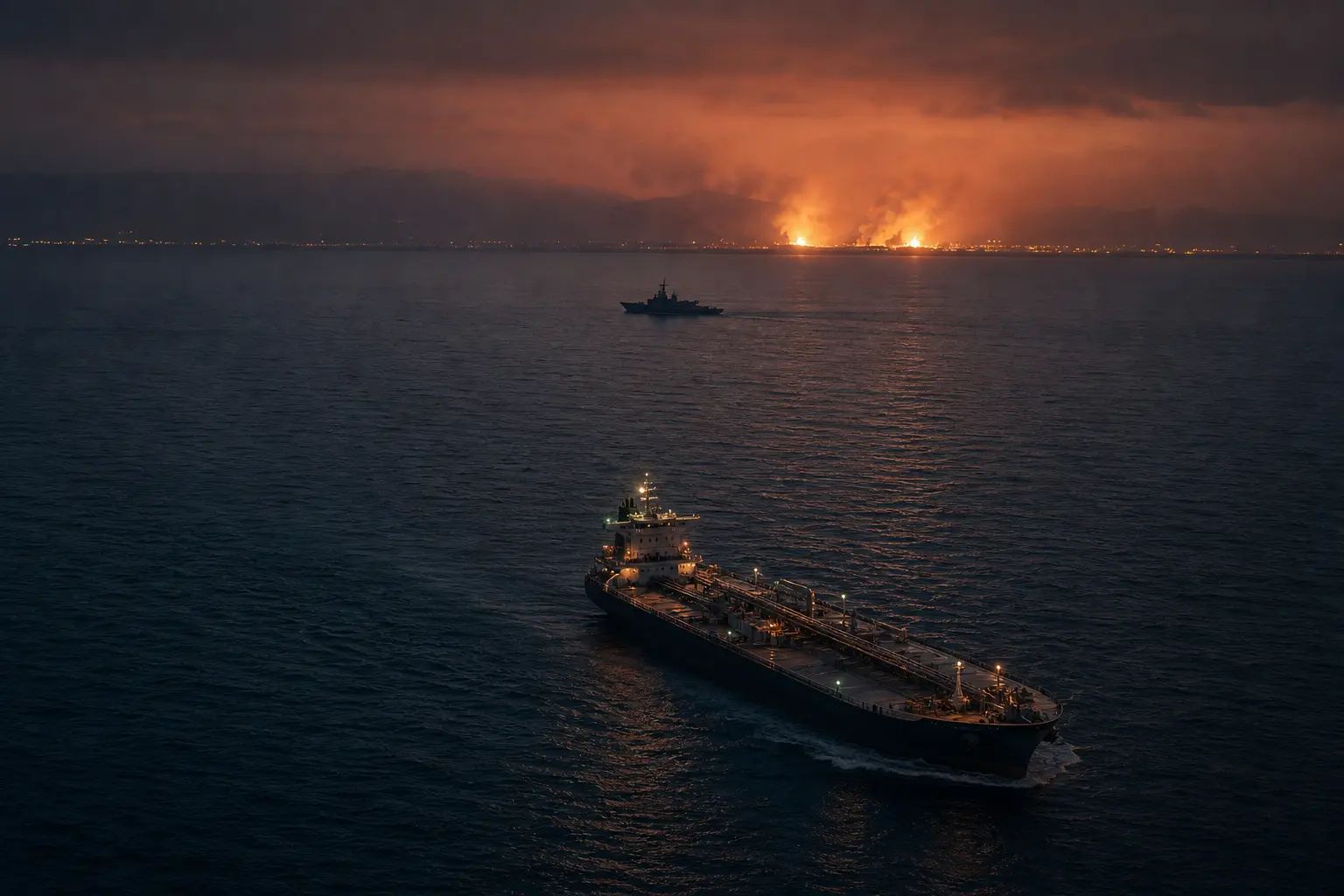
One Clause in the Truce Is Now the Whole War
The renewed fighting traces to a dispute over a single clause. Paragraph 5 of the June memorandum addresses who is responsible for safe passage through the strait, and the two governments have read it very differently ever since, according to an analysis of the collapsed talks published by the foreign policy outlet Responsible Statecraft.
Washington’s account holds that negotiations were progressing until Iran’s foreign minister was overruled by hardliners inside the IRGC. Tehran’s view is that the United States used the interim deal to help build an alternate shipping corridor through Omani waters that would erode Iran’s leverage over the waterway for good.
Iran’s parliament speaker and lead negotiator, Mohammad Bagher Ghalibaf, made clear this week that Tehran treats the memorandum as conditional, not permanent. “A memorandum of understanding only has meaning when its clauses are valid and being implemented,” he said in a statement. “If Iran is not to derive any benefit from the memorandum of understanding, we have no reason to adhere.”
The strait is worth fighting over because of what flows through it. Its two narrow shipping lanes normally carry about a fifth of the world’s traded oil every day. Iran’s grip on it also carries a financial incentive: the Brookings Institution, a Washington policy research center, wrote that unconfirmed reports put an IRGC toll at roughly $2 million for every supertanker that transits.
Vessel Traffic Is Flashing Redder Than Oil Prices
Oil prices have moved less than the shipping data suggests they should. Brent crude fell back to $84.93 a barrel Thursday after briefly topping $86, up just 0.2% on the day, CBS News reported. The sharper signal sits in the ships themselves.
| Point in Time | Daily Transits Through the Strait | Source |
|---|---|---|
| Before February 28, 2026 (pre-war) | Roughly 130 vessels | Industry estimate cited by Outlook India |
| Pre-crisis baseline | 88 transits | PortWatch, run by the International Monetary Fund |
| July 5, 2026 | 34 transits | PortWatch |
| July 14, 2026 (Tuesday) | 21 transits | Kpler |
Insurance is doing the work a blockade alone has not. Commercial operators and insurers have largely abandoned the corridor, and Kpler’s own analysts describe the result as a de facto closure despite the strait remaining open. War risk premiums have jumped to four or five times their prewar levels, a Congressional Research Service assessment found, making transit uneconomical for most owners no matter what the militaries do.
The Bill Comes Due from New Delhi to Amman
The strait’s collapse radiates far beyond the Gulf. India draws about 40% of its crude oil, 60% of its LNG and 90% of its LPG through the waterway, according to Outlook India’s review of shipping data, leaving New Delhi unable to watch from a distance.
- Maritime crews: Iran has attacked seven commercial ships in the past week, leaving nearly a dozen crew members dead, missing or injured, according to the US government.
- Air travel: The European Union Aviation Safety Agency has told airlines to avoid the airspace of Bahrain, Kuwait, Qatar, the UAE and parts of the Gulf of Oman through at least July 29.
- Qatar: A child was injured by shrapnel during interception operations this month, the country’s Interior Ministry said.
- Jordan and Kuwait: Both host US bases that Iran has now struck directly, pulling them into a war neither started.
Kuwait, Bahrain and Jordan are not formal parties to the US-Iran war, yet each has now absorbed strikes meant to pressure Washington and Tehran.
The Fed Says This Already Dwarfs the 1970s Oil Shocks
The Federal Reserve Bank of Dallas has been measuring how this shock compares with history, and the comparison is not close. The 1973 oil embargo and the 1990 Gulf War each removed about 6% of global oil supply. The 1979 Iranian revolution and the 1980 outbreak of the Iran-Iraq war removed roughly 4%.
The current disruption is approaching 20%, three to five times larger than any of those earlier shocks, Dallas Fed researchers wrote. It is also the first time in the strait’s history that it has actually closed. Saudi Arabia’s East-West pipeline is now running at full capacity, moving 7 million barrels a day to the Red Sea port of Yanbu, and the UAE’s Habshan-Fujairah line is delivering 1.8 million barrels a day to the Gulf of Oman, but both sit within range of Iranian and Houthi missiles.
Are the US and Iran Now Stuck in a Forever War?
Regional analysts increasingly think so. Four months of talks produced a memorandum both sides now openly disregard, and the current strikes are the most intense since the original ceasefire. Neither government has stated a clear military objective, leaving the strait’s status, and the wider war, without an obvious off-ramp.
It took about two months to negotiate a page and a half of the memorandum of understanding … It took only three weeks for it to unravel.
Ali Vaez, Iran project director at the International Crisis Group, told CNN’s Eleni Giokos that if such a minimal understanding cannot hold, there is no floor under the tensions, calling it exactly the shape of a forever war.
A second analyst reached a similar conclusion independently. Böhm, a Middle East affairs specialist, told CNBC that Trump had started the war without a goal. “This might result in a long-time low-level conflict and therefore one of the forever-wars Trump pledged to end,” Böhm said, adding that each side will keep raising the other’s costs until they become prohibitive.
Trump’s own words point toward more escalation, not less. “Next week it gets really bad for them because next week comes the power plants,” he said, adding that bridges would be hit next if Tehran does not return to the table.
Wood Mackenzie, the energy research firm, mapped three paths forward in a report published earlier this year, and the mildest one has already been overtaken by events.
- Quick Peace: Assumed the strait would reopen by June and Brent crude would ease to about $80 a barrel by year end. Fighting resumed in July instead.
- Summer Settlement: The ceasefire holds on paper but the strait stays largely closed until September, dragging global growth below 2% for the year.
- Extended Disruption: Fighting recurs through year end and Brent approaches $200 a barrel amid more than 11 million barrels a day of shut-in production.
It is the same pattern that has marked Trump’s Middle East diplomacy all year, a ceasefire announced, then contested within weeks, echoing how Hamas’s silence over the 60-day Gaza ceasefire terms Trump said Israel had accepted left that truce in doubt too.
Trump says the reckoning for Iran’s power plants and bridges begins next week if Tehran does not return to the table.
Frequently Asked Questions
What Is the Strait of Hormuz and Why Does It Matter?
The Strait of Hormuz is a narrow waterway between Iran and Oman, about 21 miles wide at its narrowest point, linking the Persian Gulf to the open ocean. Beyond oil and gas, the strait also carries roughly 30% of the world’s traded fertilizer products, including urea and ammonia, a flow separate from energy markets.
Is the Strait of Hormuz Fully Closed Right Now?
Not formally. Iran created a Persian Gulf Strait Authority in May to license and regulate maritime transit, and a limited flow of oil, mostly on Iranian and Chinese-flagged tankers, continues. But Western insurers and major oil companies have largely withdrawn, producing what analysts call a de facto closure even without a total physical blockade.
How High Could Oil Prices Climb from Here?
Brent crude was trading near $85 a barrel this week. Analysts at Barclays and Goldman Sachs have warned prices could stay elevated for a sustained period if the strait remains restricted, though Wood Mackenzie’s most optimistic scenario has prices easing back to about $65 a barrel in 2027 once the waterway fully reopens.
Had Iran Threatened to Close the Strait Before This War?
Yes. Iran tripled its oil exports and drew down onshore storage in the days before the February 28 war began, and briefly imposed a partial closure of the strait as a warning shot, a sign Tehran had signaled its intentions well before the fighting started.
Which Countries Import the Most Oil Through the Strait?
China receives about a third of its oil through the strait and held roughly a billion barrels in reserve, a few months of supply, when the war began. Japan draws about 95% of its crude from Saudi Arabia, Kuwait, the UAE and Qatar, and roughly 70% of that oil sails through Hormuz, prompting Japanese refiners to ask Tokyo to release stockpiled reserves.
