
The U.S. State Department cleared a $1.96 billion sale of 20,000 laser-guided rocket kits to Saudi Arabia on July 15. The kits, known as APKWS II, turn a decades-old unguided rocket into a precision interceptor built to knock down cheap drones without burning through missiles that cost dozens of times more. It is Riyadh’s largest order of the weapon yet.
The purchase also lands in the middle of a much bigger pattern. Five other air forces have adopted the same rocket within the past eleven months, and Saudi Arabia has not even said which of its jets will carry it.
A $1.96 Billion Order for 20,000 Guided Rockets
The formal notification, filed with Congress by the Defense Security Cooperation Agency (DSCA), the Pentagon office that clears foreign arms sales, splits the order evenly. Saudi Arabia is seeking 10,000 guidance sections built for air-to-air use against drones and aircraft, plus another 10,000 built for air-to-ground strikes. The air-to-air version is designated AGR-20F, also called FALCO, and adds a proximity fuze tuned for fast-moving aerial targets instead of stationary ones.
BAE Systems, the sole manufacturer of the guidance kit, is the named contractor. The rest of the package fills out a full engagement kit rather than just rockets:
- LAU-131 A/A launchers – seven-round pods that let one wing pylon carry a magazine of rockets instead of a single missile
- Mk-152 high-explosive warheads – the standard warhead fitted to most rounds in the order
- MK66 rocket motors – the same Hydra 70 motor the guidance section slots behind
- Proximity fuzes – detonation triggers tuned for knocking down small aerial targets
- WTU-1/B practice warheads and inert motors – non-explosive rounds for training crews before they fire live rockets
Fielding the system would also require 15 additional U.S. government representatives and 15 U.S. contractor staff stationed in the kingdom for training and technical oversight. The order dwarfs Riyadh’s first APKWS II purchase, a $100 million notice for 2,000 guidance kits filed in March 2025 and aimed mainly at Apache and Seahawk helicopters. The new order is roughly twenty times the price and ten times the unit count, and it arrives with rocket pods built for fixed-wing jets instead.
The State Department said the sale backs a partner it calls “a force for political stability and economic progress in the Gulf Region,” and added that Saudi Arabia would have no trouble absorbing the equipment since it already flies compatible aircraft.
None of it is final yet. A congressional notification only starts the review clock. It is not a signed contract, and Saudi Arabia could still adjust the quantities before any rocket ships.
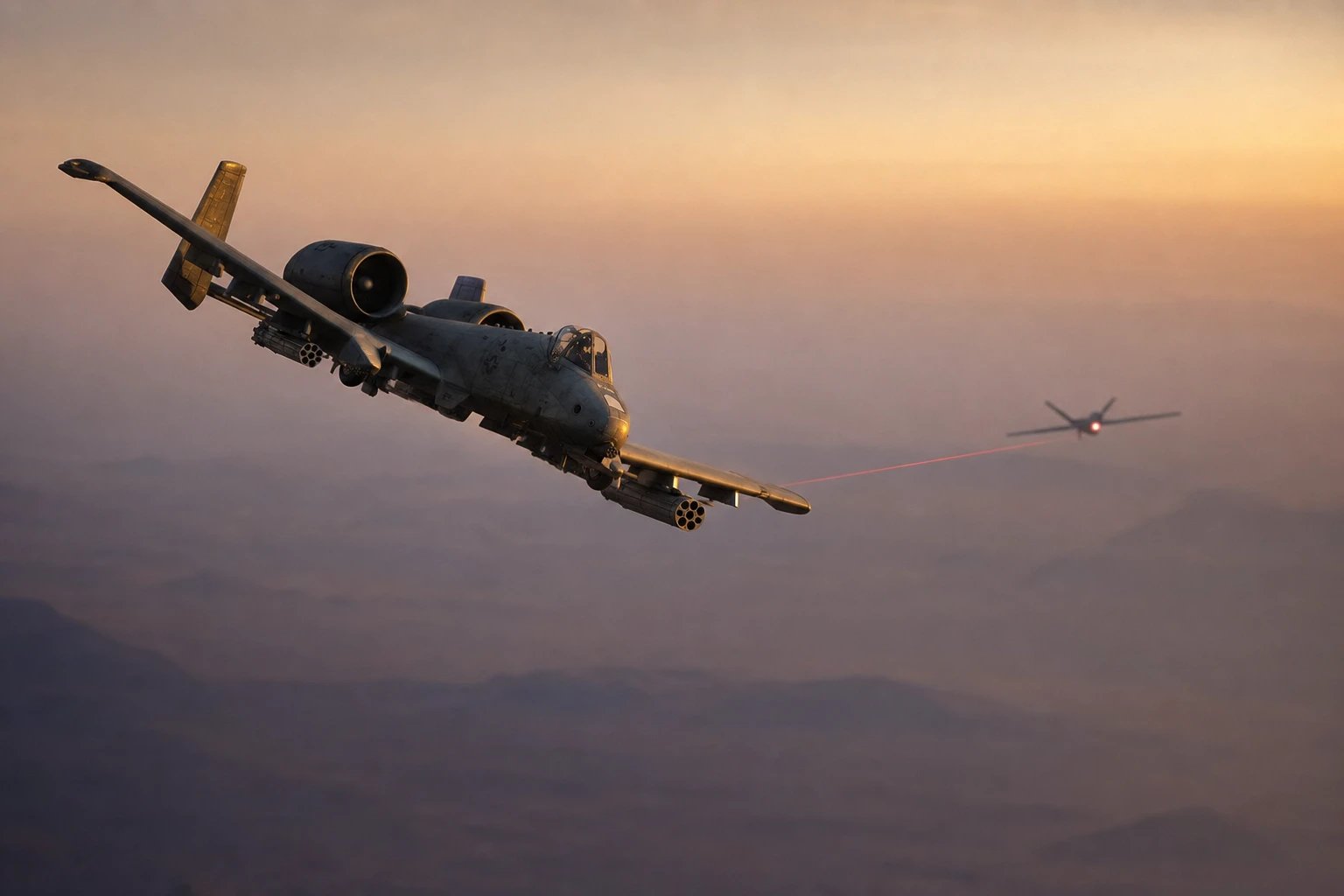
Houthi Missiles Over Abha Force Riyadh’s Hand
The timing tracks a specific flashpoint. On July 13, Houthi forces fired ballistic missiles and drones at Abha International Airport and military bases in southern Saudi Arabia, retaliating after Riyadh and Yemen’s recognized government blocked an Iranian plane from landing at Sanaa airport.
That strike came out of a truce that has looked shakier by the month. A Saudi-UAE-led coalition has backed Yemen’s recognized government against the Houthis since 2015, after the group seized Sanaa and much of the country’s north. A 2022 ceasefire brought a lull, not an end, and it now looks like it is unraveling.
Saudi Arabia was largely spared during the latest round of Iranian escalation, which hit Kuwait and Jordan instead. But Prince Sultan Airbase, which hosts American personnel and equipment, took multiple hits during the earlier 40-day war between the United States and Iran.
The kingdom’s hunt for cheaper intercept options is not limited to American hardware. Riyadh has separately looked at its parallel pursuit of cost-effective air defenses, layering multiple low-cost systems against a drone threat no single interceptor can cover alone.
Washington, London and Kyiv Already Made the Same Bet
Saudi Arabia is not the first government to reach for this rocket, and it will not be the last. The past year and a half reads like a rollout schedule.
- March 2025: The State Department clears Saudi Arabia’s first APKWS II purchase, 2,000 kits for $100 million.
- August 2025: The Pentagon commits a $1.7 billion order for 55,000 rockets for the U.S. Air Force, with deliveries running through 2031.
- September 2025: BAE Systems confirms feasibility studies to fit the rocket onto the Eurofighter Typhoon.
- December 2025: Ukrainian F-16s are photographed carrying APKWS-loaded rocket pods for the first time.
- February 2026: The U.S. Marine Corps prioritizes an air-to-air APKWS II variant for its F/A-18 Hornet fleet, and the Air Force awards BAE a separate contract for a dual-mode version.
- May 2026: The Royal Air Force confirms Typhoons are flying operational counter-drone missions with the rocket from Cyprus.
- June 2026: BAE Systems says strong interest in the rocket has emerged from every Eurofighter customer nation since the Middle East war.
- July 2026: The State Department clears Saudi Arabia’s $1.96 billion order for 20,000 more kits.
By the time Riyadh’s request reached Congress, a Ukrainian F-16 had already used the rocket to intercept a Russian target caught on infrared footage, and BAE was fielding requests across continents. The Eurofighter consortium alone counts ten operators, the UK, Germany, Italy, Spain, Austria, Kuwait, Oman, Qatar, Saudi Arabia and incoming customer Turkey, and BAE says interest in the rocket now spans that entire roster. Saudi Arabia’s purchase is simply the largest single order in that run so far.
Why Does a $35,000 Rocket Beat a Million-Dollar Missile?
Because the drones it shoots down are almost as cheap as the rocket itself. A complete APKWS II round costs about $35,000, while the missiles fighter pilots previously used against the same drones run from roughly $450,000 to $1 million each. Matching the cost of the interceptor to the cost of the target is the entire point.
| Weapon | Approximate Unit Cost | Primary Role |
|---|---|---|
| APKWS II guidance kit | $15,000 to $22,000 (about $35,000 complete with motor and warhead) | Laser-guided 70mm rocket, air-to-air and air-to-ground |
| AIM-9X Sidewinder | About $450,000 | Short-range air-to-air missile |
| AIM-120 AMRAAM | About $1 million | Medium and long-range air-to-air missile |
| Shahed-136 drone | $20,000 to $50,000 | Iranian-designed one-way attack drone |
That parity changes the math of a long drone war. Officials have said the rocket’s price makes it the default tool against this exact threat, since spending a missile worth twenty to fifty times the drone it kills is not sustainable across hundreds of engagements.
It protects expensive Patriot missile stockpiles from being depleted by cheap drone swarms.
Zafer Al Ajami, a retired Kuwaiti Air Force colonel and defense analyst, told Breaking Defense the guidance kits “convert cheap, unguided rockets into precise, low-cost interceptors,” freeing higher-end interceptors for threats that actually need them.
Which Saudi Jets Will Actually Carry It?
Saudi Arabia has not named a platform, and the DSCA notification does not specify one either. But the kingdom’s own fleet narrows the field. The Royal Saudi Air Force flies both the F-15SA, a Saudi-specific variant of the Strike Eagle, and the Eurofighter Typhoon, and analysts tracking the program consider both airframes ready-made for the rocket.
Both jets already carry the same LAU-131 pods included in this order. Earlier Saudi APKWS II purchases were tied mainly to AH-64 Apache and MH-60R Seahawk helicopters. This order’s mix of air-to-air kits and fixed-wing launch gear points toward fighters instead, following the same path the U.S. and UK already cut with their own F-15s and Typhoons.
A Laser Still Has to Stay Locked Until Impact
The rocket’s economics come with a tradeoff. APKWS II uses semi-active laser guidance, meaning a pilot, a wingman or a ground operator has to keep a laser trained on the drone until the round hits it. Unlike a fire-and-forget missile, the shooter cannot look away mid-shot.
Smoke, dust and heavy weather can break that laser link and cause a miss. The rocket’s range is also shorter than that of the missiles it is replacing, so the launching aircraft has to get closer to the threat than it would with an AIM-120.
BAE Systems is already working on a fix. In February, the U.S. Air Force awarded the company a $145 million contract for dual-mode rockets that pair the laser seeker with an infrared sensor, cutting how long a shooter has to babysit each shot. That same month, the Marine Corps folded APKWS II into a bridge capability for its aging Hornets ahead of the type’s retirement around 2030.
Neither upgrade is part of Saudi Arabia’s order. For now, Riyadh is buying the version that needs a steady hand on the laser, not the one BAE is racing to finish.
Frequently Asked Questions
What exactly is the APKWS II?
The Advanced Precision Kill Weapon System II is a guidance kit, not a missile in its own right. It began as a U.S. Army effort in the late 1990s and early 2000s to bridge the gap between unguided rockets and pricier missiles like the AGM-114 Hellfire. Its guidance section, built on Distributed Aperture Semi-Active Laser Seeker technology, slots between the rocket motor and warhead of an ordinary 70mm Hydra rocket.
How much does the deal actually cost per rocket?
Divide the $1.96 billion headline figure by the 20,000 guidance sections and it works out to roughly $98,000 per unit. That is well above the standalone rocket’s price because the total also covers launchers, warheads, fuzes, spare parts, years of contractor support and training, not just the guidance kits themselves.
What other aircraft can carry APKWS II?
Beyond the F-15SA and Typhoon under consideration for Saudi Arabia, the rocket has already been certified on the F-16, F-15E, A-10, F/A-18 Hornet, AH-64 Apache and MH-60 Seahawk. BAE Systems has said in promotional material that the kit can fit more than 45 different aircraft and helicopter types.
Is the Saudi Arabia sale locked in?
No. A congressional notification only starts the formal review process. Saudi Arabia and the United States still have to negotiate a signed Letter of Offer and Acceptance, and the kingdom could change the quantities or drop parts of the request before that happens.
Why doesn’t Saudi Arabia just use its Patriot batteries against drones?
It has, and found the math punishing. Saudi Arabia leaned on Patriot interceptors and AIM-120 missiles during the Decisive Storm campaign it launched against the Houthis in March 2015, a war that dragged on for years against an enemy that kept firing missiles and drones costing a fraction of what it took to shoot them down.
